eBook - ePub
Artificial Intelligence and Soft Computing
Behavioral and Cognitive Modeling of the Human Brain
- 816 pages
- English
- ePUB (mobile friendly)
- Available on iOS & Android
eBook - ePub
Artificial Intelligence and Soft Computing
Behavioral and Cognitive Modeling of the Human Brain
About this book
With all the material available in the field of artificial intelligence (AI) and soft computing-texts, monographs, and journal articles-there remains a serious gap in the literature. Until now, there has been no comprehensive resource accessible to a broad audience yet containing a depth and breadth of information that enables the reader to fully understand and readily apply AI and soft computing concepts.
Artificial Intelligence and Soft Computing fills this gap. It presents both the traditional and the modern aspects of AI and soft computing in a clear, insightful, and highly comprehensive style. It provides an in-depth analysis of mathematical models and algorithms and demonstrates their applications in real world problems.
Beginning with the behavioral perspective of "human cognition," the text covers the tools and techniques required for its intelligent realization on machines. The author addresses the classical aspects-search, symbolic logic, planning, and machine learning-in detail and includes the latest research in these areas. He introduces the modern aspects of soft computing from first principles and discusses them in a manner that enables a beginner to grasp the subject. He also covers a number of other leading aspects of AI research, including nonmonotonic and spatio-temporal reasoning, knowledge acquisition, and much more.
Artificial Intelligence and Soft Computing: Behavioral and Cognitive Modeling of the Human Brain is unique for its diverse content, clear presentation, and overall completeness. It provides a practical, detailed introduction that will prove valuable to computer science practitioners and students as well as to researchers migrating to the subject from other disciplines.
Information
1
Introduction to Artificial Intelligence and Soft Computing
This chapter provides a brief overview of the disciplines of Artificial Intelligence (AI) and Soft Computing. It introduces the topics covered under the heads of intelligent systems and demonstrates the scope of their applications in real world problems of significant complexity. It also highlights the direction of research in this broad discipline of knowledge. The historical development in AI and the means by which the subject was gradually popularized are briefly outlined here. The chapter addresses many new tools and techniques, commonly used to represent and solve complex problems. The organization of the book in light of these tools and techniques is also presented briefly in this chapter.
1.1 Evolution of Computing
At the beginning of the Stone Age, when people started taking shelters in caves, they made attempts to immortalize themselves by painting their images on rocks. With the gradual progress in civilization, they felt interested to see themselves in different forms. So, they started constructing models of human being with sand, clay and stones. The size, shape, constituents and style of the model humans continued evolving but the man was not happy with the models that only looked like him. He had a strong desire to make the model ‘intelligent’, so that it could act and think as he did. This, however, was a much more complex task than what he had done before. So, he took millions of years to construct an ‘analytical engine’ that could perform a little arithmetic mechanically. Babbage’s analytical engine was the first significant success in the modern era of computing. Computers of the first generation, which were realized following this revolutionary success, were made of thermo-ionic valves. They could perform the so-called ‘number crunching’ operations. The second-generation computers came up shortly after the invention of transistors and were more miniaturized in size. They were mainly used for commercial data processing and payroll creation. After more than a decade or so, when the semiconductor industries started producing integrated circuits (IC) in bulk, the third generation computers were launched in business houses. These machines had an immense capability to perform massive computations in real time. Many electromechanical robots were also designed with these computers. Then after another decade, the fourth generation computers came up with the highspeed VLSI engines. Many electronic robots that can see through cameras to locate objects for placement at the desired locations were realized during this period. During the period of 1981-1990 the Japanese Government started to produce the fifth generation computing machines that, besides having all the capabilities of the fourth generation machines, could also be able to process intelligence. The computers of the current (fifth) generation can process natural languages, play games, recognize images of objects and prove mathematical theorems, all of which lie in the domain of Artificial Intelligence (AI). But what exactly is AI? The following sections will provide a qualitative answer to this question.
1.2 Defining AI
The phrase AI, which was coined by John McCarthy [1] three decades ago, evades a concise and formal definition to date. One representative definition is pivoted around the comparison of intelligence of computing machines with human beings [11]. Another definition is concerned with the performance of machines which “historically have been judged to lie within the domain of intelligence” [17], [35]. None of these definitions or the like have been universally accepted, perhaps because of their references to the word “intelligence”, which at present is an abstract and immeasurable quantity. A better definition of AI, therefore, calls for formalization of the term “intelligence”. Psychologist and Cognitive theorists are of the opinion that intelligence helps in identifying the right piece of knowledge at the appropriate instances of decision making [27], [14].The phrase “AI” thus can be defined as the simulation of human intelligence on a machine, so as to make the machine efficient to identify and use the right piece of “Knowledge “ at a given step of solving a problem. A system capable of planning and executing the right task at the right time is generally called rational [36]. Thus, AI alternatively may be stated as a subject dealing with computational models that can think and act rationally [18]1, [47]2, [37]3, [6]4. A common question then naturally arises: Does rational thinking and acting include all possible characteristics of an intelligent system? If so, how does it represent behavioral intelligence such as machine learning, perception and planning? A little thinking, however, reveals that a system that can reason well must be a successful planner, as planning in many circumstances is part of a reasoning process. Further, a system can act rationally only after acquiring adequate knowledge from the real world. So, perception that stands for building up of knowledge from real world information is a prerequisite feature for rational actions. One step further thinking envisages that a machine without learning capability cannot possess perception. The rational action of an agent (actor), thus, calls for possession of all the elementary characteristics of intelligence. Relating AI with the computational models capable of thinking and acting rationally, therefore, has a pragmatic significance.
1.3 General Problem Solving Approaches in AI
To understand what exactly AI is, we illustrate some common problems. Problems dealt with in AI generally use a common term called ‘state’. A state represents a status of the solution at a given step of the problem solving procedure. The solution of a problem, thus, is a collection of the problem states. The problem solving procedure applies an operator to a state to get the next state. Then it applies another operator to the resulting state to derive a new state. The process of applying an operator to a state and its subsequent transition to the next state, thus, is continued until the goal (desired) state is derived. Such a method of solving a problem is generally referred to as state-space approach. We will first discuss the state-space approach for problem solving by a well-known problem, which most of us perhaps have solved in our childhood.
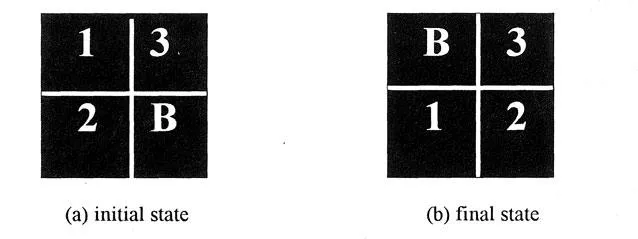
Example 1.1: Consider a 4-puzzle problem, where in a 4-cell board there are 3 cells filled with digits and 1 blank cell. The initial state of the game represents a particular orientation of the digits in the cells and the final state to be achieved is another orientation supplied to the game player. The problem of the game is to reach from the given initial state to the goal (final) state, if possible, with a minimum of moves. Let the initial and the final state be as shown in figures 1(a) and (b) respectively.
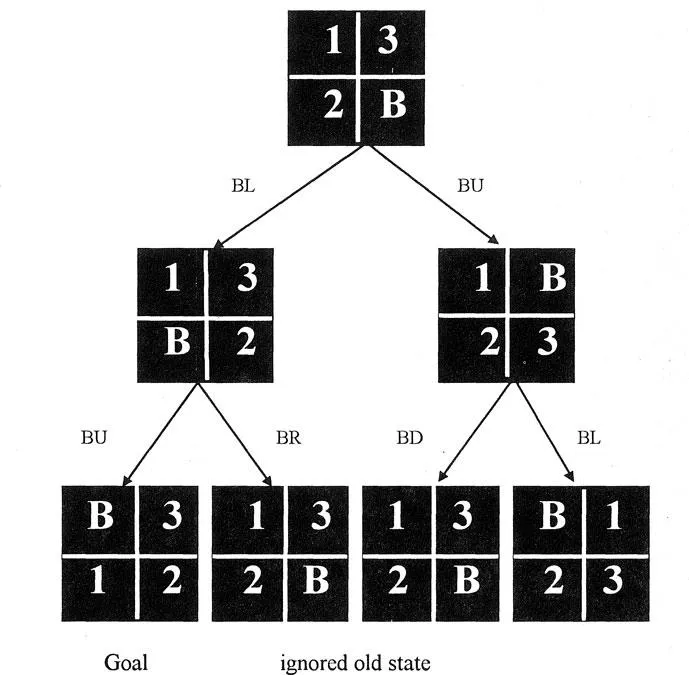
We now define two operations, blank-up (BU) / blank-down (BD) and blank-left (BL) / blank-right (BR) [9], and the state-space (tree) for the problem is presented below (vide figure 1. 2) using these operators.
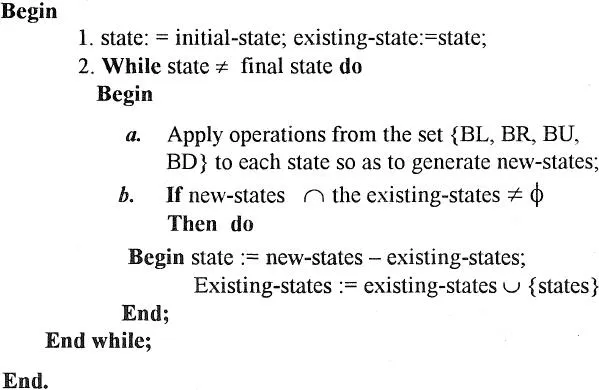
The algorithm for the above kind of problems is straightforward. It consists of three steps, described by steps 1, 2(a) and 2(b) below.
Algorithm for solving state-space problems
It is thus clear that the main trick in solving problems by the state-space approach is to determine the set of operators and to use it at appropriate states of the problem.
Researchers in AI have segregated the AI problems from the non-AI problems. Generally, problems, for which straightforward mathematical / logical algorithms are not readily available and which can be solved by intuitive approach only, are called AI problems. The 4-puzzle problem, for instance, is an ideal AI Problem. There is no formal algorithm for its realization, i.e., given a starting and a goal state, one cannot say prior to execution of the tasks the sequence of steps required to get the goal from the starting state. Such problems are called the ideal AI problems. The well-known water-jug problem [35], the Travelling Salesperson Problem (TSP) [35], and the n-Queen problem [36] are typical examples of the classical AI problems. Among the non-classical AI problems, the diagnosis problems and the pattern classification problem need special mention. For solving an AI problem, one may employ both AI and non-AI algorithms. An obvious question is: what is an AI algorithm? Formally speaking, an AI algorithm generally means a non-conventional intuitive approach for problem solving. The key to AI approach is intelligent search and matching....
Table of contents
- Cover
- Half Title
- Title Page
- Copyright Page
- Dedication
- Table of Contents
- Chapter 1: Introduction to Artificial Intelligence and Soft Computing
- Chapter 2: The Psychological Perspective of Cognition
- Chapter 3: Production Systems
- Chapter 4: Problem Solving by Intelligent Search
- Chapter 5: The Logic of Propositions and Predicates
- Chapter 6: Principles in Logic Programming
- Chapter 7: Default and Non-Monotonic Reasoning
- Chapter 8: Structured Approach to Knowledge Representation
- Chapter 9: Dealing with Imprecision and Uncertainty
- Chapter 10: Structured Approach to Fuzzy Reasoning
- Chapter 11: Reasoning with Space and Time
- Chapter 12: Intelligent Planning
- Chapter 13: Machine Learning Techniques
- Chapter 14: Machine Learning Using Neural Nets
- Chapter 15: Genetic Algorithms
- Chapter 16: Realizing Cognition Using Fuzzy Neural Nets
- Chapter 17: Visual Perception
- Chapter 18: Linguistic Perception
- Chapter 19: Problem Solving by Constraint Satisfaction
- Chapter 20: Acquisition of Knowledge
- Chapter 21: Validation, Verification and Maintenance Issues
- Chapter 22: Parallel and Distributed Architecture for Intelligent Systems
- Chapter 23: Case Study I: Building a System for Criminal Investigation
- Chapter 24: Case Study II: Realization of Cognition for Mobile Robots
- Chapter 24+: The Expectations from the Readers
- Appendix A: How to Run the Sample Programs?
- Appendix B: Derivation of the Back-propagation Algorithm
- Appendix C: Proof of the Theorems of Chapter 10
- Index
Trusted by 375,005 students
Access to over 1.5 million titles for a fair monthly price.
Study more efficiently using our study tools.
Frequently asked questions
Yes, you can cancel anytime from the Subscription tab in your account settings on the Perlego website. Your subscription will stay active until the end of your current billing period. Learn how to cancel your subscription
No, books cannot be downloaded as external files, such as PDFs, for use outside of Perlego. However, you can download books within the Perlego app for offline reading on mobile or tablet. Learn how to download books offline
Perlego offers two plans: Essential and Complete
- Essential is ideal for learners and professionals who enjoy exploring a wide range of subjects. Access the Essential Library with 800,000+ trusted titles and best-sellers across business, personal growth, and the humanities. Includes unlimited reading time and Standard Read Aloud voice.
- Complete: Perfect for advanced learners and researchers needing full, unrestricted access. Unlock 1.5M+ books across hundreds of subjects, including academic and specialized titles. The Complete Plan also includes advanced features like Premium Read Aloud and Research Assistant.
We are an online textbook subscription service, where you can get access to an entire online library for less than the price of a single book per month. With over 1.5 million books across 990+ topics, we’ve got you covered! Learn about our mission
Look out for the read-aloud symbol on your next book to see if you can listen to it. The read-aloud tool reads text aloud for you, highlighting the text as it is being read. You can pause it, speed it up and slow it down. Learn more about Read Aloud
Yes! You can use the Perlego app on both iOS and Android devices to read anytime, anywhere — even offline. Perfect for commutes or when you’re on the go.
Please note we cannot support devices running on iOS 13 and Android 7 or earlier. Learn more about using the app
Please note we cannot support devices running on iOS 13 and Android 7 or earlier. Learn more about using the app
Yes, you can access Artificial Intelligence and Soft Computing by Amit Konar in PDF and/or ePUB format, as well as other popular books in Computer Science & Artificial Intelligence (AI) & Semantics. We have over 1.5 million books available in our catalogue for you to explore.