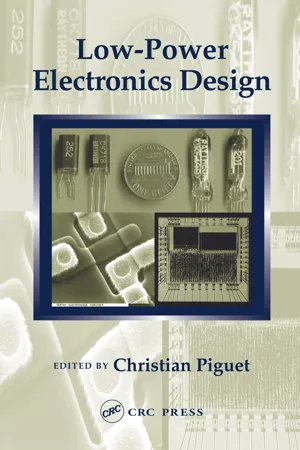
The power consumption of integrated circuits is one of the most problematic considerations affecting the design of high-performance chips and portable devices. The study of power-saving design methodologies now must also include subjects such as systems on chips, embedded software, and the future of microelectronics. Low-Power Electronics Design covers all major aspects of low-power design of ICs in deep submicron technologies and addresses emerging topics related to future design. This volume explores, in individual chapters written by expert authors, the many low-power techniques born during the past decade. It also discusses the many different domains and disciplines that impact power consumption, including processors, complex circuits, software, CAD tools, and energy sources and management. The authors delve into what many specialists predict about the future by presenting techniques that are promising but are not yet reality. They investigate nanotechnologies, optical circuits, ad hoc networks, e-textiles, as well as human powered sources of energy. Low-Power Electronics Design delivers a complete picture of today's methods for reducing power, and also illustrates the advances in chip design that may be commonplace 10 or 15 years from now.
- 896 pages
- English
- PDF
- Available on iOS & Android
eBook - PDF
Low-Power Electronics Design
About this book
Information
Table of contents
- Front cover
- Preface
- Editor-in-Chief
- Contributors
- Table of Contents
- Section I. Technologies and Devices
- Chapter 1. History of Low-Power Electronics
- Chapter 2. Evolution of Deep Submicron Bulk and SOI Technologies
- Chapter 3. Leakage in CMOS Nanometric Technologies
- Chapter 4. Microelectronics, Nanoelectronics, and the Future of Electronics
- Chapter 5. Advanced Research in On-Chip Optical Interconnects
- Section II. Low-Power Circuits
- Chapter 6. Modeling for Designing in Deep Submicron Technologies
- Chapter 7. Logic Circuits and Standard Cells
- Chapter 8. Low-Power Very Fast Dynamic Logic Circuits
- Chapter 9. Low-Power Arithmetic Operators
- Chapter 10. Circuits Techniques for Dynamic Power Reduction
- Chapter 11. VHDL for Low Power
- Chapter 12. Clocking Multi-GHz Systems
- Chapter 13. Circuit Techniques for Leakage Reduction
- Chapter 14. Low-Power and Low-Voltage Communication for SoCs
- Chapter 15. Adiabatic and Clock-Powered Circuits
- Chapter 16. Weak Inversion for Ultimate Low-Power Logic
- Chapter 17. Robustness of Digital Circuits at Lower Voltages
- Section III. Low-Power Processors and Memories
- Chapter 18. Techniques for Power and Process Variation Minimization
- Chapter 19. Low-Power DSPs
- Chapter 20. Energy-Efficient Reconfigurable Processors
- Chapter 21. Macgic, a Low-Power Reconfigurable DSP
- Chapter 22. Low-Power Asynchronous Processors
- Chapter 23. Low-Power Baseband Processors for Communications
- Chapter 24. Stand-By Power Reduction for SRAM Memories
- Chapter 25. Low-Power Cache Design
- Chapter 26. Memory Organization for Low-Energy Embedded Systems
- Section IV. Low-Power Systems on Chips
- Chapter 27. Power Performance Trade-Offs in Design of SoCs
- Chapter 28. Low-Power SoC with Power-Aware Operating Systems Generation
- Chapter 29. Low-Power Data Storage and Communication for SoC
- Chapter 30. Networks on Chips: Energy-Efficient Design of SoC Interconnect
- Chapter 31. Highly Integrated Ultra-Low Power RF Transceivers for Wireless Sensor Networks
- Chapter 32. Power-Aware On-Demand Routing Protocols for Mobile Ad Hoc Networks
- Chapter 33. Modeling Computational, Sensing, and Actuation Surfaces
- Section V. Embedded Software
- Chapter 34. Low-Power Software Techniques
- Chapter 35. Low-Power/Energy Compiler Optimizations
- Chapter 36. Design of Low-Power Processor Cores Using a Retargetable Tool Flow
- Chapter 37. Recent Advances in Low-Power Design and Functional Coverification Automation from the Earliest System-Level Design Stages
- Section VI. CAD Tools for Low Power
- Chapter 38. High-Level Power Estimation and Analysis
- Chapter 39. Power Macro-Models for High-Level Power Estimation
- Chapter 40. Synopsys Low-Power Design Flow
- Chapter 41. Magma Low-Power Flow
- Chapter 42. Sequence Design Flow for Power-Sensitive Design
- Section VII. Battery Cells, Sources of Energy, and Chip Cooling
- Chapter 43. Battery Lifetime Optimization for Energy-Aware Circuits
- Chapter 44. Miniature Fuel Cells for Portable Applications
- Chapter 45. Human-Generated Power for Mobile Electronics
- Chapter 46. Chip Cooling: Why – How
- Back cover
Trusted by 375,005 students
Access to over 1.5 million titles for a fair monthly price.
Study more efficiently using our study tools.
Frequently asked questions
Yes, you can cancel anytime from the Subscription tab in your account settings on the Perlego website. Your subscription will stay active until the end of your current billing period. Learn how to cancel your subscription
No, books cannot be downloaded as external files, such as PDFs, for use outside of Perlego. However, you can download books within the Perlego app for offline reading on mobile or tablet. Learn how to download books offline
Perlego offers two plans: Essential and Complete
- Essential is ideal for learners and professionals who enjoy exploring a wide range of subjects. Access the Essential Library with 800,000+ trusted titles and best-sellers across business, personal growth, and the humanities. Includes unlimited reading time and Standard Read Aloud voice.
- Complete: Perfect for advanced learners and researchers needing full, unrestricted access. Unlock 1.5M+ books across hundreds of subjects, including academic and specialized titles. The Complete Plan also includes advanced features like Premium Read Aloud and Research Assistant.
We are an online textbook subscription service, where you can get access to an entire online library for less than the price of a single book per month. With over 1.5 million books across 990+ topics, we’ve got you covered! Learn about our mission
Look out for the read-aloud symbol on your next book to see if you can listen to it. The read-aloud tool reads text aloud for you, highlighting the text as it is being read. You can pause it, speed it up and slow it down. Learn more about Read Aloud
Yes! You can use the Perlego app on both iOS and Android devices to read anytime, anywhere — even offline. Perfect for commutes or when you’re on the go.
Please note we cannot support devices running on iOS 13 and Android 7 or earlier. Learn more about using the app
Please note we cannot support devices running on iOS 13 and Android 7 or earlier. Learn more about using the app
Yes, you can access Low-Power Electronics Design by Christian Piguet in PDF and/or ePUB format, as well as other popular books in Technology & Engineering & Computer Engineering. We have over 1.5 million books available in our catalogue for you to explore.