eBook - ePub
Uninterruptible Power Supplies and Active Filters
- 296 pages
- English
- ePUB (mobile friendly)
- Available on iOS & Android
eBook - ePub
Uninterruptible Power Supplies and Active Filters
About this book
As industry power demands become increasingly sensitive, power quality distortion becomes a critical issue. The recent increase in nonlinear loads drawing non-sinusoidal currents has seen the introduction of various tools to manage the clean delivery of power. Power demands of medical facilities, data storage and information systems, emergency equipment, etc. require uninterrupted, high quality power. Uninterruptible power supplies (UPS) and active filters provide this delivery.
The first to treat these power management tools together in a comprehensive discussion, Uninterruptible Power Supplies and Active Filters compares the similarities of UPS, active filters, and unified power quality conditioners. The book features a description of low-cost and reduced-parts configurations presented for the first time in any publication, along with a presentation of advanced digital controllers. These configurations are vital as industries seek to reduce the cost of power management in their operations.
As this field of power management technology continues to grow, industry and academia will come to rely upon the comprehensive treatment found within this book. Industrial engineers in power quality, circuits and devices, and aerospace engineers as well as graduate students will find this a complete and insightful resource for studying and applying the tools of this rapidly developing field.
Information
1
Uninterruptible Power Supplies
CONTENTS
- 1.1 Classification
- 1.1.1 Static UPS
- 1.1.1.1 On-Line UPS
- 1.1.1.1.1 Normal Mode of Operation
- 1.1.1.1.2 Stored-Energy Mode of Operation
- 1.1.1.1.3 Bypass Mode of Operation
- 1.1.1.2 Off-Line UPS
- 1.1.1.2.1 Normal Mode of Operation
- 1.1.1.2.2 Stored-Energy Mode of Operation
- 1.1.1.3 Line-Interactive UPS
- 1.1.1.3.1 Normal Mode of Operation
- 1.1.1.3.2 Stored-Energy Mode of Operation
- 1.1.2 Rotary UPS
- 1.1.3 Hybrid Static/Rotary UPS
- 1.2 Batteries for UPS Applications
- 1.2.1 History
- 1.2.2 Valve-Regulated Lead–Acid Batteries
- 1.2.3 UPS Battery Features
- 1.2.4 Problems
- 1.2.5 Charging Strategies
- 1.2.6 Failure Category
- 1.2.7 Monitoring
- 1.3 Flywheels for UPS Applications
- 1.3.1 Fundamentals
- 1.3.2 Classification
- 1.3.2.1 Low-Speed Flywheel Systems
- 1.3.2.2 High-Speed Flywheel Systems
- 1.3.3 UPS Applications of Flywheels
- 1.4 Comparative Analysis of Flywheels and Electrochemical Batteries
- 1.5 Applications of UPS Systems
- 1.5.1 Distributed Approach
- 1.5.2 Centralized Approach
- 1.6 Parallel Operation
- 1.6.1 Configurations
- 1.6.2 Fundamental Principles of Parallel Operation
- 1.6.3 Control Strategies in UPS Parallel Operation
- 1.6.3.1 Concentrated Control
- 1.6.3.2 Master–Slave Control
- 1.6.3.3 Distributed Control
- 1.6.3.4 Wireless Independent Control
- 1.7 Performance Evaluation of UPS Systems
- 1.8 Power Factor Correction in UPS Systems
- 1.8.1 Passive PFC Techniques
- 1.8.2 Active PFC Techniques
- 1.9 Control of UPS Systems
- 1.9.1 Single-Voltage Control Loop Strategy
- 1.9.2 Multiple Control Loops
- 1.9.2.1 Hysteresis Current Control
- 1.9.2.2 SPWM Current Control
- 1.9.2.3 Predictive Current Control
- 1.10 Converters for UPS Systems
- 1.10.1 Rectifiers
- 1.10.1.1 Uncontrolled Rectifiers
- 1.10.1.2 Controlled Rectifiers
- 1.10.2 Inverters
- 1.10.2.1 Basic Principles of Operation
- 1.10.2.2 Pulse Width-Modulated Switching Scheme
- 1.11 Battery Charger/Discharger
- References
Uninterruptible power supply (UPS) systems provide uninterrupted, reliable, and high-quality power for vital loads. They, in fact, protect sensitive loads against power outages as well as overvoltage and undervoltage conditions. UPS systems also suppress line transients and harmonic disturbances. Applications of UPS systems include medical facilities, life-support systems, data storage and computer systems, emergency equipment, telecommunications, industrial processing, and on-line management systems.
Generally, an ideal UPS should be able to deliver uninterrupted power while simultaneously providing the necessary power conditioning for the particular power application. Therefore, an ideal UPS should have the following features [1]:
- Regulated sinusoidal output voltage with low total harmonic distortion (THD) independent of the changes in the input voltage or in the load, linear or nonlinear, balanced or unbalanced.
- On-line operation, which means zero switching time from normal to backup mode and vice versa.
- Low THD sinusoidal input current and unity power factor.
- High reliability.
- Bypass as a redundant source of power in the case of internal failure.
- High efficiency.
- Low electromagnetic interference (EMI) and acoustic noise.
- Electric isolation of the battery, output, and input.
- Low maintenance.
- Low cost, weight, and size.
The advances in power electronics during the past three decades have resulted in a great variety of new topologies and control strategies for UPS systems. The research has been focused mainly on improving performance and expanding application areas of UPS systems. The issue of reducing the cost of converters has recently attracted the attention of researchers [2–15]. Reducing the number of switches provides the most significant cost reduction. Another form of cost reduction is to replace active switches such as IGBTs, MOSFETs, and thyristors with diodes. Not only are diodes more reasonable than the controlled switches, but there is also a cost reduction from eliminating gate drivers for active switches and power supplies for gate drivers.
Another way of reducing cost is to develop topologies that employ switches with lower reverse voltage stresses and lower current ratings, which means less silicon and smaller switching losses resulting in lower cost and higher efficiency.
1.1 Classification
UPS systems are classified into three general types: static, rotary, and hybrid static/rotary. In this section, we explain these three categories of the UPS systems.
1.1.1 Static UPS
Static UPS systems are the most commonly used UPS systems. They have a broad variety of applications from low-power personal computers and telecommunication systems, to medium-power medical systems, and to high-power utility systems. Their main advantages are high efficiency, high reliability, and low THD. The inherent problems related to static UPS systems are poor performance with nonlinear and unbalanced loads and high cost for achieving very high reliability. On-line, off-line, and line-interactive configurations are the main types of the static UPS systems [2, 14, 15].
1.1.1.1 On-Line UPS
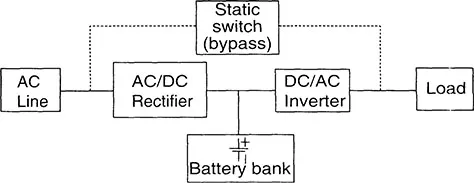
On-line UPS systems appeared during the 1970s [14]. They consist of a rectifier/charger, a battery set, an inverter, and a static switch (bypass). Other names for this configuration are inverter-preferred UPS and double-conversion UPS [14, 15]. Figure 1.1 shows the block diagram of a typical on-line UPS. The rectifier/charger continuously supplies the DC bus with power. Its power rating is required to meet 100% of the power demanded by the load as well as the power demanded for charging the battery bank. The batteries are usually sealed lead–acid type. They are rated in order to supply power during the backup time, when the AC line is not available. The duration of this time varies in different applications. The inverter is rated at 100% of the load power since it must supply the load during the normal mode of operation as well as during the backup time. It is always on; hence, there is no transfer time associated with the transition from normal mode to stored energy mode. This is the main advantage of the on-line UPS systems. The static switch provides redundancy of the power source in the case of UPS malfunction or overloading. The AC line and load voltage must be in phase in order to use the static switch. This can be achieved easily by locked-phase control loop.
There are three operating modes related to this topology: normal mode, stored energy mode, and bypass mode.
1.1.1.1.1 Normal Mode of Operation
During this mode of operation, the power to the load is continuously supplied via the rectifier/charger and inverter. In fact, a double conversion, that is, AC/DC and DC/AC, takes place. It allows very good line conditioning. The AC/DC converter charges the battery set and supplies power to the load via the inverter. Therefore, it has the highest power rating in this topology, increasing the cost.
Figure 1.1
Block diagram of a typical on-line UPS system.
1.1.1.1.2 Stored-Energy Mode of Operation
When the AC input voltage is outside the preset tolerance, the inverter and battery maintain continuity of power to the load. The duration of this mode is the duration of the preset UPS backup time or until the AC line returns within the preset tolerance. When the AC line returns, a phase-locked loop (PLL) makes the load...
Table of contents
- Cover Page
- Half Title Page
- Title Page
- Copyright Page
- Preface
- Biography
- Contents
- 1. Uninterruptible Power Supplies
- 2. Active Filters
- 3. Unified Power Quality Conditioners
- 4. Reduced-Parts Uninterruptible Power Supplies
- 5. Reduced-Parts Active Filters
- 6. Modeling, Analysis, and Digital Control
- Index
Trusted by 375,005 students
Access to over 1.5 million titles for a fair monthly price.
Study more efficiently using our study tools.
Frequently asked questions
Yes, you can cancel anytime from the Subscription tab in your account settings on the Perlego website. Your subscription will stay active until the end of your current billing period. Learn how to cancel your subscription
No, books cannot be downloaded as external files, such as PDFs, for use outside of Perlego. However, you can download books within the Perlego app for offline reading on mobile or tablet. Learn how to download books offline
Perlego offers two plans: Essential and Complete
- Essential is ideal for learners and professionals who enjoy exploring a wide range of subjects. Access the Essential Library with 800,000+ trusted titles and best-sellers across business, personal growth, and the humanities. Includes unlimited reading time and Standard Read Aloud voice.
- Complete: Perfect for advanced learners and researchers needing full, unrestricted access. Unlock 1.5M+ books across hundreds of subjects, including academic and specialized titles. The Complete Plan also includes advanced features like Premium Read Aloud and Research Assistant.
We are an online textbook subscription service, where you can get access to an entire online library for less than the price of a single book per month. With over 1.5 million books across 990+ topics, we’ve got you covered! Learn about our mission
Look out for the read-aloud symbol on your next book to see if you can listen to it. The read-aloud tool reads text aloud for you, highlighting the text as it is being read. You can pause it, speed it up and slow it down. Learn more about Read Aloud
Yes! You can use the Perlego app on both iOS and Android devices to read anytime, anywhere — even offline. Perfect for commutes or when you’re on the go.
Please note we cannot support devices running on iOS 13 and Android 7 or earlier. Learn more about using the app
Please note we cannot support devices running on iOS 13 and Android 7 or earlier. Learn more about using the app
Yes, you can access Uninterruptible Power Supplies and Active Filters by Ali Emadi,Abdolhosein Nasiri,Stoyan B. Bekiarov in PDF and/or ePUB format, as well as other popular books in Technology & Engineering & Electrical Engineering & Telecommunications. We have over 1.5 million books available in our catalogue for you to explore.