1.1 Introduction
Power quality has assumed increasing importance in view of the widespread use of power electronic equipment. For reactive var compensation, in addition to shunt capacitors and reactors, static var compensators (SVCs) are used. They are also used to solve several power quality problems—for reducing voltage sags, overvoltages after fault clearing, voltage regulation, negative sequence voltages, etc. In some cases, harmonics can cause misoperaton of the protective equipments, contributing to a reduction in power quality. Harmonic filters are used to absorb undesirable harmonics.
Further, with the deregulation of the power industry, competitive pressures force electric utilities to cut costs, which sometimes affects power quality and reliability. Hence, it must be ensured by suitable regulations that customers do not suffer from reduced power quality and reliability.
This chapter covers issues of power quality, and later chapters deal with other topics such as SVCs, harmonics, filters and shunt capacitors, and reactors for reactive var compensation.
Already several books1–8 and papers9,10 have been published in the technical literature dealing with power quality. Hence, it is not necessary, nor will it be practicable, to cover the topic of power quality in detail in this chapter. The aim is to introduce the concept of power quality and its importance, and explain the common terms used in describing power quality. Any person who is interested in pursuing this subject further can find material from the references at the end of this chapter.
The term power quality is rather nebulous and may be associated with reliability by electric utilities. However, equipment manufacturers can interpret it rather differently, referring to those characteristics of power supply that enable the equipment to work properly. Recently, people working in the field appear to have agreed on the following definition of a power quality problem.1,11 A power quality problem is any occurrence manifested in voltage, current, or frequency deviation that results in failure or misoperation of customer equipment. Although people talk of “power quality” quite often, they are actually referring to “voltage quality” because most of the time the controlled quantity is voltage.
Another term that is used to indicate the nonavailability of electricity supply to consumers because of sustained interruptions is reliability.
1.2 Importance of Power Quality
Before the widespread use of power electronic equipment, microprocessors for industrial control, and automation in factories and offices, minor variations in power did not seriously affect the operation of conventional equipment such as lights and induction motors. If the supply voltage dipped because of a fault (i.e., a sag in voltage occurred), the lights just dimmed, and the induction motor produced a lower output. These days the effects of power interruptions are rather costly. Reference 10 lists the following cases to illustrate the cost of short-duration power interruptions:
One glass plant estimates that a five-cycle interruption, a momentary interruption less than a tenth of second, can cost about $200,000.
A major computer center reports that a 2-s interruption can cost some $600,000.
In some factories, following a voltage sag, the restarting of assembly lines may require clearing the lines of damaged work, restarting of boilers, and reprogramming automatic controls at a typical cost of $50,000 per incident.
One automaker estimated that total losses from momentary power interruptions at all its plants run to about $10 million a year.
1.4 Short-Duration Voltage Variation
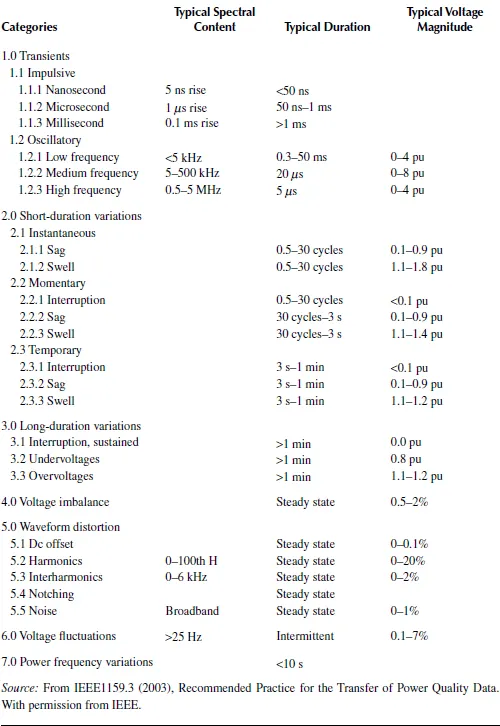
A voltage sag (dip) is defined as a decrease in the root-mean-square (rms) voltage at the power frequency for periods ranging from a half cycle to a minute.11 It is caused by voltage drops due to fault currents or starting of large motors. Sags may trigger shutdown of process controllers or computer system crashes.
A voltage swell is defined as an increase up to a level between 1.1 and 1.8 pu in rms voltage at the power frequency for periods ranging from a half cycle to a minute.
An interruption occurs when the supply voltage decreases to less than 0.1 pu for a period of time not exceeding 1 min. Interruptions can be caused by faults, control malfunctions, or equipment failures.
Table 1.1 Categories and Typical Characteristics of Power System Electromagnetic Phenomena
All these types of disturbances, such as voltage sags, voltage swells, and interruptions, can be classified into three types, depending on their duration.
Instantaneous: 0.5–30 cycles
Momentary: 30 cycles–3 s
Temporary: 3 s–1 min
It is helpful to distinguish the term outage used in reliability terminology from sustained interruption when the supply voltage is zero for longer than 1 min. Outage refers to the state of a component in a system that has failed to function as expected and is used to quantify reliability statistics regarding continuity of service, whereas sustained interruptions as used in monitoring power quality to indicate the absence of voltage for long periods of time.
1.5 Long-Duration Voltage Variations
An undervoltage is a decrease in the rms ac voltage to less than 90% at the power frequency for a duration longer than 1 min. These can be caused by switching on a large load or switching off a large capacitor bank.1,11 Undervoltages are sometimes due to a deliberate reduction of voltage by the utility to lessen the load during periods of peak demand. These are often referred to by the nontechnical term brownout.
An undervoltage will lower the output from capacitor banks that a utility or customer will often ins...