eBook - ePub
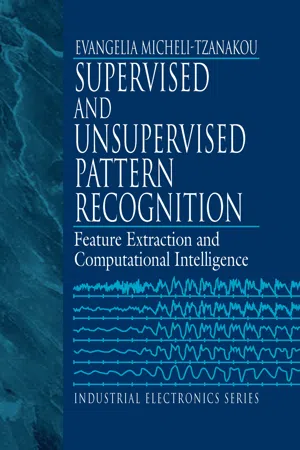
Supervised and Unsupervised Pattern Recognition
Feature Extraction and Computational Intelligence
- 392 pages
- English
- ePUB (mobile friendly)
- Available on iOS & Android
eBook - ePub
Supervised and Unsupervised Pattern Recognition
Feature Extraction and Computational Intelligence
About this book
There are many books on neural networks, some of which cover computational intelligence, but none that incorporate both feature extraction and computational intelligence, as Supervised and Unsupervised Pattern Recognition does. This volume describes the application of a novel, unsupervised pattern recognition scheme to the classification of various types of waveforms and images.
This substantial collection of recent research begins with an introduction to Neural Networks, classifiers, and feature extraction methods. It then addresses unsupervised and fuzzy neural networks and their applications to handwritten character recognition and recognition of normal and abnormal visual evoked potentials. The third section deals with advanced neural network architectures-including modular design-and their applications to medicine and three-dimensional NN architecture simulating brain functions. The final section discusses general applications and simulations, such as the establishment of a brain-computer link, speaker identification, and face recognition.
In the quickly changing field of computational intelligence, every discovery is significant. Supervised and Unsupervised Pattern Recognition gives you access to many notable findings in one convenient volume.
Information
Section I
Overviews of Neural Networks, Classifiers, and Feature Extraction Methods—Supervised Neural Networks
1 Classifiers: An Overview
1.1 Introduction
One way to better understand a subject is to classify or categorize it among related subjects. Many classifiers result from different approaches to classification problems. The purpose of this article is to categorize the well-known classifiers in the literature according to how they learn to classify.
Lippmann’s tutorial paper1 described various classifiers as well as neural networks in detail after his first discussion2 on the general application of neural networks. Another general overview on this subject is found in a paper by Hush and Horne3 in which neural networks are reviewed in the broad dichotomy of stationary vs. dynamic networks. Weiss and Kulikowski’s book4 generally touches the classification and prediction methods from the point of view of statistics, neural networks, machine learning, and expert systems.
The purpose of this article is not to give a tutorial on the well-developed networks and other classifiers but to introduce another branch in the growing classifier tree, that of nonparametric regression approaches to classification problems. Recently Hastie, Tibshirani, and Buja5 introduced the Flexible Discriminant Analysis (FDA) in the applied statistics literature, after the unpublished work by Breiman and Ihaka.6
Canonical Correlation Analysis (CCA) for two sets of variables is known to be a scalar multiple equal to the Linear Discriminant Analysis (LDA). Optimal Scaling (OS) is an alternative to CCA, where the classical Singular Value Decomposition (SVD) is used to find the solutions. OS brings the flexibility obtained via nonparametric regression and introduces this flexibility to discriminant analysis, hence the name Flexible Discriminant Analysis.
A number of recently developed multivariate regressions are used for classification, in addition to other groups of classifiers for a data set obtained from handwritten digit images. The software is contributed mainly from the authors or active researchers in this area. The sources are described in later sections after the description of each classifier.
1.2 Criteria For Optimal Classifier Design
We start with a general description of the classification problem and then proceed to a discussion of simpler cases in which assumptions are made. Which criterion should be used is application specific. Expected Cost for Misclassification (ECM) is applied to problems in which...
Table of contents
- Cover
- Title Page
- Copyright
- Contents
- Section I — Overviews of Neural Networks, Classifiers, and Feature Extraction Methods—Supervised Neural Networks
- Section II Unsupervised Neural Networks
- Section III Advanced Neural Network Architectures/Modular Neural Networks
- Section IV General Applications
- Index
Trusted by 375,005 students
Access to over 1.5 million titles for a fair monthly price.
Study more efficiently using our study tools.
Frequently asked questions
Yes, you can cancel anytime from the Subscription tab in your account settings on the Perlego website. Your subscription will stay active until the end of your current billing period. Learn how to cancel your subscription
No, books cannot be downloaded as external files, such as PDFs, for use outside of Perlego. However, you can download books within the Perlego app for offline reading on mobile or tablet. Learn how to download books offline
Perlego offers two plans: Essential and Complete
- Essential is ideal for learners and professionals who enjoy exploring a wide range of subjects. Access the Essential Library with 800,000+ trusted titles and best-sellers across business, personal growth, and the humanities. Includes unlimited reading time and Standard Read Aloud voice.
- Complete: Perfect for advanced learners and researchers needing full, unrestricted access. Unlock 1.5M+ books across hundreds of subjects, including academic and specialized titles. The Complete Plan also includes advanced features like Premium Read Aloud and Research Assistant.
We are an online textbook subscription service, where you can get access to an entire online library for less than the price of a single book per month. With over 1.5 million books across 990+ topics, we’ve got you covered! Learn about our mission
Look out for the read-aloud symbol on your next book to see if you can listen to it. The read-aloud tool reads text aloud for you, highlighting the text as it is being read. You can pause it, speed it up and slow it down. Learn more about Read Aloud
Yes! You can use the Perlego app on both iOS and Android devices to read anytime, anywhere — even offline. Perfect for commutes or when you’re on the go.
Please note we cannot support devices running on iOS 13 and Android 7 or earlier. Learn more about using the app
Please note we cannot support devices running on iOS 13 and Android 7 or earlier. Learn more about using the app
Yes, you can access Supervised and Unsupervised Pattern Recognition by Evangelia Miche Tzanakou in PDF and/or ePUB format, as well as other popular books in Computer Science & Computer Vision & Pattern Recognition. We have over 1.5 million books available in our catalogue for you to explore.