- 456 pages
- English
- ePUB (mobile friendly)
- Available on iOS & Android
eBook - ePub
Sensitivity of Automatic Control Systems
About this book
Although it arose much earlier in a variety of contexts, sensitivity theory became an independent branch of science in the sixties. Since then, researchers from around the world have continued to make great strides in both the theory and its applications. However, much of the work of Russian scientific schools and specialists remain unknown in the West.
Sensitivity of Control Systems summarizes the results of the authors and their disciples in sensitivity theory, addressing the basic notions of the theory and the problem of selecting technical parameters of systems. The authors formulate problems for actual technical systems and their models, and establish relations between sensitivity theory and classical stability problems. They offer a significant, general theory for investigating the sensitivity of boundary problems and use elements of this theory for sensitivity analysis of solutions to nonlinear programming and variational calculus problems, as well as oscillatory processes. The book also presents general investigation methods for discontinuous systems, including those described by operator models.
Full of powerful new methods and results, this book offers a unique opportunity for those in theoretical investigation and in the design, testing, and exploitation of various control systems to explore the work of Russia's leading researchers in sensitivity theory. Furthermore, its techniques for parametric perturbation investigation, Sensitivity of Control Systems will prove useful in fields outside of control theory, including oscillation theory, motion dynamics, and mathematical economy.
Information
Chapter 1
Parametric Models of Control Systems and Statement of the Problem in Sensitivity Theory
________________________
1.1 State Variables and Control Systems Parameters
1.1.1 General Principles of Control
The notion of control always implies a plant to which the control is applied, and a target that is to be attained using this control. In practice, control process is realized by means of specially formed exogenous actions applied to the plant. These actions are intended to change some properties of the latter. This idea is illustrated in Figure 1.1, where O is a multivariable plant, Y is a vector of generalized coordinates that define properties of the plant, and U is a vector of control actions.

Figure 1.1
Block-diagram of control process
Block-diagram of control process
Denote by MY the set of values of Y for which properties (state) of the plant satisfy the requirements, and by RY the set of values of Y that can really take place during plant operation. Then, the target of the control can be defined by the relation
If equation (1.1) is satisfied for the plant without any interference from outside, control process becomes superfluous. Control is necessary if the plant is affected by factors (we will call them disturbances) that lead to violation of (1.1)1.
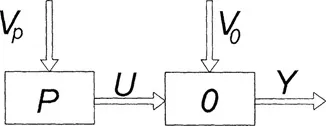
Figure 1.2
General block-diagram of control
General block-diagram of control
In practice control action U is realized by a system called controller that is, in the general case, functionally connected with the state of the plant and disturbances applied to it. As a result, we obtain a more detailed control scheme (Figure 1.2), where P is a controller and Vo and Vp are disturbances applied to the plant and control, respectively. According to Figure 1.2, the controller P is to provide equation (1.1) in the presence of disturbances V0 applied to the plant and Vp infringing controller actions. The block-diagram shown in Figure 1.2 is the most general and, therefore, the least substantial. Schemes of actual control systems, and still more their realizations, are very diversified and are determined by a number of factors. The mam factors are: physical nature of the plant; the choice of the vector Y, which gives the state of the plant; the set MY of admissible states of the plant; availability of information about variations of plant properties during the control process; availability of information about vectors Vo and Vp, etc.
If the information about the plant and corresponding disturbances is sufficiently complete, we can, as a rule, employ the classic block-diagram of combined control shown in Figure 1.3, where , , a...
Table of contents
- Cover
- Half Title
- Title Page
- Copyright Page
- Preface
- Table of Contents
- 1 Parametric Models
- 2 Finite-Dimensional Continuous Systems
- 3 Finite-Dimensional Discontinuous Systems
- 4 Discontinuous Systems Given by Operator Models
- 5 Non-Time Characteristics
- 6 Sensitivity Invariants
- 7 Sensitivity of Mathematical Programming and Variational Calculus Problems
- 8 Applied Sensitivity Problems
- Bibliography
- Index
Trusted by 375,005 students
Access to over 1.5 million titles for a fair monthly price.
Study more efficiently using our study tools.
Frequently asked questions
Yes, you can cancel anytime from the Subscription tab in your account settings on the Perlego website. Your subscription will stay active until the end of your current billing period. Learn how to cancel your subscription
No, books cannot be downloaded as external files, such as PDFs, for use outside of Perlego. However, you can download books within the Perlego app for offline reading on mobile or tablet. Learn how to download books offline
Perlego offers two plans: Essential and Complete
- Essential is ideal for learners and professionals who enjoy exploring a wide range of subjects. Access the Essential Library with 800,000+ trusted titles and best-sellers across business, personal growth, and the humanities. Includes unlimited reading time and Standard Read Aloud voice.
- Complete: Perfect for advanced learners and researchers needing full, unrestricted access. Unlock 1.5M+ books across hundreds of subjects, including academic and specialized titles. The Complete Plan also includes advanced features like Premium Read Aloud and Research Assistant.
We are an online textbook subscription service, where you can get access to an entire online library for less than the price of a single book per month. With over 1.5 million books across 990+ topics, we’ve got you covered! Learn about our mission
Look out for the read-aloud symbol on your next book to see if you can listen to it. The read-aloud tool reads text aloud for you, highlighting the text as it is being read. You can pause it, speed it up and slow it down. Learn more about Read Aloud
Yes! You can use the Perlego app on both iOS and Android devices to read anytime, anywhere — even offline. Perfect for commutes or when you’re on the go.
Please note we cannot support devices running on iOS 13 and Android 7 or earlier. Learn more about using the app
Please note we cannot support devices running on iOS 13 and Android 7 or earlier. Learn more about using the app
Yes, you can access Sensitivity of Automatic Control Systems by Efim Rozenwasser,Rafael Yusupov in PDF and/or ePUB format, as well as other popular books in Technik & Maschinenbau & Optimierung. We have over 1.5 million books available in our catalogue for you to explore.