Modern Japanese Grammar
eBook - ePub

Modern Japanese Grammar

A Practical Guide

  1. 394 pages
  2. English
  3. ePUB (mobile friendly)
  4. Available on iOS & Android
eBook - ePub

Modern Japanese Grammar

A Practical Guide

About this book

First published in 2013. As with its series counterparts, this is an innovative reference guide to the Japanese language, combining traditional and function-based grammar in a single volume.

In its two-part structure, Part A covers traditional grammatical categories, such as structural features of the language and the behaviour of parts of speech. With a strong emphasis on contemporary usage, all grammar points are richly illustrated with examples written in a combination of hiragana, katakana and kanji, alongside romanizations and sentence meanings in English.Part B is organised around language functions such as expressing likes and dislikes, giving and seeking information, making decisions and apologising. This function-based presentation is an invaluable guide to the situationally-appropriate use of Japanese for learners at all levels.

The two parts of the Grammar are closely linked by extensive cross-references, providing a grammatical and a functional perspective on many patterns in the language. This is the ideal reference grammar for learners of Japanese at all levels, from novice to advanced. No prior knowledge of grammatical terminology is assumed and a glossary of grammatical terms is provided.

Frequently asked questions

Yes, you can cancel anytime from the Subscription tab in your account settings on the Perlego website. Your subscription will stay active until the end of your current billing period. Learn how to cancel your subscription.
No, books cannot be downloaded as external files, such as PDFs, for use outside of Perlego. However, you can download books within the Perlego app for offline reading on mobile or tablet. Learn more here.
Perlego offers two plans: Essential and Complete
  • Essential is ideal for learners and professionals who enjoy exploring a wide range of subjects. Access the Essential Library with 800,000+ trusted titles and best-sellers across business, personal growth, and the humanities. Includes unlimited reading time and Standard Read Aloud voice.
  • Complete: Perfect for advanced learners and researchers needing full, unrestricted access. Unlock 1.4M+ books across hundreds of subjects, including academic and specialized titles. The Complete Plan also includes advanced features like Premium Read Aloud and Research Assistant.
Both plans are available with monthly, semester, or annual billing cycles.
We are an online textbook subscription service, where you can get access to an entire online library for less than the price of a single book per month. With over 1 million books across 1000+ topics, we’ve got you covered! Learn more here.
Look out for the read-aloud symbol on your next book to see if you can listen to it. The read-aloud tool reads text aloud for you, highlighting the text as it is being read. You can pause it, speed it up and slow it down. Learn more here.
Yes! You can use the Perlego app on both iOS or Android devices to read anytime, anywhere — even offline. Perfect for commutes or when you’re on the go.
Please note we cannot support devices running on iOS 13 and Android 7 or earlier. Learn more about using the app.
Yes, you can access Modern Japanese Grammar by M. Endo Hudson,Fumiko Nazikian,Naomi McGloin,Tomomi Kakegawa in PDF and/or ePUB format, as well as other popular books in Languages & Linguistics & Languages. We have over one million books available in our catalogue for you to explore.

Information

Part B
Functions

I
Social interaction and communication strategies

30
Social interaction

In any language, choosing appropriate linguistic forms and strategies according to the context is important for successful communication. The ā€˜context’ includes who is talking to whom, when, where, about what, in what way, and why (with what intention). In addition, how the speaker identifies or wishes to project himself/herself at the time affects how he/she speaks. Use of inappropriate speech styles may have serious consequences in Japanese, in which such distinctions as formal–informal and polite–rough are overtly made. The failure to use appropriate communication strategies may also result in being considered rude.
In Japan it is customary for people to bow when they greet someone, introduce themselves, apologize, and so on. Bowing about 30 degrees is considered ordinary, and a person lower in rank is expected to wait to raise his/her head until the social superior does so first.

30.1 Determining the style

There are two main styles in Japanese, formal and informal. Formal style is defined as sentences ending in desu (with nouns and adjectives), masu (with verbs), and their variations (e.g. negative, past tense), and informal style as those ending in da, (r)u, and their variations. They are typically used as follows.
  • Informal style: To family members, close friends and colleagues, and children
  • Formal style: To social superiors and acquaintances.
Speaking to social superiors, such as people who are higher in rank and/or older, honorific words and constructions (keego) are also expected to be used to a varying degree.
During a social interaction, one’s communication style often shifts for a variety of reasons. The factors can be divided into three major categories: (a) medium of communication; (b) setting; and (c) participants and referents. These and additional factors, such as the topic of conversation and the presence of bystanders, interact and shape the speaking (or writing) style.
(a) Medium of communication
Spoken and written languages are different in any language, but the difference seems particularly prominent in Japanese. Spoken Japanese displays the following features to a different degree.
  • • Fragmented with many incomplete sentences and omissions.
  • • Interactive, accompanied by interactive particles (e.g. ne, yo), fillers (e.g. anoo ā€˜um’), and listener responses (called aizuchi; e.g. hai ā€˜yes’).
  • • Full of contractions (e.g. ik-anaku-cha ¬ ik-anaku-te wa ā€˜I must go’).
  • • The word order may be switched around, and subject, object, time and place words, etc. may appear after the verb, as opposed to the canonical subject–object–verb order.
Both spoken and written languages can be more or less conversational or presentational. For example, chatting with friends is very different from how news reports and formal speeches are presented. The writing style in scholarly articles and newspaper editorials is presentational, containing many Sino-Japanese (kanji) words, while texting, e-chat, and e-mail to friends are highly conversational.
ā–ø 6
(b) Setting
The setting of communication may be formal, informal (casual), business, professional, private, or ritual, among others. A job interview is an example of a formal setting.
(c) Participants and referents ...
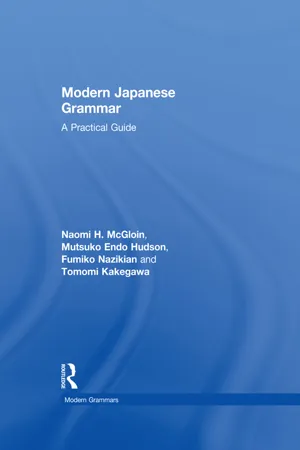
Table of contents

  1. Cover
  2. Title
  3. Copyright
  4. Contents
  5. Introduction
  6. Acknowledgments
  7. Glossary of grammatical terms
  8. Abbreviations and symbols
  9. Notes on romanization
  10. Part A Structures
  11. Part B Functions
  12. Appendix I: Hiragana charts
  13. Appendix II: Katakana charts
  14. Appendix III: Verb basic conjugation table
  15. Appendix IV: Copula and adjective basic conjugation table
  16. Bibliography
  17. Index