Among the key debates fought in developing economies is whether globalization through liberalization is the means by which economies can industrialize and provide their labour forces with tangible improvements in the material conditions of living. This book addresses this issue head on, using empirical evidence from some of the fastest growing and transition economies from East and South Asia. Countries such as the Philippines and Malaysia have already started to deindustrialize before enjoying industrial maturity, while with the exception of China and evidence of some growth in real wages in the other economies, the evidence appears compelling to suggest that increased industrialization and integration into the capitalist economy have not succeeded in providing significant labour improvement. The evidence suggests that a proactive state, focusing on enhancing the material conditions of labour, is pertinent to ensuring sustainable long term industrialization and thus improving material conditions for workers. This book was originally published as a special issue of the Journal of the Asia Pacific Economy.
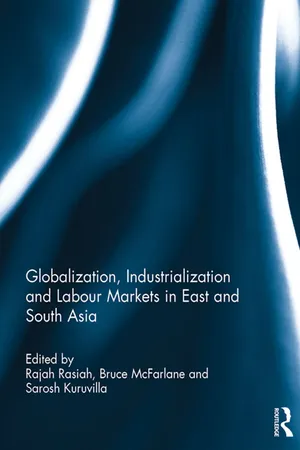
eBook - ePub
Globalization, Industrialization and Labour Markets in East and South Asia
- 174 pages
- English
- ePUB (mobile friendly)
- Available on iOS & Android
eBook - ePub
Globalization, Industrialization and Labour Markets in East and South Asia
Globalization, industrialization and labour markets
Rajah Rasiaha, Bruce McFarlaneb and Sarosh Kuruvillac
aDepartment of Development Studies, University of Malaya, Kuala Lumpur, Malaysia; bEconomics Department, Newcastle University, Callaghan, NSW, Australia; cSchool of Labor and Industrial Relations, Cornell University, Ithaca, NY, USA
While mainstream accounts of globalization are telling us that liberalization is essential for engendering the conditions of prosperity across the world, we argue that selective interventions are necessary to ensure that these processes open the path to the high road to industrialization. While recognizing the importance of relative surplus appropriation through technological deepening as the engine of capitalist accumulation, the extant evidence suggests that a proactive state focusing on enhancing labour is pertinent to ensure sustainable long-term industrialization and structural change so that the material conditions of workers improve over time. Hence, this article provides the introduction to globalization, industrialization and labour market experiences in selected East and South Asian economies.
1. Introduction
Two major processes have impacted extensively on the labour markets in Asia, namely globalization and industrialization. Whereas globalization refers to the integration of local and national economies globally with serious developmental consequences, industrialization refers primarily to the emergence and expansion of manufacturing activity, but also its appendages of construction and utilities (Kaldor, 1967). Advocates emphasizing the need to promote industrialization as a necessary condition to stimulate rapid economic growth have argued that its increasing returns characteristics is essential to evolve the productive forces of economies so that the material conditions of populations can be improved dramatically (Chang 2003; Reinert 2007).
However, Piore and Sabel (1984) and Pyke and Sengenberger (1992) argue that the road to industrialization does not necessarily guarantee that its fruits will trickle equally between capital and labour, distinguishing in the process the high and low roads to industrialization. While the increasing returns advocates of industrialization have focused wholly on its potential to drive rapid economic growth, the under-consumption theorists have targeted wage improvements for it to be sustainable (Hobson 1965; Brewer 1980). High wage regimes not only offer the demand for sustained growth with domestic consumption becoming a major driver of growth, it will also ensure that class contradictions could be kept from exploding. In addition, high-wage regimes are also an essential component of flexible specialization practices that draw on workers knowledge capabilities. Flexible specialization regimes are the polar opposite of exploitative Taylorist regimes. Whereas the former are in sync with what Marx (1967) and Luxembourg (1951) referred to as focused on relative surplus value appropriation that is associated with industrial capitalism, the latter is predicated on absolute surplus value appropriation.
We examine here how the forces of globalization, especially the nature of capitalist integration into the global economy, have affected industrialization in selected Asian economies, including with varying degrees of national and local policy initiatives, and how these processes have influenced changes in domestic labour markets. We discuss the arguments and the evolution of globalization, industrialization and labour markets in this introduction. These were critical issues Beresford (1988, 1989, 2009) addressed in her works on Vietnam and Cambodia, including its effects on the labour force processes.
2. Globalization
Globalization can be traced to the seventeenth century when the historian Hopkins (2003) used the term proto-globalization to refer to the phase when trade links and cultural exchange began to rise rapidly as the age of discovery, colonization and sea links between Europe and other countries expanded (see also Hobsbawm 1998). Information flow and the physical movement of people took a new dimension following the advent of jets, transistors, computers and the Internet (Perez 1985; Best 2001). Humans have since evolved to engage in interactive brain circulation, such that knowledge development has not only received a quantum leap but it has also expanded the synergistic capacity of knowledge nodes through the installation of broadband technology. Concerns of an overexpansion of technology that could destroy planet earth are also increasingly allayed with efforts taken by several countries to check climatic change and global warming. Interestingly, Mathews (2014) argues that it is the most populous countries of China and India that are currently recording the fastest rate of industrialization-led GDP growth, and who are also poised to green capitalism by displacing fossil fuels with renewable fuels. While one cannot any longer question the power of science and technology in making the world both materially more comfortable, as well as, environmentally more inhabitable, serious questions still linger on whether globalization as a process will continue to exacerbate inequalities, thereby only allowing a handful of countries and the peoples to make the transition to developed and sustainable status.
In addition, the consequences of globalization continue to be interpreted differently by different scholars, and hence, the prescriptions for stimulating economic development have also varied widely. While the neo-Marxist argument that the process has given rise to the simultaneous occurrence of exploitation (the periphery) and accumulation (in the core) is now only a force in populist circles following rapid growth and structural change experienced by countries such as Korea, Taiwan, Singapore, China and India (Mathews 2014; Rasiah and Schmidt 2010), the lack of economic convergence involving most other countries means that the processes of global integration have been highly uneven with host-states becoming a major explanatory variable as to why some countries have managed it while others have failed.
3. Industrialization
The arguments on industrialization as the engine of growth and development arose largely from the advocates of increasing returns industries. Smith (1776) and Young (1928) had argued incisively on the capacity of industrialization to drive increasing returns activities. Veblen (1915), Gerschenkron (1962) and Abramovitz (1956) provided evidence to argue that successful industrializers have used industrial policy to stimulate rapid economic growth and structural change.1 As manufacturing matures, Rowthorn and Wells (1987) provided evidence to show that the shift towards services has been accompanied by continued improvements in productivity in a number of industries in the United States (positive deindustrialization) while it has declined in the United Kingdom (negative deindustrialization). Information and knowledge exchange synergies do support GDP growth, especially when countries achieve high income status.
Industrialization – both the growth in share of GDP and its diversification into higher value added activities – have been associated with the successful development of the Organization for Economic Cooperation and Development (OECD) countries in the initial years of rapid growth. East and Southeast Asia’s successful developers – i.e. the first wedge of the flying geese stock of Japan, Hong Kong, Korea, Singapore and Taiwan – enjoyed rapid industrialization throughout their high growth years.2
Marx (1967) had argued over the superior productive forces that industrial capitalism generates over other modes of production, though his predicted route of class antagonism and revolution to communism did not happen. Kalecki (1976) acknowledged this dimension when formulating his model of economic development by focusing on the development of productive forces over simply the creation of jobs (see also McFarlane 1971, 1982). However, Lenin (1950) turned Marx on his head by claiming that capitalism had reached a monopoly stage, and hence, orchestrated the Bolshevik revolution in rural Russia. The inability of the vanguard to transform the productive forces comparable to the competitively driven capabilities evolved in industrial capitalism undermined the socialist experiment (Kontorovich and Ellman 1992), which eventually ended in 1991 with the fall of the Berlin wall. Also, the denial of individual freedom through centralized control acted as a powerful social glue to expand the reservoir of hatred against communism.
Economic transition from communism to industrial capitalism has helped countries such as Cambodia, Laos, Myanmar and Vietnam enjoy fairly strong economic growth, though the first three still had GDP per capita incomes less than US$1000 in 2012 (World Bank 2013). However, the fall of the Soviet Union did not herald the conditions of economic convergence for most countries. For example, the sub-Saharan countries have continued to languish in poverty with countries such as Angola, Benin, Burkina Faso, Cameroun, Chad, Congo, Ethiopia, Guinea Bissau, Kenya, Madagascar, Malawi, Niger, Senegal, Sierra Leone, Somalia, The Gambia, Togo, Uganda, Zambia and Zimbabwe failing to break away from least developed country (LDC) status. In Asia, the landlocked countries of Mongolia, Uzbekistan, Tajikistan, Afghanistan, Nepal and Bhutan, and the sea-linked countries of Bangladesh and Pakistan have also remained poor. The Pacific states of Cook Islands, Fiji, Marshall Islands, Papua New Guinea, Samoa, Solomon Islands, Tonga, Timor Leste and Vanuatu have also remained in the periphery with their external economics very much dominated by Australia and New Zealand.
Attempts to discuss the importance of industrialization will not be complete without a discussion of the trade and the structural orientation of industries that should be promoted. The 1950s advocates of industrial development recommended a focus on inward-oriented heavy and capital goods as an integral part of final consumption goods manufacturing. Advocates of this approach argue that the department two goods were critical complementary inputs for the development of other industries.3 Britain, United States, Germany, Japan, South Korea and Taiwan very much enjoyed the development of both light manufacturing and complementary heavy industries, thereby making them versatile in entering a wide range of final goods industries. Yet, light manufacturing goods such as textiles and garments also grew rapidly in these countries. Because the expansion of these industries did not raise substantially the material living conditions of the masses, Adam (1975) referred to them as: ‘banana republics’ transforming into pyjama republics’.
The focus on heavy industries behind import-substitution – in both large and small domestic markets – failed in many countries because of a combination of a lack of scale and clientelist approaches that removed competitive pressures and the translation of subsidies and grants into productive rents to drive firm-level technological catch-up. For example, poorly coordinated and corrupt import-substitution policies failed in Indonesia (Rasiah 2010), the Philippines (Ofreneo 2008) and many Latin American countries (Jenkins 1987).
However, Korea managed to achieve international competitiveness in the heavy industries of steel, shipbuilding and cars, and machinery and steel by using import-substitution for export promotion (Amsden 1989), while Taiwan managed to achieve competitiveness in machinery and metals, and electronics (Fransman 1986; Amsden and Chu 2003) through deliberate promotional strategies and effective appraisal mechanisms. Governments in these countries enjoyed autonomy from clientelist groups to enforce stringent performance conditions on the manufacturers (Khan 1989). Hence, it can be argued that strategic industrial policy a la the Northeast Asian models have been successful. South Korea and Taiwan have also experienced a contraction in manufacturing’s contribution to GDP with a trend expansion in services but manufacturing productivity has continued to rise.
Taking the argument of Poulantzas (1978) and later Jessop (1990) on state autonomy, Evans (1995) advanced the concept of the developmental state using the computer industry in Brazil, India and Korea as examples. This argument posits that state capacities distinguish development outcomes ranging from the developmental states of Korea and Taiwan to the predatory states of Zaire (C...
Table of contents
- Cover
- Half Title
- Title
- Copyright
- Contents
- Citation Information
- Notes on Contributors
- 1. Globalization, industrialization and labour markets
- 2. Globalization, industrialization and labour markets in China
- 3. Growth, industrialisation and inequality in India
- 4. Industrialization, globalization, and labor market regime in Indonesia
- 5. Industrialization and labour in Malaysia
- 6. Globalization of industrialization and its impact on clothing workers in Myanmar
- 7. Growth and employment in de-industrializing Philippines
- 8. Industrialization, globalization and labour force participation in Thailand
- 9. Globalization, industrialization, and labor markets in Vietnam
- Index
Trusted by 375,005 students
Access to over 1.5 million titles for a fair monthly price.
Study more efficiently using our study tools.
Frequently asked questions
Yes, you can cancel anytime from the Subscription tab in your account settings on the Perlego website. Your subscription will stay active until the end of your current billing period. Learn how to cancel your subscription
No, books cannot be downloaded as external files, such as PDFs, for use outside of Perlego. However, you can download books within the Perlego app for offline reading on mobile or tablet. Learn how to download books offline
Perlego offers two plans: Essential and Complete
- Essential is ideal for learners and professionals who enjoy exploring a wide range of subjects. Access the Essential Library with 800,000+ trusted titles and best-sellers across business, personal growth, and the humanities. Includes unlimited reading time and Standard Read Aloud voice.
- Complete: Perfect for advanced learners and researchers needing full, unrestricted access. Unlock 1.5M+ books across hundreds of subjects, including academic and specialized titles. The Complete Plan also includes advanced features like Premium Read Aloud and Research Assistant.
We are an online textbook subscription service, where you can get access to an entire online library for less than the price of a single book per month. With over 1.5 million books across 990+ topics, we’ve got you covered! Learn about our mission
Look out for the read-aloud symbol on your next book to see if you can listen to it. The read-aloud tool reads text aloud for you, highlighting the text as it is being read. You can pause it, speed it up and slow it down. Learn more about Read Aloud
Yes! You can use the Perlego app on both iOS and Android devices to read anytime, anywhere — even offline. Perfect for commutes or when you’re on the go.
Please note we cannot support devices running on iOS 13 and Android 7 or earlier. Learn more about using the app
Please note we cannot support devices running on iOS 13 and Android 7 or earlier. Learn more about using the app
Yes, you can access Globalization, Industrialization and Labour Markets in East and South Asia by Rajah Rasiah,Bruce McFarlane,Sarosh Kuruvilla in PDF and/or ePUB format, as well as other popular books in Business & Business General. We have over 1.5 million books available in our catalogue for you to explore.