This book highlights the relationship between the state and religion in India and Europe. It problematizes the idea of secularism and questions received ideas about secularism. It also looks at how Europe and India can learn from each other about negotiating religious space and identity in this globalised post-9/11 world.
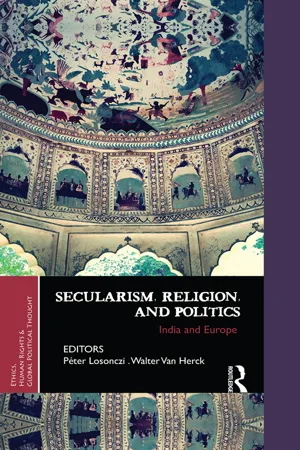
- 236 pages
- English
- ePUB (mobile friendly)
- Available on iOS & Android
eBook - ePub
About this book
Information
Part I
Conceptualizing Contexts: The Secularism and Post-secularism Debates in India and Europe
1
Secularism: The Life and Times of a Difficult Concept
Foregrounding Three Debates
Reading Orhan Pamuk is a fascinating and an absorbing experience. His grasp of history, his political sensibilities, the range of his imagination, the elegance of his prose, and the sheer power of his vocabulary is unparalleled. We in India have much to learn from at least one of his novels, Snow. In this novel, Pamuk charts the debate between secularists and the religious revivalists. At one point, Muhtar, a friend of the protagonist Ka says: ‘“After my years as a leftist atheist, these people [Muslim conservatives] come as such a great relief. You should meet them. I’m sure you’d warm to them too.” “Do you really think so?” asks Ka. “Well, for one thing, all these religious men are modest, gentle, understanding. Unlike westernized Turks, they don’t instinctively despise the common people; they’re compassionate and wounded themselves. If they got to know you, they’d like you. There would be no harsh words” replies Muhtar’. Pamuk describes Ka’s response in the following sentence: ‘As Ka knew from the beginning, in this part of the world faith in God was not something achieved by thinking sublime thoughts and stretching one’s creative powers to their outer limits; nor was it something one could do alone; above all it meant joining a mosque, becoming part of a community. Nevertheless, Ka was still disappointed that Muhtar could talk so much about his group without once mentioning God or his own private faith’ (Pamuk 2005: 61–62).
This is precisely what ails the religious right in India; the transformation of religion into a political weapon. However, the more interesting questions raised by Pamuk are different. Is political secularism inappropriate for religiously inclined societies? Are the secularists out of sync with the people they seek to legislate for? Is secularism fated to be relevant only for the west which has undergone a process of secularization? This particular debate is discussed in the first section of this essay.
The second debate revolves around the issue of what the implications of secularism are. We could negotiate this question in two ways. We could adopt US President Thomas Jefferson’s position that a ‘wall of separation’ exists or should exist between the state and religion. Alternatively, we could carry out historical investigations and see how a concept that originates in particular sorts of practices in one part of the globe, is re-shaped in different social and political contexts. This essay seeks to explore the specific features that the concept has historically acquired in India, and what implications this historical experience holds for the generic concept.
The third debate is related to the second. If secularism means that all religions, and it is well known that the major religions of the world have found a home in India, are equal, what precisely does equality mean? What does it mean to treat religious groups equally? Does the state stay away from religious beliefs and practices equally? Or does it intervene in the internal affairs of religious groups, for whatever reason, equally? Does the equal treatment of religious groups not reproduce the empirical fact that one of these religious groups is numerically dominant and culturally hegemonic, and that minority groups are at risk because they are vulnerable to assimilation on the one hand and cultural domination of the majority on the other? Does equality in other words imply that minority groups should be granted special protection to their culture and religion to protect them against advertent or inadvertent assimilation? What is then the relationship between secularism and minority rights?
The central argument of this essay is that secularism is not and cannot be a standalone concept. It is best thought of as derived from, and justified by reference to a core concept of political theory, which is elaborated hereafter. Here let me just say that secularism is a complex and a somewhat muddled concept. But it is just as well that we recognize the untidiness of political concepts. If political theory as a critical activity is geared to addressing and reflecting on intractable political problems and dilemmas, then theorists simply cannot afford to live and work in rarefied conceptual spaces or theoretical debates shorn of the complexities of actually existing social, economic, and political worlds. In any case, in a world that is stamped by inflexible political predicaments, can the theorist resort only to formal propositions and hypothetical examples to illustrate the finer points of theory? Does he or she have any other option except to philosophically reflect on, and try and sort out the ambivalences, the uncertainties, and the contingent nature of the political world and of the concepts that try to organize this world? This is more than true of secularism, which is a difficult concept as the title points out.
Is Secularism Appropriate for India?
Since the 1980s when the religious right began to manoeuvre its way into the centre stage of Indian politics, a troubled and troublesome question began to stalk the conceptual debate on secularism. Considering the pervasiveness of religious sensibilities in India, is secularism appropriate for the country? Correspondingly, has secularism proved capable of warding off the communalization of Indian society and polity? Does it have the capacity to do so?1 Regrettably the communalization of society has been paralleled by the communalization of the polity. The role of individual administrators and police officials in the communal riots that have scarred the body politic since the late 1960s has been well-documented. But in 1984 the state came to be seen as complicit in the genocidal attacks on the Sikh minority. In 1992, not only was the central government inactive when mobs demolished the Babri mosque, but both the central and state governments failed to prevent massive riots, which targeted members of both communities following the demolition. In 2002, about 2000 Muslims were killed in a massive pogrom against the minority in Gujarat. The pogrom followed the death of a number of Hindus when a train compartment in which they were travelling was set on fire by a crowd of Muslims at Godhra station. Rather than waiting for the law to take its course, the Hindu right initiated a programme of brutal vigilante justice.
The inability of the state to prevent communal riots, and the role of state officials in fomenting communalism, has necessarily caused a great deal of consternation and apprehension. Has secularism been able to safeguard the life, the property, and the dignity of citizens? Does secularism have the capacity to ensure inter-religious harmony? Given the communalization of Indian society and of the polity, it is not surprising that scholars wonder whether secularism is appropriate for the country at all. Others rush to defend secularism as the only option for a society that has repeatedly been bitterly divided over religion. In effect, the academic community has been deeply and more often than not caustically divided on the issue.
In a piece provocatively titled ‘An Anti-Secularist Manifesto’ (originally written in the 1980s), Ashis Nandy argued that secularism provides us with an impoverished public sphere devoid of any substantive system of meaning. Therefore, the entry of religious identities into the public sphere diminishes religion, which is subordinated to political pursuits. Societies are left with few substantive resources which can enrich individual or collective lives, which can negotiate relationships between religious communities, and which can control pure politics. Nandy finds an alternative to the twin ills of secular public spaces filled with crippled and truncated personalities and religious zealots using religion for their own narrow partisan ends, in the recovery of tolerance which exists in and through unarticulated but lived faiths (Nandy 2002: 47).
T. N. Madan is often lumped together with Nandy as anti-secularist. And his critics quote one of his aphorisms as evidence of the fact — ‘I believe that in the prevailing circumstances secularism in South Asia as a generally shared credo of life is impossible, as a basis for state action impracticable, and as a blueprint for the foreseeable future impotent’ (1998: 298). Madan cites three reasons for this belief. First, the majority of people living in the region are active adherents of some religious faith. Second, Buddhism and Islam have been declared state religions. Third, secularism is incapable of countering religious fundamentalism. Yet there are major differences between Nandy’s and Madan’s positions, notably that Madan does not give notice to secularism as Nandy does. In a postscript added 10 years after the publication of the 1987 piece, Madan addressing his critics insists that he had not dismissed secularism. What he had done was to caution against the ‘easy confidence of secularists regarding [the] unproblematic adaption’ of secularism’ (ibid.: 318). The only way that secularism may succeed, is if we take both religion and secularism seriously, and not reject the former as superstition and reduce the latter as a mask for communalism or mere expediency.
These critiques of secularism have not gone unchallenged. Akeel Bilgrami (1998) accused Nandy of practising both nostalgia and skewed historiography. Achin Vanaik suggested that both Nandy and Madan support a form of religious communitarianism which celebrates the traditional idea of the embedded self, rather than the modern idea of the free, equal, individuated self. The critics of secularism may be anti-communal, accepts Vanaik, but they land up sharing a discursive terrain with religious communalism (Vanaik 1997: 130–236). The exaggerated criticisms of what was typed to be anti-secularist positions only make sense, when we recollect the highly-charged political atmosphere in the 1980s and the 1990s. At this time the religious right appeared on the political scene to mobilize civil society in the cause of Hindutva, a mobilization that resulted on the one hand in the destruction of the Babri mosque, and on the other in the ascent of the BJP to power in the central government in 1986. The polarized debate served to obscure what was significant in Nandy and Madan’s argument. Both theorists sought to grapple with the uncomfortable fact that the grip of religious identities on popular imaginations has lasted longer than might have been once hoped, and that this has led to incivility, violence, riots, and murderous assaults. Can secularism help us to ward off the communalization of society and the polity?
Other arguments that hinge on the mismatch between secularism and non-secularization of the Indian polity recognize the salience of religious identities, but they go in different directions. Vanaik proposes that traditional beliefs and practices are responsible for undermining the secular state, because they have blocked the project of rationalization and democratization of society. Secularism in India must mean three things: the right to freedom of worship, the primacy of citizenship, and the non-affiliation of the state to any religion and impartiality (ibid.: 171). Bilgrami suggested that secularism has run into trouble because it stands in a conceptual and political space which lies outside the sphere of substantive political commitments. It was adopted from an Archimedean point. And it is precisely this feature that makes it unsustainable. Had secularism been grounded in debate and the understanding of different communities, it would have proved more compelling. For all groups would have had reason to subscribe to the notion of secularism (Bilgrami 1998).
In the highly polemical exchanges that followed, it was overlooked that Nandy and Madan raised two sets of distinctions to the forefront of debate: between secularism and secularization, and that between the state and civil society. If India’s civil society is deeply religious, then this poses a problem for secularism as a state project. Accordingly, both theorists sought the answer to communalism in the practices of civil society; particularly that of tolerance. Though Nandy dismissed secularism altogether, Madan suggested that state practices of secularism have to based on the recognition of religious practices. This has to be buttressed by discovering and strengthening internal resources of religious pluralism and tolerance. But in the end both theorists ground their understanding of tolerance in largely undefined and unarticulated lived practices. That these practices may have changed or degenerated in the context of competitive electoral politics, and an equally competitive market economy, is something that they would rather not take into account.
In the years that followed these exchanges, secularism came to be questioned simply because it has been identified as quintessentially a part of the project of modernity. In the process, it has often been forgotten that political secularism gains even more importance and relevance in multi-religious societies because it pre-empts the mixture of two forms of power: political power and religious power. It has also been forgotten that political practices and policy also can shape popular sensibilities. India is no longer the exotic ‘Other’ of the modern materialist west, it is a country riven by competition for material and symbolic domination. The case for political secularism becomes even more compelling, and the case against political secularism on grounds of some essentialized spiritual Indian identity becomes even less compelling.
What is Secularism About?
Despite the onset of a rich and textured debate on secularism in the 1980s, scholars do not really seem to share understandings of what secularism means in and for India. The uncertainty that dogs secularism however breeds unfortunate consequences. As Madan points out, though the ambiguity of secularism was at one point considered its strength, now its vagueness is a poor foundation for clear headed public policies (2003: 65).
For instance it is clear that Nandy hinges his critique of secularism on the separation of religion and politics. Even though he accepts that secularism holds another meaning for India: the idea of equality of all religions (Nandy 2002: 34–35), for some inexplicable reason he puts aside the second conception of secularism as an ‘avoidable Indianism’ and uses secularism in its ‘proper English sense’, presumably as contingent upon secularization. Yet secularism and secularization are to some extent independent of each other. Kemal Attaturk did after all establish a secular state in religious Turkey. And the leaders of the freedom struggle in India sought a way out of religious conflict in and through the adoption of the principle of secularism. In other words the extent of religious belief or unbelief does not necessarily correlate positively with the extent of state separation from or control over religion (Keddie 2003: 16).
If we revisit Indian history and see what the circumstances in which secularism was propelled to the forefront of the political agenda were, this argument might acquire the virtue of cogency. Since the early decades of the 20th century the politicization of religious identities had inexorably propelled religion into the public sphere in India (Tejani 2008). Gandhi, who sought to weld people belonging to different castes and creeds into a massive anti-colonial movement, loo...
Table of contents
- Cover Page
- Half Title page
- Series
- Title Page
- Copyright Page
- Contents
- Foreword
- Introduction Religion, Democracy, and Secularism in Contexts: Dilemmas and Arguments
- Conceptualizing Contexts: The Secularism and Post-secularism Debates in India and Europe
- 1 Secularism: The Life and Times of a Difficult Concept
- 2 Contextualizing Secularism: The Relationship between State and Religion in India
- 3 Beyond Moderate Secularism
- 4 Secularism in Plural Post-colonial Democracies: Is Liberal Toleration Enough?
- 5 Religion, Pluralism, Politics: Case for an Inter-contextual Study on Europe and India
- Contextualizing Concepts: Between Secularism and Democracy in Europe, India, and Beyond
- 6 Religious Political Parties in Europe and India
- 7 Secular Pluralism in India: Lessons for Europe?
- 8 Secularism and the Spirit of Capitalism
- 9 Sri Lankan Post-coloniality, Secular Time, Future of Democracy
- 10 Shaping Secularism through the Judiciary in Nepal: Case Studies from the Kathmandu Supreme Court
- About the Editors
- Notes on Contributors
- Index
Trusted by 375,005 students
Access to over 1.5 million titles for a fair monthly price.
Study more efficiently using our study tools.
Frequently asked questions
Yes, you can cancel anytime from the Subscription tab in your account settings on the Perlego website. Your subscription will stay active until the end of your current billing period. Learn how to cancel your subscription
No, books cannot be downloaded as external files, such as PDFs, for use outside of Perlego. However, you can download books within the Perlego app for offline reading on mobile or tablet. Learn how to download books offline
Perlego offers two plans: Essential and Complete
- Essential is ideal for learners and professionals who enjoy exploring a wide range of subjects. Access the Essential Library with 800,000+ trusted titles and best-sellers across business, personal growth, and the humanities. Includes unlimited reading time and Standard Read Aloud voice.
- Complete: Perfect for advanced learners and researchers needing full, unrestricted access. Unlock 1.5M+ books across hundreds of subjects, including academic and specialized titles. The Complete Plan also includes advanced features like Premium Read Aloud and Research Assistant.
We are an online textbook subscription service, where you can get access to an entire online library for less than the price of a single book per month. With over 1.5 million books across 990+ topics, we’ve got you covered! Learn about our mission
Look out for the read-aloud symbol on your next book to see if you can listen to it. The read-aloud tool reads text aloud for you, highlighting the text as it is being read. You can pause it, speed it up and slow it down. Learn more about Read Aloud
Yes! You can use the Perlego app on both iOS and Android devices to read anytime, anywhere — even offline. Perfect for commutes or when you’re on the go.
Please note we cannot support devices running on iOS 13 and Android 7 or earlier. Learn more about using the app
Please note we cannot support devices running on iOS 13 and Android 7 or earlier. Learn more about using the app
Yes, you can access Secularism, Religion, and Politics by Peter Losonczi,Walter Van Herck in PDF and/or ePUB format, as well as other popular books in Politics & International Relations & Political Philosophy. We have over 1.5 million books available in our catalogue for you to explore.