- 554 pages
- English
- ePUB (mobile friendly)
- Available on iOS & Android
eBook - ePub
History of the Indian Archipelago
About this book
First Published in 1967. History of the Indian Archipelago, contains an account from 1820, on the manner, arts, languages, religions, institutions and commerce of its inhabitants.
BOOK III
PROGRESS IN SCIENCE AND THE HIGHER ARTS
From what has been already stated respecting the character and manners of the Indian islanders, the reader will not expect to find that they have made much progress in the sciences or higher arts. Some, however, they have made, and a description of it will be found highly curious and instructive. I shall endeavour to furnish it in the three following chapters; the first, rendering an account of their arithmetic ; the second, of their calendar ; the third, of their geography and navigation ; and the fourth, of their music and medicine.
CHAPTER I
Arithmetic
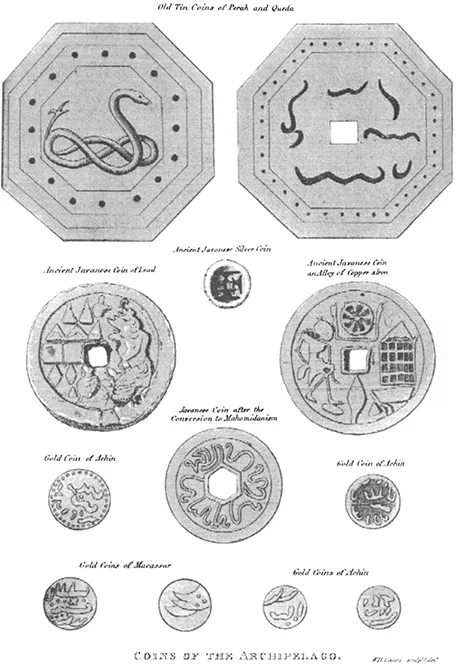
Indian islanders ignorant of arithmetic as a science.—Employ foreigners as accountants, and count by cutting notches on slips of wood, or tying knots on cords.—History of the origin of numbers among them.— One system of numerals generally prevalent from Madagascar to New Guinea.—Binary scale.—Quaternary scale.—Quinary scale.—Senary scale.—Denary scale.—A thousand, the highest term generally known to the native languages.—Sanskrit terms borrowed, and error in doing so.— Ten thousand, the common limit of the numerical scale of the Indian islanders.—Javanese alone extend their terms as far as ten billions.—Principles on which the numerals of the ceremonial dialect of the Javanese are formed.—Origin of the ordinal numbers and fractions.—Indian islanders acquainted with the Hindu digits.—Principle on which the Javanese digits are fanned. — Vocabulary of the numerals of twelve languages.—Measures used by the Indian islanders.—Bulk, and not weight, the principle on which measure is estimated.—Example in the com measure of the Javanese.—Dry and liquid measures.—Measures by weight, introduced by foreigners, chiefly by the Chinese.—Description of these.—Gold measure.— Measures of extent still more imperfect than those of gravity.—Description of them.— Land measure of the Javanese.—Standards of exchangeable value.—Articles med by the ruder tribes for this purpose.— Introduction of metallic currency.—Tin coins—Brass coins.—No silver coins anciently used.—Cold coins.— European coins.—Paper currency introduced by the European governments.
The Indian islanders are wholly ignorant of arithmetic as a science, and, indeed, know nothing of the common rules of calculation. In their mercantile transactions, they employ the Chinese and natives of the east coast of the peninsula of India as accountants; and, notwithstanding the knowledge which the Javanese have of the Hindu numeral characters, they frequently calculate by cutting notches on slips of wood or bamboo, or by tying knots on a cord. In all pecuniary transactions the women are more expert than the men, and we find them mostly employed as brokers and money changers.*
* “When they have occasion to recollect, at a distance of time, the tale of any commodities they are carrying to market or the like, the country people often assist their memory by tying knots on a string, which is produced when they want to specify the number. The Peruvian Quipæs were, I suppose, an improvement on this simple invention.”—Marsden’s Sumatra, p. 192.
The history of the origin of numbers among them affords a more interesting subject of disquisition than their rude processes of calculation. Each tribe appears originally to have possessed a distinct system of numerals, and traces of this may be detected in almost all the languages. Indeed, those of Tambora and Ternati, very centrically situated, retain them, the first unaltered, and the last nearly so ; but the influence of one pervading speech upon all the rest has in no department been so complete as in that of the numerals. Generally speaking, the same numerals may be said to prevail from Madagascar to New Guinea, and the Philippines, and even to have spread to the South Sea Islands. The general question of the dissemination of the great Polynesian language will afterwards be considered ; and it will, at present, be sufficient to remark, that the history of mankind affords no other example of so wide a dissemination of a rude speech among savage and barbarous tribes, who never appear to have been more civilized, and seldom more enterprising than we at present find them. The tribes under whom this striking phenomenon is discoverable form, to be sure, the most numerous portion of the human race, connected by a proximity of insular situation, and the facility of intercourse which this situation naturally presents, will go far towards a rational explanation of it.
The prevalence of the great Polynesian, necessarily an obsolete and obscure language, affords a principal obstacle to the detection of the etymologies of the numeral terms. Many striking etymologies may still, however, be detected, and were we better acquainted with the ruder dialects in which the Polynesian is least...
Table of contents
- Cover
- Half Title
- Title Page
- Copyright Page
- Original Title Page
- Advertisement
- Table of Contents
- Introduction
- Book I Character
- Book II Arts
- Book III Pbogeess in Science and the Higher Arts
- Book IV Agriculture
Trusted by 375,005 students
Access to over 1.5 million titles for a fair monthly price.
Study more efficiently using our study tools.
Frequently asked questions
Yes, you can cancel anytime from the Subscription tab in your account settings on the Perlego website. Your subscription will stay active until the end of your current billing period. Learn how to cancel your subscription
No, books cannot be downloaded as external files, such as PDFs, for use outside of Perlego. However, you can download books within the Perlego app for offline reading on mobile or tablet. Learn how to download books offline
Perlego offers two plans: Essential and Complete
- Essential is ideal for learners and professionals who enjoy exploring a wide range of subjects. Access the Essential Library with 800,000+ trusted titles and best-sellers across business, personal growth, and the humanities. Includes unlimited reading time and Standard Read Aloud voice.
- Complete: Perfect for advanced learners and researchers needing full, unrestricted access. Unlock 1.5M+ books across hundreds of subjects, including academic and specialized titles. The Complete Plan also includes advanced features like Premium Read Aloud and Research Assistant.
We are an online textbook subscription service, where you can get access to an entire online library for less than the price of a single book per month. With over 1.5 million books across 990+ topics, we’ve got you covered! Learn about our mission
Look out for the read-aloud symbol on your next book to see if you can listen to it. The read-aloud tool reads text aloud for you, highlighting the text as it is being read. You can pause it, speed it up and slow it down. Learn more about Read Aloud
Yes! You can use the Perlego app on both iOS and Android devices to read anytime, anywhere — even offline. Perfect for commutes or when you’re on the go.
Please note we cannot support devices running on iOS 13 and Android 7 or earlier. Learn more about using the app
Please note we cannot support devices running on iOS 13 and Android 7 or earlier. Learn more about using the app
Yes, you can access History of the Indian Archipelago by John Crawfurd in PDF and/or ePUB format, as well as other popular books in History & World History. We have over 1.5 million books available in our catalogue for you to explore.