Volume One of three, this is a reprint of James Bowen's A History of Western Education originally published by Methuen in the 1970s. Volume One covers The Ancient World: Orient and Mediterranean 2000B.C - A.D. 1054. The volume traces the development of education in the ancient world from the first scribal cultures of Mesopotamia and Egypt to learning in the early Christian church. A detailed account is given of the achievements of Greece in literacy, learning, philosophy and training for public life - achievements which were further developed in the Hellenistic Orient and incorporated by the Romans into their own highly organized educational system. This leads to the emergence of a specifically Christian ideal of education, the decline of secular learning in the West, and the preservation of learning both in Byzantium and in Western monasticism.
- 424 pages
- English
- ePUB (mobile friendly)
- Available on iOS & Android
eBook - ePub
Hist West Educ:Ancient World V 1
About this book
Information
CHAPTER 1
The First Scribal Cultures: Mesopotamia
Pre-literate man
Prologue: education and the world of symbols
Life began on earth probably more than fifteen hundred million years ago. During the past million man’s immediate ancestors appeared and man, of the species hom sapiens, took his present form about 35,000 B.C. At that time he possessed his present cranial capacity and began to make tools, thus commencing the process of controlling his environment; all of man’s achievements since then have depended upon the application of existing physical and mental powers. The use of tools prompted the development of techniques for their manufacture and employment, leading in turn to further developments — forms of social life in which tools became essential instruments. The organization of society around the making and use of tools marked the beginning of culture — that accumulation of instruments, ideas and institutions by which social life proceeds. In man’s early culture improvements in the techniques of tool-making were accompanied by the appearance of abstract conceptions, evidenced by the incision of designs on tools and rocks and the execution of cave paintings, the famous Palaeolithic art of Lascaux in France currently being dated by radio-carbon methods to a period around 13,000 B.C.1 Such paintings mark a major development in man’s capacity for thought, since the ability to abstract visual design from the environment and give it graphic representation is a conceptual skill of the highest order. Some time in that first period a further effort of abstraction was achieved, with the development of speech. Of the origins of speech, nothing can be said with certainty. Theories are legion but all remain speculative; yet its significance cannot be overestimated: through its use ideas emerged, were communicated and transmitted through time. Speech and graphic representation provided the two elements from which the symbolisms of writing and reckoning were made, and these formed the basis of civilization. With them man was able to develop the many instruments and processes by which he pursued his activities; they enabled the transcendence of time and space, the liberation of man from the immediate and fortuitous. By these symbolisms the world of ideas was constructed and its exploration sustained.
The constant search for control, liberation and expansion characterized man from his first appearance, and part of his success in devising effective mechanisms rested in his ability to secure the perpetuation and refinement of such skills through the procedures of education. For education includes that cultural process by which techniques for control of the environment are transmitted. Since man’s environment from the end of the Neolithic period was as much social and intellectual as physical, the process of education took on a social and intellectual cast and increasingly through the course of history has been mediated symbolically. The operation of the process changed the character of man’s environment: with the extension of symbolic control the physical environment diminished in significance and social aspects predominated, until, with increased dependence on conceptual achievements, the social environment in turn became less fortuitous, and the intellectual or noetic environment became paramount.
Settlement of the Ancient Orient 8000–3000 B.C.
The archaeological record shows Palaeolithic man to have been widely distributed throughout Africa, Asia and Europe. By the end of the last ice-age, perhaps around 8000 B.C., some groups living at the meeting place of those continents in the lands known as the Ancient Orient began to effect changes in tools and food production. In that region the climate was sufficiently hospitable to free man from excessive concern with sheer survival: simple forms of shelter were adequate, vegetable foods grew in relative abundance. There the Palaeolithic changed into a new culture, the Neolithic; new types of tools appeared — the adze, hoe and sickle — along with refinements in the production of stone tools. At Mt Carmel on the coast of present-day Israel what are presumed to be the earliest of Neolithic tools have been discovered, including a wood-and-flint sickle used for harvesting grain, from the Lower Natufian culture of Palestine. Neolithic sites proliferated in the region of the Ancient Orient after 8000 B.C., all displaying the features of settled agriculture, domestication of animals, the use of relatively advanced artefacts — pottery, polished axe-heads and implements for cultivation. Development of man’s culture thereafter proceeded rapidly, and around 6500 B.C. organized village life appeared in the foothills of the mountains north of Mesopotamia where two of the world’s earliest known villages, Jarmo and Barda Balka, have been excavated. In addition, more recently at Çatal Hüyuk in modern Turkey a remarkable pre-Neolithic town has been discovered which contains a wealth of remains including shrines and wall-paintings in houses. Within the ensuing 2,000 years Neolithic man in this region controlled his environment to such a degree that he was able to descend from the hillside regions where he depended upon rudimentary and fortuitous agriculture, supplemented by food-gathering and hunting, to the fertile plains of the river valleys of the Tigris, Euphrates and Nile. To these areas, over the relatively short period of 1,000 years, he took his stone implements, animals and cultivated plants; by 4000 B.C. settled agriculture based upon irrigation supported a growing population and large villages became the unit of social organization.
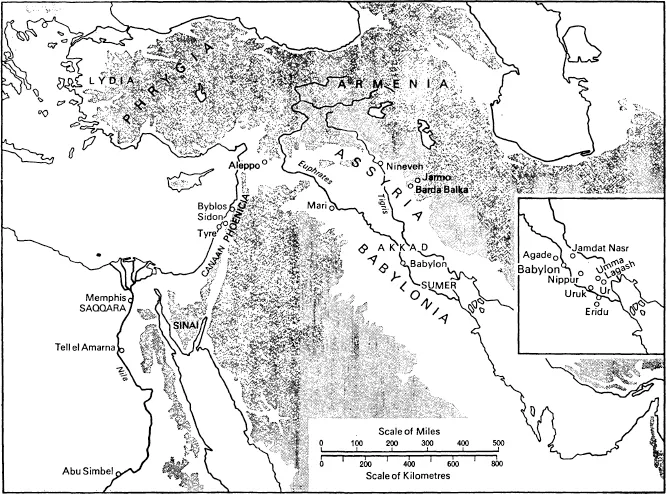
Some time during the fourth millennium copper was discovered, and while it remained a precious and rare possession the increasing use of that metal between 4000 and 3000 B.C. marked the entry of many Neolithic groups into the Chalcolithic or Copper Age. Civilization began to take distinctive shape in the Ancient Orient: the activities of agriculture predominated over hunting, and settled village life became common, even for farmers. In that period of urbanization, surpluses from controlled agriculture became the underlying factor, enabling the release of part of the population from food production for the pursuit of other activities — crafts and services. There was a corresponding increase in commercial activity in the expanding urban settlements of the river valleys, and throughout the fourth millennium a complex pattern of caravan and river routes developed to supply the growing trade in gold, copper, precious stones, wood, implements, donkeys and camels. In the same period, and as part of the same great process of invention, man devised some of his most important creations: seasonal agriculture with irrigation, the plough, copper tools, animal power, the wheel. Villages grew into cities, particularly in the land of Sumer towards the mouth of the Euphrates where the great centres of Uruk, Lagash, Ur, Eridu and Umma were regarded by their inhabitants, as they are by men to this day, as the cradle of civilization. From that early culture — from which, in time, the civilization of the West was to develop — there emerged a mythopoeic tradition which included an account of Creation and stories of the great flood, while the building of the great cities was celebrated in The Epic of Gilgamesh, the story of the legendary king of Uruk, the biblical Erech.
Proto-literate man: Mesopotamia 3000–2000 B.C.
Cities, with all of their complex activities, depended upon adequate developments in the social control of man himself, since only when human behaviour is predictable can urban life operate satisfactorily. A moral order was increasingly evident during the pre-literate Copper Age in Sumer, and in the Bronze Age it became firmly institutionalized. Evidence from the proto-literate period reveals man’s attempts at community consolidation, and from such tremendous efforts were evolved the means for maintaining social continuity: a moral code explicated in literary form, although generally not written down, and the institution by which it was mediated — the temple.
The early Mesopotamian temple
The origins of the temple lie in the prehistoric period, how early cannot be estimated; certainly, however, in that period when the offices of king and high priest were still exercised actively by the one person.2 It was not until later, in the period of the great empires, that these offices separated with the high priests becoming vicegerents of the king and the local gods minor deities of the greater cosmic god. Since sovereignty had not spread beyond the individual city-state in the early period of urbanization the temple was the sole regulator of social life, and through its offices all activities proceeded. Little is known of the temple’s functioning in the early Chalcolithic Age, chiefly on account of a lack of evidence; history begins only with records, and these in fact are virtually non-existent before 3000 B.C. From the remains that have been excavated, however, and by inference from later records, it seems that the temple in that period was concerned with securing control of agricultural production. Despite the urbanization of society, life still rested upon the basis of agriculture, and it was to such activity that much of the administrative work of the temple was directed.
The world of early oriental man was pantheistic: he had not achieved an intellectual separation of subject and object; the cyclic rhythm of agriculture and its occasional failures were part of the mystery of the gods. The gods could not be known, their workings were inscrutable, and man could only propitiate. The temple supplied that need, and the high priest became mediator between man and god. Man met these obligations through offerings and the payment of tribute to the temple, so that, in the course of time, the temples accumulated considerable wealth, controlled by what became a corporation of priests. Propitiation, however, had to issue in practical results, and a major duty of the temples was the regulation of the calendar, an activity of some importance in such societies where prediction of the flood cycles of rivers was basic to agricultural needs. The priests developed a lunar calendar and compensated for its lack of precision by adding intercalary months at irregular intervals. The calendar and astronomical observation were linked with prediction and propitiation; from those activities astrology developed, as a study of the influence of nature on man, and it remained a significant element of Mesopotamian thought.
Beginnings of reckoning and writing
Writing and reckoning had their beginnings in this context. Later Mesopotamian mythology attributed the origin of writing to the great god-scribe Nabu, and throughout several thousand years of high civilization in the region the peoples of Mesopotamia continued to cultivate a reverence towards writing: in their minds it was mystically charged. The first development of this activity cannot be traced through remains. In all likelihood the elements came from the graphic art of the Palaeolithic period which could have suggested the visual designs, but of their application to speech and the precise manner in which these designs became fused into the symbolisms of reckoning and writing only hypotheses exist, supported by occasional fragments of evidence. The earliest use of graphic symbols for such purposes appears to be designs pressed into small lumps of clay, often no more than one inch in...
Table of contents
- Cover Page
- Half Title
- Series
- Title Page
- Copyright Page
- Dedication
- Title Page1
- Contents
- LIST OF ILLUSTRATIONS
- PREFACE
- 1 The First Scribal Cultures : Mesopotamia
- 2 The First Scribal Cultures: Egypt
- 3 Early Civilization of Hellas: Literacy, Learning and Philosophy
- 4 The Achievement of Athens: the Fifth Century
- 5 Rhetoric and Philosophy: Higher Learning in Fourth-Century Athens
- 6 Aristotle and Higher Learning in Hellenistic Athens
- 7 The Hellenistic Orient
- 8 Republic of Rome
- 9 Empire of Rome
- 10 Religious Conflict and Syncretism: Early Christian Thought on Education
- 11 Foundations of Christian Education
- 12 Preservation of Traditional Learning : Byzantium
- 13 The Christian Church and Western Learning
- NOTES
- BIBLIOGRAPHY
- INDEX
Trusted by 375,005 students
Access to over 1.5 million titles for a fair monthly price.
Study more efficiently using our study tools.
Frequently asked questions
Yes, you can cancel anytime from the Subscription tab in your account settings on the Perlego website. Your subscription will stay active until the end of your current billing period. Learn how to cancel your subscription
No, books cannot be downloaded as external files, such as PDFs, for use outside of Perlego. However, you can download books within the Perlego app for offline reading on mobile or tablet. Learn how to download books offline
Perlego offers two plans: Essential and Complete
- Essential is ideal for learners and professionals who enjoy exploring a wide range of subjects. Access the Essential Library with 800,000+ trusted titles and best-sellers across business, personal growth, and the humanities. Includes unlimited reading time and Standard Read Aloud voice.
- Complete: Perfect for advanced learners and researchers needing full, unrestricted access. Unlock 1.5M+ books across hundreds of subjects, including academic and specialized titles. The Complete Plan also includes advanced features like Premium Read Aloud and Research Assistant.
We are an online textbook subscription service, where you can get access to an entire online library for less than the price of a single book per month. With over 1.5 million books across 990+ topics, we’ve got you covered! Learn about our mission
Look out for the read-aloud symbol on your next book to see if you can listen to it. The read-aloud tool reads text aloud for you, highlighting the text as it is being read. You can pause it, speed it up and slow it down. Learn more about Read Aloud
Yes! You can use the Perlego app on both iOS and Android devices to read anytime, anywhere — even offline. Perfect for commutes or when you’re on the go.
Please note we cannot support devices running on iOS 13 and Android 7 or earlier. Learn more about using the app
Please note we cannot support devices running on iOS 13 and Android 7 or earlier. Learn more about using the app
Yes, you can access Hist West Educ:Ancient World V 1 by James Bowen in PDF and/or ePUB format, as well as other popular books in Education & Education General. We have over 1.5 million books available in our catalogue for you to explore.