This is Volume IV of 9 historical works from the International Library of Sociology. This is part one of two looking at the history of the autobiography. Appearing in isolation as they do, autobiographies demand for their description and appreciation, a comprehensive view of the development of the human mind. This volume covers the conception and the origin of autobiography, looking at ancient civilisations of the Middle East, classical Greece and Greco-Roman periods.
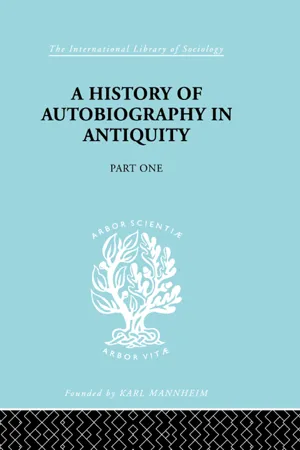
- 368 pages
- English
- ePUB (mobile friendly)
- Available on iOS & Android
eBook - ePub
About this book
Information
PART I
THE DEVELOPMENT OF AUTOBIOGRAPHY IN THE POST-HOMERIC AND CLASSICAL EPOCHS IN GREECE
Today we no longer see the Greeks in the romantic light in which their incomparable creations were once revered as the perfect and ultimate revelation of every human potentiality. Historical investigation is everywhere bringing to light the natural conditions that limit human greatness. We are increasingly able to picture the interconnected world of the ancient East, extending from the banks of the Euphrates and the Nile as far west as Hellas, which had given birth to Homer; we are also learning that the Hellenic spirit did not simply evolve from itself, and the wider panorama opened to us makes it clear that the creative activity of the Greeks, like that of other peoples, was limited by mental characteristics peculiar to them, and by the circumstances of their history. Thus we have reached a position of detachment even toward the culture that has influenced us most deeply, and we are ready to view it critically.
But this modern mood of relativism should not be allowed to destroy our reverence for the classical age of Greece. We must see the historical process as a whole in its true perspective. Stretching back through some thousands of years to the dim horizon of recorded history were the Eastern civilizations of the great river-valleys and plains. Then in the space of a few centuries this relatively tiny Greek people came into prominence and by its own genius reached a new pinnacle of human development, the degree of man’s self-knowledge being raised at a bound. Then the tide of civilization turned back to the eastern shores of the Mediterranean; into this Hellenistic culture Rome forced her way with vast power, underpinning its labile foundations, until in the racial conglomeration of her empire the life of the spirit began to stir and to shift the focus of men’s thoughts and emotions, as religion reasserted its claims. Finally there was welded together the powerful all-inclusive spiritual system that was to shelter for several centuries the early development of the modern European mind. Viewed in this light, the history of Western culture seems like the work of some great tragedian, a drama that stirs and purifies the inmost being. It is as an element in this great process that we have to consider the appearance of autobiography in antiquity, necessarily piecing our account together from all too scanty material.
All that the oriental documents we have dealt with had to give us was a general view of the emergence in a highly developed civilization of autobiographical works that did not present the full personal life of their subject. Quite different are the problems offered us by the classical peoples of the Mediterranean. A truly historical consideration of autobiography first becomes possible with the Hellenic world. Here we are no longer confined to an empiricist description of our material, approaching it from without while simply taking note of the opportunities that have occurred for autobiographical writing. Here, in the Greco-Roman world, is enacted the great spectacle of a continuous intellectual evolution. Fragmentary as is our knowledge of long stretches of this evolution, it nevertheless reveals a complete and unified whole, starting from definable beginnings, passing through an incomparable variety of historical periods, and finally coming in the Dark Ages to a visible end, although in the last resort it remains as great a mystery as every beginning and ending of life. If it is to be of any intrinsic human interest, autobiography must be related in its commencement and continuance to the course of this intellectual development. And from the nature of this relationship it should be possible to gain a general insight into the nature of autobiography.
If the relationship were simple, like that prevailing in the modern world from whose different epochs we possess autobiographical documents, then the history of ancient autobiography would be able to provide us with the basis we need; we should find in Greece a topography, as it were, of the typical forms of autobiography, just as we do in the case of most other branches of literature. The literary forms in which the various methods of men’s self-examination are reflected would thus be given in historical sequence, each in its place in the pageant of Greek thought. With this picture before our mind, we should be able to consider the luxuriance of autobiography among the nations of the modern world; in this later development we should easily recognize, as on a new world-map, the regularity of the appearance and growth of autobiography in modern times and its different character from that of the ancients. This would be of the greater importance since in the Western world Hellenic culture alone has risen independently to the freedom of deep human self-knowledge, while it is precisely this ancient treasure that the later peoples have inherited and then creatively made their own. But the actual facts of the course of history are more complicated and have a deeper meaning.
If we take stock of the autobiographies that remain to us from antiquity, we are struck first of all—as regards the centuries before the birth of Christ—by a remarkable incongruity. In the Greek culture, which, as will presently be explained, discovered and freed human personality, and found so many forms in which to portray it, autobiography has only a restricted place, as a literary speciality of secondary importance. Apart from the autobiographies of statesmen and generals, the only type that is cultivated to any significant extent is that of the literary man, and as a rule this type only goes deeper for didactic purposes—the illustration of an ideal of culture, and the like. Even these autobiographies suffer a good deal from the literary trend that treated them as mere matter for the display of the art of rhetoric. Outside the political sphere hardly a single outstanding personality appears among the autobiographers of pre-Christian times. It was only under the conditions that brought about the collapse of the ancient type of civilization that autobiography attained full independence among the ancient peoples, and, as a branch of literature in the modern sense, undertook the intimate revelation of the whole course of an individual life.
It must be admitted that here we have a limitation of the Greek spirit. For although the fewness of the survivals, especially from the Hellenistic period, imposes a cautious reserve in any general judgment, one thing is plain—that it is not to a mere chance that we owe our lack of knowledge, but that the reason for this peculiar feature must somehow lie in the Greek attitude to the realities of life. Aristotle introduced into his portrayal of the magnanimous man—his ideal of humanity—as one of his characteristics the fixed habit in his self-sufficiency of never discussing either himself or other persons.*
This conception of man is presented to us most clearly in Greek sculpture—the majestic aloofness of the soul, which will never entirely reveal and confess its inmost thoughts and feelings, the physical contour and poise of a personality that does not abandon itself to the moment but itself gives form to every situation. Man, who only attains man’s dignity in his complete development, has his inner unity not in the historical process of his life, but in the balanced power of a will guided by reason, or, to quote Plato, of “the wise and calm temper which is constantly uniform and unchanging”.1 Philosophically, this kind of vision is to be found in the Greek idea of life, in the meaning of the word bios, which first appears in Euripides. Bios means “conduct of life”, the “mode of living”2 that reflects the man’s character. So the whole life is summed up in character, and sculpture, which in its tranquil beauty can seize its subject only in a single pose, is the perfect medium for the full expression of such a conception of man. The sculptor’s imagination perceives in every individual aspect of human existence the permanent ethos according to which each man in his own way moves and has his being. It was the sculptor’s imagination that provided Herodotus and the Peripatetic historians of the “bios” (culture) of Greece with their insight into the individuality of peoples and into the distinct types of civilization. It was at work in the vivacity of the Platonic dialogue, which treats even abstract things “like a piece of sculpture in the round”, handling them and moulding them from every side. Biography, which became a definite literary form among the Greeks, belongs by nature to the same context. Its origins lie in philosophy, with Plato and Aristotle, and its basis was this same conception of bios. It did not narrate for the sake of narration, and any question of the development of character lay beyond its horizon. It was essentially concerned with the unchanging ego of the fully matured human being, whose personality, in Aristotle’s words, is “first in the order of nature”, even if last to appear in the process of life. So here, too, as in those early oriental documents, man, that complex and variable creature, was treated as a fixed quantity. But here, with deeper insight, it was realized that growth is based on being—that is, on something completed—and is not merely the product of elements developing historically. This original reality of a man’s character, which in truth gives consistency to his life, should not, however, be separated from the shape life takes: the shaping of life should be considered as a completion that makes a man’s beauty. We meet here with the essential connexion of the ethical with the æsthetic that is expressed by the term kalokagathon. This Aristotelian or, rather, classical Greek conception of personality was at work not only in the formation of biography but also in other literary forms available for the description of individual life, and may be found epitomized in Pindar’s paradox, “Become what thou art” (γενοι̃ οἱ̃ος ἐσσί), that is to say, achieve what is your real self. Given this deep conception of the character of the individual, we wonder why the classical method of approach, implying the artist’s vision of humanity, should, from its nature, preclude the presentation of the true content of an individual personality in biographical form.
The effect, however, of looking at man’s experience in this way was that the peculiar task of biography was left on one side and the portrayal of the individual was neglected in favour of some general aspect of his character, as is proved incontestably by the works of Greek and Roman biographers that have come down to us. The ordinary biographer did not proceed inductively from observation of the particular to the discovery of the typical, which does not then lose the features of the individual; he took as his starting-point the typical forms of life, the philosophical, political, moral, and so on, and then the individual whom he was to depict remained a mere example.3 There are but few great works of biographical art, including those of modern times, and they are always made possible only by a living relationship between the biographer and his subject, whether resulting from close personal contact or from the historical influence still exerted by the subject and strongly felt by his biographer. Then the writer moulds for himself the literary form he needs. In antiquity the greatest representations of historical personalities, Plato’s Socrates, Thucydides’ Pericles, Tacitus’ Tiberius, are in fact not given in strictly biographical form.
Now, for autobiography that living relationship and sympathetic understanding can, it seems, almost be taken for granted. And, indeed, in modern times autobiography has, for that reason, again and again set a standard for biography in general, which it actually outnumbers in documents of universal human importance. But in Greek literature the writers appear to have neglected the natural basis of the autobiographer’s intimate selfknowledge, just as the philosophical impulse associated with the Greek conception of mankind became atrophied in the hands of the rhetoricians. Ancient autobiography did not develop on lines of its own, but remained for the most part dependent on current literary forms, not all of them strictly biographical, and from the outset its highest aim was to depict an ideal standard of culture or a definite type of character, cast into the form of a self-portrait.
In stating this historical fact, however, we must guard against generalizing. We are too inclined to infer from the classical attitude to autobiography that little importance was attached in ancient times to self-portrayal. To assess its importance we must take a wider view, regarding the facts referred to as derivative, and starting from the more deep-seated biographical impulse from which they derived and diverged.
The literary form of biography produced by the Greeks did admit of an all-round portrayal of an individual man. This is generally recognized with regard to the work of Plutarch, and becomes still more evident in the Renaissance. In that epoch, when writers looked to antiquity for their models, we find again in operation the same tendency to present a man’s character fully developed rather than in process of development; yet through their original handling of those literary forms some Renaissance writers mastered one of the crucial problems of biography—that of seeing at the same time, with an artist’s eye, the broad conception of the individual, and, more analytically, the characteristics of which it is built up. And it is in the field of autobiography that this achievement is found. There is nothing in the nature of classical art that makes it incompatible with autobiography. Classical art, it is true, does not bow to the particular details of actual life, and it is also true that the objective works created by the imagination or by thought (as, for instance, Plato’s dialogues or Dante’s (Divina Commedia) may frame the artist’s personality with such truthfulness that on the whole he is seen as his true self and has no further need to speak of himself in his own person: personal matters are first sought by the scientific interest or the human sympathy of a later generation. So long as the imagination can go freely and fully to work, it simply draws from the writer’s life the material for the shaping of its story. But autobiography, too, is by no means necessarily bound to the recording of particular details of fact: in it, too, the form of the work and the artistic shaping of the picture of its subject—which, when given, must be true to life—are of more importance than the recording of the actual data of the life of the subject, and as a rule the accuracy of the details remains open to question. Indeed, in face of the formless flow of the narrative of later books of confessions, it must be said that the classical attitude, demanding from the autobiographer both form and style, has permanent validity. Was that not Goethe’s own rule? The artistic purpose implicit in Greek literature may have made it more difficult to write great autobiographical works, but it did not stand in their way. The causes lie deeper. They are contained in the very general obedience to historic law which has determined the development of Western autobiography.
What we are concerned with is the manner in which autobiography first became aware of its true object. This object is the revelation of the full content of the life of an individual considered as a characteristic whole, whether that revelation is developed purely from within as the story of a soul or condensed into a portrayal of character or given palpable shape as a record of the outward activity of the inner life, a life grown strong enough to face the outer world without losing itself in it. Other types of literature, which can present human life vividly by setting forth particular situations, problems, emotions, and conflicts, or through a synthesis of different characters, may grow and attain a high degree of perfection without directing their whole attention to the inner life of the individual. For autobiography there is laid down by the very nature of its subject matter a law of development that does not, or at least does not so exclusively, determine the development of poetry or of literature in general. As the scope of the individual’s mental life, and therewith his capacity to shape his life (or, in a word, his personality), increases, so also the importance of the autobiographer’s attempt grows. But his ability to grasp and then to hold fast to his supreme aim depends on his becoming aware of the significance of that aim: the autobiographer’s task must, in the course of the development of the human mind, have been disclosed in its full reality and recognized as a supreme object of human effort. That is the condition for the assessment of autobiography as a thing to be pursued for its own sake, and not merely as a matter of vanity, and for its elevation to the rank of those objectives in whose pursuit the human mind marches forward.
Now, this disclosure of the significance of individual life has been a long historical process. The philosophic spirit of the Greeks traced only the first difficult steps, beginning with the determination of the ethical process on which depends the firmness of character and the trueness to self of the person guided by reason, and proceeding to the Stoic concept of personality. That concept, fundamental as it remained, was nevertheless formal and, in a sense, abstract—until it came by religious experience to be related to the pantheistic view of the world, so that the individual found himself in his relation to the one universal source of all life, as we shall see in Marcus Aurelius. The full reality of the unique life of the soul was not revealed to the ancients,4 and devices other than those at the disposal of the sculptor’s imagination and the philosopher’s reasoning were required in order to give any grasp of that reality with its lack of precise boundaries, its endless expansions, and its elusive changes. But it was from the ancient world itself that these modifications in man’s attitude towards existence emerged, to result in Augustine’s time in the creative lifting of autobiography above all other types of literature. In this lies the true problem of our history in regard to ancient times. It will have to be shown which literary forms of self-presentation developed in antiquity out of reflection on inner experience, and within what limits they approached autobiography.
In ancient literature, apart from a comparatively large number of political autobiographies, and from the highly sophisticated form of rhetori...
Table of contents
- Cover
- Half Title
- Title Page
- Copyright Page
- PREFACE TO THE ENGLISH EDITION
- PREFACE TO THE FIRST EDITION
- PREFACE TO THE SECOND EDITION
- Table of Contents
- INTRODUCTION
- Part I THE DEVELOPMENT OF AUTOBIOGRAPHY IN THE POST-HOMERIC AND CLASSICAL EPOCHS IN GREECE
- Part II AUTOBIOGRAPHY IN THE HELLENISTIC AND GRECO-ROMAN WORLD
- NOTES
Trusted by 375,005 students
Access to over 1.5 million titles for a fair monthly price.
Study more efficiently using our study tools.
Frequently asked questions
Yes, you can cancel anytime from the Subscription tab in your account settings on the Perlego website. Your subscription will stay active until the end of your current billing period. Learn how to cancel your subscription
No, books cannot be downloaded as external files, such as PDFs, for use outside of Perlego. However, you can download books within the Perlego app for offline reading on mobile or tablet. Learn how to download books offline
Perlego offers two plans: Essential and Complete
- Essential is ideal for learners and professionals who enjoy exploring a wide range of subjects. Access the Essential Library with 800,000+ trusted titles and best-sellers across business, personal growth, and the humanities. Includes unlimited reading time and Standard Read Aloud voice.
- Complete: Perfect for advanced learners and researchers needing full, unrestricted access. Unlock 1.5M+ books across hundreds of subjects, including academic and specialized titles. The Complete Plan also includes advanced features like Premium Read Aloud and Research Assistant.
We are an online textbook subscription service, where you can get access to an entire online library for less than the price of a single book per month. With over 1.5 million books across 990+ topics, we’ve got you covered! Learn about our mission
Look out for the read-aloud symbol on your next book to see if you can listen to it. The read-aloud tool reads text aloud for you, highlighting the text as it is being read. You can pause it, speed it up and slow it down. Learn more about Read Aloud
Yes! You can use the Perlego app on both iOS and Android devices to read anytime, anywhere — even offline. Perfect for commutes or when you’re on the go.
Please note we cannot support devices running on iOS 13 and Android 7 or earlier. Learn more about using the app
Please note we cannot support devices running on iOS 13 and Android 7 or earlier. Learn more about using the app
Yes, you can access A History of Autobiography in Antiquity by Georg Misch in PDF and/or ePUB format, as well as other popular books in Social Sciences & Sociology. We have over 1.5 million books available in our catalogue for you to explore.