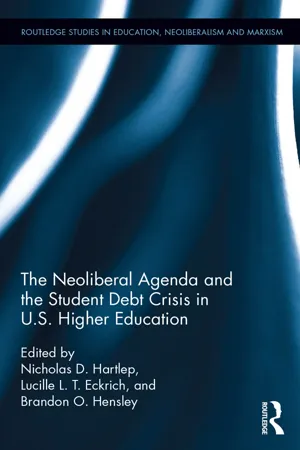
Capturing the voices of Americans living with student debt in the United States, this collection critiques the neoliberal interest-driven, debt-based system of U.S. higher education and offers alternatives to neoliberal capitalism and the corporatized university. Grounded in an understanding of the historical and political economic context, this book offers auto-ethnographic experiences of living in debt, and analyzes alternatives to the current system. Chapter authors address real questions such as, Do collegians overestimate the economic value of going to college? and How does the monetary system that student loans are part of operate? Pinpointing how developments in the political economy are accountable for students' university experiences, this book provides an authoritative contribution to research in the fields of educational foundations and higher education policy and finance.
eBook - ePub
The Neoliberal Agenda and the Student Debt Crisis in U.S. Higher Education
- 280 pages
- English
- ePUB (mobile friendly)
- Available on iOS & Android
eBook - ePub
The Neoliberal Agenda and the Student Debt Crisis in U.S. Higher Education
About this book
Trusted by 375,005 students
Access to over 1.5 million titles for a fair monthly price.
Study more efficiently using our study tools.
Information
Topic
EducationSubtopic
Education GeneralPart I
Critical Perspectives on Financing Higher Education in the United States
1 Financing Higher Education in the United States
A Historical Overview of Loans in Federal Financial Aid Policy
Introduction
This chapter provides an overview of how American higher education has historically been partially financed through student loans, signaling a neoliberal approach since the beginning of the 20th century whereby students have been carrying a sizable burden of the financing of higher education for their own private good. In particular, we illustrate the evolution of financial aid policies from the GI Bill to the massification of higher education in the 1960s, followed by rapid growth in the 1970s, marketization and endowment in the 1980s, and intensification of neoliberalism in the 1990s into the present.
The 1940s to 1960s: Initiation of Student Loan Programs
Before World War II, college was regarded as an option only for higher-income students due to its up-front expense and the delay in workforce entry caused by college attendance. However, college access and affordability became open to a wider segment of society with the first federal grant program, known as the GI Bill, which was established by the passage of the Servicemen’s Readjustment Act of 1944. To support the postwar economy and recovery, the 1944 GI Bill provided federal grants for all returning veterans who wanted to enroll in postsecondary institutions (public or private for-profit and not-for-profit) (Thelin, 2007).
The GI Bill paid up to $500 a year ($6,765 in 2016 dollars) directly to any accredited 2–4 year public or private accredited postsecondary institution to cover tuition, fees, and supplies for each veteran, as well as a monthly living allowance (Thelin, 2007). The development of the GI Bill had a significant impact on college access and success. Nearly 3.9 million veterans received some education benefits from the GI Bill to attend postsecondary institutions, and college graduates increased from four to ten percent (Best & Best, 2014). Moreover, the GI Bill offered benefits regardless of race, although minority veterans faced more difficulties accessing those benefits (Frydl, 2009). Overall, the GI Bill created social mobility opportunities for many veterans and fostered economic growth after World War II (Mumper, Gladieux, King, & Corrigan, 2011; Thelin, 2011).
One prominent contribution of the GI Bill was its pioneering of the notion of federal grants for college students. However, for-profit schools had unexpectedly cashed in on the GI Bill, and so, when it was renewed after the Korean War, lawmakers passed the 85/15 rule, whereby at least 15% of the students—and revenue—at any school receiving education benefits had to be from non-veterans in order to prevent schools from surviving by virtue of heavy influx of federal payments (Mettler, 2014).
The GI Bill’s contribution to college access was limited to veterans. However, later in the 1950s, federal financial aid programs became available to all college students (Hearn, 1998) as a national strategy to regain U.S. leadership in science and technology during the Cold War and the Space Race. To that end, Congress passed the National Defense Education Act (NDEA) in 1958 to increase federal support for higher education and to encourage college enrollment, especially in fields of national interest, such as science, technology, mathematics, and foreign languages (National Defense Education Act, 1958). One important feature of the NDEA was its Title II, which created the National Defense Student Loan program, later renamed as the Perkins Loans in 1986, as a mechanism to increase college access (Best & Best, 2014; Thelin, 2007). The NDEA’s loan program was the first of its kind targeting low-income college students (Hearn, 1998).
Before the NDEA’s loan program, most college student loans were provided by private, institutional, or state lending agencies. Although some states offered guaranty funds to support private student loans, the interest of these loans was not subsidized. There were no federally supported loans for college students before the 1950s (Hearn, 1998). Federal NDEA’s loan funds went directly from the government to postsecondary institutions, which had to match $1 for every $9 of federal funds they received. The government subsidized these loans in that no interest accrued and no payments had to be made as long as borrowers were enrolled. In addition, students who went into full-time public school teaching were further subsidized by having up to half their loan forgiven. The federal NDEA’s loan program provided low interest (3%) loans of $1,000 per year, up to a maximum of $5,000 ($41,199 in 2016 dollars), to students with financial need (Best & Best, 2014; Hearn, 1998). The NDEA’s loan program provided an initiation of federal involvement in student loans. As the NDEA’s loan program expanded its eligibility and increased its funds in the late 1950s, the number of students using loans to pay for college dramatically increased. Federally supported loans became a new alternative for students to finance their higher education (Best & Best, 2014).
Despite its significance, the NDEA’s loan program remained narrowly focused until the passage of the Higher Education Act (HEA) of 1965. As part of the Great Society Program established by President Lyndon Johnson, the HEA of 1965 promoted equal opportunities of college access for all Americans by providing financial aid for low, middle, and even high income students (all but the top 10%) to support their higher education (Hearn, 1998; Higher Education Act, 1965; Mumper et al., 2011).
The Title IV of the 1965 HEA created three types of federal financial aid programs: the Educational Opportunity Grant, the Federal Work Study, and the Guaranteed Student Loans. The Educational Opportunity Grant (EOG), later renamed the Basic Educational Opportunity Grant and later the Pell Grant, was the largest need-based program providing federal grants to undergraduate students based on their financial need. The purpose of the EOG was to provide college access to low-income students who otherwise could not go to college (Federal Student Aid, 2016b; Mumper et al., 2011; Thelin, 2011).
The eligibility of the Pell Grant was based on a calculation of a student’s expected family contribution (EFC) and the cost of attendance (COA). The rationale behind the EOG was the belief that broad access to higher education could serve national economic interests and contribute to a better society (Curs, Singell, & Waddell, 2007). The need-based Federal Work Study (FWS) program provided part-time employment for low-income students to work on or off campus while they were enrolled in college. Both EOG and FWS were administered and delivered by on-campus financial aid offices (Avery & Turner, 2012; Hearn, 1998; Mumper et al., 2011).
For those students who did not qualify for the EOG but who still needed additional financial support, the HEA of 1965 created the Guaranteed Student Loan (GSL) program, also called the Stafford Loan program. The GSL program offered student loans from private lenders with lower interest rates than regular private loans. It provided interest subsidies and a deferral of repayment while students were enrolled in college; and most importantly for financial institutions, GSL was underwritten by the federal government with a guarantee (Avery & Turner, 2012; Mumper et al., 2011). Compared to the NDEA’s loan program, the GSL expanded the loan eligibility to students whose family income was less than $15,000 ($113,396 in 2016 dollars). In addition, GSL shifted the government’s role from providing the loans themselves to only subsidizing and guaranteeing them. In order to attract private financing, it raised the interest rate to 6%, all of which the government paid for low-income students while they were in school and half of it thereafter in order to protect the 3% low interest rate for low-income students. This approach to loans is essentially neoliberal in that the private sector earns interest from the ransomed future earning power of indebted collegians who for years pay that interest and eventually the principal too. These neoliberal changes opened the floodgates of student loans (Best & Best, 2014). At the same time, higher education became more and more a private good worthy of investment for personal gain.
Eligibility for these federal guarantee loans and direct loans was expanded to students who enrolled in postsecondary business, trade, vocational, and technical schools by the passage of the National Vocational Student Loan Insurance Act (NVSLI) of 1965. The features of the NVSLI’s loan program were similar to the GSL program. In fact, the NVSLI’s loan program was merged with the GSL through the HEA reauthorization of 1968 (Coomes, 1998).
In sum, a neoliberal approach to financing higher education started during the decades of the 1940s and 1950s through two main strategies: giving funds to students and allowing private institutions to enroll students with federal monies. The policy of financing students directly assumes higher education as a private good and fosters competition among institutions for students who bring federal funds and who have the freedom to choose what institution to attend in a market of private and public institutions. A non-neoliberal approach would have been to give public funding directly to public institutions and provide free tuition for all admitted, as it is the case in many countries, or all under a certain income bracket. What’s more, allowing private schools to receive federal funds through students, including state-guaranteed loans, fostered growth of private industry around higher education services, including loan intermediaries and for-profit institutions.
The 1970s: Expansion of Student Loan Programs
The passage of the Education Amendments of 1972 initiated a period of expansion of federal higher education financial aid policy. It created the Basic Educational Opportunity Grant (BEOG) program designed to distribute federal grants (as opposed to loans as they already happened with the GSL) and so students now had more choices for their higher education because grants could also go to any public or private institution. The logic behind this measure was to increase competition among institutions by allowing students to choose where to enroll, pushing institutions to find their niche in an emergent market of higher education institutions (Curs et al., 2007).
This publicly subsidized market fostered the proliferation of different types of institutions, programs, and amenities, each designed to attract specific students. Another program created from the 1972 Education Amendments was the State Student Incentive Grants (SSIG), also called the LEAP program. This program aimed to provide funds, mostly matching, to states to establish state need-based aid and work study programs (Zumeta, Breneman, Callan, & Finney, 2012).
To increase the availability of student loans, the Higher Education Reauthorization of 1972 also established the Student Loan Marketing Association (SLMA), known as Sallie Mae. This was a government-sponsored enterprise (GSE), which aimed to support the GSL program through commercial and institutional lending to college students. Sallie Mae was created to work similarly to how Fannie Mae works with mortgage loans. Banks would lend money to students (the primary market) but then sell their loans to Sallie Mae, enabling banks to offload the risk and get cash back rather than having to wait years for those loans to be repaid. In turn, Sallie Mae would issue its own government-guaranteed debt in the capital markets, creating a secondary market where investors (probably some of whom had just sold the original loans to Sallie Mae) could purchase bundles of student loans as long-term investments (Best & Best, 2014).
Another significant impact of the Education Amendments of 1972 was the expansion of the eligibility criteria for federal aid. The income ceiling on GSL eligibility increased to $25,000 ($142,423 in 2016 dollars). The new criteria allowed students enrolled in accredited postsecondary institutions, including for-profit and vocational institutions, to receive federal aid. The federal aid expansion, particularly of student loans, to for-profit institutions sowed the seeds of the high student loan defaults in the future (Deming, Goldin, & Katz, 2012; Hearn, 1998; Thelin, 2011).
During the economic downturn of the 1970s, many students, especially middle-income students, could not afford to go to college. Therefore, in 1978, the Middle Income Student Assistance Act (MISAA) was passed to support more middle-income families by increasing the income ceiling for the Guaranteed Student Loans. The $25,000 ($142,423 in 2016 dollars) income ceiling of GSL eligibility was removed, and any student who enrolled in a postsecondary institution could participate in the GSL program (Hearn, 1998; Zumeta et al., 2012).
Student participation in the federal loan program dramatically increased after the passage of MISAA. In 1980, the number of GSL borrowers was 2.9 million (Hearn, 1998). From 1978 to 1981, the amount of student loans increased from $2.2 billion to $6.2 billion (Zumeta et al., 2012). Over time, with continual growth of higher education through the GSL program, student loan default rates also grew. In 1978, Congress passed legislation to limit bankruptcy protection for GSL borrowers in order to prevent students discharging debts and filing for bankruptcy after graduation. Under this ruling, the GSL could not be discharged in bankruptcy for five years after graduation unless borrowers could show “undue hardship.” This non-dischargeability of student loans would be tightened in the future (Fossey, 1998).
The Education Amendments of the 1970s clarified the post World War II role of the federal government in financing American higher education and laid the foundation for future expansion of federal support. However, the cost of attending college continued to increase over the years. Through the passage of HEA Reauthorization of 1972 and the MISAA of 1978, American higher education finance policy continued to emphasize student loans and higher education as a private good.
The 1980s and 1990s: The Rise of Private Lenders and Student Debt
In the 1980s, the number of students who were eligible for federal financial aid grew significantly. Government officials were under pressure to provide more financial aid to low-income students to offset raising college costs. There was a heated debate over whether federal aid programs harmed students and helped drive up college costs. At the end of the decade, as college costs continued to rise, more and more students had to obtain loans to support their higher education (Mumper et al., 2011).
Coincidentally, during the 1980s the country went through a significant economic recession and, as a result, employment opportunities for college graduates declined. Unlike his predecessors, President Ronald Reagan believed that market-based economies, in which private rather than public interests drive the economy, were the best alternative. Under these ideas of a free-market economy, justification for public support of higher education began to weaken (Kotz, 2015; Zumeta et al., 2012). In this climate, libera...
Table of contents
- Cover
- Title
- Copyright
- Contents
- List of Figures
- List of Tables
- List of Contributors
- Foreword
- Preface
- Acknowledgments
- Part I Critical Perspectives on Financing Higher Education in the United States
- Part II The Debt That Won’t Go Away: Stories of Non-Dischargeable Student Debt
- Part III Alternatives to American Neoliberal Financing of Higher Education
- Name Index
- Subject Index
Frequently asked questions
Yes, you can cancel anytime from the Subscription tab in your account settings on the Perlego website. Your subscription will stay active until the end of your current billing period. Learn how to cancel your subscription
No, books cannot be downloaded as external files, such as PDFs, for use outside of Perlego. However, you can download books within the Perlego app for offline reading on mobile or tablet. Learn how to download books offline
Perlego offers two plans: Essential and Complete
- Essential is ideal for learners and professionals who enjoy exploring a wide range of subjects. Access the Essential Library with 800,000+ trusted titles and best-sellers across business, personal growth, and the humanities. Includes unlimited reading time and Standard Read Aloud voice.
- Complete: Perfect for advanced learners and researchers needing full, unrestricted access. Unlock 1.5M+ books across hundreds of subjects, including academic and specialized titles. The Complete Plan also includes advanced features like Premium Read Aloud and Research Assistant.
We are an online textbook subscription service, where you can get access to an entire online library for less than the price of a single book per month. With over 1.5 million books across 990+ topics, we’ve got you covered! Learn about our mission
Look out for the read-aloud symbol on your next book to see if you can listen to it. The read-aloud tool reads text aloud for you, highlighting the text as it is being read. You can pause it, speed it up and slow it down. Learn more about Read Aloud
Yes! You can use the Perlego app on both iOS and Android devices to read anytime, anywhere — even offline. Perfect for commutes or when you’re on the go.
Please note we cannot support devices running on iOS 13 and Android 7 or earlier. Learn more about using the app
Please note we cannot support devices running on iOS 13 and Android 7 or earlier. Learn more about using the app
Yes, you can access The Neoliberal Agenda and the Student Debt Crisis in U.S. Higher Education by Nicholas Hartlep,Lucille Eckrich,Brandon Hensley,Nicholas D. Hartlep,Lucille L.T. Eckrich,Brandon O. Hensley in PDF and/or ePUB format, as well as other popular books in Education & Education General. We have over 1.5 million books available in our catalogue for you to explore.