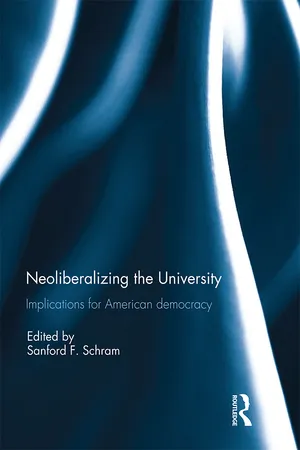
This collection brings together essays to address the crisis of Higher Education today, focusing on its neoliberalization. Higher Education has been under assault for several decades as neoliberalism's preference for market-based reforms sweeps across the US political economy. The recent push for neoliberalizing the academy comes at a time when it is ripe for change, especially as it continues to confront growing financial pressure, particularly in the public sector. The resulting cutbacks in public funding, especially to state universities, led to a variety of debilitating changes: increases in tuition, growing student debt, more students combining working and schooling, declining graduation rates for minorities and low-income students, increased reliance on adjuncts and temporary faculty, and most recently growing interest in mass processing of students via online instruction. While many serious questions arise once we begin to examine what is happening in higher education today, one particularly critical question concerns the implications of these changes on the relationship of education to as yet still unrealized democratic ideals. The 12 essays collected in this volume create important resources for students, faculty, citizens and policymakers who want to find ways to address contemporary threats to the higher education-democracy connection. This book was originally published as a special issue of New Political Science.
eBook - ePub
Neoliberalizing the University: Implications for American Democracy
- 215 pages
- English
- ePUB (mobile friendly)
- Available on iOS & Android
eBook - ePub
Neoliberalizing the University: Implications for American Democracy
About this book
Information
Realpolitik in the American University: Charles A. Beard and the Problem of Academic Repression
Abstract Charles A. Beard resigned from Columbia University on October 8, 1917 at a time when modern universities were emerging as significant institutions in the economic and political development of the United States. Thus, Beard’s highly publicized resignation came at a time when universities were under exceptional scrutiny by economic and political elites, who increasingly viewed higher education institutions as either private corporations which they owned or as extensions of the modern state apparatus. Moreover, Beard’s resignation came after a long string of dismissals, resignations, and censures at American universities that progressive historians have ironically chronicled as a history of the development of academic freedom in the United States. In fact, the early “academic freedom” cases were successful acts of academic repression and, in this context, Charles A. Beard’s resignation opened a window onto the realpolitik of American universities, which have never been ivory towers, but have always been fundamentally political institutions, where groups and individuals engage in contests for power, authority, and resources within the framework of even larger social conflicts.
You need only reflect that one of the best ways to get yourself a reputation as a dangerous citizen these days is to go about repeating the very phrases which our founding fathers used in the struggle for independence. (Charles A. Beard)
Between Corporations and the State
Charles A. Beard resigned from Columbia University on October 8, 1917 at a time when modern universities were emerging as significant institutions in the economic and political development of the United States (US).1 While many of Beard’s critics dismissed his resignation as the isolated action of an impetuous professor, Beard resigned at a time when universities were under exceptional scrutiny by economic and political elites, who increasingly viewed higher education institutions as either private corporations which they “owned” by virtue of their capital investments or as extensions of the modern state apparatus that should implement the decrees of powerful state elites. Indeed, in the same year that Beard resigned, Thorstein Veblen published The Higher Learning in America, which wryly explored “the immediate and ubiquitous effect” on faculty of operating higher education institutions as if they were business enterprises.2 Similarly, shortly after Beard’s resignation, Max Weber delivered a lecture to graduate students at Munich University, where he observed that the ivory tower image of American universities was “fictitious,” because colleges and universities were in reality “state capitalist enterprises, which cannot be managed without very considerable funds.”3
In fact, Charles A. Beard’s resignation from Columbia University was not an isolated event in the larger context of American higher education, and in this sense it was not him personally, nor even his scholarship on the US Constitution (1913), that was under attack by a corporate elite and its political allies, but rather an engaged vision of the political and social sciences was under siege by “external” political forces operating from locations inside the university.4 Beard’s resignation came after a long string of dismissals, resignations, and censures that began with Edward Beemis, Edward A. Ross, and Richard T. Ely—all radical political economists—at the turn of the twentieth century and culminated with the founding of the American Association of University Professors (AAUP) almost exactly one hundred years ago (1915). Ironically, mainstream progressive historians, such as Richard Hofstadter and Walter P. Metgzer have chronicled these early instances of conflict between faculty, administrators, trustees, and conservative politicians as a history of “the development of academic freedom in the United States.”5 The truth is that the early “academic freedom” cases were actually successful acts of academic repression; while in the midst of World War I patriotic hysteria, the AAUP found itself not only helpless to stem a growing tide of academic repression, but leading members of the organization often colluded with administrators in implementing repressive policies.6 In this context, Charles A. Beard’s resignation turned into a much larger event, because it opened a now well-documented window onto the realpolitik of American universities, which have never been ivory towers, but have always been fundamentally political institutions, where groups and individuals engage in contests for power, authority, and resources within the framework of even larger social conflicts.7
The Problem of Academic Repression
Charles A. Beard is best remembered for his book An Economic Interpretation of the Constitution of the United States (1913), which explained the writing and adoption of the US Constitution as the political outcome of a class struggle between capitalistic and agricultural interests in the early Republic.8 According to Beard, capitalistic interests had dominated the constitutional convention of 1787 and, consequently, they authored a founding document that appealed “directly and unerringly to identical interests in the country at large.”9 However, it is the book’s political context, as well as the growing importance of universities in economic and political development, that made the book an intellectual lightning rod. Beard’s book became a powerful weapon in the hands of populists, progressives, liberals, socialists and, later, even communists, who would all cite his book as evidence that the constitution was of the capitalists, by the capitalists, and for the capitalists.10 Thus, against the recent backdrop of the Populist Revolt, the meteoric rise of the Socialist Party in 1912, and later the Russian Revolution of 1917, Beard’s book set off a political firestorm inside and outside academia that made it perhaps the most controversial scholarly work of its time.11
Moreover, Beard was living in a highly charged academic and political atmosphere, where academic freedom, or more properly academic repression, was rapidly becoming a major issue for the American professoriate. By the time Beard published his Economic Interpretation of the Constitution, the problem of academic repression had grown to such proportions that even P.P. Claxton, the US Commissioner of Education, felt compelled to state in his 1915 annual report that:
within the past two or three years…there have been so many recurrences of disciplinary action directed by trustees and presidents of prominent institutions against professors reputed to hold unorthodox political, economic, or religious views that the question of academic freedom has become temporarily one of the foremost issues in university administration…. instructors in the field of economics and political science are at the present time especially in danger.12
Laurence R. Veysey, the renowned historian of higher education, observes that the early cases of academic repression in the US were “a rather accurate reflection of the degree of social alarm felt at any given hour by the more substantial elements in the American population.”13 These cases signaled “seasons of fear” among the ruling economic and political elite and typically coincided with periods of major labor and social unrest and/or international wars. While the original targets of academic repression dating back to 1894 all had ties to Johns Hopkins University and the school of institutional economics, the battleground for academic freedom shifted to Columbia University around 1912, only a year before Beard published his infamous book on the US Constitution.
Nicholas Murray Butler, Columbia University’s president, was a leading proponent of a concept of academic freedom that took hold among university administrators and trustees around the turn of the century.14 The basic premise of this managerial concept of academic freedom was its distinction between academic freedom and academic license. Butler claimed that “the proper freedom of speech of university professors” depended on “habits of self-control, self-direction, and self-ordering,” which was not merely a personal characteristic, but based on the “reasonable presumption” that what exists should carry greater moral and intellectual authority than “untested and untried” theories.15
Butler was quite specific about what he meant by untested and untried theories. Academic freedom became academic license at any one of five different points. The first transgression was “irreverence” for the religious faith or political convictions of others, which clearly excluded atheism and overtly partisan politics (notwithstanding that he had run for vice-president as a Republican). A second boundary was crossed when professors attempted to contravene “the laws of nature” by advocating “all forms of artificial equality.” A third transgression occurred whenever professors took classroom time to express personal opinions on any subject, including those on which the individual was an expert. Another boundary was violated when professors abused the authority of their professional expertise by making public statements about issues of current political controversy, because professors should maintain a clear distinction between their status as experts and those of a demagogue or propagandist. Butler defined a propagandist as anyone who supported socialism, prohibition, cohabitation by unmarried couples, women’s suffrage, and all things “queer, odd, unconventional” or “otherwise minded,” including all ideas advocated by “freaks, oddities, revolutionaries.”16 Butler’s definition of propaganda obviously excluded a wide variety of ideological and political perspectives, but his concept of disciplinary specialization and professional expertise more broadly contravened the interdisciplinary vision of political science that had been articulated at Johns Hopkins University and Columbia University for the last two decades and which Beard came to epitomize in his Economic Interpretation of the Constitution.
Butler claimed that professors are further restricted in their pronouncements by the disciplinary boundaries that define the limits of professional expertise. Thus, for example, an economist has no expertise to talk about political institutions, nor can a political scientist talk about phenomena that rightfully belong to the sociologist (that is, classes), nor can a historian (who specializes in the past) talk about its relevance to contemporary politics. Furthermore, since a professional expert is defined by his command of “facts,” an expert always confines his teaching to “facts” that are generally accepted by others in the field. Thus, academic freedom also becomes academic license when professors go beyond these facts, or when they transgress the boundaries of disciplinary expertise to speculate about untested political, moral, or social arrangements.17 Of course, Beard routinely violated most of these ideological and disciplinary strictures, including an active and open relationship with the Socialist Party until 1917.18
Under the leadership of President Nicholas Murray Butler, the Columbia University board of trustees became particularly aggressive at rooting out the “otherwise minded,” especially on its Faculty of Political Science. It is no coincidence that many of ...
Table of contents
- Cover
- Half Title
- Title Page
- Copyright Page
- Table of Contents
- Citation Information
- Notes on Contributors
- Introduction: The Future of Higher Education and American Democracy
- 1. Realpolitik in the American University: Charles A. Beard and the Problem of Academic Repression
- 2. From E Pluribus Unum to Caveat Emptor: How Neoliberal Policies are Capturing and Dismantling the Liberal University
- 3. Academic Governance and Democratic Processes: The Entrepreneurial Model and Its Discontents
- 4. Ideology and the Reform of Public Higher Education
- 5. Resisting the Exploitation of Contingent Faculty Labor in the Neoliberal University: The Challenge of Building Solidarity between Tenured and Non-Tenured Faculty
- 6. Contingent Academic Labor Against Neoliberalism
- 7. The Web We Weave: Online Education and Democratic Prospects
- 8. The Changing Democratic Functions of Historically Black Colleges and Universities
- 9. Open Admission and the Imposition of Tuition at the City University of New York, 1969–1976: A Political Economic Case Study for Understanding the Current Crisis in Higher Education
- 10. Lowering the Basement Floor: From Community Colleges to the For-Profit Revolution
- 11. Academic Conservatives and the Future of Higher Education
- 12. Transforming the Game: Democratizing the Publicness of Higher Education and Commonwealth in Neoliberal Times
- Index
Trusted by 375,005 students
Access to over 1.5 million titles for a fair monthly price.
Study more efficiently using our study tools.
Frequently asked questions
Yes, you can cancel anytime from the Subscription tab in your account settings on the Perlego website. Your subscription will stay active until the end of your current billing period. Learn how to cancel your subscription
No, books cannot be downloaded as external files, such as PDFs, for use outside of Perlego. However, you can download books within the Perlego app for offline reading on mobile or tablet. Learn how to download books offline
Perlego offers two plans: Essential and Complete
- Essential is ideal for learners and professionals who enjoy exploring a wide range of subjects. Access the Essential Library with 800,000+ trusted titles and best-sellers across business, personal growth, and the humanities. Includes unlimited reading time and Standard Read Aloud voice.
- Complete: Perfect for advanced learners and researchers needing full, unrestricted access. Unlock 1.5M+ books across hundreds of subjects, including academic and specialized titles. The Complete Plan also includes advanced features like Premium Read Aloud and Research Assistant.
We are an online textbook subscription service, where you can get access to an entire online library for less than the price of a single book per month. With over 1.5 million books across 990+ topics, we’ve got you covered! Learn about our mission
Look out for the read-aloud symbol on your next book to see if you can listen to it. The read-aloud tool reads text aloud for you, highlighting the text as it is being read. You can pause it, speed it up and slow it down. Learn more about Read Aloud
Yes! You can use the Perlego app on both iOS and Android devices to read anytime, anywhere — even offline. Perfect for commutes or when you’re on the go.
Please note we cannot support devices running on iOS 13 and Android 7 or earlier. Learn more about using the app
Please note we cannot support devices running on iOS 13 and Android 7 or earlier. Learn more about using the app
Yes, you can access Neoliberalizing the University: Implications for American Democracy by Sanford Schram, Sanford F. Schram in PDF and/or ePUB format, as well as other popular books in Politics & International Relations & Politics. We have over 1.5 million books available in our catalogue for you to explore.