Internal Marketing
eBook - ePub

Internal Marketing

Another Approach to Marketing for Growth

  1. 230 pages
  2. English
  3. ePUB (mobile friendly)
  4. Available on iOS & Android
eBook - ePub

Internal Marketing

Another Approach to Marketing for Growth

About this book

Establishing, developing, or promoting a brand or product in a market stems from aligning of divisions within an organization, with the perspective of providing value to customers – an idea which is known as internal marketing. Unlike external marketing, internal marketing ensures that organizational divisions are aligned in the marketing strategies, so that the resultant external marketing is effective and not impeded by internal shortcomings.

This book provides a comprehensive review of internal marketing research and illustrates the role of internal marketing in enhancing the capabilities of a company's internal resources. Putting forward a guiding principle for business practices by considering such questions from a multilateral perspective, this book is a must-read for practitioners and academics alike.

Frequently asked questions

Yes, you can cancel anytime from the Subscription tab in your account settings on the Perlego website. Your subscription will stay active until the end of your current billing period. Learn how to cancel your subscription.
At the moment all of our mobile-responsive ePub books are available to download via the app. Most of our PDFs are also available to download and we're working on making the final remaining ones downloadable now. Learn more here.
Perlego offers two plans: Essential and Complete
  • Essential is ideal for learners and professionals who enjoy exploring a wide range of subjects. Access the Essential Library with 800,000+ trusted titles and best-sellers across business, personal growth, and the humanities. Includes unlimited reading time and Standard Read Aloud voice.
  • Complete: Perfect for advanced learners and researchers needing full, unrestricted access. Unlock 1.4M+ books across hundreds of subjects, including academic and specialized titles. The Complete Plan also includes advanced features like Premium Read Aloud and Research Assistant.
Both plans are available with monthly, semester, or annual billing cycles.
We are an online textbook subscription service, where you can get access to an entire online library for less than the price of a single book per month. With over 1 million books across 1000+ topics, we’ve got you covered! Learn more here.
Look out for the read-aloud symbol on your next book to see if you can listen to it. The read-aloud tool reads text aloud for you, highlighting the text as it is being read. You can pause it, speed it up and slow it down. Learn more here.
Yes! You can use the Perlego app on both iOS or Android devices to read anytime, anywhere — even offline. Perfect for commutes or when you’re on the go.
Please note we cannot support devices running on iOS 13 and Android 7 or earlier. Learn more about using the app.
Yes, you can access Internal Marketing by Tatsuya Kimura in PDF and/or ePUB format, as well as other popular books in Business & Business General. We have over one million books available in our catalogue for you to explore.

Information

Publisher
Routledge
Year
2017
Print ISBN
9781138651104
eBook ISBN
9781317224556
Edition
1

1
Purpose and structure of this book

1. Purpose

The aim of this book is to analyze from various angles the functions and roles of internal marketing conducted within the firm and to systematically reconstruct them. Before proceeding to the various discussions in this book, we first define the ultimate goal of marketing as ā€œthe creation and delivery of customer value.ā€ Also, in our analyses, we divide marketing activities into two types: activities in the market that target consumers (for external integration or cooperation) and activities within the firm that target its employees (for internal integration or cooperation). These types of activities are called external marketing and internal marketing, respectively. The latter is the focus of this book. Figure 1.1 summarizes the relationships among these concepts.
The necessity of internal marketing can be seen in many organizations. In a product launch, for example, it is often pointed out that outstanding coordination of market needs and technological seeds is a key factor in successfully developing new products, bringing them to the market, and expanding the market. Yet, in reality, countless firms have failed to achieve market success in spite of their novel ideas and technologies. In other cases, viable firms have fallen behind their competitors after being slow to introduce appropriate products and failing to adapt to changes in the market
The functions and roles of marketing are linked with a series of customer orientations and relevant processes intended to properly connect the customers (or the market) with the firm, to provide value to the customers more effectively than the competitors, and thereby to increase customer satisfaction in the long run. Thus, for firms that have failed due to unsuccessful adaptation to the market, the marketing department should no doubt bear its share of the responsibility for the failure. The question then arises – why are some marketing efforts ineffective in the market?
One reason may be that marketing is not properly integrated within the organization before launching marketing activities in the market. If this is so, then what are the causes? What are the situations where the problem occurs? What is the essence of the problem? How should firms respond? This book aims to address these questions from multiple angles and offer practical guidelines.
Figure 1.1 Internal marketing, external marketing, and customer value
Note: For simplicity, the market environment and the competitive environment are included in ā€œother factors.ā€

2. Methods

This book uses several research approaches holistically to reconstruct an overall theoretical framework for internal marketing and to elucidate the practical and overall aspects of marketing in a multifaceted manner.
Within the literature concerned with internal marketing, the portion that examines outcomes in the Japanese context is quite narrow. In our review of the literature, we therefore intensively explore the entire body of research, particularly including central studies of internal marketing in other countries, and summarize the results. Empirical analysis and hypothesis testing are also performed to quantitatively understand the current situation. Specifically, an original model for hypothesis testing is set up based on prior studies and is statistically tested using data obtained from a survey of firms. Also, theories from certain fields are reviewed and then examined as reflections of the reality, based on interviews with corporate managers, product developers, and heads of marketing departments.

3. Structure of this book

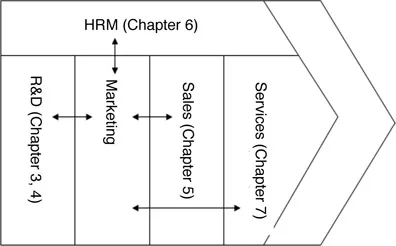
This remainder of this book consists of nine chapters. Chapter 2 discusses the basic concept of internal marketing, including its background, theoretical underpinnings, definitions, and scope. Chapters 3 to 7 discuss cooperation between the marketing department and main organizational functions from the standpoint of internal marketing (Figure 1.2).
Figure 1.2 Chapters 3 to 7
Specifically, Chapter 3 focuses on cooperation between the marketing department and the R&D department in product development and the introduction of products to the market; summarizes relevant issues; and explains the roles of both departments, barriers between them, and the ideal form of cooperation. Based on an original data set, Chapter 4 empirically analyzes the theoretical views discussed in Chapter 3 to examine the internal reality of the organizations. Chapter 5 discusses the organizational structure and role of the marketing department and the sales department, and considers issues involving integrating their activities. Chapter 6 examines the application of marketing in human resource management as well as branding within the firm. Chapter 7 discusses marketing to internal customers, taking into account the characteristics of services in businesses.
Chapter 8 mainly summarizes the issues clarified in Chapters 3 to 7 and presents a practical framework for internal marketing. The final chapter concludes with a general summary and discusses the outcomes of this work as well as issues for future study.

2
The basic concept of internal marketing

What is internal marketing? This chapter discusses its background, definition, concept, and scope. In addition, the theoretical significance of treating organizations as internal markets is clarified based on transaction cost analysis. This chapter examines the relationship between internal customers and internal suppliers within an organization’s business systems, and looks at their roles in various internal segments and the kinds of interactions that take place.

1. Background

1.1 Necessity of integrated marketing

Marketing activities involve not just one department in an organization but the entire organization. For marketing functions to work properly, various departments within the organization must cooperate with one another in providing value to its customers.1 Beckham (1992) argues that not only the marketing department but all other departments within an organization should be responsible for marketing:
Marketers who don’t learn the language of quality improvement, manufacturing, and operations will become as obsolete as buggy whips. The days of functional marketing are gone. We can no longer afford to think of ourselves as market researchers, advertising people, direct marketers, strategists – we have to think of ourselves as customer satisfiers – customer advocates focused on whole processes.
(p. 3)
The main point here is that integrated marketing should be conducted by an organization as a whole. This proposition is not difficult to understand, but in reality, marketing activities are probably not conducted in this way at most firms because they each must contend with numerous practical issues. Different departments have different interests. They also differ in many respects, including their attitudes and approaches toward work and the characteristics of their employees. Many problems related to coordination can consequently arise, as demonstrated in the following example:
The marketing vice president of a major European airline wants to increase the airline’s traffic share. His strategy is to build up customer satisfaction through providing better food, cleaner cabins, better-trained cabin crews, and lower fares. Yet he has no authority in these matters. The catering department chooses food that keeps down food cost; the maintenance department uses cleaning services that keep down cleaning costs; the human resources department hires people without regard to whether they are naturally friendly; the finance department sets the fares. Because these departments generally take a cost or production point of view, the vice president of marketing is stymied in creating an integrated marketing mix.
(Kotler 2000, p. 22)
Three conditions are considered necessary for realizing integrated marketing: (1) integration of various functions of the marketing department, (2) marketing-oriented approaches taken by non-marketing departments, and (3) a good cooperative relationship between the marketing department and other departments.
Once the marketing department has grown to a certain size, it starts to perform several horizontal functions. Then there may be cases where conflict arises between a brand manager and an advertising manager in regard to the details of a promotional campaign – for example, in media planning. Also, disputes are not uncommon between a product development manager and a sales manager over the launch timing or pricing of a planned new product.
An important goal of internal marketing is to convince non-marketing departments into taking marketing-oriented approaches and to coordinate organization-wide integration. As for the relationship between internal marketing and external marketing (i.e., ā€œmarketingā€ in the general sense), internal marketing is a prerequisite for effective implementation of external marketing in the market.
In internal marketing, the term ā€œdirect customersā€ refers not to the end consumers who purchase products or services from one’s firm, but to the firm’s employees whose work involves providing a high level of value and satisfaction to the end customers. The idea is that not only sales and marketing personnel who come into contact with end consumers and product distributors in their daily work but also various other employees act as internal customers. Moreover, as discussed later, the idea forming the basis of internal marketing is th...
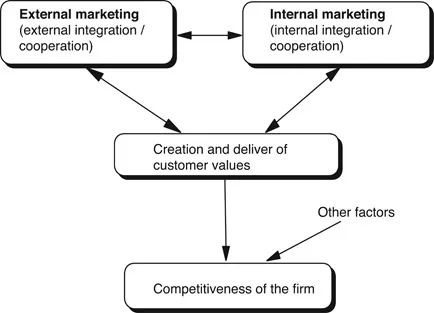
Table of contents

  1. Cover
  2. Title
  3. Copyright
  4. Dedication
  5. Contents
  6. List of figures
  7. List of tables
  8. Acknowledgement
  9. Introduction
  10. 1 Purpose and structure of this book
  11. 2 The basic concept of internal marketing
  12. 3 Internal marketing and R&D
  13. 4 Empirical investigation on the integration of marketing and R&D
  14. 5 Internal marketing and sales
  15. 6 Internal marketing and human resource management
  16. 7 Internal marketing of services
  17. 8 Major issues and practical proposals
  18. 9 Summary and topics for future research
  19. Bibliography
  20. Index