Motherhood remains a complex and contested issue in feminist research as well as public discussion. This interdisciplinary volume explores cultural representations of motherhood in various contemporary European contexts, including France, Italy, Germany, Portugal, Spain, and the UK, and it considers how such representations affect the ways in which different individuals and groups negotiate motherhood as both institution and lived experience. It has a particular focus on literature, but it also includes essays that examine representations of motherhood in philosophy, art, social policy, and film. The book's driving contention is that, through intersecting with other fields and disciplines, literature and the study of literature have an important role to play in nuancing dialogues around motherhood, by offering challenging insights and imaginative responses to complex problems and experiences. This is demonstrated throughout the volume, which covers a range of topics including: discursive and visual depictions of pregnancy and birth; the impact of new reproductive technologies on changing family configurations; the relationship between mothering and citizenship; the shaping of policy imperatives regarding mothering and disability; and the difficult realities of miscarriage, child death, violence, and infanticide. The collection expands and complicates hegemonic notions of motherhood, as the authors map and analyse shifting conceptions of maternal subjectivity and embodiment, explore some of the constraining and/or enabling contexts in which mothering takes place, and ask searching questions about what it means to be a 'mother' in Europe today. It will be of interest not only to those working in gender, women's and feminist studies, but also to scholars in literary and cultural studies, and those researching in sociology, criminology, politics, psychology, medical ethics, midwifery, and related fields.
eBook - ePub
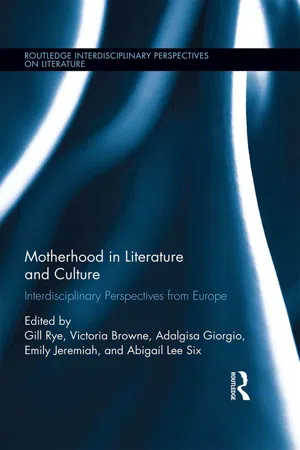
Motherhood in Literature and Culture
Interdisciplinary Perspectives from Europe
- 280 pages
- English
- ePUB (mobile friendly)
- Available on iOS & Android
eBook - ePub
Motherhood in Literature and Culture
Interdisciplinary Perspectives from Europe
About this book
Information
Part I
Pregnancy and Birth
1 Birth Fear and the Subjugation of Women’s Strength
Towards a Broader Conceptualization of Femininity in Birth
Introduction
This chapter considers symbolic and political meanings of fear within characterizations of pregnant and birthing women in contemporary Western culture, and examines aspects of these representations that are understood as ‘normal’ and as ‘pathological’. Exploration of discourses that have developed around fear and fearfulness reveals their roles as central determinants in the characterization and location of women within biomedical frameworks, which dominate understandings of pregnancy and birth in Western cultures. Key aspects in the discussion of birth fear include the construction of normative femininity in pregnancy and birth, particularly the identification and elevation of fearfulness as a ‘natural’ feminine trait, informed by the cultures and practices of modern Western maternity culture and reinforced through the multiple channels of social life. Crucially, such constructions have the corollary of undervaluing dimensions of femininity that challenge fear and fragility and support an empowered experience of pregnancy and birth. It is argued that dominant conceptions of normative – fearful – femininity in birth can be challenged by developing an understanding of pregnancy and birth as inherently powerful embodied experiences. This involves the identification of strength and authority as legitimate characteristics for women within these quintessentially female experiences, representing empowered, rather than compromised, femininity.
Formulating a new framework in which to reconceptualize birth fear is approached in the following ways: first, Bordo’s (1993) identification of pathology as a form of protest at the boundaries of what is considered ‘normal’ femininity is seen as highly relevant to contemporary readings of birth fear and understood as a protest against rigid cultural imperatives that foreclose agency in women’s experiences of pregnancy and birth. Second, it is suggested that the nature of the relationship between pregnant and birthing women and ‘experts’ may be described as ‘doxic’, a concept developed by Bourdieu (1977) to denote social practices that are largely taken for granted, but which underpin the functioning and perpetuation of systems of power and inequality. Finally, it is proposed that the embodied experiences of pregnancy and birth are inherently imbued with qualities that, if embraced, threaten to destabilize the balance of power and elevate the position of women, and are denied or pathologized for that very reason. Deeper exploration of these experiences reveals their potential as opportunities for integrating subjectivity with experience, and exposing as subjugation and inequality the kind of mass alienation (Young 2005) and feelings of incompetence (De Koninck 1998; Fisher et al. 2006) that are associated with a highly medicalized approach to childbirth.
Normative Femininity: Embodied Meanings
The pregnant woman’s location is on the threshold between nature and culture, biology and language.
(Kristeva 1986: 297)
Conboy et al. (1997: 5) suggest that understanding how women’s social roles are generated revolves around the female body as the organizing principle, often without due consideration of how cultural meanings inscribed on lived bodily experiences mediate those experiences. This conceptualization of women in terms of a ‘bodily’ situation that is itself situated in terms of the particularities of lived experience is recognized by many theorists including Moi (1999), who notes that it is the body in the midst of social context that constitutes the ‘myths of femininity’ (Thomson et al. 2011: 6). Unsurprisingly, enquiry into the experiences of women within pregnancy and birth has focused particularly closely on the female body and biological processes, from which profound meanings are drawn about the nature of female identity. Emphasis on the ‘naturalness’ of the maternal uses the physicality of pregnancy and birth as its starting point: women’s experiences of birth are defined through their bodies, their subjecthood stealthily replaced by their state as an inhabited subject. Recognition of the dual roles of nature and culture in the construction of female subjective experience is evident in how paradigms of womanhood are constructed and in how often they coincide with perceived inferiority of women’s roles and status in domestic and economic spheres (Oakley 1974; Butler 1990; Hays 1996). As Oakley (2005: 2) suggests, ‘the distinction between bodily constraints and possibilities on one hand, and the weight of culture, economics and tradition on the other facilitates an understanding of the gendered subject in specific cultural and historical locations’. In many ways, it is the clarity of this distinction that represents the possibility of an alternative, by exposing ways in which female oppression is naturalized and maintained, both as a result of overarching patriarchal systems and of the internalization of such systems into modes of self-surveillance and monitoring (Foucault 1977; Bordo 1989; Bartky 1990). Consideration of the relationship between the biological and the cultural as complicitous and inextricable rather than oppositional reveals how social rules and hierarchies are literally incorporated, inscribed, and thus enforced and reinforced through the concrete language of the body (Douglas 1982). The implications of such gendered hierarchies for pregnant and birthing women are profound: understanding the role of fear within this requires a reading of how normative femininity is coded both within and beyond medical discourses of birth fear.
Normative Femininity and Birth Fear
Most women in developed countries experience pregnancy and birth within the techno-medical model of maternity care. Conceiving of normative femininity in this context is perhaps best understood in relational terms, that is, in terms of the social dynamics between women and those they encounter in the course of their experiences of pregnancy and birth. Relationality is a recurring theme in the consideration of female subjective experience and identity (for example, Irigaray 1985; Wittig 1985; McNay 2000) and is particularly salient in the context of birth, where relationships between women and their caregivers are understood as enormously important in the evaluation of experience (Hodnett 2002; Leap et al. 2010a; Hodnett et al. 2012).
In the context of the dominant, medicalized model of maternity care, the prevailing woman-expert relationship is based on complementary opposites, in which the characteristics of one group are unavailable to the other: women, in the main, are construed as fearful, dependent, and compliant, while both female and male medical experts are authoritative and instructive. Within this framework, struggles over status and resources relegate the legitimacy of women’s expertise as subordinate to that of medical professionals, through established normative and regulative practices. The symbolic pairing of characteristics that are complementary opposites proliferates in representations of normative femininity in pregnancy and birth. The relational imperatives derived from this template of how women are located within medical discourse are diffused and reinforced through the multiple channels of modern social life in both public and private arenas: at a macro level, the media and other institutions including maternity hospitals and healthcare policies, and the tens of thousands of advice books and manuals aimed at pregnant women, and at a micro level, the individual exchanges and encounters that contribute to a more generalized public discourse around birth, of which fear is a significant feature.
Normative Fear, Pathological Fear
Fear has traditionally been a close companion of birthing (Mander 2007: 97), though its sources vary greatly and reveal a complex polyphony of beliefs about birth (Dick-Read 1944; Areskog et al. 1981; Ryding et al. 1998; Zar et al. 2001; Wijma 2003; Waldenström et al. 2006; Fenwick et al. 2009; Salomonsson et al. 2010, 2013). Tokophobia, described as ‘an unreasoning fear of childbirth’ (Hofberg and Brockington 2000), was classified as a psychological condition for the first time in 2000, defined primarily as an anxiety disorder. Over the course of the past decade or so, understanding of birth fear has expanded to include the broader concept of Fear of Childbirth (FOC) (Spice et al. 2009; Nilsson et al. 2010, 2012), a continuum on which tokophobia is located at one extreme. The focus on women’s emotional reaction to pregnancy and birth, and the distinction between what is considered normal and abnormal by medical and psychological frameworks are starkly exposed in discussions of birth fear: Hofberg and Ward (2007: 169) note that women who present with extreme fear during pregnancy may be ‘anxious and fearful […] angry and demanding’. The identification of tokophobia as an irrational emotional response to pregnancy and birth decisively locates the source of fear within women themselves, drawn from the belief that ‘fear of childbirth is not an isolated problem but associated with the woman’s personal characteristics, mainly general anxiety, low self-esteem, and depression, and dissatisfaction with their partnership, and lack of support’ (Saisto and Halmesmäki 2003: 201). Other factors identified as contributing to FOC can be understood as markers of social vulnerability more generally, including low educational attainment, pregnancy at a young age, and a poor social network (Waldenström et al. 2006; Ryding et al. 2007, and Laursen et al. 2008). This focus deflects attention away from the notion of birth fear as emerging from other sources: the context of birth itself and the social relations and structures that produce and reproduce normative femininity in birth.
Birth Fear and Protest
The implications of an ‘emphasized femininity’, that is, one that is rigidly defined by specific cultural and social imperatives, are found in the work of feminist theorists including Ehrenreich and English (1978), Orbach (1978), and Bordo (1993), who identify a number of disorders including hysteria, anorexia, and agoraphobia as particularly gendered and historically localized, representing how the body is ‘a citadel of contemporary and historical meaning’ (Bordo 1993: 95) both as a text of culture and the locus of social control. In this sense, it is argued that these disorders are not a deviation from hegemonic or normalizing culture, but its epitome. Bordo’s (1993: 95) argument that ‘the continuum between female disorder and “normal” feminine practice is sharply revealed through a close reading of those disorders’ is equally salient in the consideration of birth fear and tokophobia. Just as the symptoms of hysteria, anorexia, and agoraphobia are not that far removed from a historically and culturally determined construction of ideal femininity, the intense fear experienced by tokophobic women is a logical, albeit extreme, extension of the kind of caution, vigilance, and insecurity about pregnancy and birth that are part of how women are expected to be in birth: Hofberg and Ward (2007: 165) comment that ‘pregnancy can be a time of considerable but appropriate anxiety’, a statement that illustrates how discussions of birth fear are overseen by an authority that confers legitimacy on certain ways of being in birth, and pathology and deviance on others. If we understand normative femininity in birth as being accepting of the reassuring advances of techno-medical expertise, then we may understand fear as becoming problematic when it cannot be assuaged. In this sense, and to draw further on Bordo’s work, tokophobia may also be understood as a pathology of protest, an attempt, albeit a desperate one, to control what happens to one’s pregnant and birthing body. Some women with tokophobia refuse to engage in the process of pregnancy and birth altogether, disengaging from a system whose functioning depends on the compliance of women: in 2007, the actress Helen Mirren talked of her avoidance of pregnancy and birth and her disgust at anything to do with childbirth, having been traumatized as a young teenager by being shown a video of a woman giving birth. This article has been circulated widely, and ‘the Helen Mirren reason’ (Williams 2007; Campbell 2010; Hewitson 2010) has now largely replaced the ‘too posh to push’ argument in debates around elective caesarean. Numerous articles report women feeling ‘repulsed’ at the ‘agony’ of birth, describing it as ‘medieval’, ‘like a horror film’, ‘barbaric’, and ‘undignified’. Women talk of being ‘frequently tearful and shaking’ and experiencing ‘panic attacks and nightmares’ during pregnancy at the thought of giving birth (Nicholas 2007; Coleman 2009; see also, for example, Carol Ryan 2011; Rosalind Ryan 2011). Hofberg and Ward (2007: 168) note that some women who present with extreme fear ‘insist on a specific method of delivery without discussion of medical risk or benefit […] [Women] may well request a home delivery even for [their] first baby’. Some women, it is added, request a termination of pregnancy (TOP) and may be ‘distressed, angry or defensive – terrified that [their] request for TOP will be refused’ (169). This reference to home birth – in an obstetric text on the clinical management of psychological disorders during pregnancy – is worth noting for its implication: that expressing a desire to have a home birth is viewed as a potential indication of a psychologically unsound reaction to pregnancy and birth. This recalls the cultural focus on risk that exists within the medical model of birth and the recognition that women who choose to have a home birth are often accused of recklessness, putting themselves and their babies at risk. Dahlen (2010) and Edwards (2005: 105) argue that ‘free-floating fear’, generated by obstetrics, exacts a coercive contract in which obstetric advice is seen as responsible, and questioning that advice is defined as ‘immoral’, or perhaps pathological. Tokophobic women who avoid pregnancy and birth are too fearful; women who choose to have a home birth are not fearful enough. It is only women who achieve the correct balance of fear, as determined by the biomedical framework, who are conferred with social approval. Such an example illustrates Bourdieu’s argument that challenging a doxic system, in this case the supposed natural superiority of medical authority in birth, results, at least initially, in the rejection of ‘heretical’ remarks as ‘blasphemies’ (Bourdieu 1977: 169). Driven by fear, tokophobic women make decisions about their experiences of pregnancy and birth that are not contingent on the approval or advice of the medical profession as a starting point; their decisions, in an inversion of what is seen as the natural order, require the compliance of those experts. In considering the link between birth fear and maternal requests for elective caesarean section, Di Renzo (2003: 217) asks, ‘Should we blame the “delirious” pregnant woman who wants to escape “nature’s obligations” or the condescending obstetrician who has a new reason for not attending a possibly highly dangerous labour while gaining more income and at the same time giving his patient the illusion of happiness?’ Such questions highlight the need to reframe birth fear in ways that deepen our understanding of the context in which it is generated.
Treatment of Birth Fear: The Extension of the Doxa
I wanted a baby, but all I felt...
Table of contents
- Cover
- Half Title
- Title Page
- Copyright Page
- Table of Contents
- Acknowledgements
- Foreword
- Introduction: Motherhood in Literature and Culture
- PART I Pregnancy and Birth
- PART II Generation and Relation
- PART III Experience and Affect
- PART IV Reflections
- List of Contributors
- Index
Trusted by 375,005 students
Access to over 1.5 million titles for a fair monthly price.
Study more efficiently using our study tools.
Frequently asked questions
Yes, you can cancel anytime from the Subscription tab in your account settings on the Perlego website. Your subscription will stay active until the end of your current billing period. Learn how to cancel your subscription
No, books cannot be downloaded as external files, such as PDFs, for use outside of Perlego. However, you can download books within the Perlego app for offline reading on mobile or tablet. Learn how to download books offline
Perlego offers two plans: Essential and Complete
- Essential is ideal for learners and professionals who enjoy exploring a wide range of subjects. Access the Essential Library with 800,000+ trusted titles and best-sellers across business, personal growth, and the humanities. Includes unlimited reading time and Standard Read Aloud voice.
- Complete: Perfect for advanced learners and researchers needing full, unrestricted access. Unlock 1.5M+ books across hundreds of subjects, including academic and specialized titles. The Complete Plan also includes advanced features like Premium Read Aloud and Research Assistant.
We are an online textbook subscription service, where you can get access to an entire online library for less than the price of a single book per month. With over 1.5 million books across 990+ topics, we’ve got you covered! Learn about our mission
Look out for the read-aloud symbol on your next book to see if you can listen to it. The read-aloud tool reads text aloud for you, highlighting the text as it is being read. You can pause it, speed it up and slow it down. Learn more about Read Aloud
Yes! You can use the Perlego app on both iOS and Android devices to read anytime, anywhere — even offline. Perfect for commutes or when you’re on the go.
Please note we cannot support devices running on iOS 13 and Android 7 or earlier. Learn more about using the app
Please note we cannot support devices running on iOS 13 and Android 7 or earlier. Learn more about using the app
Yes, you can access Motherhood in Literature and Culture by Gill Rye, Victoria Browne, Adalgisa Giorgio, Emily Jeremiah, Abigail Lee Six, Gill Rye,Victoria Browne,Adalgisa Giorgio,Emily Jeremiah,Abigail Lee Six in PDF and/or ePUB format, as well as other popular books in Literature & European Literary Criticism. We have over 1.5 million books available in our catalogue for you to explore.