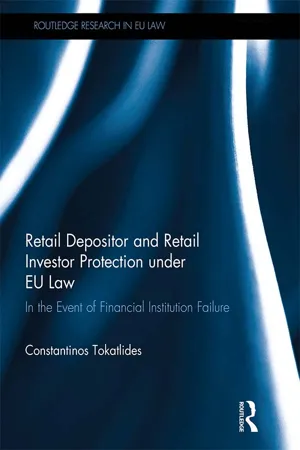
Retail Depositor and Retail Investor Protection under EU Law offers an original perspective on EU financial law in the area of retail investor protection, examining the status of protection awarded by EU law to retail depositors and retail investors in the event of financial institution failure. The analysis of relevant EU law is on the basis of effectiveness and has been elaborated in two levels of comparison. The first comparative approach examines relevant EU law both externally and internally: externally, vis-à-vis relevant international initiatives and developments in the area of financial law, as the latter affect the features and evolution of EU law, and internally by examining relevant instruments of EU law with regard to each other as to their normative structure and content. The second comparative approach also examines the status of retail depositors in relation to that of retail investors under EU law, in the event of financial institution failure, and the relevant legal consequences thereof.
eBook - ePub
Retail Depositor and Retail Investor Protection under EU Law
In the Event of Financial Institution Failure
- 222 pages
- English
- ePUB (mobile friendly)
- Available on iOS & Android
eBook - ePub
Retail Depositor and Retail Investor Protection under EU Law
In the Event of Financial Institution Failure
1 Introduction
What is the status of protection awarded by EU law to retail depositors and retail investors in the event of financial institution (FI) failure? Who is a considered to be a protected retail depositor or retail investor (financial consumer) in such a case? What is the difference in the protection awarded by EU law to retail depositors vis-à-vis retail investors, and how is it justified? Does EU law in this area provide coherent, predictable and flexible enough rules to allow for the protection of financial consumers? In other words, is it effective? Should it be effective in protecting financial consumers in the event of FI failure – or is its aim only or primarily to protect financial market stability and integrity? If its aim is (also) to protect financial consumers, does EU law confer upon them justiciable rights?
These are the main questions addressed in this study, which can be summarised under the general question: how effective is retail depositor and retail investor protection under the light of EU law in the event of FI failure? To start examining these issues, it would be best to begin from a general survey of the basic underlying concepts of the operation of financial markets.
1.1 The real economy and the financial market – the issue of promises and trust
While there can be a real economy without a financial market, as happened for many centuries, the opposite does not stand. The financial market depends on – and is, or should be, secondary to – the real economy.
The development of complicated forms of exchange in the context of the real economy, forms more complicated than bilateral barter and exchange, has led to the invention on the one hand of currencies, representing or incorporating value, and on the other hand to the provision of services by persons intermediating in the transactions.
Thus, two fundamental forms of promises could be said to have emerged from the growth and refinement of transactions through the ages: the first relates to the medium used as payment in a transaction (concerning the value represented or incorporated in the currency used), and the second to the behaviour of the contracting parties to each other (concerning the execution of the obligations undertaken by the main and any third parties).
The acceptance of such fundamental promises by interested parties is understood as trust – which is thus at the foundation of any transaction.
The complication of the structure of transactions, in terms of media and persons involved, has an exponential effect on the promises provided and thus to the trust required for the transactions to be successfully completed.
In this context, trust in the media used in the transaction, i.e. in the value of the currency or currencies used, is relevant to monetary policy considerations, whereas trust in the execution of obligations by the transacting parties is relevant to market and counterparty considerations. Both have many aspects, including legal, economic and financial, social and behavioural.
Where obligations undertaken have the form of financial instruments, then trust in the financial market, its stability and integrity, is essential not only for transactions to be successfully completed, but also for agreements on transactions to be concluded in the first place.
Financial consumers, i.e. persons not sophisticated in financial transactions, may participate in the financial market in many ways; mainly, financial consumers participate in financial markets as depositors or as investors trusting their money with FIs – and this will be the focus of this study.
Financial consumers participating in the financial market may realise or accept a degree of risk because of the very nature of financial operations, especially in the context of investment services. In this sense, market risk (the risk associated with fluctuation of values, so that profit expectations cannot be guaranteed) under usual market conditions is intrinsic to financial markets.
However, it is possible that the trust expressed by a financial consumer to an FI, or more generally to the financial market, may be disproved in situations where the consumer incurs financial loss for reasons not directly connected to market risk, but because of failure of the FI which is the counterparty of the consumer.
A first issue that emerges then, in particular in relation to the protection awarded to financial consumers in the event of FI failure, is how financial market supervision and regulation is connected to financial consumer protection.
1.2 The reason to regulate and supervise the financial market, and financial consumer protection
Many theories have been advanced for the reason to regulate (in a wide sense) and supervise the financial markets.1
Often, reference is made to the need to achieve market stability (protecting the market from systemic dangers), and individual participant protection, as the ratio of financial law.
Regulation of financial markets through state intervention has thus been connected to ‘public interest’ considerations. Intervention in the public interest has been criticised by ‘public choice’ theory, which has in turn influenced the development of new theories in favour of the need for state intervention (relevant to ‘public interest’ notions). According to these ‘revised’ public interest arguments, the main reasons for regulating financial markets, investment firms and transactions, relate to controlling systemic risk, providing financial stability to the market, and to correcting information asymmetries in the market.2
Information asymmetry is regarded as inherent in the financial system, in that certain participants in the financial market will possess less or less important information on certain factors affecting the market than other participants – in particular, financial consumers will be less informed than professionals of the financial markets, and issues arising from information asymmetry may have serious consequences for financial consumers.
Several objectives of financial law and regulation may be identified, including economic development, market competition, integrity and efficiency and combating financial crime.
However, in general it appears valid to support that regulation and supervision of financial markets is primarily connected to ‘systemic risk’ considerations.
The notion of ‘systemic risk’ refers to the threat arguably presented to the financial system at large, in the event of a FI collapse, which may have serious repercussions to the whole market, as has happened many times through the centuries.3
Thus, traditionally, banks have been regarded as the main source of systemic risk.
They are, in general, understood as inherently unstable, largely due to liquidity risks relevant to maturity transformation, i.e. owing to the fact that banks borrow short from depositors and lend on a medium- to long-term basis, so that massive deposit withdrawals in a short period may lead to exhaustion of reserves.4
In legal terms, at least in the EU legal order, no definition of ‘systemic risk’ had been issued until recently.5
Thus, systemic risk is perceived as a form of financial risk affecting the financial system as a whole, causing disruption to the functions of the financial system which are vital to the operation of the economy, and thus having the potential to cause ‘serious negative consequences’ for the real economy and, at the EU level, for the functioning of the internal market.
A particular source of systemic risk is a situation where the collapse of FIs affects or leads to the collapse of other FIs, in a chain of reactions. The so-called ‘domino effect’, in which the failure of one FI leads to the failure of another, until the banking and payments system is led to collapse, has been traditionally regarded as the fundamental reason for rescuing failing FIs – usually banks – by states, by bailing them out, through some form of public funding.
In particular, in relation to the banking sector, the loss of confidence by the public, i.e. by depositors who constitute the basis of retail banking, is strongly connected to the danger of bank collapses.
A wave of withdrawals by retail depositors (a ‘bank run’) for fear of instability of a bank may lead itself to its collapse, and at the same time cause further ‘bank runs’, eventually even causing risk to the banking system as a whole.6
In this sense, enhancing confidence of the public to the banking system, inter alia by deposit insurance, may be considered as a means to deal with an externality potentially threatening the stability of the system.7
The Global Financial Crisis (GFC)8 has shown that systemic risk to the financial sector may be caused not only by a ‘bank run’ and deposit withdrawals, but also by lack of funds on interbank markets, withdrawal of credit on money markets, speculative attacks on bank share prices or other share price collapses; and that banking sector stability can be undermined by exposures in more volatile securities, derivatives and other financial instruments,9 and by the operation of unofficial, unregulated and unsupervised ‘shadow banking’.10
In the banking sector in particular, systemic risk has (at least until the GFC) been ultimately addressed by the ‘Lender of Last Resort’ (LoLR) function usually held by the central bank of a state. Operating as the LoLR, the central bank of a state has traditionally been expected to provide liquidity to a failing bank, so as to prevent its collapse and also the eventual systemic danger emanating from wavering of public confidence to the banking system as a whole, as a result of a not avoided bank collapse.11
State intervention to save a bank in distress, using public funds, has thus been used as a last resort mechanism to avoid collapse of the financial sector.
At least until the GFC, the so-called ‘too-big-to-fail’ approach entailed an understanding that certain FIs were too large in financial volume or too important to fail, or at any extent that owing to their size or importance they would not be allowed to fail, even if state intervention were necessary to save them from collapse. So, the ‘too-big-to-fail’ concern has been linked to the size of a FI (usually a bank), which has been traditionally considered as a factor for the state not to allow it to fail, since repercussions to market stability have been perceived, at least until the GFC, as analogous to market share of the failing FI. In practice, however, foreseeing whether the failure of one FI, of systemic importance, may lead to distortion of the whole market has proven to be quite difficult.
While the bailing-out of a failing FI protects the institution itself and its clients, and arguably the financial market at large especially when the FI is systemically important, it is an ultimate measure, applied when all else has practically failed. It is a measure to protect depositors and thus ultimately confidence in the financial market, promoting financial stability.12
Thus, the existence of a ‘financial safety net’ (FSN) for financial consumers participating in the financial market has been considered essential, in particular in the direction of enhancing their trust in the financial system, and more specifically in the banking sector.
Such an FSN in the banking sector is considered to include prudential regulation and supervision, LoLR and deposit insurance functions.
Financial consumer protection may take various forms in the context of participation in the financial market, when the consumer is receiving services provided by financial intermediaries, on the basis of available information and by concluding financial contracts.13
A FI may fail either as a result of wider financial market reasons or for reasons more c...
Table of contents
- Cover
- Half Title
- Title Page
- Copyright Page
- Table of Contents
- Foreword
- Preface and acknowledgements
- Acronyms and abbreviations
- Table of legislation
- Table of cases
- Dedication
- 1 Introduction
- Part I The double aim of protecting financial consumers and the stability of the markets in the context of financial institution failure
- Part II Delineating financial consumer protection under EU law in the event of financial institution failure
- Bibliography
- Index
Trusted by 375,005 students
Access to over 1.5 million titles for a fair monthly price.
Study more efficiently using our study tools.
Frequently asked questions
Yes, you can cancel anytime from the Subscription tab in your account settings on the Perlego website. Your subscription will stay active until the end of your current billing period. Learn how to cancel your subscription
No, books cannot be downloaded as external files, such as PDFs, for use outside of Perlego. However, you can download books within the Perlego app for offline reading on mobile or tablet. Learn how to download books offline
Perlego offers two plans: Essential and Complete
- Essential is ideal for learners and professionals who enjoy exploring a wide range of subjects. Access the Essential Library with 800,000+ trusted titles and best-sellers across business, personal growth, and the humanities. Includes unlimited reading time and Standard Read Aloud voice.
- Complete: Perfect for advanced learners and researchers needing full, unrestricted access. Unlock 1.5M+ books across hundreds of subjects, including academic and specialized titles. The Complete Plan also includes advanced features like Premium Read Aloud and Research Assistant.
We are an online textbook subscription service, where you can get access to an entire online library for less than the price of a single book per month. With over 1.5 million books across 990+ topics, we’ve got you covered! Learn about our mission
Look out for the read-aloud symbol on your next book to see if you can listen to it. The read-aloud tool reads text aloud for you, highlighting the text as it is being read. You can pause it, speed it up and slow it down. Learn more about Read Aloud
Yes! You can use the Perlego app on both iOS and Android devices to read anytime, anywhere — even offline. Perfect for commutes or when you’re on the go.
Please note we cannot support devices running on iOS 13 and Android 7 or earlier. Learn more about using the app
Please note we cannot support devices running on iOS 13 and Android 7 or earlier. Learn more about using the app
Yes, you can access Retail Depositor and Retail Investor Protection under EU Law by Constantinos Tokatlides in PDF and/or ePUB format, as well as other popular books in Business & Corporate Governance. We have over 1.5 million books available in our catalogue for you to explore.