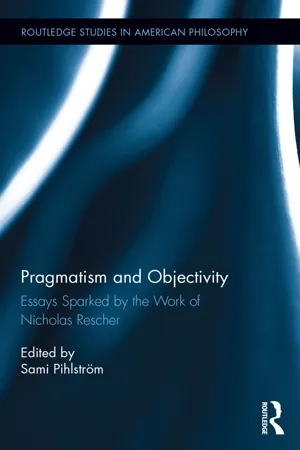
Pragmatism and Objectivity illuminates the nature of contemporary pragmatism against the background of Rescher's work, resulting in a stronger grasp of the prospects and promises of this philosophical movement. The central insight of pragmatism is that we must start from where we find ourselves and deflate metaphysical theories of truth in favor of an account that reflects our actual practices of the concept. Pragmatism links truth and rationality to experience, success, and action. While crude versions of pragmatism state that truth is whatever works for a person or a community, Nicholas Rescher has been at the forefront of arguing for a more sophisticated pragmatist position. According to his position, we can illuminate a robust concept of truth by considering its links with inquiry, assertion, belief, and action. His brand of pragmatism is objective and organized around truth and inquiry, rather than other forms of pragmatism that are more subjective and lenient. The contingency and fallibility of knowledge and belief formation does not mean that our beliefs are simply what our community decides, or that truth and objectivity are spurious notions. Rescher offers the best chance of understanding how it is that beliefs can be the products of human inquiry yet aim at the truth nonetheless. The essays in this volume, written by established and up-and-coming scholars of pragmatism, touch on themes related to epistemology, philosophy of mind, philosophy of science, and ethics.
- 282 pages
- English
- ePUB (mobile friendly)
- Available on iOS & Android
eBook - ePub
About this book
Information
Part I
Truth and Reality
1 Pragmatic Realism, Idealism, and Pluralism
A Rescherian Balance?
1 Introduction
One of the most remarkable features of the kind of pragmatism committed to advancing scientific rationality and objectivity—and thus to criticizing subjectivist and relativist misconstruals of pragmatism—that Nicholas Rescher has defended for several decades is its attempt to maintain a balance of a number of philosophical ideas that are often thought to be in tension with each other. Rescherian pragmatism is realistic (even “metaphysically realistic”), but it is also idealistic (in the sense of what he calls “conceptual idealism” or “pragmatic idealism”); moreover, its realism and objectivism do not seem to preclude a pluralistic conception of a variety of different perspectives (or “systems,” “conceptual schemes”) that we may employ for conceptually categorizing reality. These views are highly relevant to the general realism discussion as well as its special applications in the philosophy of science, to which Rescher has been a key contributor for decades.
Starting from some of Rescher’s own formulations of these and related ideas—spanning dozens of years and volumes of systematic philosophical work, from Conceptual Pragmatism (1973) via A System of Pragmatic Idealism (1992–1994) to Realistic Pragmatism (2000) and beyond—this essay will critically examine the Rescherian attempt to overcome the potential conflicts between realism, idealism, and pluralism. Thus, this chapter will, to some extent, still serve an introductory function, aiming at a relatively general outline of the specifically Rescherian position in the contemporary debates over realism. The core of Rescher’s distinctive realistic project, in my view, is his pragmatism. Although Rescher has hardly presented any truly novel interpretations of the classical thinkers of the pragmatist tradition, his discussions are highly valuable, as they distinguish between significantly different currents within the movement from the standpoint of his own preferred form of pragmatism. In particular, he powerfully argues, against Richard Rorty and some other neopragmatists inclined toward relativism, that pragmatism should not be construed (or, rather, deconstructed) as a form of “antiphilosophical nihilism” abandoning systematic argumentative work in philosophy conceived as a rational project.1 Pragmatism, he urges, is compatible not only with scientific realism and objectivity but also with a conception of philosophy itself as a systematic cognitive enterprise (and, thus, as broadly speaking “scientific”). Rescher, indeed, is a profoundly systematic philosopher; yet he wishes to recognize a certain plurality in the possible ways in which one can be systematic and argumentative.2
I will, inevitably moving significantly beyond Rescher’s own position and its historical development,3 yet in a continuous critical dialogue with Rescher, seek to articulate a pragmatist approach whose key aim is a critical balance of Rescher’s allegedly mutually incompatible philosophical commitments. Such a balance will be sought by utilizing Rescher’s own systematic rational methods. I will, in particular, suggest that the kind of holistic pragmatism defended by Morton White (who, like Rescher, is a somewhat neglected pragmatist thinker fighting against various subjectivist and relativist tendencies within pragmatism), since his Toward Reunion in Philosophy (1956), is a helpful, albeit not unproblematic, resource for integrating pragmatic realism, idealism, and pluralism. I will argue that the Rescherian type of pragmatic realism-cum-idealism, even when enriched by White’s holism, needs to take seriously the Kantian (and, therefore, transcendentally idealistic) background of pragmatism, pluralistically reinterpreted. Furthermore, in order to illustrate these issues, I will briefly apply the problem of pragmatic realism and objectivity to the science vs. religion debates.
2 Rescher as a Pragmatist
As anyone acquainted with his writings knows, Rescher is an exception in contemporary philosophy in the sense that he is not only a pragmatist but also an idealist. He has for decades insisted that reality, as experienced by us humans, is inescapably “our reality,” that is, constructed, conceptually grasped, or schematized by us. While some pragmatists—most famously, or notoriously, William James, and more recently Hilary Putnam—have also often been regarded as idealists in a roughly similar sense,4 it is possible to interpret Rescher’s commitment to pragmatism itself as “a counterweight to idealism”: far from subscribing to any antirealist form of idealism, pragmatism reminds us that our mental activities cannot be detached from our natural needs, corporeality, and interests; accordingly, a pragmatic “reality principle,” while still compatible with idealism, prevents idealism from going too far in its legitimate emphasis on human world-construction.5 According to Rescher, such a reality principle is “an objective monitor whose operations lie above and beyond the reach of our own arbitrary contrivings”; it is with reference to “the nature of things” that the question of the pragmatic, purposive efficacy of particular means for particular ends is to be settled (RP, xiii). In this sense, pragmatism is, for Rescher, a realistic doctrine: pragmatic efficacy is sought and found in the operations of our conceptual machinery in a largely mind-independent reality. As Rescher explains, the pragmatist method of evaluating methods of inquiry in terms of their efficiency can also be applied to itself; far from leading to any vicious circularity, this makes pragmatism “self-substantiating” (RP, 240–242). Indeed, Rescher maintains that his realistic pragmatism “fares well by its own standards of utility” (RP, 248).
Curiously, Rescher’s idealism, strongly emphasized, for example in his three-volume System of Pragmatic Idealism, one of his main works in the 1990s, is virtually absent as we arrive at his key statement of pragmatism, Realistic Pragmatism.6 Possibly he there wishes to emphasize the realistic element in pragmatism so strongly that there is no room for his former idealism in the book any longer—or perhaps he had by the year 2000 come to the conclusion that what he earlier called “idealism” (or “conceptual idealism”)7 is actually quite far from any recognizably idealistic doctrine. In any event, his failure to connect idealism with pragmatism in his work around the turn of the millennium is obviously related to another striking feature of Realistic Pragmatism, namely, his failure to acknowledge Immanuel Kant as one of the central background figures of the pragmatist tradition. I am afraid we cannot get rid of idealism so easily—either Kant’s, the pragmatists’, or Rescher’s own. Or so I will try to argue, returning to Kantian matters more explicitly in section 4 below.
It can also be argued that Rescher’s understanding of pragmatism is based on an unnecessarily sharp distinction between what he regards as objectivist and subjectivist (or realist and relativist) forms of pragmatism. His own version, the objectivist and realist one seeking an impersonal reality principle in real-world considerations of purposive efficacy, follows Charles S. Peirce’s and C. I. Lewis’s pragmatism, whereas subjectivist pragmatism originates, in Rescher’s view, with James and F.C.S. Schiller, culminating in Rorty’s more straightforwardly relativistic thought. As a picture of pragmatism, this is rather crude, however, and can serve as only a rough summary of the history of the tradition.8 There is, admittedly, a great difference between Peirce and Rorty, and Schiller’s “humanistic” pragmatism in particular was a radically subjectivist doctrine hard to reconcile with the spirit of objective scientific thinking, but there are also interesting intermediary positions that may be more plausible than either Peirce’s or Rorty’s (or Schiller’s). I believe (although I am unable to argue for this view here) that James’s and Dewey’s pragmatisms were among such intermediary positions and that in our days, too, a Jamesian or Deweyan pragmatist may be able to avoid both strongly realist metaphysical speculations and the relativist and antiphilosophical swamps of mere Rortyan “conversation.”9
The Rescherian objective pragmatist’s “reality principle” can be considered self-subsistent and person-indifferent, but Jamesian or Deweyan pragmatists need not be irresponsible subjectivists or relativists, either. Rescher is, arguably, right in being critical of Schiller’s personalist subjectivism and Rorty’s postmodernist ironism, but he is somewhat unfair to James: while it may be correct to note that James “opened the way to fragmenting truth into a plurality of contextualizations” (RP, 17), it is far from clear that James himself walked that road of fragmentation and started a “deconstructive transformation of pragmatism” (RP, 61).10 Such an overhasty attack on James illustrates how Rescher himself falls back to a number of rather unpragmatic conceptual dichotomies, reflecting the most fundamental distinction he makes, i.e., the one between realistic “pragmatism of the right” and relativistic “pragmatism of the left” (RP, Chapter 2; cf. 246–247). He subscribes to the dualisms between, say, epistemic and non-epistemic (affective), cognitive and normative/evaluative, objective and subjective, impersonal and personalistic, as well as legitimation and de-legitimation (RP, 49, 245).11 Instead of showing that pragmatism simply ought to take an objective (“Peircean”) route, Rescher thus succeeds in demonstrating how surprisingly unpragmatic some allegedly Peircean realistic and objectivist commitments are, at least on a certain strongly realistic interpretation. Rescher’s classifications of different forms of pragmatism—semantic, epistemic, metaphysical, moral, and political—are clarifying, but, by suggesting that we should return to what he takes to be the Peircean roots of the tradition, he loses much of what is philosophically valuable in post-Peircean pragmatism.
Rescher’s most problematic, and presumably the most important, division lies between “thesis pragmatism” and “method pragmatism” (or methodological pragmatism). The latter, which he subscribes to, urges that pragmatic considerations ought to be applied to methods and procedures employed in the validation of theses, not to theses themselves (RP, 77, and Chapter 3). Apart from historical inaccuracies,12 the obvious problem with this view is that it hardly acknowledges the idea of the theory-dependence of methods. It is a simplification to state that “a thesis can be justified by application of a method,” which, in turn, is justified by practical criteria (RP, 96). The very possibility of using some particular method, let alone the availability of the practical criteria with reference to which the method is assessed, may crucially depend on assumptions concerning the truth of certain “theses,” i.e., on researchers being committed to a theoretical framework that takes the world to be in some way rather than another. Methods can scarcely be developed and evaluated in total abstraction from the theoretical theses they are used to validate; it sounds suspicious to suggest that there even could be a completely “theory-external quality control upon cognition” (RP, 97). The threatening circularity built into the view that methods depend on theories and vice versa has been widely debated in the philosophy of science at least since Thomas Kuhn, but, especially in Realistic Pragmatism, Rescher simply fails to pay sufficient attention to this issue. Paradoxically, then, his “scientific” pragmatism is harmed by his not being sufficiently responsive to developments in the philosophy of science in, and since, the 1960s.
On the other hand, Rescher is certainly right—and obviously up-to-date—in conceiving of “the scientific method” as “not a single and uniform mode of procedure but a vast manifold of thought-tools,” as a fallible “procedural organon that is itself evolving under the pressure of considerations of pragmatic efficacy” (RP, 114). Here, I think, all pragmatist philosophers of science should follow him; however, the notion of pragmatic efficacy, inviting the pragmatic realist’s “reality principle,” brings us back to the question of realism, the main issue of this paper.
3 Rescher (and His Critics) on Realism and Idealism—an Uneasy Balance?
Rescher labels his basic view of reality—which he considers not only compatible with pragmatism but supported by it—metaphysical realism, defined as the doctrine that “there indeed is a real world—a realm of mind-independent, objective physical reality” (RP, 126; see also 147), i.e., that “the world exists in a way that is substantially independent of the thinking beings that inquire into it, and that its nature—its having whatever characteristics it does actually have—is also comparably thought independent” (SPI, I, 255).13 A critic of realism might question the notion of (mind-)independence here, problematizing statements such as the one about objective things existing and functioning “in themselves,” “without specific dependence on us” (RP, 131). In the terms of Rescher’s (earlier) idealism, the objective world might still be regarded as “conceptually” dependent on us—and not everybody, and certainly not every pragmatist, maintains that conceptual and (say) existential or ontological (in)dependence can be sharply distinguished from one another.
In any event, realism is, in Rescherian pragmatism, a deeply human commitment, not a description of the world in itself or of things in themselves from a God’s-Eye-View. It is “a commitment that we presuppose for our inquiries rather than discover as a result of them” (RP, 126). We cannot discover, on the basis of evidence, that such a general thesis as realism is true; we can only presuppose realism as something that makes sense of and regulates our inquiries and other practices. Realism can, then, be supported by means of something like a transcendental argument: it is a necessary precondition for the possibility of inquiry and communication (RP, 134–135). It is not a view to be defended on the basis of evidence but to be postulated in order for us to be able to collect any evidence for any view whatsoever (or better, in order for us to be able to make sense of our “given,” unproblematized practice of gathering evidence for any other view). In this sense, Rescher’s realism is a transcendentally grounded commitment arising from what seems to be a transcendentally idealistic (Kantian) conception of the necessary constitutive conditions for the possibility of certain given actualities of human life (i.e., inquiry, discovery, conceptualization, and communication).
Again, one may wonder, therefore, why Rescher has not devoted more space to Kantian issues in his discussions of pragmatism, though he does refer to Kant’s “Refutation of Idealism” (RP, 127, n1). It is not clear without further investigation that the transcendental mode of argumentation (in favor of realism or anything else) could be employed entirely independently of transcendental idealism.14 A key issue here is the relation bet...
Table of contents
- Cover
- Title
- Copyright
- Contents
- Acknowledgments
- Foreword
- Introduction
- Part I Truth and Reality
- Part II Reasoning
- PART III Value
- List of Contributors
- Index
Trusted by 375,005 students
Access to over 1.5 million titles for a fair monthly price.
Study more efficiently using our study tools.
Frequently asked questions
Yes, you can cancel anytime from the Subscription tab in your account settings on the Perlego website. Your subscription will stay active until the end of your current billing period. Learn how to cancel your subscription
No, books cannot be downloaded as external files, such as PDFs, for use outside of Perlego. However, you can download books within the Perlego app for offline reading on mobile or tablet. Learn how to download books offline
Perlego offers two plans: Essential and Complete
- Essential is ideal for learners and professionals who enjoy exploring a wide range of subjects. Access the Essential Library with 800,000+ trusted titles and best-sellers across business, personal growth, and the humanities. Includes unlimited reading time and Standard Read Aloud voice.
- Complete: Perfect for advanced learners and researchers needing full, unrestricted access. Unlock 1.5M+ books across hundreds of subjects, including academic and specialized titles. The Complete Plan also includes advanced features like Premium Read Aloud and Research Assistant.
We are an online textbook subscription service, where you can get access to an entire online library for less than the price of a single book per month. With over 1.5 million books across 990+ topics, we’ve got you covered! Learn about our mission
Look out for the read-aloud symbol on your next book to see if you can listen to it. The read-aloud tool reads text aloud for you, highlighting the text as it is being read. You can pause it, speed it up and slow it down. Learn more about Read Aloud
Yes! You can use the Perlego app on both iOS and Android devices to read anytime, anywhere — even offline. Perfect for commutes or when you’re on the go.
Please note we cannot support devices running on iOS 13 and Android 7 or earlier. Learn more about using the app
Please note we cannot support devices running on iOS 13 and Android 7 or earlier. Learn more about using the app
Yes, you can access Pragmatism and Objectivity by Sami Pihlström in PDF and/or ePUB format, as well as other popular books in Philosophy & Epistemology in Philosophy. We have over 1.5 million books available in our catalogue for you to explore.