This volume provides a critical examination of quality in the interpreting profession by deconstructing the complex relationship between professional norms and ethical considerations in a variety of sociocultural contexts. Over the past two decades the profession has compelled scholars and practitioners to take into account numerous factors concerning the provision and fulfilment of interpreting. Building on ideas that began to take shape during an international conference on interpreter-mediated interactions, commemorating Miriam Shlesinger, held in Rome in 2013, the book explores some of these issues by looking at the notion of quality through interpreters' self-awareness of norms at work across a variety of professional settings, contextualising norms and quality in relation to ethical behaviour in everyday practice. Contributions from top researchers in the field create a comprehensive picture of the dynamic role of the interpreter as it has evolved, with key topics revisited by the addition of new contributions from established scholars in the field, fostering discussion and further reflection on important issues in the field of interpreting. This volume will be key reading for scholars, researchers, and graduate students in interpreting and translation studies, pragmatics, discourse analysis, and multilingualism.
eBook - ePub
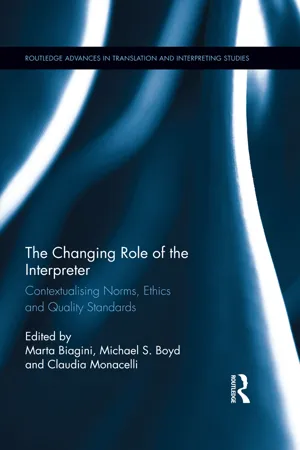
The Changing Role of the Interpreter
Contextualising Norms, Ethics and Quality Standards
- 264 pages
- English
- ePUB (mobile friendly)
- Available on iOS & Android
eBook - ePub
The Changing Role of the Interpreter
Contextualising Norms, Ethics and Quality Standards
About this book
Information
Part I
A Dynamic Sociocultural Perspective of the Interpreter’s Role
1
Fictional vs. Professional Interpreters
Conference interpreters are a rare commodity (AIIC) 1
There are no more than a few hundred conference interpreters in even the largest of […] cities, and only a few thousand in the whole world. The structure of demand for interpretation has changed over time, but the demand is still there. Given its linguistic diversity and historical tradition, Europe is still the largest interpreting market, but the requirements in other parts of the world, particularly Asia, are growing rapidly.
1. Introduction
By 2012, the topic of interpreters’ representation in fiction had become so popular, that even Wikipedia supplied a list of language interpreters in fiction. “This profession is not a very common one, it is therefore quite surprising how many works of fiction make a try at depicting it with rather less than more accuracy”2 (emphasis mine). Translation Studies discovered the abundance of fictional translators/interpreters somewhat belatedly, although with such fervor that it earned Andrew Chesterman’s ironic title of Translator Studies. In previous essays, I joined in the discussion, suggesting some prototypes for fictional representations of translators/interpreters (Ben-Ari 2010, 2014): the postcolonial novel from the periphery, with the hybrid interpreter torn between conflicting loyalties, the postcolonial translator/interpreter who seems to be a fictional rendition of poststructural theories, the bestseller interpreter used mainly for thrillers, and last but not least, the would-be—though incompetent—interpreter (Safran Foer 2003: 1) or the equally incompetent interpreter malgré lui (Hasak-Lowy 2005), both used for parody. I suggested that, with parody, the flood of novels about translators/interpreters has exhausted itself, and that, concomitantly, so has research on the topic. And here I am adding some more observations—as a sort of closure, and tribute—that I feel we owe to the real people involved. I have decided to examine what professional interpreters have to say about their move into the spotlight and about their representation in fiction. I was interested both in their opinion of their literary counterparts and in their views on the literary depiction of their profession.
My essay will therefore move in three directions. The first will briefly analyze eight recent postcolonial literary representations (those that interpreters reacted to). The second will give voice to the author, preferably if he/she had some experience in translating/interpreting. The third will present professional interpreters’ reactions to author and/or protagonist. Three types of ‘voices’ will thus be heard: that of the (real) author, that of the (fictional) protagonist, and that of the (real) professional interpreter. As you will see, they are not in agreement; the final part of this essay will therefore try to understand the reasons underlying the conflicting voices.
I should perhaps explain my methodology, for it is not self-evident. First, in order to collect data on the reactions of real interpreters to their fictional counterparts, I planted key words, such as book titles or authors’ names, on the Internet, and then selected from the variety of reactions written by professed interpreters. The results collected are therefore a mixture of opinions, from learned articles to accidental blogs, located in a special section of the references. I did my best to distinguish between more ‘formal’ sites such as online magazine reviews, official blogs of official associations (i.e. AIIC3), and random personal blogs. For example, in one case, I found a discussion group organized around a bestselling novel. These Internet sources form my corpus, along with the novels they refer to.4 Second, I selected bestselling award-winning novels hoping they would have incited interpreters’ reactions on the web. I only looked up reactions to novels in English and French, and although they represent a large body of Internet users, I am sure that investigating titles in other languages could yield more significant results.
2. Categories of Postcolonial Novels
Following my previous research (Ben-Ari 2010, 2014), I suggest discussing four categories of interpreters in twenty-first century postcolonial novels. The categories intermingle and are far from being clear-cut, so that my categorization is, of course, an artificial one:
- The postcolonial hybrid interpreter with conflicting loyalties: The Blue Manuscript by Sabiha Al Khemir (2008), The Interpreter by Suki Kim (2003).
- The postcolonial hybrid interpreter in the midst of an identity crisis: The Mission Song by John le Carré (2006), The Bad Girl by Mario Vargas Llosa (2006).
- The postcolonial interpreter torn by moral and ethical issues: Small Wars by Sadie Jones (2009), The Interpreter by Alice Kaplan (2005).
- The interpreter who aspires to have a voice of his own, become a translator, or eventually an author: Bel Canto by Ann Patchett (2001), The Interpreter by Suzanne Glass (1999).
These novels (and countless more) have interpreters as their main protagonists. As befits novel protagonists, the literary interpreters are all in the midst of a crisis. Most are brilliant in their jobs, and most will quit their jobs at the end of the novel, some in order to become literary translators or authors.
The first book I would like to present is not a novel, but an academic publication, Wortklauber, Sinnverdreher, Brückenbauer Dolmetscher Innen und Übersetzer Innen als literarische Geschöpfe5 (Kurz and Kaindl 2005). I found a review of this book (Smith 2007) on the prestigious official site for conference interpreters, AIIC. His review makes a few elementary points, which will be repeated by critiques and posts elsewhere, so I find it helpful.
Generally speaking, as opposed to reviews of fictional works, this non-fiction publication is handled carefully. The reason may stem from respect of the academy, even though Smith (Smith 2007) describes the collection as non-academic; it comprises 15 essays by what he calls “working professionals” discussing their work: “This book does not set out to provide an academic study of the interpreter in literature, but simply to give us a taste of how others view our lives and work”. It may also stem from Smith’s general impression that these professionals were fond of the fictional translators/interpreters they reviewed.
He starts with the underlying pleasure of all interpreters of being promoted to the limelight, yet he seems cynical about their description and their raison d’être in the novel:
The editors of this collection of essays know that we interpreters enjoy seeing ourselves depicted in book or film yet cannot help judging the accuracy of any description of our profession or its practitioners, even if the interpreter is no more than a convenient hook on which to hang the story within the confines of artistic license.
(Smith 2007)
As for the image of the interpreter, he agrees that interpreters can be viewed as outsiders, away from home, shouldering “the burden of bilingualism” (Smith 2007), overburdened by bilingualism:
The thread that runs through all the reviewed stories is the interpreter as perpetual outsider, a person who does not live entirely in just one culture, but commutes between them and is therefore rootless and envious of those with a clear-cut identity. Language is often the well-spring of a firm sense of self. Home for an interpreter is his or her native language, yet because of where they live interpreters may have lost their mother tongue—they are geographically and linguistically adrift. The constant processing of the world around us that multilingualism brings can be a burden, and the interpreter may envy others the security of speaking just one language.
(Smith 2007)
Smith’s main reservation has to do with the “miraculous” language acquisition of the fictional interpreters: “Interpreters in literature appear ready made with all their languages—by accident of birth or linguistic osmosis—and few authors appear aware that most of us have had to acquire our languages from scratch and learn our tradecraft” (Smith 2007). His second reservation is that not all interpreters received as much sympathy from the writer:
The reviewers find the portrayals of interpreters generally sympathetic, even insightful, although our colleague Sergio Viaggio is clearly no fan of Javier Marías’ Corazón tan Blanco— the scene in the book where two interpreters work for a thinly veiled Margaret Thatcher and a thinly disguised Felipe González has acquired a kind of cult status amongst interpreters; I guess you either love it or hate it.
On the whole, Smith compliments the collection of essays for its accessibility: “Each thought-provoking essay is short and deals with an individual work, which makes this a good book for dipping into” (Smith 2007). Let us then proceed with the individual works—i.e. the postcolonial fiction of the four categories I suggested.
2.1. The Postcolonial Hybrid Caught Between Cultures
In the twenty-first century, novels about interpreters crossed from Europe and the United States to Asia and Africa, with an astonishing array of hybrid protagonists. Sabiha Al Khemir offers an interesting example with her Blue Manuscript (2008). Al Khemir is a Tunisian born writer, illustrator and expert in Islamic art, who lives in London. A Tunisian in London, a Francophone writing in English, the main character of the novel, Zohara, is at a crossroads where “four linguistic stations converge, with corresponding states of consciousness, narrative possibilities, and articulations of meaning. There are four stages of intertextual engagement, four distancing devices, four spaces of rupture, four broken bridges” (Omri 2006: 57).6
The protagonist of The Blue Manuscript is an interpreter (female) accompanying a group of archeologists (mostly male) on a quest for the Blue Qur’an. She is crippled by her shared Tunisian and English heritage. She will never find love, she says, for “every man who showed an interest in her was in harmony with only one side of her, not the other” (Al Khemir 2008: 136). As opposed to Homi Bhabha’s ‘Third Space’ theory in which the meeting between two cultures ultimately creates a third, shared one, Zohara sees no possibility of a shared oriental-occidental identity: “My mother the west, my father the east. I grew up in the chasm that separated them” (Al Khemir 2008: 160).
Zohara’s attempt to bridge present and past Islamic tradition is a failure:
She crossed barriers between people of different nationalities and felt like a ghost among them. But there was also the untranslatable. That which was unique, particular to each language and each culture and there were moments when she, the translator, felt trapped in that zone, the zone of the untranslatable.
(Al Khemir 2008: 109, emphasis mine)
The climax of the novel is that crucial moment when she is torn between her conflicting loyalties. She finds herself in a position where she knows that the blue manuscript ‘discovered’ by the archeological delegation is a fake. Will she be loyal to her employers, to Islamic tradition, to the east, to the west, to her own voice?
Reacting to Zohara’s predicament, Omri (2006: 64) analyzes her difficulty in connecting, a direct result from her hybridity, at the same time revealing his understanding of the role of the interpreter a ‘mediator’, rather than a mere ‘go-between’:
Is Zohara a weak go-between rather than a mediator, a translator in the cultural sense? She struggles with voice throughout: getting it, losing it, wanting to have it, being the voice of others. Zohar...
Table of contents
- Cover
- Title
- Copyright
- Contents
- List of Figures and Tables
- Acknowledgments
- Introduction: The Changing Role of the Interpreter Contextualising Norms, Ethics and Quality Standards
- PART I A Dynamic Sociocultural Perspective of the Interpreter’s Role
- PART II Ethical Challenges in a Changing Professional Role
- PART III Norms and Quality in Changing Professional Practices
- PART IV Norms, Quality and Ethics: A Discussion
- Afterword: The Changing Role of the Interpreter Contextualising Norms, Ethics and Quality Standards: A Way Forward
- Bionotes: Authors, Discussants, Editors
- Index
Trusted by 375,005 students
Access to over 1.5 million titles for a fair monthly price.
Study more efficiently using our study tools.
Frequently asked questions
Yes, you can cancel anytime from the Subscription tab in your account settings on the Perlego website. Your subscription will stay active until the end of your current billing period. Learn how to cancel your subscription
No, books cannot be downloaded as external files, such as PDFs, for use outside of Perlego. However, you can download books within the Perlego app for offline reading on mobile or tablet. Learn how to download books offline
Perlego offers two plans: Essential and Complete
- Essential is ideal for learners and professionals who enjoy exploring a wide range of subjects. Access the Essential Library with 800,000+ trusted titles and best-sellers across business, personal growth, and the humanities. Includes unlimited reading time and Standard Read Aloud voice.
- Complete: Perfect for advanced learners and researchers needing full, unrestricted access. Unlock 1.5M+ books across hundreds of subjects, including academic and specialized titles. The Complete Plan also includes advanced features like Premium Read Aloud and Research Assistant.
We are an online textbook subscription service, where you can get access to an entire online library for less than the price of a single book per month. With over 1.5 million books across 990+ topics, we’ve got you covered! Learn about our mission
Look out for the read-aloud symbol on your next book to see if you can listen to it. The read-aloud tool reads text aloud for you, highlighting the text as it is being read. You can pause it, speed it up and slow it down. Learn more about Read Aloud
Yes! You can use the Perlego app on both iOS and Android devices to read anytime, anywhere — even offline. Perfect for commutes or when you’re on the go.
Please note we cannot support devices running on iOS 13 and Android 7 or earlier. Learn more about using the app
Please note we cannot support devices running on iOS 13 and Android 7 or earlier. Learn more about using the app
Yes, you can access The Changing Role of the Interpreter by Marta Biagini, Michael S. Boyd, Claudia Monacelli, Marta Biagini,Michael S. Boyd,Claudia Monacelli in PDF and/or ePUB format, as well as other popular books in Languages & Linguistics & Linguistics. We have over 1.5 million books available in our catalogue for you to explore.