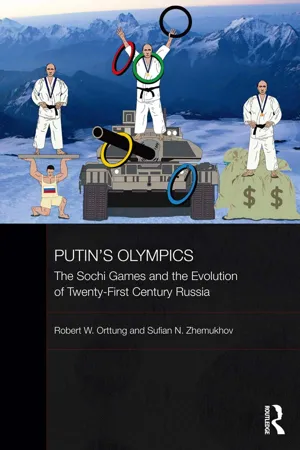
President Vladimir Putin's Olympic venture put the workings of contemporary Russia on vivid display. The Sochi Olympics were designed to symbolize Russia's return to great power status, but subsequent aggression against Ukraine, large-scale corruption, and the doping scandal have become the true legacies of the games. The Kremlin's style of governance through mega-projects has had deleterious consequences for the country's development. Placing the Sochi games into the larger context of Olympic history, this book examines the political, security, business, ethnic, societal, and international ramifications of Putin's system.
eBook - ePub
Putin's Olympics
The Sochi Games and the Evolution of Twenty-First Century Russia
- 136 pages
- English
- ePUB (mobile friendly)
- Available on iOS & Android
eBook - ePub
Putin's Olympics
The Sochi Games and the Evolution of Twenty-First Century Russia
About this book
Information
1 Introduction
How Putin’s political system led to Olympic corruption, military adventurism, and state-sponsored doping
Two puzzles stand at the centre of this book. The first examines what the 2014 Sochi Olympics tell us about the development of Russia. As Russia’s leader and the individual who was the main driving force behind the games and the person most closely associated with them, President Vladimir Putin has chosen to cultivate Russia through a variety of mega-projects, of which the Sochi Olympics is the most important example. These mega-projects necessarily concentrate state and private resources for a specific purpose while assigning a lower priority to other goals. What are the consequences of such a development policy and what does it mean for Russia’s future? Our argument here is that the path that Putin chose facilitated widespread corruption, the development of extensive security forces, and a crackdown on civil society. These are the defining features of the Putin era and key components of the Sochi games.
The second puzzle involves the legacy of the Sochi Olympics. As soon as the closing ceremonies were over, Russia invaded Ukraine and annexed Crimea in the first European land grab since the end of World War II. In the West, the two events did not fit together, and the Olympics were quickly forgotten. The ideal of the Olympics is to promote greater peace in the world through a coming together of young people for athletic competition. Invading your neighbour with military force seemed to be the antithesis of such idealistic objectives. By annexing Ukrainian territory immediately after the Olympics concluded, Putin erased any goodwill that he had earned in the international community from hosting the games.
We resolve this paradox by arguing that Russia’s invasion of Ukraine was not a break with the Sochi Olympic effort, but a logical continuation of it from the Russian perspective. The nature of the Putin regime led to both the Sochi games in the corrupt, authoritarian form they occurred and the subsequent invasion of Ukraine. Sochi was not an anomalous event in Russian history, but deserves a central place in the narrative of Putin’s Russia. Likewise, the hostilities were not a radical break with Putin’s developmental model, but a logical continuation of it. Given this combination of corruption and aggression, the evidence that began to flow after the Olympics concluded that the Russian state had systematically organized doping among Russian athletes to ensure that they won the most medals fits the existing pattern. The corruption, aggression, and dishonesty were all part and parcel of the Putin system.
Combining these two threads of analysis, we conclude that Putin’s reliance on mega-projects led to a specific kind of Russian political development, the defining features of which were strict limits on civil society groups, a focus on increasing the state’s repressive capacity, and, as a direct consequence of these policies, a flourishing of corruption and efforts to undermine all forms of fair competition. The quick evolution of events from Sochi to Crimea was not an about-face from peaceful development though mega-projects to aggressive military intervention, but an effort to achieve the same goal – Putin’s vision of a Russia in which he was able to call the shots and direct resources to the projects that he personally considered the most important. The allegations of state-sponsored doping among many of Russia’s athletes simply drew more attention to this state of affairs.
Were the Sochi Olympics a success or a failure? The 17 days of competition came off without a hitch and Russia was able to organize and host an international spectacle for a massive television audience of 2.1 billion people worldwide (International Olympic Committee, 2015). The coverage spilled across 412 channels, with 42,000 hours of reporting on television and 60,000 hours available on digital platforms. But beyond the two weeks of sporting displays, Russia did not boost its image in the international media or public perceptions; surveys by the Pew Research Center in spring 2015, one year after the games, found that most of the world’s citizens held Russia and its leader in low regard (Stokes, 2015). The Kremlin’s adoption of a ‘conservative’ ideology and attack on its sexual minorities showed that it was out of step with the Western countries that frequently serve as a reference point for Russian conceptions of its own identity, leading to a boycott of the games by Western leaders. Suffering from massive corruption, the games were badly mis-managed and came in considerably over budget. From Putin’s perspective, they were probably not a success either since they did not really serve as a mechanism for uniting the country behind his leadership. It was only the invasion of Ukraine and the annexation of Crimea, resulting in a ‘small victorious war’, that seemed to cement Putin’s role as the main arbiter of Russia’s future and ensure that he would remain the paramount leader (Wood, 2015). We will return to the question of to what extent, and for whom, the games succeeded in much greater detail in considering the legacy of the Sochi Olympics in the book’s final chapter.
Mega-events and mega-projects
In examining Russian development through the lens of sports mega-events and mega-projects, we seek to blaze a new conceptual path in the study of Russian politics. The literature on mega-events and mega-projects is growing rapidly, and while it typically addresses events like the Olympics and World Cup, we argue that such events can help shed light on the overall governance of centralized authoritarian countries like Russia. We start with definitions of the terms mega-events and mega-projects and then show how this lens is useful in explaining Russian developments.
Mega-events are typically defined in the academic literature as ‘large-scale cultural (including commercial and sporting) events, which have a dramatic character, mass popular appeal and international significance’ (Roche, 2000). Such events have long-lasing consequences for the host city, region, or country in which they occur and attract extensive media coverage (Horne & Manzenreiter, 2006, p. 2). While mega-events can be a good way of mobilizing capital for infrastructure investments, studies of past experience with mega-events suggests that the gains they produce can be offset by the way that they are organized and the particular interests behind them (Cornelissen & Swart, 2006, p. 110). In other words, mega-events can play an important role in a country’s development, but their impact is not completely benign because their concentration of resources can help to facilitate the dispersal of state resources to corrupt actors. The Olympics are the largest and most significant mega-event in the world. Accordingly, they stimulate some of the most important mega-projects as well (Frawley & Adair, 2013, pp. 1, 2).
Mega-projects are massive infrastructure ventures, usually driven by public funding, which must be completed within defined time limits and with a constrained amount of resources (Frawley & Adair, 2013, pp. 3–4). Usually, they are worth more than $1 billion and seek to ambitiously change the structure of society (Flyvbjerg, 2014). They are different in kind than smaller projects, which fit into existing structures and do not attempt to transform them. In general, organizers claim that their mega-projects can create new jobs and provide for other forms of economic stimulus, such as increasing tourism and boosting sports participation in the host country (Hughes, 2012), though these initial optimistic hopes are not always borne out in practice (Müller, 2012; Owen, 2005; Shaw, 2008; Whitson & Horne, 2006). Nevertheless, economists have found that even just bidding for the Olympics is associated with a 20 per cent boost in exports for the host country (Rose & Spiegel, 2011).
Hosting a mega-event like the Olympics is a useful way of launching and carrying out mega-projects. The deadlines imposed by the need to complete the project before the opening ceremony help to ensure that the massive construction and infrastructure projects remain on schedule even if extra spending is required. The spectacle associated with the Olympics justifies the need for mega-projects.
Patriotic plans gone awry
Putin had long admired the Olympics and had worked since the 1990s to bring them to Russia as a way of demonstrating that the country had returned to its rightful place in the world. Putin planned to turn the mountains surrounding Sochi, where he regularly vacationed, into a winter resort that could rival anything in the Alps.
For Putin, the projects were not investments in the purest business sense. In fact, they were economically dubious. Rather, they were patriotic endeavors carried out for the greater public good, which he believed he best understood and which he alone decided (Myers, 2015, p. 324).
The International Olympic Committee claimed that the original seed for Russia’s winter games was a ‘strategic vision to transform an entire region by creating a sports legacy that would benefit both elite and grassroots athletes’ (International Olympic Committee, 2015). While Soviet leaders in the 1980s had considered proposing Sochi as a host of the Winter Olympics, the idea was audacious because Sochi did not have any world-class skiing facilities or the tourist infrastructure required to support the large crowds of spectators that the Olympics attracted. Building up Sochi to host the Olympics would also reshape Russia’s centralized geography since it would develop a site outside of Moscow, the host of the 1980 Olympics and the focus for much of Russia’s political, business, and cultural activity (Golubchikov, 2016).
But, whatever the lofty intentions at the origins of the 2014 Sochi Olympics, they quickly ran into the reality of Russia’s deeply authoritarian and corrupt system. Even if Putin may have initially wanted the games to promote Russian greatness – we will never know what he was actually thinking – ultimately the Olympic project became symbolic of a system that excludes the public from decision-making and hands the most benefits to a select few. The Olympics provided a specific form of patrimonialism – Putin was willing to give large sums to his cronies, but they had to deliver results in terms of new sporting facilities and urban infrastructure to secure them. While this kind of corruption is certainly present in Western countries, it reached a peak in Russia.
In the case of the Sochi Olympics, Putin was the main organizer (Wood, 2015) and it was his favoured elites who benefitted most from them. Putin played the key role in securing the games for Russia and working to implement them. In contrast to typical mega-projects in Western countries that must operate within a constrained budget and with accountability to a broader public, Russia’s income from oil and natural gas sales abroad and its centralized authoritarian leadership meant that Putin could essentially spend money without regard to rationality or public oversight, thinking only of maintaining the corrupt political system he had established since 2000. As Peter Pomerantsev put it ‘The USSR built mega-projects that made no macroeconomic sense but fitted the hallucinations of the planned economy; the new hyper-projects make no macroeconomic sense but are vehicles for the enrichment of those whose loyalty the Kremlin needs to reward’ (Pomerantsev, 2014, p. 206).
Although the Russian government does not refer to mega-projects in the most prominent strategic economic planning documents, such as Strategy 2020, published in March 2012 (Connolly, 2013; Strategiya 2020, 2012), in practice, it has invested in numerous such projects in addition to the Olympics. Among them are the $20 billion reconstruction of Vladivostok for the 2012 APEC summit (Kalachinsky, 2010) and the even more expensive plans ($42 billion) to develop the Far East in general (Medetsky, 2013); the $6.9 billion Universiade Games held in Kazan in July 2013 (ITAR-TASS, 2013); the 2018 World Cup; the $15.2 billion Skolkovo innovation centre (Ulyukaev, 2013)...
Table of contents
- Cover
- Half Title
- Title Page
- Copyright Page
- Dedication
- Table of Contents
- List of Tables
- Notes on authors
- Preface
- Abbreviations and acronyms
- 1 Introduction: how Putin’s political system led to Olympic corruption, military adventurism, and state-sponsored doping
- 2 The 2014 Sochi Olympic mega-project and Russia’s political economy
- 3 Political and civil society and the Sochi games
- 4 Security: fighting terrorism and strengthening the military
- 5 International issues: Circassians, the former Soviet countries, and the West
- 6 The legacy of the Sochi Olympics
- Index
Trusted by 375,005 students
Access to over 1.5 million titles for a fair monthly price.
Study more efficiently using our study tools.
Frequently asked questions
Yes, you can cancel anytime from the Subscription tab in your account settings on the Perlego website. Your subscription will stay active until the end of your current billing period. Learn how to cancel your subscription
No, books cannot be downloaded as external files, such as PDFs, for use outside of Perlego. However, you can download books within the Perlego app for offline reading on mobile or tablet. Learn how to download books offline
Perlego offers two plans: Essential and Complete
- Essential is ideal for learners and professionals who enjoy exploring a wide range of subjects. Access the Essential Library with 800,000+ trusted titles and best-sellers across business, personal growth, and the humanities. Includes unlimited reading time and Standard Read Aloud voice.
- Complete: Perfect for advanced learners and researchers needing full, unrestricted access. Unlock 1.5M+ books across hundreds of subjects, including academic and specialized titles. The Complete Plan also includes advanced features like Premium Read Aloud and Research Assistant.
We are an online textbook subscription service, where you can get access to an entire online library for less than the price of a single book per month. With over 1.5 million books across 990+ topics, we’ve got you covered! Learn about our mission
Look out for the read-aloud symbol on your next book to see if you can listen to it. The read-aloud tool reads text aloud for you, highlighting the text as it is being read. You can pause it, speed it up and slow it down. Learn more about Read Aloud
Yes! You can use the Perlego app on both iOS and Android devices to read anytime, anywhere — even offline. Perfect for commutes or when you’re on the go.
Please note we cannot support devices running on iOS 13 and Android 7 or earlier. Learn more about using the app
Please note we cannot support devices running on iOS 13 and Android 7 or earlier. Learn more about using the app
Yes, you can access Putin's Olympics by Robert W. Orttung,Sufian N. Zhemukhov,Sufian Zhemukhov in PDF and/or ePUB format, as well as other popular books in Social Sciences & Ethnic Studies. We have over 1.5 million books available in our catalogue for you to explore.