In this study, Oaklander's primary aim is to examine critically C.D. Broad's changing views of time and in so doing clarify the central disputes in the philosophy of time, explicate the various positions Broad took regarding them, and develop his own responses both to Broad and the issues debated.
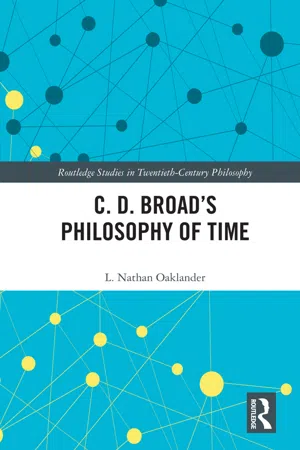
- 218 pages
- English
- ePUB (mobile friendly)
- Available on iOS & Android
eBook - ePub
C. D. Broad’s Philosophy of Time
About this book
Information
1 Problems in the Ontology of Time
I. Introduction
My mentor, Gustav Bergmann (1906–1987), would occasionally remark that philosophers stand on each other’s shoulders and that great philosophers go back to the same fundamental issues over and over again. Clearly, over the past hundred years, philosophers interested in the philosophy of time have benefited from Broad’s careful analysis of the problems of time and have stood on his shoulders. Broad certainly benefited from contemporaries such as Bertrand Russell, John M. E. McTaggart, Alfred North Whitehead, G. F. Stout, Samuel Alexander, G. E. Moore, W. E. Johnson and other historical figures, of course. Like other great philosophers, Broad also returned with increasing originality and subtlety to the problems of time. What, then, were the problems in the philosophy of time to which Broad returned throughout his career, and how did he attempt to resolve them? In this introductory chapter, I shall discuss the first question, and in the remaining chapters, I shall explore Broad’s changing responses to the second.
In “A Reply to My Critics” (1959), Broad tells us that “at the back of all [his different accounts of time] is McTaggart’s paper ‘The Unreality of Time,’ published in Mind in 1908” (1959, p. 765). Indeed, McTaggart’s views on time play a central role in many of Broad’s writings on time (see, for example, 1921, 1923, 1928, 1938). Arguably, one of Broad’s most well-known and famous writing on time is his discussion of McTaggart’s chapter on “Time” (1927) in Examination of McTaggart’s Philosophy (Broad, 1938). It will be useful, therefore, to approach Broad’s philosophy of time by a consideration of McTaggart. In this way we can better understand the fundamental problems of time to which Broad frequently returned. Since McTaggart and Broad are ontologists, it is appropriate to discuss the aims of ontology as I understand them.
Ontology has as its subject matter everything that exists or all the entities there are, and its aim with regard to that subject matter is to determine the most general categories and general principles of classification, and then to say something about the relations between those categories. Of course, ontology does not consider each existent one by one, but is concerned primarily with the most general categories (for example, things, relations, qualities, identity, fact), founded on the most widespread, pervasive or omnipresent phenomena. Surely, time is a ubiquitous phenomenon. Therefore, the ontologist of time asks what category or categories of intrinsically temporal entity or entities there are, or must be, to explain the temporal phenomena. To answer the ontological question “What is the nature of time?” is to give an inventory of all temporal entities, or rather, an inventory of all the kinds of such entities there are.1 Are there intrinsically temporal individuals or particulars; time points or moments of absolute time capable of existing unoccupied? Does time consist of relations, and if so, are those relations internal, grounded in the nature or properties of one or more of their terms, or are they external, grounded in an additional entity obtaining between its terms, or some combination of both? Are temporal relations reducible to other relations, such as causation or entropic increase, or are they irreducible? Are there intrinsically temporal (non-relational) properties, such as pastness, presentness and futurity (hereafter “A-properties”), introduced by McTaggart (1908, 1927) to distinguish events that are past, present or future? Are there the so-called “coordinate qualities,” to use Gustav Bergmann’s terminology (1967, p. 24), or “temporal positional qualities” as Broad calls them (1925, p. 592), such as being at t1 and being at t2?2 Is there a special category of temporal change such as temporal becoming that is, a change of A-properties or absolute becoming—the coming into and going out of existence of temporal objects—or is the passage or flow of time or events in time to be understood in terms of some other category already delineated? If temporal or absolute becoming is primitive and ontologically basic, then how is it to be understood? Certainly, time is a basic and fundamental phenomenon within the purview of ontological explanation. We must ask, then, what temporal phenomena there are, and to what category or categories do temporal phenomena belong? In the next section, I shall explore some answers to these last two questions and, in so doing, identify one central debate in the ontology of time.
II. Temporal Phenomena and the Ontology of Time
In the section from “Ostensible Temporality” titled an “Independent account of the phenomenology of time” (1938, p. 36), Broad distinguishes two phenomena that are at the forefront of debates in the philosophy of time: the transitory aspect of temporal facts and the extensive aspect of temporal facts. The phenomena in question roughly correspond to McTaggart’s A-series of events that runs from future to present to past, and the B-series of events that are ordered by the relations of earlier than/later than. As we shall see, McTaggart has already built into the A-series and B-series a specific ontological account of what entities constitute those series, if time is real. I shall eventually argue that his analysis is mistaken, but in this introduction, to help structure the debate in the ontology of time, I will continue to use the A-series and B-series terminology that has become standard. Later in this chapter and especially in the chapters that follow, I shall introduce and explain the Russellian view, or R-theory, and be more precise about McTaggart’s conception of the B-series and B-relations and how they differ from the R-series and R-relations. I shall also argue that while the transitory and the extensive aspects of time are nominally different and expressed differently in language, they are fundamentally grounded in entities belonging to the same ontological category.
When McTaggart characterized time in terms of the A-series, he and subsequent philosophers meant that we experience time, or events in time, as moving or flowing—as having a transitory or dynamic quality. Time involves a flow or flux from one event to another, and not a “static” temporal relation between them. For Broad, transition in time also means that we experience events as moving from the distant future to the near future to the present, and then receding into the more and more distant past. He expresses this by means of an expression that A. N. Prior (1959) made famous more than 20 years later, after a visit to the dentist writing, “Thank god (on the theistic hypothesis) that is over now!” (Broad, 1938, p. 38).
There is a sense in which time or events in time seems to flow or move through time and this puzzling, yet pervasive, aspect of time is reflected in ordinary thought, language and experience. In our thoughts and emotions, the transitory aspect of time is reflected in the different attitudes we have toward events depending on their temporal position relative to us. For example, it is natural to anticipate, perhaps with dread, an unpleasant future event, perceive or directly experience the unpleasant event when it is happening now or at present, and then to remember it with relief when we reflect on its passing into or becoming past. Thus, we think differently about events and experiences that appear to be moving toward us or away from us; a pleasant future event is thought of with joyful anticipation whereas the same event when it becomes past is remembered with nostalgia.
The transitory aspect of time also has a foothold in the language of time. For we speak, write and talk of past, present and future events, and we use tensed language to reflect the unique form of change events undergo when they move from the future to the present and into the past. For example, it is now true to say that “I will have dinner in a few hours,” and in a few hours it will be true that “I am now eating dinner.” Still later tonight, it will be true to say that “I had dinner already.” It is natural to say, as Broad does, that these sentences accurately reflect facts about events in time that strike at something essential to its nature (1938, p. 38). More specifically, such sentences suggest that events pass through time by changing their A-properties; first possessing futurity, then presentness and then pastness. Moreover, since each of these sentences (or the propositions they express), change their truth value with the passage of time it would appear, for that reason, they cannot be translated or eliminated in favor of sentences that solely express propositions about temporal relations between events whose truth values are unchanging.
Our experience of time is also seemingly inseparable from time’s dynamism since the present which is always experienced as changing has a force and vivacity about it, to use Hume’s characterization of impressions, that the past and future do not have. What is present or now seems to have a greater reality than what is past or future. George Schlesinger once expressed this, when he said, “The NOW is, of course, not conceived as some sort of object but rather as the point in time at which any individual who is temporally extended is alive, real or Exists with a capital E” (Schlesinger, 1980, p. 23).
Given that time’s dynamism (the whoosh, flow or passage of our experiences and events in time) and its transiency (or flow of events from future to present to past) are so deeply embedded in our thinking, language and experience of time, it would seem to be an act of folly to deny they exist. That may well be true, but it doesn’t necessarily follow that the ontological explanation requires an A-theoretic ontology (after McTaggart’s A-series) or that one abandon the B-theory (after McTaggart’s B-series). Indeed, Broad, in his earliest reflections on time, to be discussed in the next chapter, maintained that our thought, language and experience of time could be explained without positing temporal properties or temporal becoming as some A-theory advocates interpret those notions.
Another temporal phenomenon that Broad calls to our attention is what he calls the “extensive” aspect of time. It consists of the fact that two experiences of the same person may stand to each other in a determinate temporal relation of earlier than/later than or simultaneous with, or they may partly or entirely overlap. In fact, he distinguishes several different relations that experiences can have to each other; for example, two experiences can be such that they start simultaneously, but the first lasts longer than the second (Broad, 1938, p. 37). We experience events occurring successively and simultaneously. This happens, for example, when someone rapidly knocks on the front door and you hear a series of sounds, one after the other; or when one hears a whistle sounding and hears the conductor yelling “all aboard” at the same time as the whistle, we experience the simultaneity of two events. We use temporal relational language to place events in time, as in “President Kennedy was assassinated almost 50 years before President Obama’s second inauguration,” or “I’ll see you later.” In reverie we may think to ourselves, “How did I get by before I met you?”
Some have claimed that in contrast to the transitory aspect of time and experience, the extensive aspect is thought to be static, lacking any dynamism, whoosh or transiency. For that reason, it is argued that the transitory A-properties are needed to account for the passage of time and its dynamic aspect. Yet those who emphasize temporal relations over temporal properties as foundational in the ontology of time are not without an explanation of the phenomena in question. We experience succession when at noon the church bell rings 12 times and we can hear the first chime occurring earlier than the second, the second earlier than the third and so on. Arguably, the experience of succession just is the experience of time’s dynamism or transition. Or, to give other examples, upon looking at the second hand of a watch, we can perceive that it is located at one position before it is at another, and before it is at still another and so on. When we go to the doctor for a checkup and feel her rapidly tapping on our chest or our abdomen or gently squeezing the glands under our neck, we experience the taping and squeezing sensations occurring in succession. Surely, one of the ways in which we experience time passing is by experiencing the successive flow of events from earlier to later. And is this not a direct experience of temporal transition and temporal passage even though it does not appeal to A-properties? I shall return to this ...
Table of contents
- Cover
- Half Title
- Series
- Title
- Copyright
- Dedication
- Contents
- Acknowledgements
- Preface
- 1 Problems in the Ontology of Time
- 2 The Early Years: The Russellian Theory of Time
- 3 The Middle Period: The Growing Block Theory of Time
- 4 The Later Years: The Full-Future Theory, Presentism and McTaggart’s Paradox
- 5 Independent Account of McTaggart’s Paradox and the R-theory of Time
- 6 The Self and Time
- 7 The Philosophical Implications of Foreknowledge: Precognition, Fatalism and Time
- 8 Conclusion: Broad, the R-theory and Time
- Appendix: Is There a Difference Between Absolute and Relative Space?
- Index
Trusted by 375,005 students
Access to over 1.5 million titles for a fair monthly price.
Study more efficiently using our study tools.
Frequently asked questions
Yes, you can cancel anytime from the Subscription tab in your account settings on the Perlego website. Your subscription will stay active until the end of your current billing period. Learn how to cancel your subscription
No, books cannot be downloaded as external files, such as PDFs, for use outside of Perlego. However, you can download books within the Perlego app for offline reading on mobile or tablet. Learn how to download books offline
Perlego offers two plans: Essential and Complete
- Essential is ideal for learners and professionals who enjoy exploring a wide range of subjects. Access the Essential Library with 800,000+ trusted titles and best-sellers across business, personal growth, and the humanities. Includes unlimited reading time and Standard Read Aloud voice.
- Complete: Perfect for advanced learners and researchers needing full, unrestricted access. Unlock 1.5M+ books across hundreds of subjects, including academic and specialized titles. The Complete Plan also includes advanced features like Premium Read Aloud and Research Assistant.
We are an online textbook subscription service, where you can get access to an entire online library for less than the price of a single book per month. With over 1.5 million books across 990+ topics, we’ve got you covered! Learn about our mission
Look out for the read-aloud symbol on your next book to see if you can listen to it. The read-aloud tool reads text aloud for you, highlighting the text as it is being read. You can pause it, speed it up and slow it down. Learn more about Read Aloud
Yes! You can use the Perlego app on both iOS and Android devices to read anytime, anywhere — even offline. Perfect for commutes or when you’re on the go.
Please note we cannot support devices running on iOS 13 and Android 7 or earlier. Learn more about using the app
Please note we cannot support devices running on iOS 13 and Android 7 or earlier. Learn more about using the app
Yes, you can access C. D. Broad’s Philosophy of Time by L. Nathan Oaklander in PDF and/or ePUB format, as well as other popular books in Philosophy & Teaching Arts & Humanities. We have over 1.5 million books available in our catalogue for you to explore.