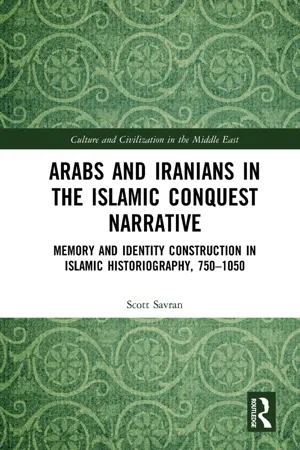
Arabs and Iranians in the Islamic Conquest Narrative
eBook - ePub

Arabs and Iranians in the Islamic Conquest Narrative

Memory and Identity Construction in Islamic Historiography, 750–1050

  1. 248 pages
  2. English
  3. ePUB (mobile friendly)
  4. Available on iOS & Android
eBook - ePub

Arabs and Iranians in the Islamic Conquest Narrative

Memory and Identity Construction in Islamic Historiography, 750–1050

About this book

Arabs and Iranians in the Islamic Conquest Narrative analyzes how early Muslim historians merged the pre-Islamic histories of the Arab and Iranian peoples into a didactic narrative culminating with the Arab conquest of Iran.

This book provides an in-depth examination of Islamic historical accounts of the encounters between representatives of these two peoples that took place in the centuries prior to the coming of Islam. By doing this, it uncovers anachronistic projections of dynamic identity and political discourses within the contemporaneous Islamic world. It shows how the formulaic placement of such embellishment within the context of the narrative served to justify the Arabs' rise to power, whilst also explaining the fall of the Iranian Sasanian empire. The objective of this book is not simply to mine Islamic historical chronicles for the factual data they contain about the pre-Islamic period, but rather to understand how the authors of these works thought about this era.

By investigating the intersection between early Islamic memory, identity construction, and power discourses, this book will benefit researchers and students of Islamic history and literature and Middle Eastern Studies.

Frequently asked questions

Yes, you can cancel anytime from the Subscription tab in your account settings on the Perlego website. Your subscription will stay active until the end of your current billing period. Learn how to cancel your subscription.
No, books cannot be downloaded as external files, such as PDFs, for use outside of Perlego. However, you can download books within the Perlego app for offline reading on mobile or tablet. Learn more here.
Perlego offers two plans: Essential and Complete
  • Essential is ideal for learners and professionals who enjoy exploring a wide range of subjects. Access the Essential Library with 800,000+ trusted titles and best-sellers across business, personal growth, and the humanities. Includes unlimited reading time and Standard Read Aloud voice.
  • Complete: Perfect for advanced learners and researchers needing full, unrestricted access. Unlock 1.4M+ books across hundreds of subjects, including academic and specialized titles. The Complete Plan also includes advanced features like Premium Read Aloud and Research Assistant.
Both plans are available with monthly, semester, or annual billing cycles.
We are an online textbook subscription service, where you can get access to an entire online library for less than the price of a single book per month. With over 1 million books across 1000+ topics, we’ve got you covered! Learn more here.
Look out for the read-aloud symbol on your next book to see if you can listen to it. The read-aloud tool reads text aloud for you, highlighting the text as it is being read. You can pause it, speed it up and slow it down. Learn more here.
Yes! You can use the Perlego app on both iOS or Android devices to read anytime, anywhere — even offline. Perfect for commutes or when you’re on the go.
Please note we cannot support devices running on iOS 13 and Android 7 or earlier. Learn more about using the app.
Yes, you can access Arabs and Iranians in the Islamic Conquest Narrative by Scott Savran in PDF and/or ePUB format, as well as other popular books in History & Middle Eastern History. We have over one million books available in our catalogue for you to explore.

Information

Publisher
Routledge
Year
2017
Print ISBN
9780367869311
eBook ISBN
9781317749080
Edition
1
Topic
History
Index
History

Table of contents

  1. Cover
  2. Half Title
  3. Title Page
  4. Copyright Page
  5. Dedication
  6. Table of Contents
  7. Preface
  8. List of abbreviations
  9. 1 Introduction
  10. 2 Shifting patterns of identity and early Islamic historiography in context
  11. 3 The opening of the drama: Shāpūr and the Sheikh
  12. 4 Bahrām V Gūr, the Lakhmids, and the Hephthalite disaster
  13. 5 The twilight of Sasanian power: Khusraw I Anūshirvān and the saga of Ḥimyar
  14. 6 The buildup to the confrontation: Khusraw II Parvīz and the rise of the Arabs
  15. 7 The climax: the Islamic victory over the Sasanians
  16. 8 Conclusion
  17. Bibliography
  18. Index