A mix tape for Part 1
‘Evoke the Sleep’ by NUN
‘Uni Break’ by Ciggie Witch
‘University Fiend’ by Bitch Prefect
‘University Narcolepsy’ by Woollen Kits
‘Another Year’ by Tape/Off
‘I Soon Found Out My Lonely Life Wasn’t So Pretty’ by TV Colours
‘Higher Forms’ by Rule of Thirds
‘Systematic Fuck’ by Total Control
‘Manic Saturday’ by The Laurels
‘Goin’ to the Tote’ by Yabbie
‘Scent of my Youth’ by You Beauty
‘Teenage Satellites’ by The Stevens
‘No Fun’ by Bloods
‘Be Yourself’ by The UV Race
‘Patience is for Waiters’ by A GENDER
‘Falling down the Stairs’ by Blank Realm
‘Bitter Defeat’ by Kitchen’s Floor
‘Expensive Dog’ by Total Control
‘Starter Humanism’ by ScotDrakula
‘Brisbane Town’ by Scrabbled
‘Home’ by Mere Women
‘Better Next Time’ by Bitch Prefect
‘Cheap Education’ by Twerps
‘Shit for Brains’ by Bored Nothing
‘PraktisePraktiseFailure’ by Castings
‘Body Body Body I Need It I need It I Need It’ by Cured Pink
‘Life Park’ by The UV Race
‘The Radicalisation of D’ by Gareth Liddiard
‘We get By’ by The Gooch Palms
‘Boomer Class’ by Dick Diver
‘Work it Out’ by Totally Mild
‘Flat City’ by Thigh Master
‘Young Drunk’ by The Smith Street Band
‘The Future’ by Taco Leg
‘The Minotaur’ by The Drones
‘We are Now’ by School of Radiant Living
‘What a Silly Day (Australia Day)’ by Eastlink
‘Depersonalisation’ by Ausmuteants
‘I Don’t Mind’ by Day Ravies
‘Bad Attitude’ by The Fighting League
‘Hunter Street Mall’ by The Gooch Palms
‘Eureka’ by Per Purpose
‘Direct Debt’ by Shrapnel
‘Bad Temper’ by Straight Arrows
‘Titty Riot’ by The Sufferjets
‘If We Can’t Get it Together’ by You Am I
‘Down the Lane’ by Royal Headache
‘I Wanna ctrl alt delete my Life’ by Disgusting People
Chapter 1
Youth, class and everyday struggles
Introduction
The concept of everyday struggles and strategies can enliven our understanding of the lives of young people and how social class is made and remade. This book invokes a Bourdieusian spirit to think about the ways young people are pushed and pulled by the normative demands directed at them from an early age, while reflexively understanding that the rewards that are meant to be on offer to them for making the ‘right’ choices and working hard – financial and familial security, social status, job satisfaction – are a declining prospect, even for the well-educated. By analysing the media representation of young people through the figures of hipster and bogan, and young people’s engagement and participation in cultural politics, precarious labour markets and their everyday notions of morals and values, by thinking through different modalities of struggle, we will be better placed to understand the means by which young people make choices, adapt, adjust, strategise, succeed, fail, get by and make do. The book is organised into three sections. Part 1sets up the theoretical lens, situating the study in the field of youth studies; introducing Bourdieu’s thinking tools and developing those tools to help think about morals, emotions and affects. Part 2presents a case study of cultural politics of class in the media by considering the figures of hipster and bogan. These figures illustrate the ways youth cultural practices are a key resource drawn upon by media and creative industries to distinguish class-imbued moral and taste boundaries, all the while creating online snark and outrage in the ever-present need to attract clicks. Part 3analyses the practices of young people in an underground DIY music scene who are striving to carve out their own affective space to be creative while trying get by. For these young people, their punk ethos is something that is struggled over and with, while also influencing their decisions about careers and everyday ethics.
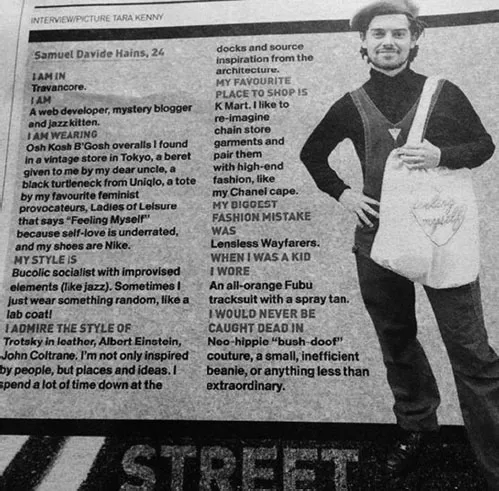
To begin with, I will use the following anecdote to contextualise some of the everyday struggles that will be the focus of the rest of the book. In 2016 the Melbourne newspaper, The Age ran a profile piece on an apparent über-hipster called Samuel Davide (Figure 1.1). It contained glorious quotes like: ‘I am a web developer, mystery blogger and jazz kitten’ and ‘my style is bucolic socialist’. The story drew many responses, both in the Australian press and internationally. The Age ran a follow up asking, ‘Is this the most Melbourne man ever?’1 The UK’s Independent interviewed Samuel, where he managed to come up with more gems, such as, ‘I was in Ikea once and I saw a stock painting of Audrey Hepburn and was moved to tears. Since then I’ve only smoked Vogues, so elegant. I’m also really into fridge magnet wisdom and ideology, such as “keep calm and sparkle on”’.2 Comments under various stories on Davide, were not encouraging to put it mildly, with the vitriol ranging from the usual snark to outright misogyny and homophobia:
Figure 1.1 Samuel Davide Hains profile
Source: The Age.
‘The very definition of a cunt’, ‘#hipsterwanker’, ‘Melbourne hipster scum’, ‘why we need Trump’, someone who ‘deserves to be beaten thoroughly and savagely every single day’, one who ‘must be eradicated’ and the slightly more imaginative ‘pretentious fucking cockwomble of the highest order …’3
Essentially it seems that this apparent hipster is not why we fought World War II.
‘This man is about as far from the trenches of the western front as a man can be. Just think a whole generation died so he could be a cunt’. The upshot? Davide’s capacity to galvanise the common man: ‘cunts like this can unite the world by giving us all something to hate’.4
But in fact, the whole thing was an ironic hoax, a ‘performance piece’. Talking to Vice5, Sam Hains said ‘Samuel Davide’ ‘is a persona – there are elements of my authentic self in Davide’, but he is a ‘satirical character … when the media took such interest in my half-assed, satirical “street column”, my interest in how life is marketed and mediatised grew’. From there he just went with the flow, giving the media interviewers what they wanted: a hipster clown to be used as a straw man for all the apparent foibles and failures of young people’s, and by extension popular and consumer culture, foibles. Hains felt that everyone was trying to exploit ‘Davide’:
He was being contacted, if not harassed by so many publications. It was a really unhealthy relationship between Davide and the media organisations. It felt very manic … the intensity of it. Everyone wanted blood from Davide.6
Davide had ‘this huge PR push – without a material product or a tangible personal brand identity – yet effectively and inadvertently held a mirror up to some of the flaws of the system’.7 The writer of the original profile piece, Tara Kenny, who has a personal relationship with Hains, was sacked by the newspaper because she was in on the hoax, which The Guardian reported under the headline: ‘“Socialist” hipster who fooled The Age is from family worth billions’.8 When announcing the sacking, The Age commented that ‘Fairfax Media expects all journalists to report truthfully and fairly on all subjects in all sections’.9 This is a newspaper that reports what politicians have to say every day, with the obligatory and quite obviously biased opinion pieces doubling down on the constant PR spin. In Kenny’s own words, she was employed as a freelance ‘copywriter through a third party to churn out event listings and lifestyle and entertainment articles in response to briefs such as “lavish children’s birthday parties”, “frozen yoghurt” and “beetroot” (seriously)’. As she put it, she was ‘under no misconception that producing content that exists almost entirely to legitimise advertising makes you a news journalist’10. Kenny then wrote a piece for Overland 11 critically analysing her own experience, the reaction to the hoax and outlining the rather extreme ‘level of hateful vitriol levelled at a clueless but fundamentally harmless young man whose alleged crime against humanity was … wearing his overalls backwards and being a “hipster”’.
This tale characterises many aspects of the lives of young people, especially relatively middle class young people, that this book proposes are key to understanding their everyday struggles. Firstly, we have the mining and manipulation of youth culture, or more accurately the very concept of youth itself, to sell newspapers and act as clickbait. Outrage is created about the apparent vapidity of what young people get up to, from the usual perspective of ‘back in my day things were better’, or from a more general position of a superior attitude, mixed with general ignorance of young people’s actual lives. Despite the constant negativity towards youth culture, mainstream media is obsessed by it, with stories and analysis appearing nearly every day. Secondly, we have savvy young people working in and with the media, earning money, having fun and, ironically playing with the very medium itself. Samuel Hains revealed some truths about media simulations, while Tara Kenny’s job was to create interest, to garner clicks for paid advertising content, and to generally get attraction to the dying media platform of newspapers. She did this very well and was fired for it. The young people here create the content (as either writers or subject) because they know what is cool, but as soon as it crosses an arbitrary and blurry ethical line, they are persecuted for it. Thirdly, the sacking underscores the precarity of young people’s work. Kenny was working the job while studying: ‘Like many young creatives trying to make it work in a tough economy, I gratefully accepted the pay packet and complimentary champagne and attempted to exercise a level of creativity in return’.12 Kenny is juggling work and study while trying to create a career trajectory. She does exactly what is required in the world of online media and is fired by the corporation to save face, even though her misdeed is unclear in the murky world of clickbait, content farming and advertorials. Here there is no union, she is employed through a third party, and working freelance, and there is no recourse to the sacking. This is paradigmatic of work in the creative industries and more broadly, the youth labour market. Kenny is relatively privileged: attended university, friends with the children of billionaires! For those with less economic, cultural and social capital, the precarity is starker. This anecdote is archetypal of young people’s everyday struggles. They are casualised and underemployed, engaged in immaterial labour, they combine casual work and study, they are involved in cultural politics and generational conflict, yet they have a reflexive understanding of the absurdity of it all.
The above example contains factors well known to youth studies researchers. The study of ‘youth cultures’ has had a fluctuating relationship with the concept of class. For example, the figure of the hipster does not really fit previous conceptions of youth consumption practices. In general, foundational studies of subculture – and more recent work continuing that tradition – have been critiqued for (among other things): over-romanticising working class practice; finding ‘resistance’ everywhere; ignoring gender and ethnicity; and having an unhealthy focus on the ‘spectacular’ while disregarding the ‘mainstream’. Work done under the loose banner of ‘post-subcultural’ studies (including ‘scenes’ and ‘neo-tribes’) has been critiqued for giving too much heed to fluid notions of identity while ignoring structural constraints; and over-romanticising ‘choice’ in consumer culture. Meanwhile, studies of ‘youth transitions’ have consistently highlighted how class, family, gender, ethnicity, access to quality education, and geographical location continue to shape the choices and risks that face young people, and that the length of the so-called transition from being a ‘child’ to an ‘adult’ is blurry and extended. Youth transitions though, rarely take into account youth cultural practices.
While focusing on ‘youth’ as its object of study, this book uses two case studies to draw out broader implications about class in the cultural politics of a precarious and reflexive world. The first case study employs the figures of hipster and bogan as heuristics to analyse struggles in the field of representation. It includes consideration of opinion pieces and media coverage about young people that both deny and invoke class, and examples of pop cultural parodies and satire that highlight how what we laugh at is imbued with classed anxieties. The second case study analyses the ways some young people deal with a precarious existence. Within a nationally networked DIY music scene, the so-called ‘ugly Australian underground’, these young people invest themselves creatively in forms of DIY Culture, struggling through a complex but now normalised web of study, employment, unemployment and underemployment. They struggle over the very meanings of punk and DIY in their creative endeavours, while at the same time struggling to maintain space in their lives to pursue artistic passions.
The title of the book draws direct attention to three difficult and complex concepts: youth, class and struggle. The following will introduce these foci as a lens for both understanding the analysis in the rest of the book and to position this study in the broader field of youth studies.
Youth
Media moral panics about young people seem to want it both ways: do they actually grow up too early or too late? Some reports worry about protecting young people from ever-increasing threats: sexualisation at an earlier age and sexual predators; pop culture having a detrimental influence; religious radicalisation and mass shootings; technology’s apparent stupefying effects. The list goes on. On the other hand, there are constant panics that denigrate and scapegoat young people. These stories individualise or even pathologise widespread economic and social changes as individual weaknesses: irresponsibility, laziness, disloyalty, vapidity, molly-coddling, and needing to ‘grow up’. The list here too goes on. These are instances of what Beck has called ‘the biographical solution[s] of systemic contradictions’ (Beck 1992: 137). Youth studies has developed decades of research on the lives of young people that work to challenge the assumptions underlying such cultural stereotypes.
This book locates itself in the field of youth studies. But it also points to some questions about the limits of this field and how the very research findings in the field over the last few decades mean that the object of study – ‘youth’ – may need to be reconceptualised. ‘Youth’ is a lot of things: a concept, an image, a lifestyle. In the public sphere, youth is evoked in all kinds of moral panics towards whatever current social problems need a scapegoat, as well as being incessantly mined in popular and consumer culture as an image, usually a sexy, cool or rebellious one, to sell products and entertain (Ewen 2001). The concept of ‘youth’, like the invention of ‘adolescence’ before it (Payne 2010), is a social construction and has come to have a normative meaning of a liminal space between being defined as a ‘child’ or an ‘adult’. The actual age demographic of youth as a category varies between different institutions and countries (and, in some cases, different researcher requirements). It has been roughly defined by most institutions as between 15 and about 25 years of age. However, in terms of the endpoint, many people acquire the markers of adulthood both before and after this age, often depending on whether they have continued education or gone straight into work, which problematises the age limits. In this sense, a sociological understanding of the significance of age categories should be considered along the lines of where ‘cultures meet biology’ (Baars 2010), where chronological understandings of time dominate to the detriment of more rounded understandings of how life actually unfolds.
Bourdieu has claimed that ‘youth’ is ‘just a word’. The division between young and old is a power division which imposes limits and produces ‘an order to which each person must keep, keeping himself [sic] in his place’ (Bourdieu 1993a: 94). For Bourdieu, the individuals who are labelled ‘youth’ are so different and live under so many various circumstances that it becomes an ‘enormous abuse of language to use the same concept to subsume under the same term social universes that have practically nothing in common’ (Bourdieu 1993a: 95). This is not to say that ‘youth’ is unimportant as a social category, since the term acts as a key disseminator of symbolic violence in myriad ways. While youth may be seen as a social construction, the figure of youth itself is being increasingly embraced and mobilised by neoliberal forces (Sukarieh and Tannock 2015). As the canonical work of Kelly argues, youth is a social and cultural construction immersed in techniques of control (Kelly 2000, 2006). ‘Youth’, therefore may also be considered not just a word, nor just a power division, but something that materialises through the institutionalisation of education, training and labour ...