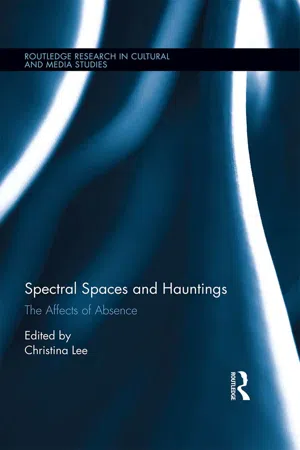
This anthology explores the spatial dimension and politics of haunting. It considers how the 'appearance' of absence, emptiness and the imperceptible can indicate an overwhelming presence of something that once was, and still is, (t)here. At its core, the book asks: how and why do certain places haunt us? Drawing from a diversity of mediums, forms and disciplinary approaches, the contributors to Spectral Spaces and Hauntings illustrate the complicated ways absent presences can manifest and be registered. The case studies range from the memory sites of a terrorist attack, the lost home, a vanished mining town and abandoned airports, to the post-apocalyptic wastelands in literary fiction, the photographic and filmic surfaces where spectres materialise, and the body as a site for re-corporealising the disappeared and dead. In ruminating on the afteraffects of spectral spaces on human experience, the anthology importantly foregrounds the ethical and political imperative of engaging with ghosts and following their traces.
- 208 pages
- English
- ePUB (mobile friendly)
- Available on iOS & Android
eBook - ePub
Spectral Spaces and Hauntings
About this book
Trusted by 375,005 students
Access to over 1.5 million titles for a fair monthly price.
Study more efficiently using our study tools.
Information
Part I
Private Hauntings
1 The Haunted Spaces of 7/7
Memory, Mediatisation and Performance
At a time when a new world disorder is attempting to install its neo-capitalism and neo-liberalism, no disavowal has managed to rid itself of all of Marx’s ghosts. Hegemony still organizes the repression and thus the confirmation of a haunting. Haunting belongs to the structure of every hegemony.
—Jacques Derrida1
I write this chapter in the spirit of Jacques Derrida in his Specters of Marx, where he lambasts the triumphalism of neoliberal democracies after the collapse of the Berlin Wall:
Instead of singing the advent of the ideal of liberal democracy and of the capitalist market in the euphoria of the end of history, instead of celebrating the “end of ideologies” and the end of the great emancipatory discourses, let us never neglect this obvious macroscopic fact, made up of innumerable singular sites of suffering: no degree of progress allows one to ignore that never before, in absolute figures, never have so many men, women, and children been subjugated, starved, or exterminated on the earth.2
Derrida performs a textualist analysis of key writings like Manifesto of the Communist Party and The Eighteenth Brumaire of Louis Bonaparte, stripping away Karl Marx’s core commitments to what Derrida calls ‘Marxism as ontology, philosophical or metaphysical system’ which is premised on historical materialism as method, and is ‘incorporated in the apparatuses of party, State, or workers’ International’.3 What is left of Marx for Derrida is the ‘radical critique, namely a procedure ready to undertake its self-critique’.4
But it is Derrida who performs that critique in Specters of Marx. This alternative Marxist spirit ‘is heir to a spirit of the Enlightenment which must not be renounced’ and is to be distinguished from those other spirits of Marx evident in Marxist doctrine, and readily apparent on the surface of his texts that are elaborated in terms of labour, modes of production, social class and a foreclosing ‘history of its apparatuses’.5 The ‘guiding thread’ in Derrida’s deconstruction of Marx will be the question ‘of the ghost, the specter or revenant’.6 His method will be to discern how Marx treated the topos of ‘ghost’, and then how he bound and foreclosed it ‘through so many tensions and contradictions, to an ontology’.7 Thus Derrida wants to liberate the Marx who is ‘haunted by what it attempted to foreclose’.8
As Jack Reynolds says of Derrida’s method, ‘[d]econstruction contends that in any text, there are inevitably points of equivocation and “undecidability” that betray any stable meaning that an author might seek to impose upon his or her text’.9 The ‘undecidable’ in Specters of Marx is the ghost. The ghost adheres to neither side of the binary language of present/absent; rather it is a trope of analysis challenging the dichotomies that disfigure Marx and the whole of Western philosophy. As Reynolds puts it, Derrida’s deconstruction:
is committed to the rigorous analysis of the literal meaning of a text, and yet also to finding within that meaning, perhaps in the neglected corners of the text (including the footnotes), internal problems that actually point towards alternative meanings … the merit of a deconstructive reading consists in this creative contact with another text that cannot be characterised as either mere fidelity or as an absolute transgression, but rather which oscillates between these dual demands.10
For Derrida, Marx’s ghost is to be discovered in those ‘many tensions’ in his texts before foreclosure within his messianic ontology. For me writing here, Derrida’s ghost is to be discovered in his own tensions between presence and absence when discussing the current era of neoliberalism, which he also sees as messianic. The spirit of Derrida I seek within Specters of Marx is not a footnote but central to the ethical passion of his text, and is embodied in Derrida’s description of neoliberalism and the ten ‘plagues’ of our time – the exclusion and expulsion of homeless citizens (such as immigrants), economic war, underemployment, contradictions of the ‘free market’, foreign debt, the arms trade, the spread of nuclear weapons, inter-ethnic wars, phantom states and the hypocrisy of international law.11 It was in the spirit of opposition to those ‘plagues’ that I attended the huge rally against the Iraq War in Sydney, Australia on 15 February 2003.
Beyond that it was in the context of Derrida’s ‘new world disorder’ that my recent writing (with Andrew Hoskins) is about many of those ‘plagues’ within what Derrida calls the haunting of a new hegemony. There are significant similarities between Hoskins’ and my method in Risk and Hyperconnectivity and Derrida’s, not least our detailed textual reading of pivotal newspapers that promoted neoliberalism at the moment of its greatest trauma, the Global Financial Crisis (GFC) in 2008–2009.12 But our methodology and theory also diverge in key aspects. We draw on the paradigm of memory, mediatisation and connectivity studies to explore how the ‘iterations and dynamics of the remembering and forgetting of terrorist events operate continually through personal recollection, commemorative rituals and events, cultural objects and markers, and the various and ongoing means through which these are mediatized’.13 We also employ a neoliberalism critique and recent risk theory to emphasise the emergence of a new (yet old) sphere of public space that acts as a place for performative and embodied agency in the face of the risk events of the twenty-first century such as war, terror and global financial breakdown. It is the task of this chapter to suggest those differences as well as our common ‘haunted’ basis in the world disorder of neoliberalism. Most importantly, while my intention is in part the deconstruction of Derrida’s ghost in Specters of Marx, it is explicitly interdisciplinary, and in this respect my ‘spirit’ is closer to Judith Butler than to Derrida.
Torn Up Time and Subjective Time
Derrida speaks much about time, as do we in Risk and Hyperconnectivity, and as does Butler. In ‘Tracking the Mechanisms of the Psychosocial’, Butler challenges the binary thinking which Derrida likewise rejects in Specters of Marx. But she does so in an interesting interdisciplinary way. In a practical response to any transdisciplinary university department seeking research and teaching resources among the rampant single-discipline departments struggling within a neoliberal audit culture, Butler poses a ‘what if’ set of questions:
If a department is transdisciplinary … how does the value of all that intellectual crossing over become communicated and persuasive? What if the key intellectual problem that a group of people seeks to address can only be understood through several lenses? And what if the tension among those various ways of seeing is actually crucial for the elaboration of the object itself? Indeed, what if matters are actually slightly worse: the object looks differently depending on how it is regarded, and so several different ways of considering the object will invariably disagree on what the object is.14
Here we find Derrida’s ‘tensions’ within the authorship of research and writing, but considered in another way from his deconstruction method. Certainly the different ‘lenses’ that Derrida and a Marxist reviewer of Specters of Marx use will lead to disagreement on what their object of attention (Marx) is, and this will create precisely the binary opposition which Derrida is so keen to subvert.15
But subversion of a text is not Butler’s way. Rather she looks for the values of ‘overlapping’, and makes her case by comparing two disciplines which have been in contestation in the social sciences, media and cultural studies over the last five decades: sociology and psychoanalysis. Discussing the various ways that the theory of the subject – ‘whether social and/or phantasmatic’ – was held to converge or diverge by Marx, Foucault, Lacan, Marcuse and others, Butler argues that by allowing for the ‘semantic excess’ of the terms it might be possible to understand how the social and psychic ‘are permeated by one another’.16 Butler takes the apparent binary of ‘self’ and ‘society’ as the focus for her consideration of ‘psychic’ or ‘social’ thinking. Rather than making the sequential claim that, as separate terms, one implies or causes the other, she prefers to ponder:
Even if we for the moment treat them as distinct spheres, it may be that they are spheres that always impinge upon, and overlap with, one another, without exactly collapsing into one another. And the analysis of their relation is one that tracks forms and effects of permeability, impingement, resonance, phantasmatic excess, the covert or implicit operations of psychic investments in the organization of social life, the way that organization falters or fails by virtue of the psychic forces it cannot fully organize, the psychic registers in which social forms of power take hold?17
To illustrate her emphasis on considering the social and psychic together without the illusion of a romantic synthesis, Butler chooses to focus on neoliberalism, the structural haunting that both Derrida and Hoskins/Tulloch challenge:
One could, or should, analyse the temporality of work under neo-liberal conditions, especially the work of women that spans domestic space and other workplaces, or is torn between them. What is this “torn up” time which becomes the subjective time of work? And what does it mean that just as neo-liberalism opens up a phantasmatic sphere of infinite self-invention, it also forecloses the very agency it figures, since it decimates those social and economic supports that enable agency at all. Indeed, neo-liberalism contracts the temporal horizon within which anyone can imagine the future of democratic social transformation. Especially under conditions in which debts become unpayable within a lifetime, the time of living becomes the time of an unexpiable guilt, a time punctuated by a vain effort to pay off the unpayable.… And for anyone who wishes to track the conflicting and ambivalent conditions in which migrant women come to “belong” to different spaces and times, it would seem important to realize that the desire to belong implies an unacceptable loss, and that the desire not to belong engenders an unbearable estrangement.18
This is a revealing passage in which Butler powerfully illustrates her claim that ‘each sphere permeates the other in ways that are not fully predictable’.19 Butler’s thinking in this instance pertains to the now of the migrant woman’s ‘debt to be paid’ (even if the context includes past exclusion and future emotional haunting). This present is a focus that Derrida can never employ because of his textualist-deconstructive rhetorical play between present/non-present.
Butler’s interdisciplinarity is important to me in this chapter: substantively (focusing on the experiential present of the poor, marginalised, starving and oppressed of Derrida’s ‘world of disorder’); theoretically (since the play between ‘self’ and ‘social’ is central to my own ‘ghosts’ of 7/7); and epistemologically (as my own analysis tracks between the critical realism of ‘walls’ of oppression and the weak constructivism of permeable ‘borders’).20 As well as engaging with the world of the ‘social’, I also speak as ‘self’, a direct, traumatised casualty of London’s terror attack on 7 July 2005.
Tunnel Victims?
I write this chapter through a lens of ‘self’: a victim of some of those other (‘social’) victims of global disorder. I was sitting less than two metres away from Mohammad Sidique Khan when he detonated a bomb in my carriage of the Circ...
Table of contents
- Cover
- Half Title
- Title Page
- Copyright Page
- Table of Contents
- List of Figures
- Acknowledgements
- Introduction: Locating Spectres
- PART I Private Hauntings
- PART II Spectres of the Social
Frequently asked questions
Yes, you can cancel anytime from the Subscription tab in your account settings on the Perlego website. Your subscription will stay active until the end of your current billing period. Learn how to cancel your subscription
No, books cannot be downloaded as external files, such as PDFs, for use outside of Perlego. However, you can download books within the Perlego app for offline reading on mobile or tablet. Learn how to download books offline
Perlego offers two plans: Essential and Complete
- Essential is ideal for learners and professionals who enjoy exploring a wide range of subjects. Access the Essential Library with 800,000+ trusted titles and best-sellers across business, personal growth, and the humanities. Includes unlimited reading time and Standard Read Aloud voice.
- Complete: Perfect for advanced learners and researchers needing full, unrestricted access. Unlock 1.5M+ books across hundreds of subjects, including academic and specialized titles. The Complete Plan also includes advanced features like Premium Read Aloud and Research Assistant.
We are an online textbook subscription service, where you can get access to an entire online library for less than the price of a single book per month. With over 1.5 million books across 990+ topics, we’ve got you covered! Learn about our mission
Look out for the read-aloud symbol on your next book to see if you can listen to it. The read-aloud tool reads text aloud for you, highlighting the text as it is being read. You can pause it, speed it up and slow it down. Learn more about Read Aloud
Yes! You can use the Perlego app on both iOS and Android devices to read anytime, anywhere — even offline. Perfect for commutes or when you’re on the go.
Please note we cannot support devices running on iOS 13 and Android 7 or earlier. Learn more about using the app
Please note we cannot support devices running on iOS 13 and Android 7 or earlier. Learn more about using the app
Yes, you can access Spectral Spaces and Hauntings by Christina Lee in PDF and/or ePUB format, as well as other popular books in Social Sciences & Popular Culture in Art. We have over 1.5 million books available in our catalogue for you to explore.