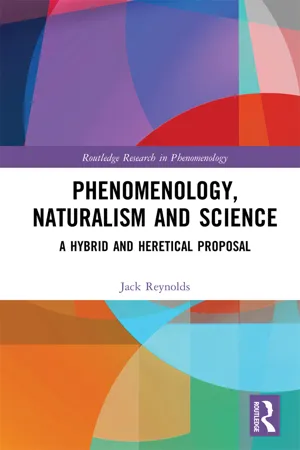
Arguing for the compatibility of phenomenology and naturalism, this book also refashions each. The opening chapters begin with a methodological focus, which seeks to curb the "over-bidding" characteristic of both traditional transcendental phenomenology and scientific naturalism. Having thus opened up the possibility that the twain might meet, it is in the detailed chapters on matters where scientific and phenomenological work overlap and sometimes conflict – on time, body, and others – that the book contests some of the standard ways of understanding the relationship between phenomenological philosophy and empirical science, and between phenomenology and naturalism. Without invoking a methodological move of quarantine, in which each is allocated to their proper and separate domains, the book outlines the significance of the first-person perspective characteristic of phenomenology – both epistemically and ontologically – while according due respect to the relevant empirical sciences. The book thus renews phenomenology and argues for its ongoing relevance and importance for the future of philosophy.
- 220 pages
- English
- ePUB (mobile friendly)
- Available on iOS & Android
eBook - ePub
About this book
Information
1
Introduction
1.1 Phenomenology and Naturalism
Phenomenology and naturalism are standardly thought of as philosophical opponents. Relatedly, the historical interaction between phenomenology and scientific inquiry has sometimes been adversarial in nature, although perhaps more often characterized by benign neglect and occasional claims of philosophical priority concerning the epistemic grounds and justification for science. While Edmund Husserl’s career commenced with philosophy of arithmetic and was generally respectful towards the empirical sciences, phenomenology began with the Psychologismusstreit (psychologism dispute) at the beginning of the twentieth century, which involved a protest against the increasing numbers of chairs in philosophy being awarded to empirical psychologists (see Vrahimis 2013; Kusch 1995). During this period, Husserl’s phenomenology develops in opposition to psychologism, most notably in his “Prolegomena to Pure Logic” in Logical Investigations (1900–1). In seeking to reduce logical and epistemological propositions and truths to psychological and otherwise scientific ones, psychologism disputes any sui generis conception of the philosophical task and is hence a form of naturalism in the broad sense. Although Husserl’s precise characterization of phenomenology shifts throughout his career, he generally holds that phenomenology alone offers an independent and autonomous means of defining the subject matter and explananda that any scientific inquiry investigates. Naturalist projects that eschew any such search for epistemic foundations are, by contrast, described as the “original sin” (Husserl, as quoted in Moran 2013, 92). Husserl also came to be increasingly preoccupied with broader sociocultural dangers associated with the dominance of science after the First World War (see Reynolds 2017), and many scholars agree that Husserl’s relationship to both scientific inquiry and naturalism becomes more antagonistic in this period (cf. Tieszen 2005, 93).
While such views have not been unanimously embraced by phenomenologists, Martin Heidegger famously tells us in a polemical but related vein that “science does not think” and, in “What Is Metaphysics?” (1929), that it knows nothing of the ‘nothing’. Heidegger can be read otherwise, perhaps especially with regard to his early work that was more Aristotelean, and perhaps also in regard to Being and Time.1 But these critical claims regarding science have resonated with many subsequent phenomenologists (e.g. Jan Patočka). Phenomenology may be a tradition of heresies, as Paul Ricoeur suggests, but it is fair to say that these “heresies” have lessened, rather than abandoned, the commitment to non-naturalism throughout the majority of the twentieth century. Even if Merleau-Ponty has proclaimed there to be a truth of naturalism (e.g. in Structure of Behaviour), and thus transformed phenomenology in significant ways, nonetheless there is but a truth of naturalism; it is not the truth, that which leaves philosophy with but a minor role in clearing up conceptual confusions as they occur in scientific theory and empirical inquiry. Likewise, while some phenomenologists have resisted any idea that philosophy might maintain an epistemic role as the queen of sciences, there has remained widespread agreement that phenomenology is concerned with understanding phenomena on their own terms rather than presupposing the truth of any causal or explanatory theories, or even seeking to integrate or cohere with such ‘truths’. As such, phenomenology is methodologically distinct from scientific practice and is antithetical to any naturalism in which philosophy is envisaged as strictly continuous with science. For the phenomenologist, the successes (and indeed failures) of empirical science should be bracketed when doing philosophy, even if it is not so clear that considerations to do with the consequences of science for the lifeworld are always quite so assiduously bracketed. Moreover, modes of reasoning that are characteristic of the empirical sciences (e.g. explanation via reduction to laws and properties of basic entities, causal explanation via decompositional analysis, inference to the best explanation, etc.) and generally endorsed by the philosophical naturalist, are held to be non-phenomenological and are sometimes therefore argued to be “naïve” or “pre-critical” for presupposing both the meaning (and sometimes the existence) of the object in question. In short, to take scientific truths as in any way constraining phenomenological reflection is something like a category error, as Husserl said before Gilbert Ryle borrowed some related insights in papers in the 1930s and then more famously in The Concept of Mind and Dilemmas (Ryle 1952, cf. Thomasson 2002).
The task of phenomenology on such an understanding is to deliver a scientific (in the broader sense of Wissenschaft) but non-empirical account of consciousness, which describes experience on its own terms and in all its rich and variegated structures, without any prior metaphysical or epistemological assumptions. Naturalism, by contrast, has generally aimed to give empirically respectable accounts of consciousness, cognition, normativity and so on, along with a range of prima facie recalcitrant phenomena sometimes called the “4Ms” for short, referring to mind, meaning, morality and modality/mathematics (Price 2004). Many have held that phenomenology is basically irrelevant to this kind of project. Daniel Dennett holds that classical phenomenology (which he calls “auto-phenomenology”) is a theoretical trajectory with no agreed method and hence no agreed results (Dennett 1991), nothing that might play a role in engagement with science, as John Searle likewise complains (Searle 1999). On both these commonly held views, then, by philosophers as otherwise diverse as Dennett and Searle, phenomenology cannot be a potential research program in interaction with empirical sciences: while the classical phenomenologist standardly embraces this, the naturalist typically bemoans it and suspects an untenable ‘first philosophy’. To cut a long story short, it is this agreement between many phenomenologists and many naturalists that I want to complicate, sometimes drawing on resources from within each of the traditions ostensibly being sublated and borrowed from, sometimes drawing on resources external to each.
It is also important to recognize, however, that there is a real sense in which phenomenology and naturalism both are, and historically have been, promissory projects. Indeed, it is hard to imagine what a knock-down and definitive proof of either might be. Short of such a proof, we might look at what, if anything, has been achieved in the name of each. Here I would maintain that both have made progress (indirectly) with regard to what has been accomplished within the terms of their respective philosophical commitments, but both have also encountered stumbling blocks, with partisans of each holding these difficulties to be solvable and contending that their opponent’s problems are more recalcitrant and intractable. With regard to naturalism, we might think of the “hard problem” of consciousness (Chalmers 1996) and how to place the “4Ms”—mind, meaning, morality and modality—within any austere physicalist construal of naturalism (Price 2004). For phenomenology, we might think of the general Husserlian program to establish an eidetic science of consciousness that might secure intersubjective agreement and consensus.
One of these promissory projects is currently in the ascendancy today, at least in a cultural and sociological sense. While phenomenology and naturalism have been consistent bugbears and philosophical provocations for each other throughout the twentieth century, they reached their respective philosophical high points at opposite ends of that century.2 As such, one obvious story, sometimes told by philosophers and theoretically minded scientists, would be that of the historical triumph of naturalism as forms of first-philosophy, like phenomenology, have been left behind as a quaint historical curiosity. This would be a progressivist story like that told by Paul Churchland regarding vitalist accounts of life, which on his telling was soon revealed as unnecessary and obsolete by developments in chemistry and other relevant sciences (Churchland 1981). Something like that story is also invoked when Jaegwon Kim and others criticize ‘spooky’ emergent properties or processes as incompatible with naturalism and scientific explanation (Kim 1999), against the claims of non-reductive and liberal naturalists alike. Nonetheless, it is not a simple narrative of either progress or decline that I will be unfolding here, but more of a peacemaking and conciliatory trajectory. It is an attempt at something like what Merleau-Ponty calls a “hyper-dialectic” in his late, unfinished work The Visible and the Invisible, in which there is no strict formal synthesis between two opposed terms, but instead is characterized by a ‘neither–nor’ strategy regarding the terms of the ostensible antinomy—that is, those characteristic of phenomenology and naturalism in both a methodological and metaphysical register—and something like an inference to the best explanation regarding alternative and intermediate possibilities.
1.2 Phenomenology and Science: A Dilemma
Although there are various understandings of naturalism that abound, some of which do little more than rule out any reference to the “supernatural”, for the stronger and orthodox construals of philosophical naturalism, philosophy and science are typically said to be continuous (Sterelny 1990). It is this form of naturalism that has been the “default and restraining presupposition” for analytic philosophical inquiry since Quine and throughout the second half of the twentieth century (Gardner 2007), and it imposes some significant constraints on philosophical practice. It is, for example, standardly accompanied by the rejection of any form of first philosophy that aims to establish significant truths on the basis of a priori argument alone. Of course, it is arguable that philosophical naturalism is itself a form of first philosophy that leaves behind the pragmatic and often deflationary scruples evidenced in actual scientific practice and reflection (cf. Ritchie 2008), as opposed to what the philo-physicist might occasionally be inclined to say “in an edifying tone of voice on Sundays”, as Ryle evocatively puts it (1952, 74–5). Nonetheless, part of the price of imperialistic versions of naturalism has been taken to be the exclusion of phenomenology as a philosophically cogent program, and, sometimes, also the exclusion of the first-person perspective more generally, both from an account of the ultimate constituents of the world and from an inventory of reliable methods for knowing about the world. Usually the refrain here is that phenomenology remains a form of introspection whose epistemic credentials are suspect, even if it is conceded that I can report on things about my own experience that a third party cannot. In reply, many phenomenologists have been inclined to correctly protest that phenomenology is not introspection but is instead concerned with describing and intuiting structural invariants for particular kinds of perception, reflection and memory, among others. But the key issue lurking in the background here, and apparent in the remarks of both Dennett and Searle, is to what extent phenomenology makes any testable predictions that might be of use in psychology and cognitive science, or, more minimally, a clarification of in what sense the kinds of things that phenomenologists discuss matter to science at all (without assuming a first-philosophy view that the scientific naturalist is unlikely to share). And here the phenomenolo-gist faces a choice, perhaps even a dilemma of sorts, and one that pertains to this book. If a phenomenologist accepts the naturalist’s challenge on its own terms, they will need to discharge both a negative and positive thesis. Negatively, they will need to show that phenomenology is not a form of methodological introspection or subjectivism, that it is not reliant upon our fragile capacities to remember, and not committed to a problematic version of metaphysical emergence, to cite just some of the potential objections to phenomenology that will concern us throughout the book. But, positively, they will also have to show what sort of difference phenomenology makes (or at least might plausibly make in the future) to the various sciences concerned with related subject matter (e.g. psychology, cognitive science, robotics, artificial intelligence). In this regard, I think contemporary phenomenology is fractured on this question, between an ongoing allegiance to classical accounts of philosophy that are avowedly not science and not a “research program” (see Crowell 2002), and other accounts that are more empirically minded and often aligned with emerging interdisciplinary research, perhaps especially with regard to ‘4e’ cognition—that is, embodied, embedded, extended and enactive cognition. The details of 4e cognition need not concern us yet, except to say that for many of these theorists, phenomenology becomes an important part, perhaps even an essential one, of a research program that incorporates philosophical reflection and empirical sciences pertaining to embodiment and cognition.
The former phenomenological camp makes what in Chapter 2 I call a “methodological separatist” move, which appears to have metaphysical implications despite the standard denial of this. Indeed, it effectively concedes the point: that phenomenology is not science and does not make empirical predictions but is concerned with meaning, intelligibility, and so on. Advocates of such a view might nonetheless add that perhaps some psychology or cognitive science presupposes (bad) phenomenology and hence may be unnecessarily constrained by bad philosophy/phenomenology that biases both their interpretation of data and the kind of questions and experiments that are framed. Phenomenology then might help to remove such blinkers, but that is fundamentally all that it can do in interaction with science. Anything stronger than this might be charged with committing the simultaneously Husserlian and Rylean error of a “category mistake”.3 Others, however, think that phenomenology does have predictive consequences in interaction with relevant sciences (for a good summary of “neuro-phenomenology”, “front-loaded phenomenology” and others, see Gallagher 2012). Teasing out such predictive consequences will be a complex matter, but it might include, for example, the thesis that we are necessarily embodied, and such a thesis might rule out some functionalist construals of the mind and cognition, depending on the details of how it is cashed out. Such a position must be able to deal with the differences between personal and sub-personal levels without simply assuming an isomorphism or parallelism between them, but the rejoinder is that any adequate account of cognition, perception and so on must be able to articulate an “intelligible interplay” between such levels (McDowell 1994, 197; Wheeler 2005). And some contemporary versions of empirically oriented phenomenology at least promise to provide an integrated explanation, rather than either a reduction or a multilevel view that leaves the details of their interrelation unexplained. And this, it is argued, is what cannot be provided by strong naturalists who aim to reduce the level of experience and first-person phenomenology to the interaction of the component parts.
The first (classical) view preserves a strict distinction between phenomenological philosophy, on one hand, and science, on the other. It also gives philosophy a constraining role vis-...
Table of contents
- Cover
- Title
- Copyright
- Contents
- Acknowledgments
- Permissions
- 1 Introduction
- PART I Methodology and Meta-Philosophy
- PART II Situated Thought: Time, Body, Others
- Index
Trusted by 375,005 students
Access to over 1.5 million titles for a fair monthly price.
Study more efficiently using our study tools.
Frequently asked questions
Yes, you can cancel anytime from the Subscription tab in your account settings on the Perlego website. Your subscription will stay active until the end of your current billing period. Learn how to cancel your subscription
No, books cannot be downloaded as external files, such as PDFs, for use outside of Perlego. However, you can download books within the Perlego app for offline reading on mobile or tablet. Learn how to download books offline
Perlego offers two plans: Essential and Complete
- Essential is ideal for learners and professionals who enjoy exploring a wide range of subjects. Access the Essential Library with 800,000+ trusted titles and best-sellers across business, personal growth, and the humanities. Includes unlimited reading time and Standard Read Aloud voice.
- Complete: Perfect for advanced learners and researchers needing full, unrestricted access. Unlock 1.5M+ books across hundreds of subjects, including academic and specialized titles. The Complete Plan also includes advanced features like Premium Read Aloud and Research Assistant.
We are an online textbook subscription service, where you can get access to an entire online library for less than the price of a single book per month. With over 1.5 million books across 990+ topics, we’ve got you covered! Learn about our mission
Look out for the read-aloud symbol on your next book to see if you can listen to it. The read-aloud tool reads text aloud for you, highlighting the text as it is being read. You can pause it, speed it up and slow it down. Learn more about Read Aloud
Yes! You can use the Perlego app on both iOS and Android devices to read anytime, anywhere — even offline. Perfect for commutes or when you’re on the go.
Please note we cannot support devices running on iOS 13 and Android 7 or earlier. Learn more about using the app
Please note we cannot support devices running on iOS 13 and Android 7 or earlier. Learn more about using the app
Yes, you can access Phenomenology, Naturalism and Science by Jack Reynolds in PDF and/or ePUB format, as well as other popular books in Philosophy & Phenomenology in Philosophy. We have over 1.5 million books available in our catalogue for you to explore.