Urban areas are increasingly contributing to climate change while also suffering many of its impacts. Moreover, many cities, particularly in developing countries, continue to struggle to provide services, infrastructure and socio-economic opportunities. How do we achieve the global goals on climate change and also make room for allowing global urban development? Increasing levels of awareness and engagement on climate change at the local level, coupled with recent global agreements on climate and development goals, as well as the New Urban Agenda emerging from Habitat III, present an unprecedented opportunity to radically rethink how we develop and manage our cities.
Urbanization and Climate Co-Benefits examines the main opportunities and challenges to the implementation of a co-benefits approach in urban areas. Drawing on the results of empirical research carried out in Brazil, China, Indonesia, South Africa, India and Japan, the book is divided into two parts. The first part uses a common framework to analyse co-benefits across the urban sectors. The second part examines the tools and legal and governance perspectives at the local and international level that can help in planning for co-benefits.
This book will be of great interest to students, practitioners and scholars of urban studies, climate/development policy and environmental studies.
Trusted by 375,005 students
Access to over 1.5 million titles for a fair monthly price.
Jose A. Puppim de Oliveira and Christopher N.H. Doll
Introduction
How do we achieve the global goals on climate change and also make room for allowing urban development in countries around the world?
The United Nations 2030 Sustainable Development Agenda (UN 2015) calls for a transformation in development processes in order to achieve the Sustainable Development Goals (SDGs), of which goal 11 is to ‘Make cities and human settlements inclusive, safe, resilient and sustainable’ (UN 2015). Development processes in cities have generated many social and economic benefits in the last decades, but patterns of urban development have shown themselves to be deficient in a number of areas. Many cities are not able to provide services, infrastructure and/or socio-economic opportunities to all, which puts tremendous pressure on the local resources. Others have good urban services and infrastructure but generate impacts on other parts of the world and on the global environment because of the unsustainable consumption patterns. Consequently, urban areas contribute increasingly to climate change, as well as suffer many of its impacts (McGranahan et al. 2007). Thus, the achievement of any meaningful development goals needs to change how we develop and manage our cities.
Future rapid urbanization in developing countries demands a massive provision of sanitation infrastructure, public transportation, housing and jobs for citizens, as well as safeguarding a healthy environment. The climate co-benefits approach we propose in this book refers to policies and other initiatives that simultaneously contribute to addressing climate change and solving local environmental problems, which also have other developmental impacts. The co-benefits approach is especially important for developing countries, which have to overcome many urban challenges simultaneously with limited capacities and resources. This book integrates themes of climate change and local development at the urban level through an analysis of the constituent urban sectors to explore where and how co-benefits may be found. It takes an explicitly transdisciplinary approach to provide insights to a wide audience on lessons for suggesting ways to promote, design and implement the co-benefits approach in urban areas.1
This book examines the main opportunities and challenges for generation of climate co-benefits in cities and how we could promote co-benefit interventions in urban areas, including concepts and tools based on empirical studies. It focuses primarily upon sub-national processes, particularly in cities in developing countries, but the research also looked into the links of local and sub-national processes to national and international regimes. This book is divided into two parts. In the first part, we use a common framework to assess co-benefits and apply it across the urban sectors. These chapters make an in-depth analysis of the sector and are supplemented by a series of cases (denoted by the chapter number followed by a section number, e.g. 2.1) to draw valuable lessons on implementation for that sector. These cases derive from the results of empirical research conducted in different parts of the world between 2011 and 2015. Part II then looks at what it will take to bring about such changes in urban development. It examines a wide range of processes, such as international governance and law, that can help and hinder co-benefits, as well as the tools that can help uncover urban co-benefits. Finally, we consider how integrated thinking about urban processes can generate wider societal co-benefits.
Defining climate co-benefits
Although, there are many definitions of co-benefits (Mayrhofer and Gupta 2016), they all reflect the notion that one initiative can result in at least one other benefit in terms of economic, social and/or environmental improvements beyond the main intended outcome. For example, if the main intended outcome is local development or environmental control, the intervention may also have implications for reducing emissions of greenhouse gases (GHGs), and consequently for combating climate change. The roots of co-benefits in climate policy are in the discussions of ancillary benefits of environmental improvements (win–win opportunities for environment protection and economic benefits) that were brought to climate discussions (Pearce 1992). In environmental policy, climate co-benefits were important to advance air pollution initiatives as a way to mitigate climate change, particularly in places where the regulation of GHGs through domestic legislation was difficult to pass politically. The United States is a prominent case but many developing countries also did not want to have their emissions capped. In this context, as climate mitigation could not be pursued solely, or even as the main purpose of public policies, climate goals would have to come as co-benefits of other goals.
Climate co-benefits can be generated when one outcome of an intervention is a benefit in terms of climate change mitigation or adaptation. On the one hand, climate co-benefits could occur as the benefits of certain development interventions in tackling climate change as compared to other viable development alternatives (including doing nothing or business as usual). On the other hand, the co-benefits can arise when purposely mitigating climate change leads to development benefits at the local or regional level, such as reduction in air pollution, creation of jobs or energy cost savings. The latter may be considered to be developmental co-benefits generated by climate action, and the former the climate co-benefits generated by a climate-friendly development option. Sometimes it is difficult to determine which benefit should come first in terms of policy priority or results. For example, the Delhi Metro was envisioned to give better public transportation access to the local population, but the project was also qualified as a climate mitigation project (see Chapter 2.1). The co-benefits approach can especially fit the development needs of developing countries, which have to overcome many challenges with limited capacity and resources. In terms of climate policy, co-benefits refer to the development and implementation of policy responses that align different goals, simultaneously addressing global (e.g. GHG emissions), local environmental (e.g. various forms of pollution) and/or socio-economic issues (e.g. jobs, energy security and income) (Puppim de Oliveira et al. 2013).
In urban areas, climate co-benefits can be an important policy approach to bring about reduction in many aspects of environmental degradation that affects the well-being of the local population. Climate co-benefits can emerge in two major forms. First, there are the climate co-benefits of solving a local environmental problem. For example, climate co-benefits of a cleaner environment, such as cleaner air and water. In the case of air pollution, there are strong linkages between global climate change (GCC) and local air pollution (LAP). These key environmental issues are discussed extensively in the international political arena, notably in the United Nations Framework Convention on Climate Change (UNFCCC), and the relevance of this approach for urban areas has been noted by the Intergovernmental Panel on Climate Change (IPCC; Seto et al. 2014). Emissions from the combustion of fossil fuels contribute significantly to both GCC and LAP. Pollution could be reduced by adding end-of-pipe technologies to abate local air pollutants (SO2, NOx, NH3, or particulates), but this would not mitigate much climate change; so co-benefits are limited. Alternatively, a co-benefit initiative could be the reduction in the combustion of fossil fuels in the first place, which would mitigate local air pollutants and the emission of GHGs. Second, there are clear co-benefits in many climate policies (NEAA 2009). Mitigating global climate change by cleaning the air from short-lived climate forcers, some pollutants, such as black carbon, have a short-term effect on climate (MOEJ 2014) and also local environment and health, as do climate policies aimed at cleaning waterways (e.g. avoiding methane formation in open sewage) or making cities more resistant to extreme weather events. However, this is not always the case in climate policy. GHG emissions can be reduced through Carbon Capture and Storage (CCS) technology applied to fossil fuel power plants, but it mainly addresses greenhouse gases but not necessarily air pollutant emissions. CCS equipment installed in isolation therefore alleviates GCC but not LAP.
The co-benefits approach can be assessed at various levels. Sometimes, the co-benefits do not happen where the action was taken, or only materialize over an extended period of time. For example, reducing energy intensity in a building may not necessarily reduce the air pollution in or around the building (unless the building had its own gas or oil generator), but it will reduce GHG emissions and the total air pollution elsewhere (assuming that part or all of the electricity generated comes from fossil fuels). Besides the reduction in GHG emissions and development impact, the assessment should take into account various other impacts in terms of the institutional changes that occurred because of the initiatives. Therefore, in order to understand how the co-benefits approach can be effectively implemented, we have to analyse beyond projects and urban policies, particularly at the city level, and also look at the links beyond the cities (higher levels of governments) or international initiatives (bilateral, multilateral and global, governmental and non-governmental).
Why are co-benefits in urban areas important?
Developed countries faced tremendous local environmental problems during their urbanization process. Even though some urban environmental problems were generally minimized (e.g. local sanitation), as they industrialized, the environment was degraded heavily, sometimes with consequences for the local population. Japan’s experience with heavy pollution in Minamata and Yokkaichi severely affected local communities in the 1960s, and serve as examples of how environmental pollution can affect local development. The costs of solving those problems were huge and responsibility was contested in the courts over many years (Puppim de Oliveira 2011).
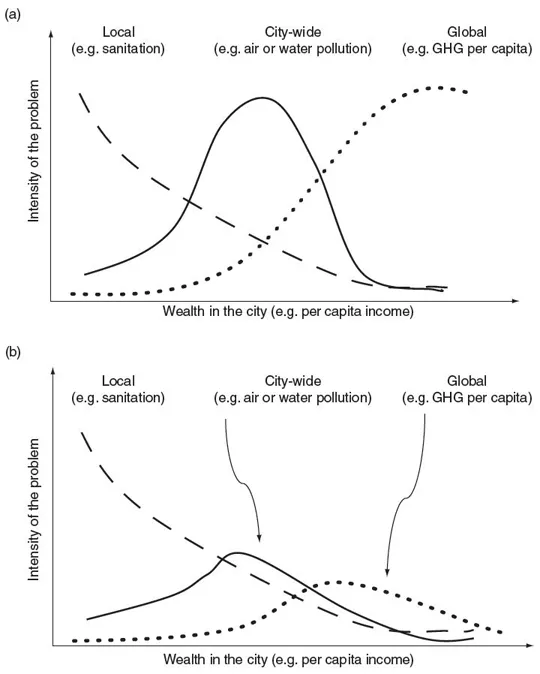
The relationship between development and pollution is often described using the so-called environmental Kuznets curve, shown in Figure 1.1a. It describes a general pattern that pollution increases as countries develop, until such time that they are rich enough to afford to invest in cleaner technologies and change the course of this pollution curve in the opposite direction. However, this is not uniform across all types of pollution. In particular, the contribution to global environmental problems, such as climate change, keeps increasing with rising incomes. Presently, many countries face the challenge of reducing those emissions. Some developing countries have rapidly urbanized and industrialized in the last decades following similar paths of environmental degradation. Some of these cities are among the most polluted in the world and increasing their contributions in terms of GHG emissions.
Figure 1.1(a) The traditional view of environmental pollution under economic development and (b) the changes required to positively impact local and global pollution.
Source: from Puppim de Oliveira 2013.
The co-benefits approach can help developing countries to avoid the same urban development path as today’s industrialized countries by tackling both local environmental problems and global environmental problems at the same time, so cities in developing countries can be wealthier and keep environmental quality, which is important for the well-being of local citizens. In doing so, the aim is to affect the pollution profile such that local pollution peaks at a lower level, whilst global emissions grow more slowly and stabilize at a lower level (Figure 1.1b).
This is appealing because tackling environmental problems, both local and global, can help cities to save financial and natural resource...
Table of contents
Cover
Half Title
Title Page
Copyright Page
Table of Contents
List of figures
List of tables
List of boxes
Notes on contributors
Acknowledgements
1 Climate co-benefits in urban areas
Part I Co-benefits in the urban sectors
Part II Co-benefits by design
Index
Frequently asked questions
Yes, you can cancel anytime from the Subscription tab in your account settings on the Perlego website. Your subscription will stay active until the end of your current billing period. Learn how to cancel your subscription
No, books cannot be downloaded as external files, such as PDFs, for use outside of Perlego. However, you can download books within the Perlego app for offline reading on mobile or tablet. Learn how to download books offline
Perlego offers two plans: Essential and Complete
Essential is ideal for learners and professionals who enjoy exploring a wide range of subjects. Access the Essential Library with 800,000+ trusted titles and best-sellers across business, personal growth, and the humanities. Includes unlimited reading time and Standard Read Aloud voice.
Complete: Perfect for advanced learners and researchers needing full, unrestricted access. Unlock 1.5M+ books across hundreds of subjects, including academic and specialized titles. The Complete Plan also includes advanced features like Premium Read Aloud and Research Assistant.
Both plans are available with monthly, semester, or annual billing cycles.
We are an online textbook subscription service, where you can get access to an entire online library for less than the price of a single book per month. With over 1.5 million books across 990+ topics, we’ve got you covered! Learn about our mission
Look out for the read-aloud symbol on your next book to see if you can listen to it. The read-aloud tool reads text aloud for you, highlighting the text as it is being read. You can pause it, speed it up and slow it down. Learn more about Read Aloud
Yes! You can use the Perlego app on both iOS and Android devices to read anytime, anywhere — even offline. Perfect for commutes or when you’re on the go. Please note we cannot support devices running on iOS 13 and Android 7 or earlier. Learn more about using the app
Yes, you can access Urbanization and Climate Co-Benefits by Christopher Doll, Jose Puppim de Oliveira, Christopher N. H. Doll,Jose A Puppim de Oliveira,Christopher Doll,Jose Puppim de Oliveira, Christopher N. H. Doll, Jose A Puppim de Oliveira in PDF and/or ePUB format, as well as other popular books in Economics & Sustainable Development. We have over 1.5 million books available in our catalogue for you to explore.