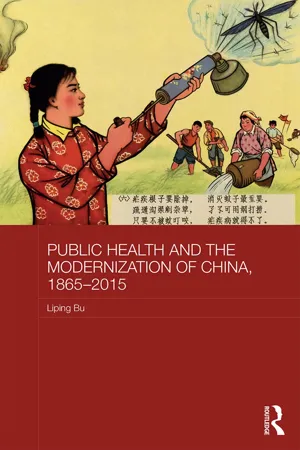
This book, based on extensive original research, traces the development of China's public health system, showing how advances in public health have been an integral part of China's rise. It outlines the phenomenal improvements in public health, for example the increase in life expectancy from 38 in 1949 to 73 in 2010; relates developments in public health to prevailing political ideologies; and discusses how the drivers of health improvements were, unlike in the West, modern medical professionals and intellectuals who understood that, whatever the prevailing ideology, China needs to be a strong country. The book explores how public health concepts, policies, programmes, institutions and practices changed and developed through social and political upheavals, war, and famine, and argues that this perspective of China's development is refreshingly different from China's development viewed purely in political terms.
- 302 pages
- English
- ePUB (mobile friendly)
- Available on iOS & Android
eBook - ePub
Public Health and the Modernization of China, 1865-2015
About this book
Information
p.25
1 Public health
A modern concept of national power
Introduction
The meaning of public health has evolved historically to indicate disease control, sanitation, disaster epidemic relief, and mental and physical health protection of the population as a whole.1 At the turn of the twentieth century, the concept of public health carried a distinct significance of national power and social progress, as the advancement of nations was measured by national death rates and sanitary control. Administration of public health was the responsibility of local and central governments of modern nations. Ruth Rogaski used “hygienic modernity” to describe this modern phenomenon of national power, which she defined as a combination of state power, scientific progress, cleanliness, and the fitness of races.2 Public health also became a contentious issue in the relations between Western imperialist powers and non-Western countries in regard to modern reforms and sovereignty. In 1901, administration of public health became a significant point in the negotiations between China and foreign powers for the return of Chinese cities after the suppression of the Boxer Uprising (义和团运动).3 The Qing court had to agree to continue the sanitary work of foreign occupation before the powers would return Beijing and Tianjin to China. The matter of hygienic modernity came up again in 1910 when a pneumonic plague epidemic caused a full-blown public health crisis in northeast China. Foreign powers in the region expanded their control of city districts in the name of health protection, undermining China’s sovereignty in controlling the epidemic and its territory. Known as the Manchurian plague in the West, this deadly epidemic took more than 60,000 human lives and caused financial losses of 100 million dollars.4 The scale of mortality and socio-economic devastation was considered to have “rivaled or exceeded the Great Plague of London” in 1665–1666.5 For the Qing dynasty, the Manchurian plague presented as much a public health crisis as a political challenge to keep China’s sovereignty.
Northeast China had attracted active commercial and political activities of foreign powers during the scramble for China in the wake of the 1894–1895 Sino-Japanese war.6 Russia and Japan each had penetrated the region with territorial concessions and railroad operations. Other powers, such as the United States, Great Britain, Germany, and France, had established consulates in the region to represent their respective governments and their local businesses. After the outbreak of the plague, foreign powers, particularly the Russian and the Japanese, were eager to expand their territorial control with the pretext of plague prevention. Japan was preparing an invasion of the northeast, while Russia tried to enlist American support for the demand that “China should entrust to foreign physicians the care of deciding” the anti-plague measures.7 Even Japanese and Russian medical scientists took an arrogant attitude towards Chinese medical scientists.8 The plague crisis offered an unexpected opportunity for foreign powers to seek more territory gains, putting increasing pressure on the Qing government. Whether the Qing government could bring the plague epidemic under control was not only a matter of saving tens of thousands of lives but also a matter of proving China’s ability to handle public health crisis as a sovereign country. It was apparent that successful management of the epidemic crisis was of immeasurable importance to China in maintaining its sovereignty.
p.26
China did not encounter the modern problems of urban squalor, pollution, and industrial diseases and poverty until the rapid growth of factories and trade in treaty-port cities after the 1860s. Cities like Shanghai, Tianjin, Hankou, and Guangzhou were major centers of foreign settlements, and by 1900, more than one hundred treaty ports were established under the unequal treaty system China had with foreign powers. The 1842 Treaty of Nanjing, which forced China to open up trade with and to cede Hong Kong to Britain after the Opium War, was a turning point in China’s modern history in terms of its relations with foreign nations and its economic and social developments and political consequences.9 The building of industrial factories in the treaty-port cities took away farmland, started environmental and health pollution, and initiated modern slums. Christian missionaries and foreign traders and soldiers introduced to China Western religion, medical science, capitalist enterprises, and modern killing and looting with gunboat diplomacy. The Qing government, which failed to fend off foreign assaults on the battlefields and at the negotiation tables, was slow and reluctant to reform in face of a fast changing world. It made frequent capitulations to foreign powers, which led to the decline of the Qing empire into a semi-colonial society, where traditional institutions of governance were weakened and new modern institutions such as those of hygiene and sanitation were barely created. The educated Chinese, particularly those influenced by Western thought and ideas and trained in the West, were anxious to explore what made the West powerful. One of their discoveries, as Yan Fu (严复, 1854–1921) first elaborated in 1895, was Western powers’ emphasis on the physical fitness of the people. Ideas of Social Darwinism from the West and martial spirits of ancient China both contributed to the intellectual argument for a strong modern country of China via strong modern citizens.
This chapter investigates the changes of China after foreign powers introduced modern commerce and factories in the treaty ports with the rise of modern health hazards, and the shift of Western notion of China from “a splendor of the East” to “the sick man of Asia.” It examines missionary medical activities in China and their impact on Chinese society in terms of relations between Western and Chinese medicines, and the contention on the validity of traditional Chinese culture and knowledge. It analyzes how Chinese modern intellectuals and health professionals promoted Western medicine at the expense of Chinese traditional culture and medicine, all in the name of science and national strength, and how the government created modern institutions of sanitation and hygiene during times of political and health crises, and the initiation of regulations on infectious diseases in the course of political transformation from a dynasty to a republic. Health education campaigns in the 1910s popularized the intellectual interpretation of individual health in relation to national strength. For the Chinese elite who shaped the social and political discourse of reform, public health was a political as well as a medical concept to promote national progress and modernization.
p.27
From salubrious cities to polluted treaty ports
Chinese cities were healthier than their counterparts in industrial Europe and America before they became treaty ports of foreign trade and industrial factories in the latter half of the nineteenth century. William Lockhart of the London Mission Society arrived in Shanghai in 1843 to find the city salubrious and the surrounding rural areas fertile, irrigated, and “well-drained and free from swamps.” Local Chinese were “healthy and strong, as robust and well-fed a race as is usually seen in Chinese cities.”10 In contrast, many in industrial London and New York died of rampant outbreaks of infectious diseases such as cholera, typhoid, smallpox and yellow fever. Lockhart, who founded the first missionary hospital in Shanghai, was reminded of the difference in 1849 when Europe was struck by epidemics and China was spared.
Shanghai is not to be regarded as an insalubrious city. Sickness, to an unusual extent, sometimes prevails in cities of the western world . . . , typhus and scarlet fever made fearful ravages in some places in Europe; and whilst cholera caused a great mortality in other parts of the world, China was mercifully preserved from its visitation.11
Lockhart was surprised that the water in the Huangpu River was “surcharged with decaying matter, and likely to cause sickness of a serious character, yet the people generally maintain a full average amount of health.”12 He observed that the Chinese had many habits conducive to health, such as drinking boiled water, wearing cotton-padded clothes in the winter, and having good ventilation of the house. “[D]uring certain periods, the Chinese suffer much from ague, diarrhea, and dysentery, but when their habits are remembered, the wonder is that they do not suffer more.”13 A decade later when Charles Alexander Gordon, the British colonial administrator who later served as Britain’s surgeon-general, visited Shanghai in 1860, he was favorably impressed with Shanghai as well, in contrast to Calcutta:
p.28
Villages appeared at intervals, and from their general looks seemed to indicate that their inhabitants were in the enjoyment of an average amount of personal comfort. Fields . . . extended to the horizon, small bulwarks being raised between them for the purpose of more ready irrigation and division according to the nature of the crops to be raised upon them.14
These accounts of personal comfort and farming activities indicated people’s health and the prosperity of China in the mid-nineteenth century.
Chinese public bathhouses and teahouses attracted the attention of foreigners as well, about personal hygiene and health in China.15 Lockhart highly praised tea-drinking in China in view of alcohol abuse in the West. He was impressed with the national habit of tea drinking and the sociopolitical role of teahouses in Chinese society.16 He was fascinated with the tea sheds that Chinese gentry set up everywhere to provide free tea for the refreshment of weary and thirsty workers and travelers in the hot summer. All comers were invited to enjoy the tea, he wrote. The Chinese tea shed made an unexpected contribution to the modern West when the concept of tea shed was “worthily imitated in England by the establishment of drinking-fountains.”17
In 1861 Lockhart came to Beijing and esta...
Table of contents
- Cover Page
- Public Health and the Modernization of China, 1865–2015
- Routledge Studies in the Modern History of Asia
- Title
- Copyright
- Dedication
- Contents
- List of Illustrations
- Acknowledgements
- List of Abbreviations
- Primary Sources
- Introduction: Modernization and Public Health
- 1 Public health: A Modern Concept of National Power
- 2 Science, Public Health and National Renaissance
- 3 Building a Modern Health System: GMD’s State Medicine and CCP’s People’s Health, 1920s–40s
- 4 People’s Health and Socialist Reconstruction
- 5 Economic Reforms and New Healthcare
- Index
Trusted by 375,005 students
Access to over 1.5 million titles for a fair monthly price.
Study more efficiently using our study tools.
Frequently asked questions
Yes, you can cancel anytime from the Subscription tab in your account settings on the Perlego website. Your subscription will stay active until the end of your current billing period. Learn how to cancel your subscription
No, books cannot be downloaded as external files, such as PDFs, for use outside of Perlego. However, you can download books within the Perlego app for offline reading on mobile or tablet. Learn how to download books offline
Perlego offers two plans: Essential and Complete
- Essential is ideal for learners and professionals who enjoy exploring a wide range of subjects. Access the Essential Library with 800,000+ trusted titles and best-sellers across business, personal growth, and the humanities. Includes unlimited reading time and Standard Read Aloud voice.
- Complete: Perfect for advanced learners and researchers needing full, unrestricted access. Unlock 1.5M+ books across hundreds of subjects, including academic and specialized titles. The Complete Plan also includes advanced features like Premium Read Aloud and Research Assistant.
We are an online textbook subscription service, where you can get access to an entire online library for less than the price of a single book per month. With over 1.5 million books across 990+ topics, we’ve got you covered! Learn about our mission
Look out for the read-aloud symbol on your next book to see if you can listen to it. The read-aloud tool reads text aloud for you, highlighting the text as it is being read. You can pause it, speed it up and slow it down. Learn more about Read Aloud
Yes! You can use the Perlego app on both iOS and Android devices to read anytime, anywhere — even offline. Perfect for commutes or when you’re on the go.
Please note we cannot support devices running on iOS 13 and Android 7 or earlier. Learn more about using the app
Please note we cannot support devices running on iOS 13 and Android 7 or earlier. Learn more about using the app
Yes, you can access Public Health and the Modernization of China, 1865-2015 by Liping Bu in PDF and/or ePUB format, as well as other popular books in Medicine & Regional Studies. We have over 1.5 million books available in our catalogue for you to explore.