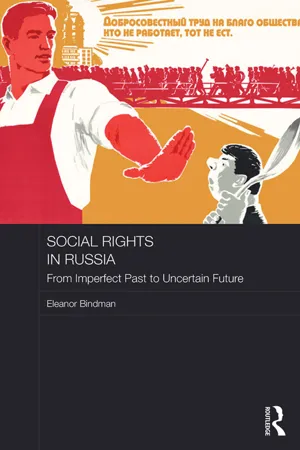
Russia's human rights record, especially violations of the right to life, liberty and freedom of expression, has been the subject of much international concern. Social, or welfare, rights, on the other hand, including the right to housing, health and access to social security, have received much less attention. This book explores the changing position in Russia towards such social rights. It explores how social rights are defined in Russia and why they are contested, and discusses how increasing liberalisation and privatisation have radically changed the very extensive former communist welfare system. It considers recent initiatives by both Putin and Medvedev to re-emphasise the role of the state in providing social services, and shows how activism to secure social benefits, especially at the local level, is relatively strong. The book concludes by assessing how social rights and welfare are likely to develop in Russia in a world increasingly concerned with austerity and the transformation of citizens into 'market citizens', where attitudes towards social rights remain less than favourable.
- 168 pages
- English
- ePUB (mobile friendly)
- Available on iOS & Android
eBook - ePub
About this book
Trusted by 375,005 students
Access to over 1.5 million titles for a fair monthly price.
Study more efficiently using our study tools.
Information
1
Introduction
Ye who sit in ease, and solace yourselves in plenty, and such there are in Turkey and Russia, as well as in England, and who say to yourselves ‘Are we not well off’, have ye thought of these things? When ye do, ye will cease to speak and feel for yourselves alone.
Tom Paine (1792, 2014: 341)
The questions of what the state should provide to its citizens; how expectations of the state’s role in the social sphere are shaped by a country’s political and historical context; and how civil society can attempt to advocate for recognition of citizens’ social rights lie at the heart of this study. The notion that as a citizen of a recognised nation-state one is entitled to the public provision of goods and services such as housing, health care and social security has not only been contested for several centuries but remains so today, with social rights constituting ideological, fluid and changing constructions (Dean 2015). Whether the debate concerns the extent to which recipients of state social benefits indicate the appropriate behaviour to be ‘deserving’ of this support or whether those forced to move to a country as refugees or asylum-seekers should be entitled to similar benefits to those enjoyed by ‘ordinary’ citizens, the idea of equal and universal entitlement has become increasingly politicised and at times dismissed, even by those positioning themselves on the Left, as outmoded. This tendency has been exacerbated at times of economic crisis, with the most recent global financial crisis of 2008–2009 providing the impetus for the introduction of a new ‘austerity’ agenda in much of Europe, bringing with it swingeing cuts to public spending and an increased reliance on means-testing and other forms of limiting entitlement. While these questions could usefully be applied to any country case-study around the world, exploring them in the context of contemporary Russia has much to tell us in terms of how social rights are perceived in a country with a long history of Communist and autocratic rule. Exploring these issues can also reveal how the relationship between the state and its citizens develops in countries moving from a totalitarian regime to whichever type of political system takes its place and of how welfare states and citizens’ perceptions of them function in authoritarian regimes. They also raise further questions of how civil society organisations in these authoritarian regimes respond to the state’s chosen social policies and attempt to mitigate the effects of changes in welfare provision which impact upon citizens’ enjoyment of social rights. As a result, Russia provides a rich case study for exploring these questions, but the issues raised have implications for similar regimes in both the post-Soviet region and the wider world.
Authoritarian regimes and the provision of public goods
Despite initial hopes that Russia and other nations emerging from the ruins of the Soviet Union after 1991 would constitute the ‘fourth wave’ of a transition from autocracy to democracy (McFaul 2002), by the 2000s it was clear that democratization in Russia had gone awry. Indeed, whereas countries in Central and Eastern Europe appeared to have made the transition to democracy successfully, Russia and many other post-Soviet states appeared to have become ‘adjectival democracies’ (Greene 2014: 13) which had formal democratic institutions such as elections and constitutions but nevertheless remained authoritarian in practice (Ottaway 2003). Rather than being passing phenomena, these ‘defective democracies’ in fact had the potential to become stable and to be seen by both elites and the population as a solution to the multiple problems that emerged in countries facing the painful transition from an autocratic regime (Merkel 2004: 55). Putin’s time in office since 2000 has not only entrenched these tendencies in Russia but has increasingly led to Russia’s political system being characterised as a ‘hybrid’ regime combining elements of democracy and autocracy and an ‘electoral’ or ‘competitive’ authoritarian regime similar to those seen in other post-Soviet states such as Belarus and Azerbaijan and further afield in countries such as Singapore and Zimbabwe (Hale 2010; Schedler 2013; Levitsky and Way 2010). Indeed, as Schedler (2013: 1) points out, electoral authoritarian regimes are now ‘the most common form of nondemocratic rule in the world’. Levitsky and Way (2010: 5) define this type of regime as one in which ‘formal democratic institutions exist and are widely viewed as the primary means of gaining power, but in which incumbents’
abuse of the state places them at a significant advantage vis-a-vis their opponents. Such regimes are competitive in that opposition parties use democratic institutions to contest seriously for power, but they are not democratic because the playing field is heavily skewed in favour of incumbents. Competition is thus real but unfair.
This definition can certainly be applied to Russia, where the formal mechanism for gaining, maintaining, and retaining power remains regular elections; real opposition parties are allowed to exist and, at least some of the time, to compete in these elections; and public opinion matters, yet where clientalist or ‘machine’ politics dominate and thus ‘tilt the playing field’ in favour of the incumbent elite under Putin (Hale 2010: 34).
One aspect of policy within electoral authoritarian regimes which remains relatively underexplored is that of welfare policy. Yet this is worthy of further analysis since, as Desai et al. (2009: 93) points out, repression is not enough to explain why authoritarian systems stay in power: some degree of redistribution to citizens is required in order to secure and maintain their loyalty to the regime, forming an ‘authoritarian bargain’, or ‘an implicit arrangement between ruling elites and citizens whereby citizens relinquish political influence in exchange for public spending’ (Desai et al. 2009: 93). This is particularly important in countries which experienced communist rule, as these regimes placed great emphasis on the provision of public welfare such as jobs, social services and subsidised housing and consumer goods in exchange for political quiescence, forming a stable ‘social contract’ between the regime and its citizens. When the regimes in Eastern Europe became unable to fulfil their side of the bargain in the 1980s, this led to protests and the ultimate implosion of the regime (Cook and Dmitrov 2017: 8–9). As this study will demonstrate, however, the idea that the state has certain obligations in terms of providing public goods to its citizens has continued to resonate in Russia even after the collapse of the Soviet regime and partial attempts at dismantling its extensive welfare system in the 1990s and early 2000s. As a result, a form of ‘social contract’ continues to apply in the post-Soviet Russian context of electoral authoritarianism, albeit in a much-modified and far narrower form. Cook and Dmitrov (2017: 9) describe it as Putin’s ‘market social contract’, or ‘a set of state of state policies and practices that shield some population strata from the effects of market competition, at the cost of economic efficiency and productivity, in order to maintain social stability’, with an emphasis on funding pensions, industrial employment subsidies, health care and maternity and family benefits (Cook and Dmitrov 2017: 18). While this form of social contract may be effective in keeping some elements of the population loyal to the Putin regime, its relatively narrow focus largely excludes other parts of the population, and this has become particularly apparent during Russia’s recent economic crisis, which began in 2014. This may in turn have an impact on the levels of public protest in Russia, which have already risen in recent years and relate to both social issues such as housing and communal services, as Chapter 4 discusses, and political issues such as the large-scale protests against fraudulent elections in 2011–2012. As Greene (2014: 220) points out, even within the constraints of an authoritarian regime Russian citizens are willing to mobilise around certain key issues which resonate with large sections of the public:
the period of Putin’s rule… reveals a citizenry capable of pressing demands against the state and, in some cases, winning; a citizenry capable of trust and mobilization; and a citizenry fully aware of the political realities in which it exists.… Russia’s election protests did not emerge from nowhere. They had roots.
There is also space for civic organisations which are interested in defending the social rights of particular vulnerable groups to step in and try to mitigate the effects of government social policy on those who do not benefit from the ‘market social contract’.
Civil society and social rights
Despite the often problematic relationship and well-documented tensions which exist between the Russian authorities and certain civic organisations, which are discussed in Chapter 6, this study reveals that where social issues in particular are concerned, civil society in Russia has an important role to play in raising and advocating for the state’s constitutional social rights obligations to be upheld. An authoritarian political regime clearly imposes a number of constraints on the work of such organisations, particularly those which are overtly critical of the authorities and which label themselves explicitly as defending the rights of ordinary citizens. Yet, as Greene (2014: 224) argues, civic groups can still find ways to work around such constraints: ‘even if we remain within an authoritarian context, civil society must recognize shifts within authoritarian rule and find ways to engage with the state along those front lines where the state continues to engage its citizens’. As a result, the relationship between the state and civil society in Russia is a key focus for this study. ‘Civil society’ as a broad concept encompasses a number of different societal actors: Faulks (1999: 18) defines it as ‘those institutions and associations, including the media, economic organisations, political parties and social movements, which are not clearly part of the state apparatus and are themselves crucial alternative sites of power. The state and civil society coexist in a relationship that is both dynamic and inherently tense’. Rather than exploring the role of these many different categories of civil society actor, this study concentrates on nongovernmental organisations (NGOs) which are organised, recognised as formal groups by the public and the authorities, and advocate for the rights and better treatment of specific groups within the population, as discussed later. The assumption that such organisations can have no input into decision making by government officials and no influence on the development of public policy within such regimes can be misleading. As Bogdanova and Bindman (2016) argue, NGOs can in fact act as valuable sources of information and expertise for policymakers and are often treated as such, particularly where social policy is concerned. Duckett and Wang (2017: 94;105) point out that where policymaking in authoritarian regimes is concerned, it is not simply a question of the ‘top leader’ taking decisions:
political institutions may work differently, but they still shape access to policy influence, and not only electoral institutions are important… policy actors in authoritarian regimes are potentially just as susceptible as their counterparts in democracies to the influence of contingent external shocks and to the complex mix and flow of ideas around them… even if they are bureaucratically dominated – policy communities can be influential in autocracies.
In China, for example, a whole range of different civil society actors, including domestic and international NGOs alongside journalists and academics, helped put the issue of rural social policy on the agenda and influenced the development of policy solutions through discussion and debate (Duckett and Wang 2017: 105). In Kazakhstan, Knox and Yessimova (2015: 14) point to evidence of ‘much greater interaction between state organs and the nongovernmental sector both in the delivery of contracted public services and direct participation on key consultation and decision-making fora’.
Where social policy in authoritarian regimes is concerned, the relatively close relationship between social-sector NGOs and the authorities at various levels of government and the regime’s reliance on such organisations to deliver certain goods and services to the population has led to concerns that these NGOs could be or have been co-opted by the state and to varying degrees absorbed into the state bureaucracy, thus voiding their ability to really challenge state policy. In the case of Kazakhstan, for example, NGOs operating in the social sphere tend not to see their main role as challenging the state, but rather as ‘a partnership model in which they felt comfortable expressing alternative opinions and views which may or may not be accepted’ (Knox and Yessimova 2015: 312). In addition, shifting social service provision onto the shoulders of NGOs allows the authorities to devolve responsibility to the third sector and to blame such organisations if the services they provide do not meet expectations in terms of quality (Knox and Yessimova 2015: 311). As Chapter 7 discusses, this is a particularly salient issue in Russia, where the tendency to outsource the provision of public services to NGOs is becoming increasingly pronounced and where such organisations frequently rely on government funding for their survival. However, this study argues that many of these organisations in fact attempt to preserve at least some degree of independence from the authorities and often prove skilled in negotiating a relationship with regional and local government which allows them to advance their goals without antagonising those in power.
Research questions and methodology
This book explores how social rights have come to be acknowledged as ‘human rights’ in the contemporary era, how such rights are conceptualised in the context of contemporary Russia, and how NGOs in Russia attempt to advocate for such rights. It focuses on the following questions:
- How are social rights defined and why do they remain contested in contemporary political discourse?
- How do Russian state and civil society actors and the general public in Russia conceptualise the meaning and significance of social rights?
- What has been the impact of the social reforms implemented by the various presidential administrations since Putin’s election in 2000 on the realisation of social rights in Russia and on civil society activity in the social sector?
- To what extent do civil society organisations in Russia working on social issues engage with the relevant state and state-affiliated structures such as the regional human rights ombudsmen and local policymakers and with the language of ‘rights’ to promote the realisation of social rights?
The research undertaken within this study sought to ascertain and interpret the views of Russian NGO representatives and a small number of relevant Russian officials, academics and members of the public on a range of issues connected to the understanding and implementation of social rights in Russia. It took an inductive and interpretivist approach to the data it has generated rather than beginning with a set of clear hypotheses to be tested. In undertaking the fieldwork aspect of this research, qualitative research methods appeared to be the most appropriate methods to employ since such methods are concerned with exploring how people interpret the social world around them (Bryman 2008). Qualitative interviews appeared to offer the time and space to explore my respondents’ attitudes and beliefs in a way that, for example, questionnaires could not. Interviews are capable of providing access to the meanings people attribute to both their experiences and the social world around them (Miller and Glassner), while Holstein and Gubrium (1997: 122) talk of ‘the interview situation’s ability to incite the production of meanings that address issues relating to particular research concerns’. The degree of flexibility provided by using interviews was also an important consideration when it came to choosing my methods for the study. Adopting a semi-structured approach by using an interview guide of possible questions or themes to raise during the interview rather than using a completely structured approach with a list of ‘closed’ questions or an unstructured approach seemed to provide the most scope for exploring meaning and allowing the respondent to lead the interview in different directions. As Holstein and Gubrium (1997: 123) point out, ‘the objective is not to dictate interpretation, but to provide an environment conducive to the production of the range and complexity of meanings that address relevant issues, and not to be confined by predetermined agendas’. In addition, opting for a semi-structured approach allows the interviewer to seek clarification of responses if necessary and thus provides greater flexibility for probing those responses. The interview thus becomes a ‘co-production’ between the interviewer and interviewee in a way that would not be possible using an unstructured or fully structured approach (Wengraf 2001: 3).
The main group of respondents with whom I was keen to make contact were representatives of two different types of Russian NGO: those working on issues more related to social rights such as social care for the elderly and d...
Table of contents
- Cover
- Title
- Copyright
- Contents
- 1 Introduction
- 2 A brief history of social rights
- 3 Social rights, neoliberalism and austerity
- 4 The development of social rights in Russia
- 5 Defending social rights? The human rights ombudsmen and NGOs
- 6 Civil society, socially oriented NGOs and the utility of a rights-based approach to advocacy
- 7 ‘Socially oriented’ NGOs and the new social policy
- 8 Conclusions
- Appendix 1: list of interviews conducted in Russia
- Appendix 2: interview guide
- Appendix 3: the Universal Declaration of Human Rights (1948)
- Appendix 4: constitution (fundamental law) of the Union of Soviet Socialist Republics
- Appendix 5: the Constitution of the Russian Federation (1993)
- Appendix 6: the Constitution of the Russian Federation (with the amendments and additions of 30 December 2008)
- Index
Frequently asked questions
Yes, you can cancel anytime from the Subscription tab in your account settings on the Perlego website. Your subscription will stay active until the end of your current billing period. Learn how to cancel your subscription
No, books cannot be downloaded as external files, such as PDFs, for use outside of Perlego. However, you can download books within the Perlego app for offline reading on mobile or tablet. Learn how to download books offline
Perlego offers two plans: Essential and Complete
- Essential is ideal for learners and professionals who enjoy exploring a wide range of subjects. Access the Essential Library with 800,000+ trusted titles and best-sellers across business, personal growth, and the humanities. Includes unlimited reading time and Standard Read Aloud voice.
- Complete: Perfect for advanced learners and researchers needing full, unrestricted access. Unlock 1.5M+ books across hundreds of subjects, including academic and specialized titles. The Complete Plan also includes advanced features like Premium Read Aloud and Research Assistant.
We are an online textbook subscription service, where you can get access to an entire online library for less than the price of a single book per month. With over 1.5 million books across 990+ topics, we’ve got you covered! Learn about our mission
Look out for the read-aloud symbol on your next book to see if you can listen to it. The read-aloud tool reads text aloud for you, highlighting the text as it is being read. You can pause it, speed it up and slow it down. Learn more about Read Aloud
Yes! You can use the Perlego app on both iOS and Android devices to read anytime, anywhere — even offline. Perfect for commutes or when you’re on the go.
Please note we cannot support devices running on iOS 13 and Android 7 or earlier. Learn more about using the app
Please note we cannot support devices running on iOS 13 and Android 7 or earlier. Learn more about using the app
Yes, you can access Social Rights in Russia by Eleanor Bindman in PDF and/or ePUB format, as well as other popular books in Politics & International Relations & Human Rights. We have over 1.5 million books available in our catalogue for you to explore.