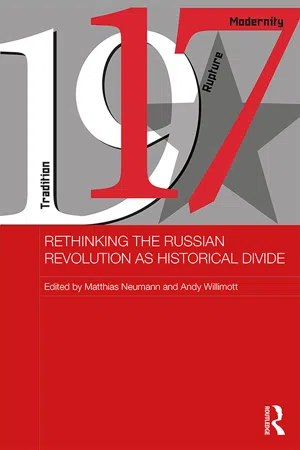
The Russian Revolution of 1917 has often been presented as a complete break with the past, with everything which had gone before swept away, and all aspects of politics, economy, and society reformed and made new. Recently, however, historians have increasingly come to question this view, discovering that Tsarist Russia was much more entangled in the processes of modernisation, and that the new regime contained much more continuity than has previously been acknowledged. This book presents new research findings on a range of different aspects of Russian society, both showing how there was much change before 1917, and much continuity afterwards; and also going beyond this to show that the new Soviet regime established in the 1920s, with its vision of the New Soviet Person, was in fact based on a complicated mixture of new Soviet thinking and ideas developed before 1917 by a variety of non-Bolshevik movements.
- 267 pages
- English
- ePUB (mobile friendly)
- Available on iOS & Android
eBook - ePub
Rethinking the Russian Revolution as Historical Divide
About this book
Trusted by 375,005 students
Access to over 1.5 million titles for a fair monthly price.
Study more efficiently using our study tools.
Information
Part I
The new state, the past, and the people
1 The problem of persistence
J. Arch Getty
Historians love watersheds and turning points. They are convenient to explain differences among periods. We put impressive labels on them: retreats are ‘Great’; upheavals of various kinds, either in policy or in the streets are ‘Revolutions’. We teach watersheds to our undergraduates because they are easy to understand and explain. And we have identified a lot of them just in the first half of the twentieth century: 1905, 1917, 1921, 1929, 1934, 1937, 1941, 1945, and 1953. Moshe Lewin was being conservative when he referred to Soviet history as a series of six different systems, each demarcated by a turning point of some kind.1
At any rate, the 1917 Russian Revolution certainly seems to be a major turning point. The economic and political collapses of 1917–1920 are striking. And because both scholars and participants who lived through the period tend to focus (sometimes exclusively) on the complete collapse of state power, the sharp break seems even more compelling. The one thing upon which the Bolsheviks and their enemies ironically agreed was that everything changed; little if anything persisted. Ideology, government, property relations, the ruling elite, established religion, and foreign policy changed suddenly and in obvious ways.
Yet it has been clear for a long time that important elements persisted across the great divide of 1917. Assertions of persistence have generally been global statements about the Soviet period rather than detailed analysis of how or why things persisted. The Soviet period was called the ‘revenge of Moscow’. An omnipotent, psychologically challenged Stalin somehow single-handedly shaped the entire Soviet culture along archaic lines. Even Edward Keenan’s classic argument for persisting ‘deep structures’ in Russian history was short on details explaining the workings and survivals of these structures.2 But we can speak meaningfully of general persistence across big events only by looking at the components. William Sewell’s studies of the French Revolution emphasized the need to identify ‘peculiar ecological situations’ and events on a case by case basis. But Sewell also insisted on the need to develop a conceptual apparatus to do this.3
This essay seeks to examine political practices that persisted across 1917 in an attempt to get below the surface of persistence using some tools of anthropology. We will reflect on such questions as ‘Why did something persist?’ ‘In what form did it persist?’ ‘What long- and short-term factors governed its persistence?’ and ‘Who, if anyone, was aware of a persisting practice?’ Aside from such specific questions, we will wonder if different kinds of persistence have anything in common with each other. Is there some thread tying them together, some underlying motor humming along beneath the surface that governs persistence?
The simplest theoretical explanation for persistence is functionalism. First applied to primitive societies, according to functionalist thinking social structure and social relations have a functional utility for the survival of society as a whole. Extending the work of Émile Durkheim and Talcott Parsons, structural functionalists argued that social roles, for example, persist because they are useful to society. There are many examples in the post-1917 period of apparent functionalism, both intentional and unconscious, as we shall see. A secret political police with broad powers, an undemocratic dictatorship, and a venal patronage oligarchy would seem to be functional to both tsars and Bolsheviks, as they would be to any regime facing revolutionary or counter-revolutionary challenges. It is easy to imagine the Bolsheviks selecting elements from the past for their new government to meet immediate utilitarian needs.4
But perhaps functionalism is too easy. Attractive as they might be at first glance, functionalist explanations have relatively weak explanatory power. Marshall Sahlins criticized functionalism because it ignores culture. ‘Functionalist practice … consists of taking the cultural properties merely as the appearance … cultural content, whose specificity consists in its meaning, is lost altogether in a discourse of “needs”’.5 ‘We speak as if … our culture were constructed out of the “real” activities and experiences of individuals rationally bent upon their practical interests’.6 Functionalism also cannot easily account for the persistence of practices long after the need for them is gone and when they obviously have become dysfunctional. Sahlins writes of a ‘rule of diminishing returns’ according to which the more distant a cultural practice is from its purported function, the less that function can describe the phenomenon.7
Sahlins’ emphasis on structure and culture bring us to historical structuralism, whose contributions may be useful to our analysis of 1917 because they explore the relationship between ‘event’ (1917, for example) and ‘structure’ (Russian culture, for example).8 In its most basic form, a strict structuralism posits that events and other human actions are determined by cultural structures. Events, along with social relations and practices, are merely products of history.
William Sewell finds that such cultural determinism assumes a too rigid causal connection in social life, because while structures define and shape events, events also redefine and reshape structures.9 As Sahlins had put it, ‘civilization … responds transformationally to events, incorporates historical perturbations as structural permutations’.10 Event and cultural structure influence each other on a two-way street.
There are plenty of ‘happenings’ but only some rise to the level of turning points that somehow change the structures that govern human conduct. Historical events are happenings that transform structures.11 Even though events redefine and reshape culture, Sewell also insists on the power of continuity and structure. ‘A proper understanding of the role of events in history must be founded on a concept of structure … most social practices … tend to be reproduced with considerable consistency over relatively extended periods of time’.12
As a student of the French Revolution, Sewell tries to come to grips with the standard notion of revolutions as ‘events’ that transform culture and structure. In so doing, he foregrounds The Event. For Sewell, a society’s cultural structure is a product of the events through which it has passed.13 But cultural structures can withstand events, fight them off, as it were. His study of the dockworkers of Marseilles shows that structured patterns can often reproduce themselves over long periods of time, even to the point of resisting major revolutionary events.14 In such cases, dramatic events do not dislodge a culture, and it makes sense to speak more of cultural continuity than persistence.
Sewell argues that structure and culture are not flat and unitary.15 Culture should be plural because ‘societies should be conceptualized as the sites of a multitude of overlapping and interlocking cultural structures’. Structures are mutually reinforcing sets of cultural schemas and material resources.16
Moreover, embedded in structure is the effect of individual agency. Sewell writes ‘What tends to get lost in the language of structure is the efficacy of human action – or “agency” to use the currently favored term.’17 Sewell believes that historical agents can change cultures and influence happenings and events; they do so in revolutions. Moreover, for him agency implies a knowledge of cultural schema and the capacity to reinterpret or mobilize an array of resources of the structure.18 As we shall also see, however, agency can be ‘unconscious’ when agents do things for reasons they don’t understand. As Pierre Bourdieu put it, there can be ‘genesis amnesia’ when actors are unaware of the cultural forces influencing them.19
For Sahlins, historical events cannot be understood except as references to and reproductions of cultural categories and meanings that comprise the field of possibilities for events. ‘The particular culture scheme constitutes the possibilities of worldly reference for the people of a given society.’20 For him, events indeed consist of references to culture, as specifications of culture. Events are not a superstructure sitting on a cultural base, as Marxists would have it.
Cultural categories, when referenced by the event, are modified and transformed; they become ‘burdened with the world’, in Sahlins’ phrase.21 ‘Every actual use of cultural ideas is some reproduction of them, but every such reference is also a difference …’.22 Every reproduction of culture is therefore an alteration, insofar as in action, the categories by which a present world is orchestrated pick up some novel empirical content.23
Sahlins takes the relationships between event and culture and between stability and change even further by abolishing the dichotomies. Because of the reciprocal impact of event on culture, ‘there is no ground either for the exclusive opposition of stability and change’.24 Both are going on at the same time; both are part of the same history. As Ferdinand de Saussure put it: ‘What predominates in all change is the persistence of the old substance; disregard for the past is only relative. That is why the principle of change is based on the principle of continuity.’25 Actions in the present are always references to the past. So past and present, system and event, structure and history are in ‘indissoluble synthesis’ with each other.26
Sahlins chides historians who ‘notoriously … isolate some changes as strikingly distinctive and call them “events” in opposition to “structure”’. He regards this as a ‘pernicious distinction’ because an event is not just a happening; it is a ‘relation between a certain happening and a given symbolic system’.27
At this point, readers might well take a deep breath, and the historians among them might be shaking their heads. Taken to extreme, the Sahlins version of structuralism erases the differences between event and culture, stability and change, and even past and present. Historians, however, at the risk of being pernicious, will always be attempting to explain events, broadly defined. We will always contrast stability and change, past and present. We have a different metaphor for explaining human action and behaviour, and dissolving everything together isn’t particularly helpful.
For purposes of historical analysis, it makes sense to agree with Sewell, who retains a focus on events and defends the difference between stability and change. So where does all this theory get us, aside perhaps from a feeling of gratitude that we are not philosophers or linguists? One does not have to become a full-blown structuralist, neo-structuralist, or post-structuralist to see that there are useful historical tools for us here, and there is no reason that we cannot pick and choose the ones that seem to help. Such propositions, which we will test below, include:
• Events cannot take place or become intelligible to us except in the structural/cultural context that produced them.
• The structure or culture of a society is in fact plural, consisting of multiple overlapping cultures.
• Continuity or persistence takes place at the level of culture.
• Events necessarily influence the cultures that produced them. When the influence is strong, culture changes to the point where we speak of dramatic change.
• When the influence is less strong, we are more likely to speak of persistence because following Sewell, we need to explain ‘why some patterns remain constant when much around them is in flux … why transformations fail to occur’.28
• Human agency, including random effects of personality, can affect the nature and power of an event. That agency can be conscious and intentional or unintentional.
Below, we will see these elements and tools in a...
Table of contents
- Cover
- Half Title
- Title Page
- Copyright Page
- Table of Contents
- List of contributors
- Crossing the divide: tradition, rupture, and modernity in revolutionary Russia
- PART I: The new state, the past, and the people
- PART II: The people, the past, and the new state
- Epilogue: the Russian tradition? Discourses of tradition and modernity
- Bibliography
- Index
Frequently asked questions
Yes, you can cancel anytime from the Subscription tab in your account settings on the Perlego website. Your subscription will stay active until the end of your current billing period. Learn how to cancel your subscription
No, books cannot be downloaded as external files, such as PDFs, for use outside of Perlego. However, you can download books within the Perlego app for offline reading on mobile or tablet. Learn how to download books offline
Perlego offers two plans: Essential and Complete
- Essential is ideal for learners and professionals who enjoy exploring a wide range of subjects. Access the Essential Library with 800,000+ trusted titles and best-sellers across business, personal growth, and the humanities. Includes unlimited reading time and Standard Read Aloud voice.
- Complete: Perfect for advanced learners and researchers needing full, unrestricted access. Unlock 1.5M+ books across hundreds of subjects, including academic and specialized titles. The Complete Plan also includes advanced features like Premium Read Aloud and Research Assistant.
We are an online textbook subscription service, where you can get access to an entire online library for less than the price of a single book per month. With over 1.5 million books across 990+ topics, we’ve got you covered! Learn about our mission
Look out for the read-aloud symbol on your next book to see if you can listen to it. The read-aloud tool reads text aloud for you, highlighting the text as it is being read. You can pause it, speed it up and slow it down. Learn more about Read Aloud
Yes! You can use the Perlego app on both iOS and Android devices to read anytime, anywhere — even offline. Perfect for commutes or when you’re on the go.
Please note we cannot support devices running on iOS 13 and Android 7 or earlier. Learn more about using the app
Please note we cannot support devices running on iOS 13 and Android 7 or earlier. Learn more about using the app
Yes, you can access Rethinking the Russian Revolution as Historical Divide by Matthias Neumann,Andy Willimott in PDF and/or ePUB format, as well as other popular books in Social Sciences & Ethnic Studies. We have over 1.5 million books available in our catalogue for you to explore.