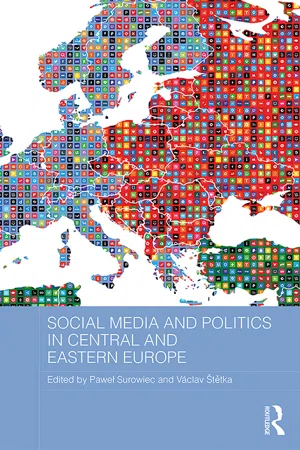
Social media are increasingly revolutionising the ways in which political communication works, and their importance for engaging citizens in politics and public affairs is well understood by political actors. This book surveys current developments in social media and politics in a range of Central and Eastern European countries, including Ukraine and Russia. It explores the process of adoption of social media by politicians, journalists and civic activists, examines the impact of the different social and cultural backgrounds of the countries studied, and discusses specific political situations, such as the 2012 protests in Moscow and the 2014 EuroMaidan events in Ukraine, where social media played an important role. The book concludes by addressing how the relationship between social media and politics is likely to develop and how it might affect the still relatively new democracies in the region.
- 208 pages
- English
- ePUB (mobile friendly)
- Available on iOS & Android
eBook - ePub
Social Media and Politics in Central and Eastern Europe
About this book
Trusted by 375,005 students
Access to over 1.5 million titles for a fair monthly price.
Study more efficiently using our study tools.
Information
Subtopic
Regional StudiesIndex
Social SciencesPart I
Political parties, actors and social media
1 Who is afraid of the platforms?
Adoption of and strategies for use of social media by politicians in the Czech Republic
Alena Macková, Václav Štětka, Jan Zápotocký, Radim Hladík
Over the course of the last several years, social media have established themselves as a stable, fully-fledged part of the political communication process across the developed world and beyond; complementing or, in the case of some political actors and parties, even replacing the traditional media as the main vehicle for disseminating information and mobilizing voters. Social media, as the advanced successors of the first Web 2.0 technologies like blogs and internet discussion forums, have come to dominate the sphere of online communication, with Facebook gaining prominence as the world’s largest social networking site (SNS), with over 1.7 billion users in 2016. Together with Twitter, YouTube and Instagram, these SNSs offer new opportunities for politicians and parties to promote their ideas, programmes and self-images, mobilize supporters and communicate with voters, while sidestepping the traditional gatekeeping role of the news media (e.g. Johnson and Perlmutter, 2011; Hendricks and Kaid, 2010). In light of such apparent benefits, it is not surprising that more and more politicians and political actors in general feel compelled to adopt these new technologies into the repertoire of instruments for political communication, and particularly election campaigns. The process of adoption of social media by political elites, as well as their actual communication practices, have recently become the subject of extensive academic enquiry, producing numerous country-case studies (e.g. Bernhard and Dohle, 2015; Grant et al., 2010; Nilsson and Carlsson, 2014; Strandberg, 2013) and comparative research (Graham et al., 2016; Larsson and Kalsnes, 2014).
However, so far the vast majority of studies has focused on either the adoption itself (mapping the penetration of SNSs among politicians and election candidates) or on the intensity of use and content of communication channelled via these platforms during interactions among politicians and citizens or journalists. Compared with a substantial amount of studies dealing with these processes and issues, research has so far rather neglected motivational, attitudinal as well as strategic aspects of the use of social networking sites by political actors. These are arguably essential for our ability to better understand the process of adoption and to get a deeper insight into the tangled relationships between politicians, parties, communication and PR strategists, and citizens/social media users which define the contemporary framework of online political communication. In other words, while we have increasingly comprehensive data – despite the still significant geographical gaps in the scholarship – on how intensely politicians and candidates use social media and what kind of content is being communicated, we are still lacking proper understanding of why they reach for these technologies: what are the driving factors behind their adoption, how elaborated or premeditated are the forms and tactics of their use, and how do members of the political elite evaluate social media’s efficiency and impact? Given this imbalance in online political communication research, which has been predominantly metrics-oriented and increasingly driven by the ‘big data’ approach, attitudes of political actors themselves vis-à-vis the social media, or the reasons why they advance a particular kind of communication style or promote a certain type of self-image on their Facebook accounts, remain a bit of a black box.
In this chapter, we attempt to contribute to this still relatively sidelined sub-domain of research on the role of social media – Facebook especially – in political communication by presenting a case study based on semi-structured interviews with fifteen members of the lower chamber of the Czech Parliament. In the study, we pursue two main goals: first, to explore the motivations of Czech politicians for their adoption of social media, as well as their general attitudes towards these technologies; and second, to examine the actual ways and strategies of their use, particularly with respect to the extent of personalization and professionalization. Through this exploratory probe we are hoping to add to the branch of international scholarship concerned with the actors’ own reflexivity in the political communication process in the age of social media; while at the same time we strive to further the understanding of the process of adoption of SNS by political elites in the Czech Republic.
Politicians on social networking sites: key discourses and areas of enquiry
Overviewing the approaches to the use of new communication technologies by politicians, we can identify two dominant – even if to some extent overlapping – discourses. In the first one, new media (or social networking sites in particular) are perceived as platforms for a democratic connection between citizens and politicians; while in the second discourse they are predominantly seen as tools for election campaigning. Within the first approach, new media are thought to foster solutions to the problems of declining political participation and diminishing appeal of traditional political institutions, which are commonplace in contemporary democratic societies. The increasing online activities of politicians and parties are seen as an attempt to bridge the widening gap between citizens and political elites (Coleman, 2005), enabling creation of a new, direct and more ‘authentic’ relationship with voters (Coleman and Blumler, 2009; Coleman and Moss, 2008). The second discourse, which is becoming increasingly dominant in academic scholarship in recent years, focuses primarily on the use of new media in election contests, where the connection between citizens/voters and politicians is not so much a goal as an instrument of potential electoral gains. The rise of Facebook and other social media brings significant broadening of the spectrum of ways in which potential voters can be addressed and influenced. Nevertheless, while such platforms certainly stimulate the emergence of new styles of campaigning and election communication, they are becoming incorporated into the spectrum of other, existing instruments of campaigns rather than comprising dominant campaign tools themselves (Howard, 2006; Karlsen, 2010).
The empirical research carried out within these two main discourses on the role of social media in politics usually concentrates on two key issues: the adoption of particular platforms (e.g. Larsson and Kalsnes, 2014; Macková et al., 2013; Strandberg, 2013; Williams and Gulati, 2013), usually in connection with the presumed influence of socio-demographic or structural variables (Ward et al., 2007), and on the content and style of communication by individual politicians or candidates (Graham et al., 2016; Larsson 2016; Štětka et al., 2014; Vergeer et al., 2013), revealing that this communication tends to be, generally speaking, more informative than interactive, as well as less personalized and discontinuous – following the election cycle – rather than incessant (Graham et al., 2016; Grant et al., 2010; Larsson, 2016). However, as the existing research so far does not identify clear, unambiguous trends and patterns across countries and party-political systems, but rather heterogeneity in the adoption and style of use of social media by political actors (see e.g. Lilleker et al., 2015), there is even more of an argument for focusing on a third topic – namely, exploring politicians’ motivations for adoption and use of social media, including attempts to better comprehend their behaviour on SNSs (Larsson and Svensson, 2014). So far there have been only a few studies in a handful of countries (particularly Scandinavian ones) which have mapped politicians’ motivations, either via surveys (Bernhard and Dohle, 2015; Marcinkowski and Metag, 2014; Karlsen, 2011; Karlsen and Enjolras, 2016) or qualitative interviews (e.g. Enli and Skogerbø, 2013; Nilsson and Carlsson, 2014; Peroutková, 2014; Ross and Bürger, 2014; Rustad and Sæbø, 2013; Sørensen, 2016), or combining interviews with other types of data (Karlsen and Skogerbø, 2015; Macková, 2015).1
While still limited, research in this particular area indicates that social media are perceived by politicians as very important instruments (Nilsson and Carlsson, 2014), the more so the more often they use them (Bernhard and Dohle, 2015). According to the politicians themselves, social media serve them primarily for gathering information, communicating with voters or setting an agenda (Bernhard and Dohle, 2015; Karlsen, 2011). In Norway, Karlsen and Enjolras (2016) identified two types of candidates according to their communication style: those whose style was more aligned with their own political party (with an attempt to inform and mobilize), and those whose style has been more individualized, oriented at gaining publicity and attempting to display their personality, with the former style being more frequent according to the researchers. Likewise, some Czech politicians and senators said that they use Facebook for a more personalized, intimate presentation of themselves – but with only a marginal tendency to involve citizens and use the interactive potential of the network (Peroutková, 2014).2
Social media in Czech society and Czech politics
The changes in political communication made possible by the new media necessarily require an adequate internet infrastructure to be in place. The Czech Republic once lagged behind Western European countries in internet penetration. Over the last decade, however, the country has seen a higher increase in internet accessibility than some other countries in the EU. While in 2006 it was placed among the low performing countries, with 29 per cent of households connected to the internet, in 2014 it approximated the EU average of 81 per cent, with 78 per cent online households (Czech Statistical Office, 2015, p. 25). This infrastructure translates into widespread use of the internet, which is reported to be at 80 per cent among people aged 16+, which is slightly above the EU average of 78 per cent (Czech Statistical Office, 2015, p. 32).
The digital divide among internet users in the Czech Republic runs along the age and education axis. There is an indication of a negligible gender gap, with 77 per cent male users and 71 per cent female users in 2014 (Czech Statistical Office, 2015, p. 31). The age gap appears more tangible, although it has also been narrowing over the years. In 2009, the age cohort 16–24 had more than twice the number of internet users (90 per cent) in comparison to 55–64 cohort (36 per cent); while by 2014 the difference between the same cohorts had diminished to one third, with 98 per cent and 64 per cent of internet users respectively (ibid., p. 31). The divide cuts the most deeply between educational levels, with, on the one hand, merely 24 per cent of internet users among people with primary education only, and, on the other hand, 95 per cent of internet users among those with completed tertiary education. Since age and education ‘consistently’ affect voting participation in the Czech Republic (Linek, 2013), we must assume that the online and offline public spheres do not easily overlap.
The participation on social network sites reflects some of the patterns of general internet use. In 2007, the global social media platforms and brands were virtually absent from the Czech online environment. According to a survey by Veselá and Šmahel (2009), in 2006 and 2007 the most popular online community was lide.cz, while no respondents included SNSs such as Facebook, MySpace or Twitter in their mix of regularly visited servers. By 2014, however, SNSs had become a truly mass phenomenon, with 37 per cent of people older than 16 years claiming to use them (Czech Statistical Office, 2015, p. 35); still, this figure puts the Czech Republic below the EU average of 46 per cent (ibid., p. 36). In the SNSs, usage, age and education act as important variables. Among those with primary education, SNS users account for 8 per cent as opposed to 47 per cent among those with tertiary degrees. Age constitutes an even more pronounced divide, where the 90 per cent of users in the 16–24 cohort contrast with 11 per cent in the 55–64 cohort (ibid., p. 35). The introduction of global SNSs, however, gradually changed the market arrangements for social media in the country. Facebook is now the most popular network, with 65.8 per cent of adult internet users, followed by YouTube (44.8 per cent) (Štětka and Mazák, 2014). The number of Twitter users remains rather uncertain, but it is generally believed not to exceed 300.000 or 3 per cent of the population (Štětka and Hladík, 2016). Without a doubt, the online environment and SNSs have become an important communication domain in the Czech Republic, especially for young people. Among the internet users, getting and checking information online has surpassed the importance of television and 37 per cent of them use the internet specifically for seeking political information (Lupač et al., 2014, p. 15). Symptoms of these new communication opportunities can be discerned in the history of recent elec...
Table of contents
- Cover
- Half Title
- Title Page
- Copyright Page
- Table of Contents
- List of illustrations
- List of contributors
- Foreword
- Acknowledgements
- Introduction: social media, politics and democracy in post-transition Central and Eastern Europe
- PART I: Political parties, actors and social media
- PART II: Social movements, interest and professional groups and social media
- Conclusions
- Index
Frequently asked questions
Yes, you can cancel anytime from the Subscription tab in your account settings on the Perlego website. Your subscription will stay active until the end of your current billing period. Learn how to cancel your subscription
No, books cannot be downloaded as external files, such as PDFs, for use outside of Perlego. However, you can download books within the Perlego app for offline reading on mobile or tablet. Learn how to download books offline
Perlego offers two plans: Essential and Complete
- Essential is ideal for learners and professionals who enjoy exploring a wide range of subjects. Access the Essential Library with 800,000+ trusted titles and best-sellers across business, personal growth, and the humanities. Includes unlimited reading time and Standard Read Aloud voice.
- Complete: Perfect for advanced learners and researchers needing full, unrestricted access. Unlock 1.5M+ books across hundreds of subjects, including academic and specialized titles. The Complete Plan also includes advanced features like Premium Read Aloud and Research Assistant.
We are an online textbook subscription service, where you can get access to an entire online library for less than the price of a single book per month. With over 1.5 million books across 990+ topics, we’ve got you covered! Learn about our mission
Look out for the read-aloud symbol on your next book to see if you can listen to it. The read-aloud tool reads text aloud for you, highlighting the text as it is being read. You can pause it, speed it up and slow it down. Learn more about Read Aloud
Yes! You can use the Perlego app on both iOS and Android devices to read anytime, anywhere — even offline. Perfect for commutes or when you’re on the go.
Please note we cannot support devices running on iOS 13 and Android 7 or earlier. Learn more about using the app
Please note we cannot support devices running on iOS 13 and Android 7 or earlier. Learn more about using the app
Yes, you can access Social Media and Politics in Central and Eastern Europe by Paweł Surowiec,Václav Štětka in PDF and/or ePUB format, as well as other popular books in Social Sciences & Regional Studies. We have over 1.5 million books available in our catalogue for you to explore.