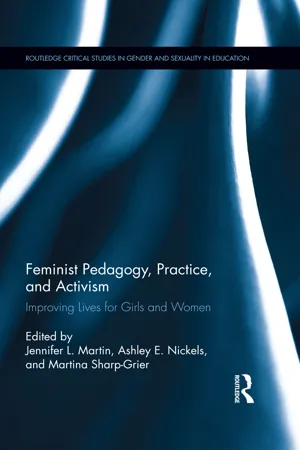
Feminist programming, no matter the venue, provides opportunities for young girls and women, as well as men, to acquire leadership skills and the confidence to create sustainable social change. Offering a wide-ranging overview of different types of feminist engagement, the chapters in this volume challenge readers to critically examine accepted cultural norms both in and out of schools, and speak out about oppression and privilege. To understand the various pathways to feminism and feminist identity development, this collection brings together scholars from education, women's studies, sociology, and community development to examine ways in which to integrate feminism and women's studies into education through pedagogy, practice, and activism.
eBook - ePub
Feminist Pedagogy, Practice, and Activism
Improving Lives for Girls and Women
- 276 pages
- English
- ePUB (mobile friendly)
- Available on iOS & Android
eBook - ePub
Feminist Pedagogy, Practice, and Activism
Improving Lives for Girls and Women
About this book
Trusted by 375,005 students
Access to over 1.5 million titles for a fair monthly price.
Study more efficiently using our study tools.
Information
Topic
EducationSubtopic
Education GeneralPart I
Introduction
Pedagogy
Feminist pedagogies share a commitment to creating change to improve women’s lives
(Williams & Ferber, 2008, p. 47)
Being the editor of the pedagogy section of this volume is truly representative of my life’s work. My first exposure to feminism in a formal sense was in 1987, when I had the opportunity to take a women’s studies course as a senior in high school. My consciousness was raised, and I was from then on forever a feminist. Although I held beliefs that would be considered feminist prior to taking this course, I had not the language to describe or characterize them. I am and will be forever grateful to my high school women’s studies teacher, Sensei Sanders, co-author of Chapter 3 in this volume, for providing me with the vocabulary and the literature to solidify my teenage sentiments. My high school women’s studies course led me to minor in women’s studies as an undergraduate, the only degree my institution then offered in the field; later I earned a master’s degree in women’s studies. Somewhere in between I became a high school English teacher where I attempted to carry on the traditions of feminism that I learned as a high school senior. For this, I will forever be grateful to Ms. Sanders. In this section, feminist pedagogy will be explored and explicated both by veteran and current scholars and practitioners.
In Chapter 1, “And the Danger Went Away: Speculative Pedagogy in the Myth of the Post-Feminist,” I review my 15 years working in an alternative high school with students labeled “at-risk” for school failure and my most relevant experience with teaching women’s studies. In this chapter, I reflect on my previous experience attempting to reduce the sexual harassment that was so prevalent in the school, filtered through the lens of critical distance. Over 10 years later, I develop a pedagogical framework, “speculative feminist pedagogy,” not only to make sense of my own experience, but also to provide guidance into the feminist pedagogical goal: an imagined future, where students and teachers collectively work toward what now seems unimaginable—a feminist utopia.
In Chapter 2, “Girls Talk Back: Changing School Culture through Feminist and Service-Learning Pedagogies,” I pull from the field of girls studies to problematize the concept of the “at-risk” girl versus the “can-do” girl (Harris, 2004). This chapter represents the power of passion and persistence. I had been working to publish this story of teaching women’s studies using service-learning pedagogies for many years—five to be exact. Eventually exhausted by the “revise and resubmit process,” I invited my colleague, Dr. Jane A. Beese, to assist me. We did eventually get the manuscript published in a peer-reviewed journal (reprinted here with permission from The High School Journal). This chapter brings together feminism and service-learning through student critique of sexist practices in the media and in the school and in establishing cultural competence through engaging in projects that students led. The need for such a proposition was the fact that many of the students continued to feel powerless to combat the sexism they faced in their lives; more specifically, despite previous interventions, there was a persistent culture of sexual harassment in this school and the female students expressed not only their helplessness in combating it, but also the sense that such phenomena were normative and simply what women have to face in the world. In order to provide these female students with a sense of control in their lives, the conditions to engage in student-led and directed projects, were established. This chapter represents a reflection on this journey.
In Chapter 3, “A Second Wave: Teaching Women’s Studies in High School from 1972 through the New Millennium,” Patricia Fowler Sanders and Ann S. Kemezis, veteran women’s studies teachers since the early 1970s, begin with an historical lens and tell the story of creating and sustaining a high school women’s studies program beginning in 1970 in metro Detroit, Michigan through 2001. Sanders and Kemezis detail their struggles and triumphs in a culture that was not necessarily ready for feminism. They also share 30 years of reflections on curricular approaches and materials in their literature-based women’s studies courses, as well as recollections on their many students of feminism, numbering in the thousands.
In Chapter 4, “Defying Cultural Norms: Launching Women’s Studies in the High School Setting,” Annie Delgado reveals her own story of the low expectations that were held for her within her community because of her sex. But for a close relative and mentor, she might not have had the opportunity to tell her story, which includes finishing college, despite the low expectations placed upon her, and completing her law degree, which took her to Washington, D.C. Working on civil rights issues in D.C., Delgado had the opportunity to work with young people, which led her back to her own community. In this chapter, she tells of her triumph in creating a women’s studies course that feminist icons took part in that not only was transformational for the students, but also for her—gaining her national recognition. This chapter recalls stories about the need and origin of the course, types of programming Delgado offers in her classes, the guest speakers she has had (including Gloria Steinem), how her students procured them, and the impact the feminist lessons have had on her students and the school.
In Chapter 5, “First, Second and Third Waves of Feminism: Providing ‘Life Rafts’ for Women of All Generations,” my mentor, Michele A. Paludi, details how she brings feminism to young undergraduates, despite the belief in the post-feminist: all of the battles have been won and feminism is no longer necessary. Paludi also reveals that some young people hold various misperceptions of feminism and of the achievements of feminism. In this chapter, Paludi shares practical exercises that have been effective with various populations to reveal the present and urgent need of feminism in our classrooms and our lives.
References
Harris, A. (2004). All about the girl: Culture, power, and identity. New York, NY: Routledge.
Williams, R. L., & Ferber, A. L. (2008). Facilitating smart-girl: Feminist pedagogy in service learning in action. Feminist Teacher: A Journal of the Practices, Theories, and Scholarship of Feminist Teaching, 19 (1), 47–67.
1
And the Danger Went Away
Speculative Pedagogy in the Myth of the Post-Feminist
We can only know what we can truly imagine. Finally what we see comes from ourselves
—Marge Piercy , Woman on the Edge of Time
As I began to think about how to write about feminist pedagogy and my experiences teaching women’s studies at an alternative high school for nearly a decade, I sought inspiration from one of my favorite feminist thinkers: Marge Piercy. Piercy reminds us why it is important to envision a different reality, particularly when our current reality is less than ideal:
When women are politically active in a way that seems to bring forward motion, then we have more energy and more desire to speculate about the kind of society we might particularly like to live in. When most of our political energy goes into defending gains we have made that are under attack, whether we are defending the existence of women’s studies, access to safe medical abortions or affirmative action, there seems to exist among us less creative energy for imagining a fully realized alternative to what surrounds us.
(pp. 76–77)
Piercy’s quotation was especially moving to me, because this is exactly what my female students were experiencing, although not in a traditionally political context. Much of their energy was spent not on their schoolwork, but in processing and dealing with sexism and sexual harassment in their male-dominated school culture. They thus did not possess the mental or emotional energy to invest in their academic pursuits as much as they might have, had they not faced such a hostile school culture.
As I detail in Chapter 2 of this volume, the girls in the alternative high school where I taught experienced a high degree of sexual harassment. I thus adapted my women’s studies course to address this and other issues that the girls were facing.
I desired, through what I deem “speculative pedagogy,” to create a classroom space where the girls in the school could experience “what could be”: a classroom of their own creation, free from the sexual harassment that was rampant outside of that space.
Piercy speaks of the purpose of envisioning utopias, “It is by imagining what we truly desire that we begin to go there. That is the kind of thinking about the future that seems to me most fruitful, most rewarding” (p. 84). It was my goal to create a feminist utopia in the classroom. My view of such a utopia is grounded in my own memories of Piercy’s speculative fiction and of my own high school women’s studies course, i.e., with my own coming to feminism. I was conscious of my own level of comfort in such a feminist utopian space; I was a sensitive and shy, but also rebellious teen—words were difficult. As a teen I experienced what I deem “inarticulate rage.” I was angry, but could not explain why. In fact, it was hard for me to express myself at all, particularly verbally, but for those few instances where I was able to find solace within that feminist pedagogical utopian framework. I did not fully find my voice until my late thirties.
As that shy rebel, as that voiceless underdog, I was able to easily relate to the population of the alternative school. They were deemed “troubled,” “rebellious,” and “at-risk.” Many were judged harshly by other teachers in the district and community members as “losers,” as “beyond hope” and “beyond help.” Although I never had any trouble in school academically, I had many friends who did. All of these alternative students had been forced to leave their traditional high schools for infractions such as physical violence, multiple suspensions, and absenteeism. Maybe I answered the call to work there because of a mutual acceptance—of a subconscious affiliation with a “misfit culture.” Many teachers who worked there did so only until a spot became available at another school in the district. I never desired this opportunity to “escape.” This was my school; this was my home, and I worked very hard to make it the best place that I could.
Now an academic and writer, I am still a teacher first and foremost. I resent it when I hear people in the media attack teachers, claiming that they get paid too much, or do not work hard enough. I also resent the attack on teacher unions. However, I think that there is a fundamental problem occurring in today’s schools. That fundamental problem is with our teaching force and it is similar to the problem with our police forces: that of the overt and implicit bias against non-hegemonic populations.
Although many teachers in the alternative school thought they possessed the best of intentions, a social worker, in describing the resilience of our students, compared them to cockroaches. Another co-worker stated that she wished the school district could spray birth control over “Shack Town,” as only residents could deem it—the low-income neighborhood housing development where many of our students lived. The principal argued that if one of the girls would simply stop “turning tricks,” that she might be better able to focus on her schoolwork. As Bay-Cheng reminds us (2015b), “The stigmatization of women of color and/or those perceived as poor or working-class hinges on their characteristics as at the mercy of boundless, undiscriminating, amoral appetites…” (p. 335). Likewise, many adults working within the school blamed students for their plights and could not or would not see the institutional factors at play in their lives. In is within this context: negative community perceptions of the school, deficit-minded thinking on the part of many of the staff, and a school culture rampant with sexual harassment, that I sought to create a feminist utopia through speculative pedagogy. To this day, it is the hardest thing I ever did.
What Is Feminist Pedagogy? Theory
Feminist education—the feminist classroom—is and should be a place where there is a sense of struggle, where there is visible acknowledgement of the union of theory and practice, where we work together as teachers and students to overcome the estrangement and alienation that have become so much the norm.
—bell hooks
Feminist pedagogy absolutely necessitates the “de-centering” of the teacher and should inspire pedagogical struggle. But most classroom sites are not places of intellectual struggle, particularly in low-income and urban areas; instead, they are places of behavioral struggle, where students are perceived as entities worthy only of control, discipline, and punishment (Milner, 2015; Morris, 2016). One wonders: if students were valued and thought capable of intellectual sophistication, would teachers have so many “behavioral issues,” which are undoubtedly exacerbated by cultural mismatch and implicit bias? According to critical pedagogue Paulo Freire (1970), the banking model of education, where teachers directly transmit knowledge into the minds of students, is a passive one. As Freire argues, “The more students work at storing the deposits entrusted to them, the less they develop the critical consciousness which would result from their intervention in the world as transformers” (p. 73). To extend Freire’s line of thinking, students in low-income and urban areas are not viewed valuable enough to grow to be transformers; thus, the teacher is the sole authority in the classroom—those who do not abide by this authoritarian type of teaching are punished accordingly.
Conversely, to create an atmosphere of transformation within the classroom requires a sense of action and involvement in one’s own learning that necessitates the de-centering of the teacher. As the teacher moves to the side, the students can move front and center, taking a more active role in learning, in choice of curriculum, in pedagogical decisions. This de-centering asks more of the learner and less of the teacher as the sole proprietor of knowledge, where, for example, students sit passively and listen to the teacher lecture. Again, this de-centering does not often happen in low-income, urban, or alternative schools w...
Table of contents
- Cover
- Title
- Copyright
- Contents
- List of Contributors
- Foreword
- Editors’ Introduction
- Acknowledgements
- PART I Pedagogy
- PART II Practice
- PART III Activism
- Index
Frequently asked questions
Yes, you can cancel anytime from the Subscription tab in your account settings on the Perlego website. Your subscription will stay active until the end of your current billing period. Learn how to cancel your subscription
No, books cannot be downloaded as external files, such as PDFs, for use outside of Perlego. However, you can download books within the Perlego app for offline reading on mobile or tablet. Learn how to download books offline
Perlego offers two plans: Essential and Complete
- Essential is ideal for learners and professionals who enjoy exploring a wide range of subjects. Access the Essential Library with 800,000+ trusted titles and best-sellers across business, personal growth, and the humanities. Includes unlimited reading time and Standard Read Aloud voice.
- Complete: Perfect for advanced learners and researchers needing full, unrestricted access. Unlock 1.5M+ books across hundreds of subjects, including academic and specialized titles. The Complete Plan also includes advanced features like Premium Read Aloud and Research Assistant.
We are an online textbook subscription service, where you can get access to an entire online library for less than the price of a single book per month. With over 1.5 million books across 990+ topics, we’ve got you covered! Learn about our mission
Look out for the read-aloud symbol on your next book to see if you can listen to it. The read-aloud tool reads text aloud for you, highlighting the text as it is being read. You can pause it, speed it up and slow it down. Learn more about Read Aloud
Yes! You can use the Perlego app on both iOS and Android devices to read anytime, anywhere — even offline. Perfect for commutes or when you’re on the go.
Please note we cannot support devices running on iOS 13 and Android 7 or earlier. Learn more about using the app
Please note we cannot support devices running on iOS 13 and Android 7 or earlier. Learn more about using the app
Yes, you can access Feminist Pedagogy, Practice, and Activism by Jennifer Martin,Ashley E. Nickels,Martina Sharp-Grier,Jennifer L. Martin in PDF and/or ePUB format, as well as other popular books in Education & Education General. We have over 1.5 million books available in our catalogue for you to explore.