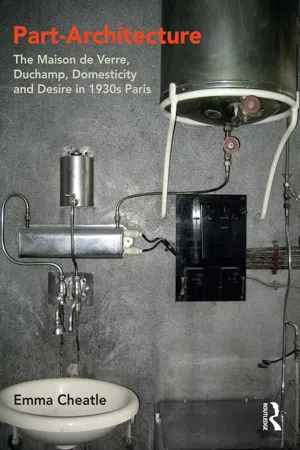
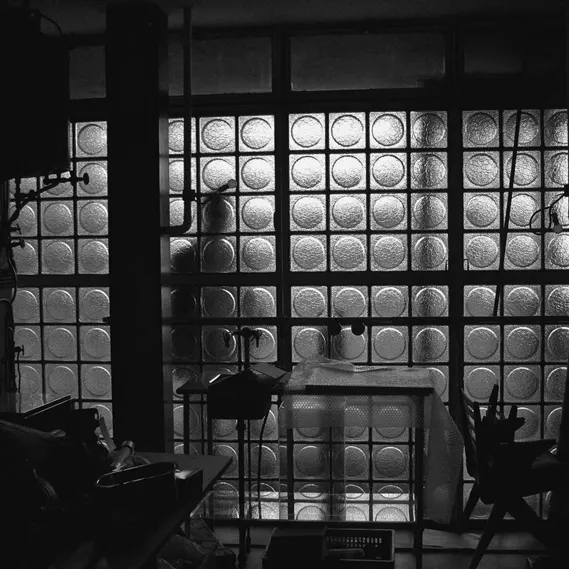
Part-Architecture presents a detailed and original study of Pierre Chareau's Maison de Verre through another seminal modernist artwork, Marcel Duchamp's Large Glass. Aligning the two works materially, historically and conceptually, the book challenges the accepted architectural descriptions of the Maison de Verre, makes original spatial and social accounts of its inhabitation in 1930s Paris, and presents new architectural readings of the Large Glass. Through a rich analysis, which incorporates creative projects into history and theory research, the book establishes new ways of writing about architecture.
Designed for politically progressive gynaecologist Dr Jean Dalsace and his avant-garde wife, Annie Dalsace, the Maison de Verre combines a family home with a gynaecology clinic into a 'free-plan' layout. Screened only by glass walls, the presence of the clinic in the home suggests an untold dialogue on 1930s sexuality. The text explores the Maison de Verre through another radical glass construction, the Large Glass, where Duchamp's complex depiction of unconsummated sexual relations across the glass planes reveals his resistance to the marital conventions of 1920s Paris. This and other analyses of the Large Glass are used as a framework to examine the Maison de Verre as a register of the changing history of women's domestic and maternal choices, reclaiming the building as a piece of female social architectural history.
The process used to uncover and write the accounts in the book is termed 'part-architecture'. Derived from psychoanalytic theory, part-architecture fuses analytical, descriptive and creative processes, to produce a unique social and architectural critique. Identifying three essential materials to the Large Glass, the book has three main chapters: 'Glass', 'Dust' and 'Air'. Combining theory text, creative writing and drawing, each traces the history and meaning of the material and its contribution to the spaces and sexuality of the Large Glass and the Maison de Verre. As a whole, the book contributes important and unique spatial readings to existing scholarship and expands definitions of architectural design and history.
Trusted by 375,005 students
Access to over 1.5 million titles for a fair monthly price.
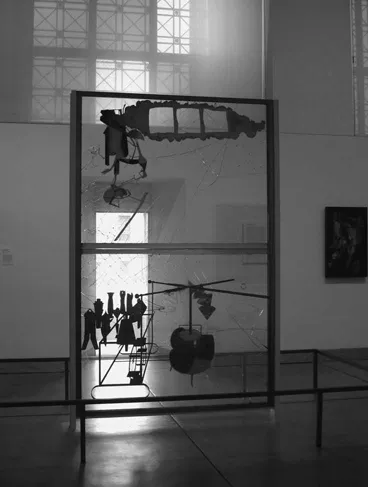
On encountering the Maison de Verre and the Large Glass 20 years ago, they appeared to me be related or aligned, sharing common materials – glass and metal – and formed around similar themes – sexual relations between male and female. This book argues for a stronger set of connections and, reading both works inventively, situates the Large Glass as a framework and set of clues to understanding the Maison de Verre (Figure 1.1). Using what I call 'part-architecture' – a series of part-analytical, part-creative processes – I both analyse the Large Glass as a spatial proposition and construct a very different view of the Maison de Verre than the one propagated by traditional architectural history.
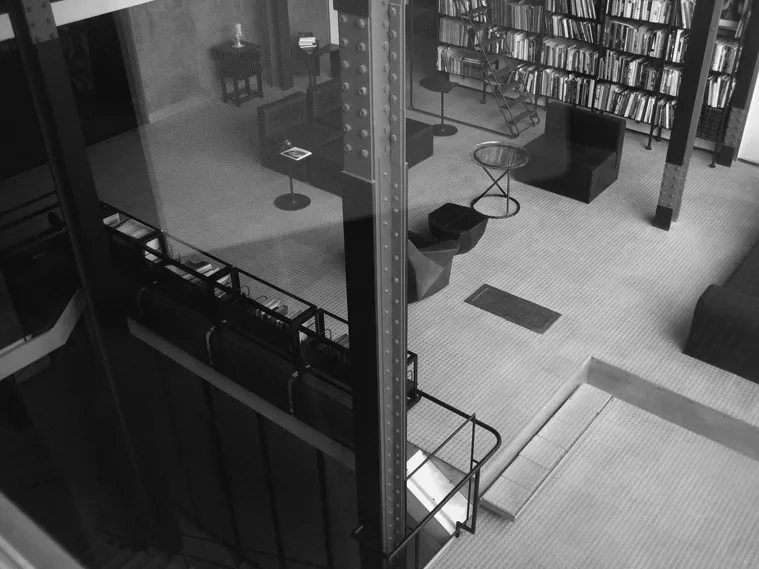
Figure 1.2 Pierre Chareau, Maison de Verre, Paris, 1928–32. Salon. Photograph Emma Cheatle, 2009, with permission of Robert Rubin
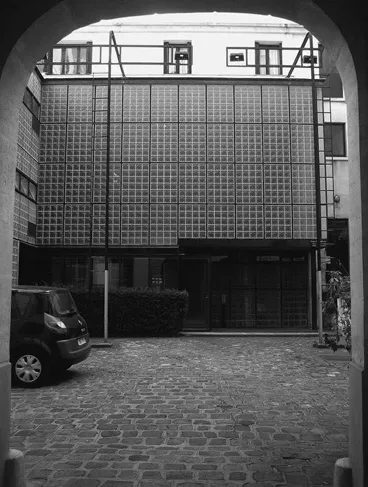
The Maison de Verre was designed by Pierre Chareau (1883–1950) in Paris from 1928 to 1932 for gynaecologist Dr Jean Dalsace and his wife, Annie Dalsace. In addition to the comprehensive use of glass as a building material, the building is notable for its 'free plan' (open plan layout) and the incorporation of a gynaecology clinic into the main body of the house. The Dalsaces were known for their intellectual connections and progressive politics. On completion, the huge first floor salon, glazed by a wall of lenses, was a scene frequented by well-known avant-garde Parisians (Figure 1.2).1 Similarly, the clinic, occupying most of the ground floor and also screened from the public face by glass lenses alone, must have been visited by numerous woman seeking treatment or advice, including contraception and abortion (Figure 1.3). Their names and histories are unknown. This, it can be argued, is due, on the one hand, to the social context of pro-natalism, which attempted to maintain a maternal and domestic agenda for women, and on the other, the perception of appropriate subject matter for twentieth-century architectural history writing.
The enigmatic artwork the Large Glass, or La mariée mise à nu par ses célibataires, même (The Bride Stripped Bare by her Bachelors, Even), was constructed by Marcel Duchamp (1887–1968) in New York from 1915–23. A large vertical construction nearly 3 metres high and 2 wide, it is divided horizontally into two glass panels on which a narrative of unconsummated sex between the bride above and the bachelors below is played out. Framed in steel, their relations are composed through instruments and figures made of oil, varnish, lead foil, lead wire, silver and dust applied painstakingly to the back surface of the panes of glass. It is now too fragile to be moved and permanently housed at the Philadelphia Museum of Art. Duchamp accompanied the artwork with a number of notes suggesting its narrative. I argue that these, along with early prototypes and other specific artworks, comprise a practice through which the figure of the Large Glass can be understood as a complex discourse on sexuality in the early twentieth-century.2
Figure 1.3 Pierre Chareau, Maison de Verre, Paris, 1928–32. Gynaecology surgery from the inside. Photograph Emma Cheatle, 2009, with permission of Robert Rubin
Where the bodies depicted in the Large Glass are engaging in spatial events, captured onto its flat surfaces, the Maison de Verre, a real house, has memories impressed onto its objects and spaces, which operate as clues to its inhabitants. I begin here with a constellation of questions and arguments, which seek to further understand the relationships between the Large Glass and Maison de Verre. First, I argue for a temporal overlap. the Large Glass was conceived as early as 1912, in Paris, with the studies Virgin No. 1, 1912, The Passage from the Virgin to the Bride, 1912 and Bride, 1912; and prototypes Glider Containing a Water Mill in Neighbouring Metals, 1913–1915, Nine Malic Moulds, 1914–1915 and Network of Stoppages, 1914. It was repaired and altered in 1936, four years after the completion of the building, which was conceived in 1927. Together then, they span a period of history from the First to the Second World War. How is their extensive use of glass a modernist response to the social conditions of the time? What is the meaning of their other materials? Second, I argue that the Large Glass, although not constructed in Paris, is Duchamp's response to the city's pre-war socio-sexual context. Can it, then, be read as a form of narrative history, and as a precedent to the Maison de Verre? If the building is similarly a register of the ensuing interwar period, how does it embody attitudes to sexuality, health, hygiene and emancipation? On completion, who were the building's inhabitants and visitors and how did they use its domestic and gynaecological spaces? How is the architecture a construct that has viewed and recorded, and now recalls their bodies? Third, is it possible there were actual social interactions between Duchamp (or his lover, Mary Reynolds) and the inhabitants of the Maison de Verre? In response to these questions, the Large Glass and the Maison de Verre become contexts and theories of sexuality and space to each other. Through alignments and juxtapositions, I make original interpretations of each.
I am not the first to suggest a relationship between the Maison de Verre and the Large Glass. Two architectural writers do so: Paolo Mellis in 1983 and Kenneth Frampton in 1984.3 Each makes formal and linguistic associations that I discuss in the next chapter, 'Histories: the Maison de Verre through the Large Glass'. Though appreciative of their ideas, I depart from them substantially. The primary goal of my work is to make original accounts of the Maison de Verre, which challenge its position in architectural history and recover its occupation and socio-sexual significance in 1930s Paris. I argue that the Large Glass forms a precedent and context to the Maison de Verre: the overt depiction of sexuality on its flat surfaces is unfolded covertly through the three-dimensional spaces of the building's house and clinic. I build a historical and theoretical dialogue between the two works, seeking consonance, overlap and points of departure. Further, my research makes pertinent and original readings of the Large Glass, around its depiction of the body as a set of medical instruments, and proposes that, as a construction and set of spaces, it is a form of incomplete architecture.
Part-architecture
This book is entitled 'Part-architecture' to describe a method of working that results in new forms of creative history writing. Part-architecture is a term I coined early in the research, and constitutes an original method of architectural history and design thinking. I have long been interested in overlapping history and theory writing with design operations. History and design are usually seen as wholly different pursuits, and I set out to devise an architectural production that critically combines them. Importantly, the aspects of history I am interested in describing – the social underpinnings, experience and inhabitation of architecture, in particular domestic interactions, sexuality and female occupations – tend to either be marginal, found from sources outside architectural history, or unrecorded and elusive. My approach is to seek out the known or knowable facts by pursuing a diverse and eclectic range of research sources. Further, when I find myself in the margins, or meet a gap, I look for answers by other means, using the design forms of creative writing and analytic plan drawings. These both extend the research and fill the gaps through acts of informed imagination.
The term part-architecture is inspired by aspects of Rosalind Krauss's work The Optical Unconscious. Here, she takes a new approach to art history, using Jacques Lacan's psychoanalytic 'L schema' diagram, and its associated concept of the 'part-object', as analytic tools.4 The L schema was one of several Lacan used to demonstrate the development of the self as a subject over time, through his or her relational part-objects, that is, the objects s/he collects or associates with particular bodies, memories or events. Krauss develops new forms of Lacan's schema to show the way certain artworks evoke memory, image or emotion in the viewing subject (Figure 3.2).
Studying Lacan's writing in more detail, I argue that the L schema is an inherently spatial and temporal figure – its part-objects are housed in a three-dimensional configuration, formed over time.5 In equal and opposite ways, the Large Glass and the Maison de Verre can be read as spatial schemas of social interactions. Both are collections of parts (or retrospective part-objects) to be scrutinised and analysed in an attempt to recover their bodies, events and social interactions.
Expanding on readings of the L schema, I devise a part-architecture schema as an index to the project.6 Rather than suggesting another formal representation or analysis of a building, it indicates the process of retrieving aspects of architectural history that are not usually told. Part-architecture sets out a reading of architecture as a frame for historic, social interactions and bodily inhabitations, exposing the parts of these that are normally forgotten or unspoken, and cannot be retrieved through the archive. It culminates in a new form of critical creative architectural writing, which, rather than forming a single definitive history, is recognised as a set of contingent and 'partial' stories. In this book, these recount the Maison de Verre as a retrospective construction, written now, in the present.
As indicated, part-architecture combines the research modes of history and design. Both are necessary, and rather than operating in parallel, or design being illustrative, the outcomes of each inform the other. Arguments driven by historical research are rethought or augmented by designs, which analyse, speculate or propose ideas beyond the history/theory. In turn, these are reflected upon by the history/theory writing.
Design
The modes of design I employ are analytic drawing, creative and fictional writing and audio works. It is perhaps somewhat unusual to denote some of these as forms of design. For me, design is any critical tool that makes something – a drawing, a piece of text, a sound – that changes our perception of a subject. Design, then, is a new work, no matter how minor, that operates as a critique. Preceding this research, I had explored architectural technical drawing as a form of exploring the details and anachronisms of a space at different scales with unexpected details of the bodies that may have inhabited it. In this book, I also use architectural drawing as a tool for analysis. Processes of measuring, observing and recording the known aspects of a space are accompanied by those that 'draw out', speculate on and uncover the unknown.
Examples include maps of Paris seeking out the places Duchamp had lived in and frequented, and then the areas around the Maison de Verre. Acco...
Table of contents
Cover
Half Title
Title
Copyright
Contents
List of illustrations
Acknowledgements
Prologue
1 Introduction
PART I
PART II
Bibliography
Index
Frequently asked questions
Yes, you can cancel anytime from the Subscription tab in your account settings on the Perlego website. Your subscription will stay active until the end of your current billing period. Learn how to cancel your subscription
No, books cannot be downloaded as external files, such as PDFs, for use outside of Perlego. However, you can download books within the Perlego app for offline reading on mobile or tablet. Learn how to download books offline
Perlego offers two plans: Essential and Complete
Essential is ideal for learners and professionals who enjoy exploring a wide range of subjects. Access the Essential Library with 800,000+ trusted titles and best-sellers across business, personal growth, and the humanities. Includes unlimited reading time and Standard Read Aloud voice.
Complete: Perfect for advanced learners and researchers needing full, unrestricted access. Unlock 1.5M+ books across hundreds of subjects, including academic and specialized titles. The Complete Plan also includes advanced features like Premium Read Aloud and Research Assistant.
Both plans are available with monthly, semester, or annual billing cycles.
We are an online textbook subscription service, where you can get access to an entire online library for less than the price of a single book per month. With over 1.5 million books across 990+ topics, we’ve got you covered! Learn about our mission
Look out for the read-aloud symbol on your next book to see if you can listen to it. The read-aloud tool reads text aloud for you, highlighting the text as it is being read. You can pause it, speed it up and slow it down. Learn more about Read Aloud
Yes! You can use the Perlego app on both iOS and Android devices to read anytime, anywhere — even offline. Perfect for commutes or when you’re on the go. Please note we cannot support devices running on iOS 13 and Android 7 or earlier. Learn more about using the app
Yes, you can access Part-Architecture by Emma Cheatle in PDF and/or ePUB format, as well as other popular books in Architecture & Architecture General. We have over 1.5 million books available in our catalogue for you to explore.