This third book in the three-volume Plant Secondary Metabolites examines the relationship between environmental stress and the physiology of plants, leading to stimulation of secondary metabolites. Various stressors are discussed, including plant and soil interfaces, changing climate elements, essential plant nutrients, pest insects, plant pathogens and microrganisms, and more. The chapters, written by experienced experts, also address the diverse utilization of plant-originated secondary metabolites and more.
eBook - ePub
Plant Secondary Metabolites, Volume Three
Their Roles in Stress Eco-physiology
- 272 pages
- English
- ePUB (mobile friendly)
- Available on iOS & Android
eBook - ePub
Plant Secondary Metabolites, Volume Three
Their Roles in Stress Eco-physiology
About this book
Information
Topic
MedicineCHAPTER 1
ENVIRONMENTAL STRESS AND STRESS BIOLOGY IN PLANTS
SUBHASISH DAS and SATYA SUNDAR BHATTACHARYA*
Department of Environmental Science, Tezpur University, Tezpur 784028, Assam, India
*Corresponding author, Tel.: +91 3712 267007/+91 3712 2670078/+91 3712 2670079x5610; E-mail: [email protected]; [email protected].
CONTENTS
Abstract
1.1 An Overview of Plant Stress Factors
1.2 Temperature Stress and Plant Response
1.3 Drought Stress and Plant Response
1.4 Salinity Stress and Plant Response
1.5 Nutrient Stress and Plant Response
1.6 Plant Secondary Metabolites and Stress
Keywords
References
ABSTRACT
The various external and internal stress factors in the form of abiotic and biotic stress lead to the changes in the physiological metabolism of the plants. This puts an effect on the mechanism of the inbuilt features (in terms of growth, reproductive patterns, and genetic patterns). Therefore, the number of factors such as effect of temperature, heat, and photosynthesis on the seedling development, hormone secretion, and plant growth were showcased.
1.1 AN OVERVIEW OF PLANT STRESS FACTORS
Terrestrial plants are sessile in nature and, thus, are vulnerable to any abrupt environmental changes. These changes are of varied nature and form. For instance, changes in soil or aerial environment constitute the abiotic stress source while pest attack, microbial infestation, overgrazing, anthropogenic influences, and so on, form the types of biotic stresses. In order to tackle with most of the stress situations, certain mechanisms in plants are developed by altering or modifying their physiology, growth, and reproductive patterns. As such, various molecular mechanisms are developed by plants in order to overcome stress.
Plants which are better adapted to their environment survive the stress conditions while the others simply perish. Genes have a significant role to play in regulating the physiology of plants as they act as the precursor for various enzyme and metabolite synthesis. These metabolites act as stress busters which soothe the plant of its stresses and finally homeostasis is created between the plant and its environment. Speaking of environment, soil and climate form the major domains of stress elicitors in plants. The soil attributes like water, nutrients, organic matter, and so on, along with its very physical makeup are at the forefront for stress enhancers in plants. Various plants simply die due to drought or nutrient stress while some die because of high soil compaction or lower organic matter availability which directly affects their phenology. The climatic stress factors include solar insolation intensity, temperature fluctuation, precipitation pattern, wind velocity, and so on, which directly influence plant physiology and thereby their very existence. Over a long time, plants have developed different strategies like nutrient and water storage, changes in morphology, alteration in flowering time and patterns, root architecture, and so on, to mitigate stress conditions. In the following sections, various types of environmental stresses, especially soil-mediated plant stresses have been discussed along with plant stress biology.
1.2 TEMPERATURE STRESS AND PLANT RESPONSE
Plants encounter massive fluctuations in temperature that poses enormous stress on their normal physiology. Extreme temperature conditions like heat, cold, or frost directly affect the plant cellular structures leading to their disruption or and damage of cellular organelles (Rurek, 2014). Various plant proteins get denatured and inactive leading to high oxidative stresses due to temperature extremes. Workers throughout the world have reported significant decline in crop productivity due to ambient temperature fluctuations (Nahar et al., 2009; Bita & Gerats, 2013; Ntatsi et al., 2014).
Plant temperature is mostly dependent on the ambient air temperature and solar influx. Different plants have different optimum temperature range for normal functioning which varies with respect to the environmental conditions. As such, a temperature range harmful for a plant in a particular place may be essential to some in other places (Krasensky & Jonak, 2012). According to Levitt (1980), plants implement two major strategies to combat temperature stress: stress avoidance and stress tolerance. Stress avoidance deals with mechanisms which resist the harmful impact of any environmental factor on plant. For example, epiphytes which have modified their morphology and physiology to adapt to the environment, and these developments are inherited to the upcoming generations. On the other hand, stress tolerance involves certain processes by which plants tune themselves to the environmental changes by modifying their physiology during the stress period. For example, production of some membrane protective proteins by plants which check cellular disruption during heat stress. Unlike stress avoidance mechanism, stress tolerance is a reversible process. The probable impact of various environmental stresses on plant physiology is presented in Figure 1.1.
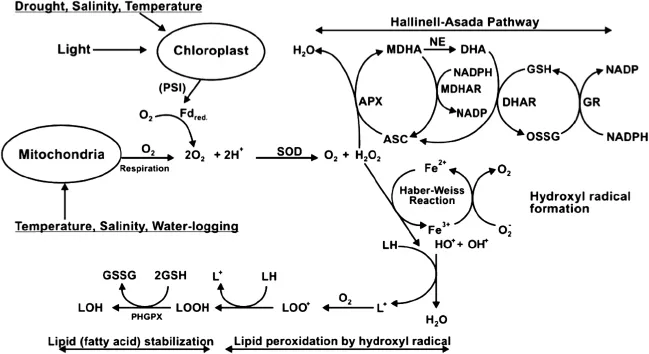
FIGURE 1.1 Schematic diagram illustrating the impact of various environmental stresses on generation and scavenging of superoxide radical, hydrogen peroxide, hydroxyl radical-induced lipid peroxidation, and glutathione POX-mediated fatty acid stabilization under environmental stresses. APX, ascorbate POX; ASC, ascorbate; DHA, dehydroascorbate; DHAR, dehydroascorbate reductase; Fd, ferredoxin; GR, glutathione reductase; GSH, red glutathione; GSSG, oxi-glutathione; HO, hydroxyl radical; LH, lipid; L, LOO; LOOH, unstable lipid radicals and hydroperoxides; LOH, stable lipid (fatty acid); MDHA, monodehydro-ascorbate; MDHAR, mono dehydro-ascorbate reductase; NE, non-enzymatic reaction; PHGPX, phospholipid-hydroperoxide glutathione POX; SOD, superoxide dismutase. (From Wahid, A., Gelani, S., Ashraf, M., Foolad, M. R., Environ. Exp. Bot., 61, 208, 2007. Reprinted with permission from Elsevier).
1.2.1 HEAT SHOCK PROTEINS
Proteins are a vital component of the plant physiological system. Under normal conditions, proteins function efficiently. However, under conditions of high temperature, proteins tend to fold and degenerate. Heat stress as well as other stresses can initiate certain defensive mechanisms like expression of particular genes that were not expressed under “normal” conditions (Morimoto, 1993; Feder, 2006). The response to stresses on the molecular level is prevalent in all living things, especially those changes in genotypic expression giving rise to an increase in the synthesis of protein groups. These groups are termed popularly as “heat shock proteins” (HSPs), “stress-induced proteins,” or “stress proteins” (Lindquist & Crig, 1988; Morimoto et al., 1994; Gupta et al., 2010). The HSPs differ in their molecular weights and are expressed in times when the plant experiences high temperature. The HSPs perform various functions in the plant body. For example some HSPs are constitutive while some are inducible in function. HSP100 is the most commonly expressed protein in plant body under high temperature stress (Queitsch et al., 2000). Subsequent research has revealed that most HSPs have strong cytoprotective effects and act as molecular chaperones for other cellular proteins. Inappropriate activation of signaling pathways could occur during acute or chronic stress as a result of protein misfolding, protein aggregation, or disruption of regulatory complexes. The major action of chaperones is thought to restore balance in protein homeostasis. Mammalian HSPs can be differentiated into five families, according to their molecular size: HSP100, HSP90, HSP70, HSP60, and the small HSPs. Each family of HSPs is composed of members expressed either constitutively or regulated inductively and are targeted to different subcellular compartments. For example, although HSP90 is constitutively abundantly expressed in the cells, HSP70 and HSP27 are highly induced by different stresses such as heat, oxidative stress, or anticancer drugs (Schmitt et al., 2007). According to Levitt et al. (1997), the function of any protein is ascertained by its formation and folding into 3-dimensional structures. The development of three dimensional structures requires 50% of primary amino acids (AAs) sequence (Dobson et al., 1998). Thus, HSPs are significant in the folding of other proteins. Reports highlight that HSPs protect cells from injury and facilitate recovery and survival after a return to normal growth conditions (Morimoto & Santoro, 1998). On the contrary, Timperio et al. (2008) showed that upon heat stress, the role of HSPs as molecular chaperones is undoubtedly prominent whereas their functions could be different in nonthermal stress conditions. Unfolding of proteins is not the main effect and protection from damage could occur in an alternative way apart from ensuring the maintenance of correct protein structure (Al-Whaibi, 2011). Figure 1.2 presents a schematic diagram illustrating the effect of heat stress on plant physiology.
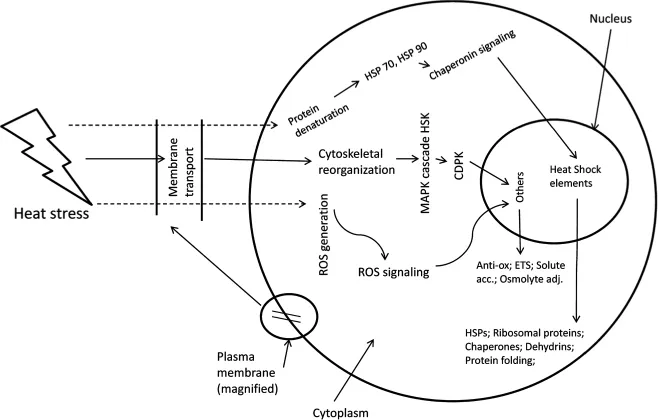
FIGURE 1.2 Schematic diagram showing the heat stress response. MAPK, mitogen activated protein kinases; ROS, reactive oxygen species; HAMK, heat shock activated MAPK; HSE, heat shock element; HSPs, heat shock proteins; CDPK, calcium-dependent protein kinase; HSK, histidine kinase.
1.2.2 INFLUENCE OF HIGH-TEMPERATURE STRESS ON PLANTS
Heat stress can affect some plant processes more than others. Extreme temperature influences various processes, but the most important effects are those that are first encountered as temperatures rise above the optimum for plant growth. Two plant processes that are particularly sensitive to heat stress are pollen development and photosynthesis. Other processes that appear to be inherently less sensitive to heat stress include respiration (Berry & Raison, 1981). Pollen development and fruit set are important as they give rise to the harvestable parts of plant. The effect of heat stress on crop yield will depend upon the timing of the heat stress. If the stress is experienced during anthesis, substantial loss in fruit set and, ultimately, crop yield can occur. Photosynthesis, on the other hand, is also particularly sensitive to heat stress and heat stress at nearly any time during crop growth could have adverse consequences on yield through stress effects on photosynthesis (Guilioni et al., 2003). Because pollen development and photosynthesis are the two most high-temperature-sensitive plant processes, the next sections will cover the effects of high temperature on these processes.
1.2.1.1 EFFECT ON POLLEN DEVELOPMENT
Various workers have mentioned the influence of heat stress on processes of pollen development in plants. Prasad et al. (2002) subjected common bean (Phaseolus vulgaris L.) to five temperature regimes between 28°C/18°C day/night and 40°C/30°C day/night. These plants exhibited substantial loss in pod set above 37°C/27°C day/night temperature and reductions in seed set at even lower temperature. Pollen viability was even more sensitive and was more than 50% inhibited in the plants grown at 37°C/27°C day/night temperature. These effects were not sensitive to increased CO2, unlike some effects of temperature on photosynthesis (Cowling & Sage, 1998). This is consistent with the effects...
Table of contents
- Cover
- Half Title
- Title Page
- Copyright Page
- Dedication
- Table of Contents
- List of Contributors
- List of Abbreviations
- Preface
- Acknowledgments
- 1. Environmental Stress and Stress Biology in Plants
- 2. Significance of Soil Organic Matter in Relation to Plants and Their Products
- 3. Plant and Soil Interfaces and Their Interactions under Different Climate
- 4. Plant Essential Nutrients, Nutrient Composition in Soil, and Activity of Plant Metabolites
- 5. Secondary Plant Metabolites: Mechanisms and Roles in Insect Pest Management
- 6. Secondary Metabolites in Pathogen-Induced Plant Defense
- 7. Polyhydroxyalkanoates: A Valuable Secondary Metabolite Produced in Microorganisms and Plants
- 8. Diverse Utilization of Plant-Originated Secondary Metabolites
- Index
Trusted by 375,005 students
Access to over 1.5 million titles for a fair monthly price.
Study more efficiently using our study tools.
Frequently asked questions
Yes, you can cancel anytime from the Subscription tab in your account settings on the Perlego website. Your subscription will stay active until the end of your current billing period. Learn how to cancel your subscription
No, books cannot be downloaded as external files, such as PDFs, for use outside of Perlego. However, you can download books within the Perlego app for offline reading on mobile or tablet. Learn how to download books offline
We are an online textbook subscription service, where you can get access to an entire online library for less than the price of a single book per month. With over 1.5 million books across 990+ topics, we’ve got you covered! Learn about our mission
Look out for the read-aloud symbol on your next book to see if you can listen to it. The read-aloud tool reads text aloud for you, highlighting the text as it is being read. You can pause it, speed it up and slow it down. Learn more about Read Aloud
Yes! You can use the Perlego app on both iOS and Android devices to read anytime, anywhere — even offline. Perfect for commutes or when you’re on the go.
Please note we cannot support devices running on iOS 13 and Android 7 or earlier. Learn more about using the app
Please note we cannot support devices running on iOS 13 and Android 7 or earlier. Learn more about using the app
Yes, you can access Plant Secondary Metabolites, Volume Three by Mohammed Wasim Siddiqui, Vasudha Bansal, Mohammed Wasim Siddiqui,Vasudha Bansal in PDF and/or ePUB format, as well as other popular books in Medicine & Alternative & Complementary Medicine. We have over 1.5 million books available in our catalogue for you to explore.