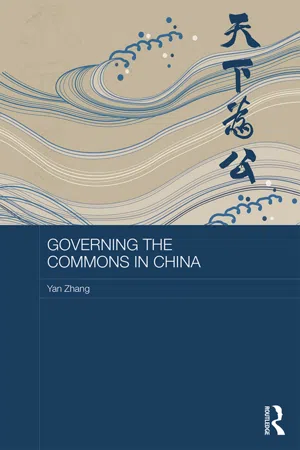
The idea of 'the commons' is a long-standing concept in the English-speaking world and in English law. A similar concept occurs in China. How different from or similar to the English idea of 'the commons' is the idea in China; and how is the concept applied? This book explores this important subject. It examines the subject from a philosophical and theoretical perspective; considers 'the commons' widely, including tangible commons of resources, intangible commons of culture, identity and social capital, and institutional commons of welfare, security and public goods; and goes on to examine the concept as it applies to the hydropower developments along the Lancang River, outlining the different competing interests of local people, central and provincial government, and environmental considerations. It argues that the concept of 'the commons' in China is dual-dimensional, with a vertical dimension of 'public authority' and a horizontal dimension of 'commonly sharing', that power structures in China have often been flexible and polycentric, and that, correctly applied, this approach will do much to serve the common interest of the people, ensuring positive impacts for shared prosperity for multiple stakeholders, whilst mitigating the negative impacts involved in the delivery of such positive impacts.
- 268 pages
- English
- ePUB (mobile friendly)
- Available on iOS & Android
eBook - ePub
Governing the Commons in China
About this book
Trusted by 375,005 students
Access to over 1.5 million titles for a fair monthly price.
Study more efficiently using our study tools.
Information
Subtopic
Ethnic StudiesIndex
Social Sciences Part I
Theoretical framework
1Commons
Origin, theory and dilemma
1.1Philosophical origins of the commons
In Western philosophy, the concept of the commons is linked to notions such as rationality, benevolence, the public sphere and property rights.
1.1.1Rationality and benevolence
The notion that humans are rational is central to the discussion on the commons – and the argument falls on whether humans are self-interested or cooperative in nature. If they are naturally cooperative, it is easier to manage and govern the commons. If they are primarily self-interested then their actions have to be regulated by a greater power. Adam Smith argued that they are basically self-interested. Homo economicus 1 acts only in his own interest, but the higher power is not necessarily the state but the ‘invisible hand’ of the market where goods of all kinds are exchanged. By ‘pursuing his own interest he [homo economicus] frequently promotes that of the society more effectually than when he really intends to promote it’, because all self-seeking individuals are ‘led by an invisible hand to promote an end which was no part of his intention’ (Smith, 1976 [1759]). The homo economicus hypothesis prevailed for centuries after Smith. The idea was given a boost by the evolutionary biologist Richard Dawkins, who updated the argument by claiming that no matter whether an action is intended to be altruistic or egoistic, it is inherently determined by the ‘selfish gene’, that ‘the fundamental unit of selection, and therefore of self-interest, is not the species, nor the group, nor even, strictly, the individual. It is the gene, the unit of heredity’ (Dawkins, 1989). Even altruistic behaviour is enacted for the selfish gains it is expected to produce.
Against this view, Kropotkin argued in the early twentieth century that a law of mutual aid exists both within one species and between different species. To supplement the seemingly cruel implication from the Darwinian law of ‘survival of the fittest’, the view of homo reciprocans suggests that humans are capable of helping others in order to survive. Kropotkin believed that mutual aid is the root of evolution in all animals, including humans, and is the universal developmental trend of nature (Kropotkin, 1902). As cooperative humans, we are naturally committed to obeying social norms and reciprocal action as a way of reducing risk and uncertainty, and in order to survive.
In addition to the concepts of the selfish gene and mutual aid, there is a subtle misunderstanding of the relationship between self-love and selfishness. The loyal followers of Adam Smith have long neglected this subtle distinction, which has misled them as to the strict rationality assumption on humans. Smith admitted in the Theory of Moral Sentiments (1759) that self-love is a necessary condition for all activities. Sympathy that may ‘be made use of to denote our fellow-feeling with any passion whatever’ is the reason that humans care about others despite strong self-love (Smith, 1976 [1759]). Self-interest is different from selfishness, for the former is bound up with self-love and concern for oneself, while the latter is bound up with greed. Self-love, which urges people to pursue their own interests, may also be restrained by feelings of sympathy for others.
The moral code regulating human behaviour exists in various forms across cultures, the essence of which is to constrain selfish desire so as to achieve the common good. Tov and Diener (2009) argued that ‘subjective well-being is a necessary condition for a flourishing society’. Social norms and positive emotions can add to the store of trust and cooperation in a society. All humans are equal, and we live together as a society in which the state sets up rules for the common interest (Hobbes, 1928 [1651]). Thus, everyone within the society should comply with those moral standards. In Smith’s moral system, benevolence is an adjunct of morality,2 while the motives for such morality are self-love, reason and sentiment. The virtue of ‘universal benevolence’ urges the ‘wise and virtuous man’ to sacrifice ‘his own private interest’ for the greater ‘public interest’, yet only within the limited scope of ‘his family, his friends, and his country’, because ‘the care of the universal happiness of all rational and sensible beings, is the business of God and not of man’ (Smith, 1976 [1759]). This is similar to Aristotle’s idea that virtue is the happiness of Golden Mean on benevolence and extended love among the community. Put differently, Aristotle tackled the difficult situation of people who do ‘not treat [others] as children only their own sons’, because ‘children will belong to everybody and to nobody’ (Aristotle, 1885 [320 bce]).
1.1.2Public philosophy on the public sphere
Public philosophy, which concerns moral or political rules that regulate people’s public sphere or common life, also reveals the origin of the Western concept of the commons. In her 1958 work, The Human Condition, Arendt claimed that the term ‘public’ has two meanings. The first is that ‘everything that appears in public can be seen and heard by everybody and has the widest possible publicity’ (1958: 70). The second is that ‘it is common to all of us and distinguished from our privately owned place in it’. Thus the public sphere ‘signifies the world itself’, and such ‘public space … must transcend the life-span of mortal men’ (1958: 72, 75). However, in modern individualistic society we might lose the opportunity of being seen and heard by others, which is vital to the public realm because ‘our feeling for reality depends utterly upon appearance’ (1958: 71).
Arendt claimed that social evolution from family-oriented ‘natural associations’ to societies with a state and polis imposed two ‘orders of existence’: the private and the public. Therefore, a ‘collective of families economically organized into the facsimile of one super-human family is what we call “society”, and its political form of organization is called a “nation”’ (1958: 49). The family is driven by the nature of man – for ‘individual maintenance and its survival’ while the polis is ‘the sphere of freedom’ (equal and not constrained by necessity) (Arendt, 1958). Therefore, the boundary between society and politics became blurred in the modern world.
Habermas described the destruction of the public sphere by the growth of the state in bourgeois society, in which the concept of a public sphere exists as an institutionalized mechanism of communication between the state and civil society. A public sphere thus grew from forces opposed to state power, and was yet still a part of the private sphere. A public sphere is not created by the state and government, but emerges naturally among equal and free citizens’ discussions, and the state only confers legitimacy of such publicity generated by equal and free individuals (Habermas, 1989).3 The reason for and justification of the division of the public and the private sphere, for the purpose of recognizing equal and free individuals who are separate from the state, are quite distinctive from the concepts used in Chinese political philosophy and society, which will be discussed in later chapters.
Another related discussion is Gramsci’s writing on the cultural hegemony of the ruling class as the artificial social construct of norms and institutions, forms of consciousness, and political-cultural practices. Within such multilayered social structures, civil society or the public sphere, or the personal common sense of daily life all exist within a political society, which produced ‘common sense’ to overarch and incorporate personal perceptions of a greater socioeconomic system. Such ‘common sense’ is imposed by the ruling class with cultural hegemony of norms and institutions, but people usually take it for granted. Gramsci’s observed that the reason why the masses did not rise up against the ruling class was because the inculcation they received was with the very same values that enabled the status quo to continue unopposed. Thus, the public sphere is not a benign place where minds could freely discourse. The directive propaganda creating ‘coercive control’ and ‘consensual control’ by mass media is one prominent example. However, people often interrogate the private sphere rather than the public sphere, dominated as it is by cultural hegemony – dominated, because the greater picture is always too big to be perceived by the individuals. The key bridge is intellectuals, who participated in the process of cultural hegemony’s creation and re-creation (Gramsci, 1992). The Western critical theorists who seemed have much wider application on the non-Western society (interpreting universal values or natural laws across cultures) might deeply participate in the creation and re-creation of public sphere in the non-Western world and hence became a part of such cultural hegemony, and this is particularly true under globalization. Examples may include neoliberal orthodox, Huntington’s crash of civilization and the so-called ‘soft power’, all those are so widely introduced and practised in non-Western world and hence became a part of their social/political constructions.
1.1.3Property rights
The concept of private property provides the line that separates the private and the public spheres. Plato thought that communal living areas and collective ownership of wealth was essential for the common interest to flourish, so he suggested that personal possessions should be kept to a minimal (Plato, 1881 [380 bce]). But Aristotle argued, ‘that which is common to the greatest number has the least care bestowed upon it’, and ‘that which is common to many is apt to be neglected’ (Aristotle, 1885 [320 bce]). Humans choose to live together within communities regulated by justice and law. To Aristotle, communal ownership is not feasible, and the private ownership of property is the source of prudence and responsibility. Society should be glued together by virtue rather than common ownership.
John Locke defined private property as the mixture of natural resources and human labour. This combination gives rise to the exclusivity of private property, because ‘it hath by this labour something annexed to it that excludes the common right of other men’ (Locke, 1988 [1689]). Locke’s assumption is that the world is given to ‘mankind in common’ and resources are not scarce, so the private appropriation of some resources would does not make anybody worse off. Common property, or land, in Locke’s view ‘is left common by compact’ of ‘some men’, not ‘all mankind’. When, according to Locke, the question of common land is related to those who cannot use resources efficiently, ‘we’ need to help them to learn the code of civilization, namely the private property regime. In the name of enlightenment, the supposed superior group robbed or enclosed ‘their’ land and resources to use it ‘better and more efficient[ly]’ (Locke, 1988 [1689]). The beneficiaries of such property regimes are not the people, but superior groups.
Hobbes and Hume interpreted the existence of property from the perspective of the sovereign state and social conventions rather than basing it on the natural rights of man. Hobbes was aware that property rights are strongly intertwined with state power. Individual rights need to be protected by political power, otherwise the rights to property are not secure. Therefore, laws about property rights are instituted by the sovereign state (Hobbes, 1928 [1651]). Hume suggested that property is an issue only when the material is scarce. An individual’s rights to property are secured by social rules. Peaceful ownership without conflict is more logical with equilibrium of ‘common sense of interest is mutually expressed and is known to both’. Therefore, it is not necessarily an external sovereign state that enforces the bond between individuals and things; it is based on informal conventions developed among the people to recognise common interest that creates property. Hence, property rights are not natural, but artificially created ‘by the laws of society, that is, by the laws of justice’ (Hume 1978 [1738], 1975 [1777]).
Property ownership is also related to the origin of the family. Engels claimed, although the family basis is love, the determinant of social change is still the economic condition of property ownership. The incentive for forming the stable monogamy is to maintain the inheritance of accumulated wealth (Engels, 1972 [1884]). Kropotkin (1902) also argued that as families separated from each other, this led to the separation of possessions and accumulation of wealth, which then evolved into the village community.
Property rights are often interpreted as the being inherent in the nature of resources themselves, rather than an institutional arrangement. However, institutionalists believed that ‘property rights do not refer to relations between men and things, but to the sanctioned behavioural relations among men that arise from the existence of things and pertain to their use’ (Furubotn and Pejovich, 1972). But the difficulty is that such institutions or rules relating to property rights never performed entirely satisfactorily. A normative understanding of property rights separates its economic meaning and legal perspective. Economically, property rights mean the ‘ability to enjoy a piece of property’, and the legal rights are ‘what the state assigns to a person’ (Barzel, 1989).
1.2School I: tangible commons – physical resources
School I adopts a narrow definition of the commons, seeing it as the set of shared physical resources, both natural and man-made, imposed by non-private property rights (property-based) or with open access (resource-based), because of its physical property and actual reality of existing (such as technological constraint), thus suffer from governing dilemmas of uncertainty, inefficiency, inequity, and unsustainability. This school originated from concerns over a fragile environment and scar...
Table of contents
- Cover
- Half Title
- Series Information
- Title Page
- Copyright Page
- Dedication
- Table of contents
- List of illustrations
- Acknowledgements
- List of abbreviations
- Introduction: Seeing in the commons
- Part I Theoretical framework
- Part II Empirical evidence from the Lancang River
- Conclusion Governing tianxia by the common spirit, the Grand Union
- Index
Frequently asked questions
Yes, you can cancel anytime from the Subscription tab in your account settings on the Perlego website. Your subscription will stay active until the end of your current billing period. Learn how to cancel your subscription
No, books cannot be downloaded as external files, such as PDFs, for use outside of Perlego. However, you can download books within the Perlego app for offline reading on mobile or tablet. Learn how to download books offline
Perlego offers two plans: Essential and Complete
- Essential is ideal for learners and professionals who enjoy exploring a wide range of subjects. Access the Essential Library with 800,000+ trusted titles and best-sellers across business, personal growth, and the humanities. Includes unlimited reading time and Standard Read Aloud voice.
- Complete: Perfect for advanced learners and researchers needing full, unrestricted access. Unlock 1.5M+ books across hundreds of subjects, including academic and specialized titles. The Complete Plan also includes advanced features like Premium Read Aloud and Research Assistant.
We are an online textbook subscription service, where you can get access to an entire online library for less than the price of a single book per month. With over 1.5 million books across 990+ topics, we’ve got you covered! Learn about our mission
Look out for the read-aloud symbol on your next book to see if you can listen to it. The read-aloud tool reads text aloud for you, highlighting the text as it is being read. You can pause it, speed it up and slow it down. Learn more about Read Aloud
Yes! You can use the Perlego app on both iOS and Android devices to read anytime, anywhere — even offline. Perfect for commutes or when you’re on the go.
Please note we cannot support devices running on iOS 13 and Android 7 or earlier. Learn more about using the app
Please note we cannot support devices running on iOS 13 and Android 7 or earlier. Learn more about using the app
Yes, you can access Governing the Commons in China by Yan Zhang in PDF and/or ePUB format, as well as other popular books in Social Sciences & Ethnic Studies. We have over 1.5 million books available in our catalogue for you to explore.