![]()
1 Introduction
Globalization, strategic HRM and China
Under the influence of globalization, organizations are facing challenges such as retaining sustained competitive advantage and differentiating themselves from their competitors. To cope with these challenges, human resource management (HRM) holds one of the keys to success. The new competitive reality requires new ways of thinking about HRM. Traditionally, HRM is defined as a set of processes and activities which are used jointly to solve people-related business problems. With the introduction of strategic human resource management (SHRM) theories, relevant policies and practices have made HR functions more supportive of business strategies by virtue of their transition from HRM to SHRM.
In the West, SHRM has gained credibility and popularity among researchers and HR professionals. These HR practices often take the Western rule as standard. However, when these same HR practices are implemented in a different environment, such as in Asia, replicating the Western model does not necessarily work (Gelfand et al., 2007). SHRM with ‘Asian characteristics’ is an emerging possibility (Zhu et al., 2007). China could be seen as a good example for investigating similarities and differences between Western and Eastern systems.
China has made attempts to reform its economy since the late 1970s. As economic reform proceeds, it is likely to match innovation in its management practices (Child, 1996). China has become the world’s second largest economy and the largest exporter, surpassing the United States and Japan. Its unprecedented economic growth amazes both people in China and the rest of the world and increases concerns about the sustainability of the fast-paced economic growth. Simultaneously, the economic structure is undergoing change, shifting from an agricultural and industrial based economy towards the light manufacturing and service sectors (Wang and Wang, 2006). Industries such as health, education, finance, insurance, real estate, telecom and IT have seen significant growth while mining has experienced decline. In addition, these changes are related to the downsizing and privatizations of state-owned enterprises (SOEs), the introduction of performance management systems in the public sector, the growing strength of the private sector and the continuing pressure of unemployment (Cooke, 2012).
In SOEs, HR policies and practices are under state government control through regional and local personnel departments. The number of employees and payment levels are largely determined by governmental departments. It is common practice for managers to be merely involved in administrative functions and policy implementation (Child, 1996). Employees holding a job for life has been the norm (Warner, 1996). With the adoption of an ‘open door’ policy and commencement of economic reforms in the late 1970s, the dominance of SOEs started to weaken. SOEs have witnessed changes in HR policies and practices, such as a reduction of direct state control and the consequent increase of autonomy and responsibility at the enterprise level in major aspects of HR policies and practices (Child, 1996). Following the ‘open door’ policy and economic reforms, SOEs downsized, which led to a significant reduction in their number. Since the middle of the 1990s a large number of SOEs have been corporatized and privatized; nowadays only 110 centrally controlled SOEs and another 80,000 provincial and local government controlled SOEs remain (Cendrowski, 2015).
In parallel to these trends, the Chinese economy has been supplemented by the increasing role of domestic private enterprises (DPEs) and the competition brought by these enterprises (Warner and Zhu, 2010). The number of DPEs has soared to approximately 1,250,000 in China (China Private Enterprises Year Book, 2014). Unlike their SOE counterparts, DPEs are not strictly constrained by governmental control and historical heritage. They are considered to be more flexible, innovative and risk-taking (Wang et al., 2007). Therefore, it is meaningful to explore the HR practices and policies adopted and implemented in Chinese indigenous enterprises, namely SOEs and DPEs, given the growing diversity of business strategies and management practices in China.
These changes present a challenge to management in China in terms of coping strategies. Options include leaving management systems unchanged, developing new indigenous forms or adopting Western management systems. The choice made by management in China was to opt for a ‘hybrid’ approach using Western knowledge to implement an evolutionary change process within the Chinese context (Warner, 2013). This choice is meaningful and strategically oriented.
Besides the aforementioned macro-level changes, workforce changes are also significant. China makes up a substantial proportion of the world’s population with a workforce that is increasingly educated and eager to succeed. It is common for people from different generations to work side by side. People of the same generation tend to be influenced by the same key historical and social life experiences of their era (Wey Smola et al., 2002). For example, millennials belong to a generation which has grown up with computers, the internet and social media, having a profound effect on the way they perceive and solve problems. They are encouraged to make their own decisions, challenge authority and value fairness. They desire a sense of belonging, the ability to learn, autonomy and feedback. They tend to be sceptical of the status quo and hierarchical relationships and expect managers to earn respect rather than gain respect by virtue of a title (Tulgan, 2004). Each generation has its own unique values, set of skills and characteristics (Gursoy et al., 2013), which creates challenges for management.
Most books have explored SHRM from a managerial perspective. The growing interest in this ‘top-down’ approach is easy to understand because HR policies and practices are traditionally implemented from a managerial perspective. Management is dominant during the decision-making process. However, the outcome of such decisions has significant impact on the life and well-being of employees. Given that there has been limited research in SHRM from a management and employee perspective, this book adopts a different approach to address this issue.
Discussion on management in general, and HRM in particular, cannot be isolated from the context. Given its importance in the global economy, China is a good example to be explored given the unique characteristics of its workforce and culture. Furthermore, this book focuses on Chinese indigenous enterprises (i.e., SOEs and DPEs). Both enterprises have witnessed dramatic changes during the economic reformation in terms of political power, size, numbers and organizational structure. They have been influenced by the Western management theory introduced by direct foreign investment, management programs and education systems such as the MBA (Warner, 2004). At the same time, they maintain and demonstrate their own features in HRM. Therefore, understanding which HRM system is adopted, discovering how this system is implemented and finding a possible explanation of how this system works in these indigenous enterprises is very meaningful.
Research framework
Most SHRM studies focus on Western advanced economies such as the US, UK, Germany, Finland, Australia and New Zealand (Boselie et al., 2001, Guthrie, 2001, Guest et al., 2003, Heffernan and Dundon, 2016). Similar studies in China are sparse. Given the importance of the Chinese economy in the world and the impact of its ‘open door’ policy and economic and management reforms, it is meaningful to develop SHRM research in China.
This book discusses SHRM in general and high performance work systems (HPWS) in particular. HPWS is a set of mutually reinforcing key SHRM practices that select, develop, retain and motivate employees to achieve superior performance. Prior research has primarily focused on managerial reports on using HPWS (Lepak et al., 2006), ignoring the role of individual employees’ actual perceptions of these systems (Boon et al., 2011).
Placing employees at the centre of a SHRM/HPWS study is meaningful. HPWS practices have an important signalling effect to employees (Wayne et al., 2002). Employees understand organizational objectives and expectations by interpreting the HR policies and practices adopted (Bowen and Ostroff, 2004). Employees observe and interact with their immediate supervisors/managers during the implementation of SHRM/HPWS. The way they perceive the intentions and attitudes of their immediate supervisors/managers (Whitener, 2001) influences their attitude towards work and their behaviour (Dittrich and Carrell, 1979). In addition, ordinate employees constitute a large proportion of the workforce in enterprises. Given the number and variety of ordinate employees, exploring SHRM/HPWS from their perspectives enhances the generalization and practical applicability of this book.
Another key aspect of this book is the mutual relationship between employees and their supervisors/managers. Social exchange theory (Blau, 1964) has been chosen as one of the key underpinning theories in this book. This theory involves a series of interactions that generate obligations among people. These interactions could be seen as interdependent on the actions of another person, which has the potential to generate high quality relationships (Emerson, 1976) such as mutual trust. By adopting the social exchange theory, we explain how and why employees develop perceptions of and relationships with their immediate supervisors/managers in the working environment and explore the subsequent effects these have on their attitudes and behaviour at work.
Therefore, this book aims:
- 1 To identify the SHRM/HPWS practices implemented in SOEs and DPEs. This is achieved by targeting managers from sampled companies in China. Their responses contain rich information on managerial intention, procedures and expected outcomes of SHRM/HPWS practices adopted in their companies.
- 2 To explore the mediating effect of trust relationships between supervisors/managers and employees on the implementation of SHRM/HPWS. This will be achieved by analysing employees’ responses and developing a conceptual framework, incorporating factors proposed from existing literature and the findings from employee interviews.
- 3 To explore additional context-specific insights into the adoption and implementation of SHRM/HPWS in Chinese indigenous enterprises by evaluating managers’ and employees’ responses, as well as other unique issues and characteristics affecting SHRM/HPWS implementation. This can offer new insights into issues that have not been covered in existing literature. Moreover, the adopted SHRM/HPWS assists managers in improving their management functions by involving employees in the decision-making process.
In order to tackle these objectives, there are four questions we address based on the research carried out in this book:
- What are the SHRM/HPWS adopted and implemented in China from manager and employee perspectives?
- What insights can we gain about SHRM and HPWS in SOEs and DPEs in China?
- What HRM systems can organizations develop to encourage positive attitudes and intentions to stay?
- What direction should managers and organizations take in implementing strategies for HRM and HPWS?
Summary of research methods
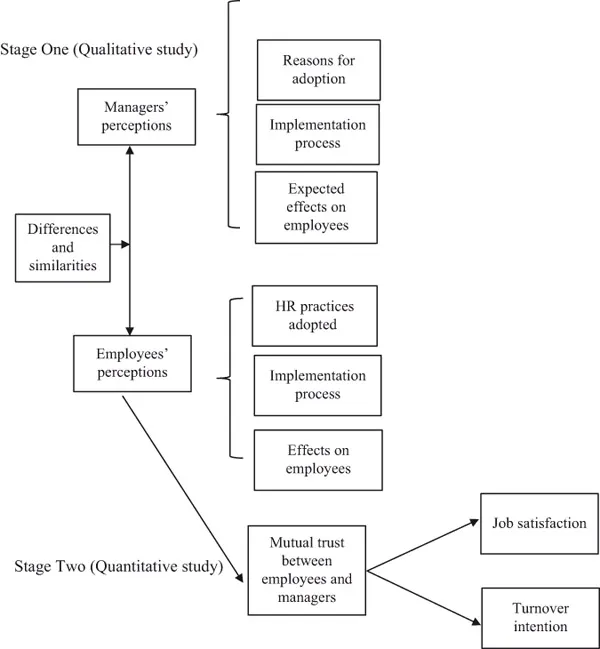
This research adopts a mixed-method design which has been increasingly established as a legitimate methodological choice and is utilized in social science. Although mixed-method designs are strongly advocated, genuinely mixed-method designs which triangulate findings from qualitative and quantitative studies remain sparse. In this book, a qualitative study was first adopted to provide researchers with opportunities to understand the same HR issues from different angles within the same context. A quantitative survey was then performed to test certain meaningful factors found in the qualitative study. A combination of qualitative and quantitative approaches through a mixed-method design provides researchers with the flexibility to explore uncertain issues regarding the impact of cultural, societal and institutional factors. This research lends support to conducting mixed-method studies in the field of SHRM/HPWS in the context of China in transition (see Figure 1.1).
Stage One of the study aimed to confirm the adoption and implementation of SHRM/HPWS and to identify any unknown issues. By performing semi-structured interviews, this first stage provided details and explorative data to understand the SHRM/HPWS practices being adopted and implemented in selected companies, and how these HR practices are implemented to achieve the companies’ goals, as well as how these HR practices influence employee attitudes and behaviour at work. The interviewees comprised 11 managers and 40 employees. A comprehensive view of the relevant issues was obtained by combining responses from both managers and employees, while a comparison of these responses helped identify differences and similarities between managers’ and employees’ perceptions.
Figure 1.1 Research framework
Stage Two of the study is a two-wave survey study that was conducted in SOEs and DPEs across four locations in China. The survey was developed based on extensive literature reviews and findings from interviews. It intended to evaluate employees’ perceptions of SHRM/HPWS implemented in their companies, perceived trustworthiness, job satisfaction and turnover intention. The survey study helped generalize findings and further identify relationships across a large sample. A total of 907 valid questionnaires were collected from 245 employees in SOEs and 662 employees in DPEs.
In the data analysis process, structural equation modelling (SEM) techniques were adopted for data analysis. Due to little empirical evidence related to SHRM/ HPWS studies in China, an exploratory factor analysis (EFA) was firstly utilized to determine an appropriate number of factors and the pattern of factor loadings from the data. A confirmatory factor analysis (CFA) was then performed to test the measurement model and structure model.
Outline of the book
The book contains a total of six chapters. Chapter 1 provides the rationale for SHRM/HPWS research in Chinese indigenous companies. Research gaps and aims are discussed. A brief research method description is presented.
Following the introductory chapter, chapter 2 reviews the evolution of the literature from HRM to SHRM. Subsequently, the focus shifts to HPWS literature by examining the importance of employee perceptions and participation elements. The chapter then reviews social exchange theory, which underpins this research. By applying social exchange theory to HPWS, this chapter provides a theoretical framework explaining the creation of a mutual investment-based relationship between employees and their supervisors/managers. Lastly, this chapter presents HPWS studies which examine the systems’ effects on organizational performance and employee outcomes.
Building on the previous chapter, chapter 3 presents the overall studies on SHRM/HPWS in China and then establishes the appropriate research methods and data analysis. It introduces the mixed-method approach and addresses issues related to the rationale of the research design.
Chapter 4 illustrates similarities and differences in the adoption and implementation of SHRM/HPWS in SOEs and DPEs. The characteristics embedded in these two types of ownership affect how managers design and implement HR policies and practices. Without constraints f...