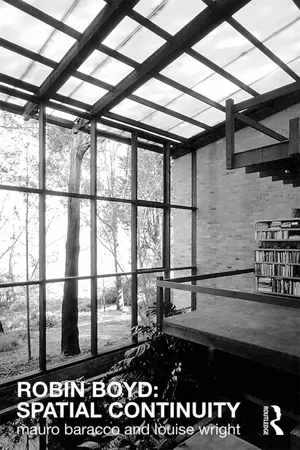
![]()
Part I
Robin Boyd
Spatial continuity
![]()
Bibliography
Banham, Reyner, ‘The New Brutalism’, The Architectural Review, no. 118, December 1955
Banham, Reyner, The New Brutalism, The Architectural Press, London, 1966
Baracco, Mauro, Coexistence of Rational Definiteness and Irrational Oneness: An Investigation of Robin Boyd’s Architecture and Theoretical Approach through a Heideggerian Perspective, RMIT University, Melbourne, Australia, 2010
Baracco, Mauro (ed.), Tree Sprawl – Consolidation and Expansion of Open Vegetated Space; Projects in the Urban Territory of Merri Creek, Melbourne, School of Architecture and Design, RMIT University, Melbourne, Australia, 2011
Baracco, Mauro (ed.), All Change, School of Architecture and Design, RMIT University, Melbourne, Australia, 2012
Baracco, Mauro; Wright, Louise, ‘Boyd in Melbourne’, Domus, no. 808, October 1998
Benedetti, Carla, Pasolini contro Calvino, Bollati Boringhieri, Torino, 1998
Boyd, Robin, Victorian Modern: One Hundred and Eleven Years of Modern Architecture in Victoria, Australia, Architectural Students’ Society of the Royal Victorian Institute of Architects, Melbourne, 1947
Boyd, Robin, ‘Mornington Peninsula’, Architecture, vol. 38, no. 4, October–December 1950
Boyd, Robin, ‘The Vanishing Gumtree: Have You Ever Tried to Find One in the Suburbs?’, The Age, 5 April 1950
Boyd, Robin, ‘A New Eclecticism?’, The Architectural Review, vol. 110, no. 657, September 1951
Boyd, Robin, Australia’s Home, Penguin, Melbourne, 1968 (original ed., Melbourne University Press, 1952)
Boyd, Robin, ‘The Functional Neurosis’, The Architectural Review, vol. 119, no. 710, February 1956
Boyd, Robin, ‘The Search for Pleasingness’, Progressive Architecture, vol. 38, no. 4, April 1957
Boyd, Robin, ‘Engineering of Excitement’, The Architectural Review, vol. 124, no. 742, November 1958
Boyd, Robin, The Australian Ugliness, F. W. Cheshire, Melbourne, 1960
Boyd, Robin, a response to ‘Six Questions on Italian Architecture’, in Quindici anni di architettura italiana (Fifteen years of Italian architecture), a monographic issue of Casabella, no. 261, May 1961
Boyd, Robin, Kenzo Tange, George Braziller, New York, 1962
Boyd, Robin, The Walls Around Us: The Story of Australian Architecture, F. W. Cheshire, Melbourne, Canberra, Sydney, 1962
Boyd, Robin, The New Architecture, Longmans, Melbourne, 1963
Boyd, Robin, ‘Under Tension’, The Architectural Review, vol. 134, no. 801, November 1963
Boyd, Robin, Design in Australia with Robin Boyd, television program, ABC (Australian Broadcasting Corporation), 1964
Boyd, Robin, The Puzzle of Architecture, Melbourne University Press, Melbourne, 1965
Boyd, Robin, ‘The State of Australian Architecture’, Architecture in Australia, vol. 56, no. 3, June 1967
Boyd, Robin, ‘The Sad End of New Brutalism’, The Architectural Review, vol. 142, no. 845, July 1967
Boyd, Robin, ‘Germany’ (a review of the German Pavilion at the 1967 Montreal International Exposition), The Architectural Review, vol. 142, no. 846, August 1967
Boyd, Robin, Artificial Australia, the Boyer Lectures 1967, Australian Broadcasting Corporation, Sydney, 1968
Boyd, Robin, New Directions in Japanese Architecture, George Braziller, New York, 1968
Boyd, Robin, Living in Australia, Pergamon Press, Sydney, 1970
Boyd, Robin, ‘The Neighbourhood’, in Ian McKay; Robin Boyd; Hugh Stretton; John Mant (eds.), Living and Partly Living, Thomas Nelson (Australia), Melbourne, 1971
Boyd, Robin, The Great Great Australian Dream, Pergamon Press, Sydney, 1972
Burns, Karen; Edquist, Harriet (eds.), Robin Boyd: The Architect as Critic, Transition Publishing, Melbourne, 1989
Button, John (ed.), Look Here! Considering the Australian Environment, F. W. Cheshire, Melbourne, 1968
Cacciari, Massimo, ‘Eupalinos or Architecture’, Oppositions, no. 21, Summer 1980
Cacciari, Massimo, Dell’Inizio, Adelphi, Milano, 1990
Cacciari, Massimo, Architecture and Nihilism: On the Philosophy of Modern Architecture, Yale University Press, New Haven, CT and London, 1993
Cacciari, Massimo, Geo-filosofia dell’Europa, Adelphi, Milano, 1994
Cacciari, Massimo, ‘Res aedificatoria. Il “classico” di Mies van der Rohe’, Casabella, no. 629, December 1995, (originally published in Paradosso, no. 9, 1994)
Cacciari, Massimo, L’Arcipelago, Adelphi, Milano, 1997
Cacciari, Massimo, ‘To Dwell, to Think’, Casabella, no. 662/663, December 1998/January 1999
Cacciari, Massimo, ‘The Shards of the All’, Casabella, no. 684/685, December 2000/January 2001
Cacciari, Massimo, ‘Nomads in Prison’, Casabella, no. 705, November 2002
Cacciari, Massimo, La citta’, Pazzini Editore, Villa Verucchio (Rimini), 2006 (original ed., 2004)
Dodd, Mel, ‘Garden House’, Architecture Australia, September/October 2015
Edquist, Harriet (ed.), Robin Boyd, a monographic issue of Transition, no. 38, 1992
Evans, Robin, The Projective Cast, MIT Press, Cambridge, MA and London, 2000 (original ed., 1995)
Frampton, Kenneth; Philip, Drew, Harry Seidler: Four Decades of Architecture, Thames and Hudson, London and New York, 1992
Hamann, Conrad, Modern Architecture in Melbourne: The Architecture of Grounds, Romberg and Boyd, 1927–1971, PhD thesis, Visual Art Department, Monash University, Clayton, Victoria, July 1978
Hamann, Conrad, ‘Against the Dying of the Light: Robin Boyd and Australian Architecture’, Transition, no. 29, 1989
Heidegger, Martin, Discourse on Thinking, Harper & Row Publishers, New York, 1966 (original ed., Gelassenheit, 1959)
Heidegger, Martin, ‘Memorial Address’, in Discourse on Thinking (© Gelassenheit, 1959), Harper and Row, New York, 1966
Heidegger, Martin, What Is Called Thinking? Harper & Row Publishers, New York, 1968 (original ed., Was Heisst Denken? 1954)
Heidegger, Martin, Poetry, Language, Thought, Harper & Row Publishers, New York, 1971
Heidegger, Martin, ‘The Thing’ (paper first delivered on the 6th June 1950; first published in 1951), in Poetry, Language, Thought, Harper & Row Publishers, New York, 1971
Heidegger, Martin, ‘Building, Dwelling, Thinking’ (paper first delivered on the 5th August 1951), in Poetry, Language, Thought, Harper & Row Publishers, New York, 1971
Heidegger, Martin, ‘.… Poetically Man Dwells …’ (paper first delivered on 6 October 1951; first published in 1954), in Poetry, Language, Thought, Harper & Row Publishers, New York, 1971
Heidegger, Martin, ‘The Age of the World Picture’ (paper first delivered on the 9th June 1938), in The Question Concerning Technology and Other Essays, Harper & Row Publishers, New York, 1977
Heidegger, Martin, ‘Letter on Humanism’ (original ed., Brief über den Humanismus, 1947), in David Farrell Krell (ed.), Martin Heidegger: Basic Writings, Harper & Row Publishers, New York, 1977, pp. 189–242
Heidegger, Martin, The Question Concerning Technology and Other Essays, Harper & Row Publishers, New York, 1977
Heidegger, Martin, ‘The Question Concerning Technology’ (paper first delivered on the 18th November 1953), in The Question Concerning Technology and Other Essays, Harper & Row Publishers, New York, 1977
Heidegger, Martin, ‘Science and Reflection’ (paper first delivered on the 4th August 1953), in The Question Concerning Technology and Other Essays, Harper & Row Publishers, New York, 1977
Heidegger, Martin, Being and Time, State University of New York Press, Albany, NY, 1996 (original ed., Sein und Zeit, Max Niemeyer Verlag, Tübingen, 1927)
Heidegger, Martin, ‘Art and Space’ (paper first delivered on the 3rd October 1964; original ed., Die Kunst und der Raum, 1969), in Neil Leach (ed.), Rethinking Architecture, Routledge, London, 1997, pp. 121–124
McKay, Ian; Boyd, Robin; Stretton, Hugh; Mant, John, Living and Partly Living, Thomas Nelson (Australia), Melbourne, 1971
McWhorter, Ladelle; Stenstad, Gail (eds.), Heidegger and the Earth: Essays in Environmental Philosophy, University of Toronto Press, Toronto, Buffalo, London, 2009
Nelson, Eric S., ‘Responding to Heaven and Earth: Daoism, Heidegger and Ecology’, Environmental Philosophy, vol. 1, no. 2, Fall 2004
Presland, Gary, The Place for a Village – How Nature Has Shaped the City of Melbourne, Museum Victoria, Melbourne, 2008
Ricardo, Ricky, interview with Mauro Baracco, Landscape Architecture Australia, no. 146, 2015
Saunders, David, ‘Afterword’, in Robin Boyd (ed.), Living in Australia, Pergamon Press, Sydney, 1970, pp. 147–152
Serle, Geoffrey, Robin Boyd: A Life, Melbourne University Press, Melbourne, 1995
Tafuri, Manfredo; Dal Co, Francesco, Modern Architecture, Harry N. Abrams, Inc., New York, 1979 (original ed., Architettura Contemporanea, 1976)
Vitiello, Vincenzo, Elogio dello Spazio, Bompiani, Milano, 1994
Wescott, Geoff, Back to Basics; Breakthrough Proposals for the Australian Environment, University of New South Wales, Sydney, NSW, Australia, 2009
Winton, Tim, Island Home; A Landscape Memoir, Hamish Hamilton (Penguin Books), Australia, 2015
![]()
1
Robin Boyd: Spatial continuity
Tim Winton observes that
two centuries after… (the Aboriginal people’s) way of living was disrupted forever, Australia is still a place where there is more landscape than culture. Our island resists the levels of containment and permanent physical presence that prevail on most other continents. It probably always will.1
This is something that Robin Boyd, in spite of the dilemma this poses to his profession, seems to have deeply understood. Many of his buildings are an attempt to come at or sort of dance around this dilemma. A pioneer of this approach, he convincingly demonstrated a trajectory of how we might build in such a place and shifted architecture in Australia away from the discrete object towards buildings that knit with their physical place. We often think of his buildings as hats.2 The ground plane carries through, sometimes literally, and the roof, or hat, compresses the vast space and sky.
The vast space and sky are what we are concentrating on when we use the word ‘landscape’ and apply this notion to some specific conditions of Australia. The more comprehensive term ‘open space’ is also – and to some degree even more – appropriate in order to express openness as a spatial condition that through Boyd’s design approach is closely integrated, so it is argued in this book, to built forms and volumes. The term ‘open landscape’ (more than ‘natural landscape’) is also a further connotation that can be used to describe the condition of outdoor space – often extensive and related to urban and suburban situations – which is in continuity with the indoor and built space of Boyd’s projects. The vast space and sky are present in these works as integrated spatial elements, registered against the usually unaltered ground plane, technically and conventionally outside of the inside, and yet subliminally, cogently merged in a continuum with the indoor space. Sometimes the surrounding landscape is more relevantly part of the continuum; sometimes, when exaggeratedly overwhelming, there is less of it. Its integrated presence is however always part of Boyd’s designed space; it is something that especially in Australia cannot be separated from people’s psyche and their built environment.
The use of the term landscape as described earlier seems ironic, being not of the land itself; but in the landscapes of Australia, which vary considerably, the vast space and sky is the consistent quality and perhaps what, to use Winton’s term, is most resistant to containment. The suburban landscapes of many of the buildings shown here, most of which would have been cheek by jowl with remnant bushland, had and still have this quality. The term landscape conjures an overall aesthetic, a visual quality. While this is true of its use here, it’s more than that. It’s also a sense of spatial quality, which is hard to pin down in terms of specific physical features. It is also used to mean the natural ecosystem of some of the places. This last definition is given more weight when we consider Boyd’s lineage a...