The Chagga and the Meru are related peoples living on the rich banana-grove and coffee-plantation slopes of Mount Kilimanjaro and Mount Meru in Northern Tanzania. While the literature on the Chagga is overwhelmingly large little is generally available on the Meru. This volume, originally published in 1977, provided for the first time a concise, comprehensive and well-documented overview of Chagga society, history and cosmology, drawing not only on the authors' field work but on the works of the prolific Germans: Gutmann, Raum and others. It also detail original research and uses reports of the famous Meru Land Case to illuminate Meru society and economy and their adjustment in turn to Arusha, German and British colonial, and independent government influences.
eBook - ePub
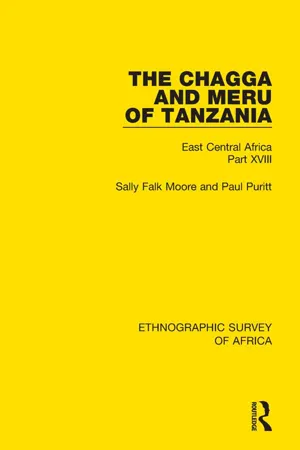
The Chagga and Meru of Tanzania
East Central Africa Part XVIII
- 156 pages
- English
- ePUB (mobile friendly)
- Available on iOS & Android
eBook - ePub
About this book
Trusted by 375,005 students
Access to over 1.5 million titles for a fair monthly price.
Study more efficiently using our study tools.
Information
PART I
THE CHAGGA OF KILIMANJARO
BY
SALLY FALK MOORE
INTRODUCTION
Nomenclature and groupings
The Chagga have been variously called: Chaga, Waschagga, Jagga, Dschagga, Wa-caga. As the people now designated as the Chagga were divided into many small, autonomous chiefdoms in the 19th century, early accounts frequently speak of each chiefdom as a separate people, the Wakilema, for example, for the people of Kilema (von der Decken, 1869–71: Vol. 1, 273). The names of what were once chiefdoms subsequently became geographical names for the various parts of the mountain. In 1899 there were 37 chiefdoms (Widenmann, 1899:2). By 1924 there were 28 (C. Dundas, 1924:50). In 1968, there were 17 administrative units, ex-chiefdoms. Those high on the mountain were from west to east: Kibongoto (Siha), Masama, Machame, Kibosho, Uru, Old Moshi, Kirua Vunjo, Kilema, Marangu, Mamba, Mwika, Keni-Mriti-Mengwe, Mkuu, Mashati, Usseri, and on the plain, Arusha Chini and Kahe. From 1946–1961 the whole of Uchagga was divided into three major administrative divisions, the most westerly known as Hai, the central as Vunjo, and the most easterly as Rombo. Vunjo and Rombo were Chagga terms for these regions, while Hai was once known as Kipoo (C. Dundas, 1924:82). The sub-units of the chiefdoms, the mitaa, some of which were once autonomous chiefdoms, have proved to be some of the most enduring political units. Today the ex-chiefdoms are divided into Wards, North (up-mountain) and South (down-mountain). The mitaa continue to exist and are represented politically by the TANU representatives of the ten-house leaders.
Linguistic data
There are significant dialectic differences in the Kichagga spoken in the major regions of the mountain. The dialects of this language have only recently been studied (Nurse, 1977; Nurse & Philippson, f.c.). The moost easterly ex-chiefdom, Ngasseni, is said to have a dialect so different from the rest that it may be a distinct language (Stahl , 1964:343). The inhabitants of Ugweno, the northernmost Pare chiefdom, are said to have a language resembling Kichagga (Kimambo, 1969:20,40). Swahili has been spoken by the Chagga for a long time. As early as 1842, there was a Swahili resident at a chief’s court (Krapf, 1860:251). Today, almost everyone except a few old people speaks Swahili.
Local cultural variation
A great deal of the older ethnographic material on the Chagga was collected by Gutmann in what was once the chiefdom of Old Moshi. More recent work has been in Machame and Vunjo, This regional bias in the description of the Chagga should be borne in mind as there may be many more local variations of detail than have been reported to date.
Demography, local settlements and house types
A 1912 population estimate put the number of households, or rather of homesteads on Kilimanjaro at 28,150 (HRAF Recht: 527; Gutmann, 1926b:586). In 1924, the population was estimated at 125,000 (C. Dundas, 1924:32). By 1968 there were 76,080 taxpayers (in theory, one per homestead)(Local Rate Records, Kilimanjaro District, Office of the Area Commissioner, 7 August 1968). The number of taxpayers may be multiplied by five to arrive at a rough estimate of the total population. This brings the figure close to 400,000 for 1968. By 1974, estimates are over 400,000. Why the immense increase between 1924 and 1974? Improved sanitation and other public health measures undoubtedly reduced infant mortality, thus increasing the number of children who survived to breeding age. But another factor also probably played a role: the missionary emphasis on monogamy and the attendant missionary disapproval of sexual relations outside of marriage. As early as 1903 it was observed that the number of children per Chagga woman was greatest in monogamous households (Merker, 1902:12). Since traditionally children were supposed to be spaced about three years apart, and various crude forms of birth control and abortion were known to the Chagga, the present situation in which women have one child a year and almost all survive was unknown (Raum, 1940:88). Inherited widows, women past the age of childbearing and barren women were approved sexual partners outside of ordinary marriage, so that traditionally men had access to women other than their wives who were not bearing children (Raum, 1940:330). Christianity was not tolerant of such sexual diversification, nor were the missionaries happy about abortion or polygyny. They may, hence, have substantially affected the birth rate. A house to house census of 300 families in Mwika carried out in 1969 indicated that roughly half the population was under 18. Age estimates are difficult to be certain of, but the age distribution was estimated to be as follows: total population surveyed 2242; persons over 50: 245; persons under 18: 1265.
There are no Chagga villages, nor were there any in the 19th century. Each household lived in the midst of its own banana grove. Ideally each man’s plot was next to those of other members of his patrilineage. In the 19th century there was unoccupied space between the lineage territories. Today, open space scarcely exists at all, and the lands of one lineage cluster are completely interdigitated with the lands of another at their boundaries. The modern population density is very high and reaches urban levels in many places. In 1962 in Lyamungo, Machame there were 954 people per square mile, in Kitandu, Kibosho there were 3,690 per square mile (von Clemm, 1964:100).
The indigenous forms of Chagga houses were of two sorts. One was a conical grass-thatched house which looks rather like a pointed hay-stack, the other was a flatter curved roof type, often thatched with banana leaves. The conical houses required the effort of a number of persons, and considerable skill to construct. They were huge, the circular base being as much as 25 feet in diameter, and the height of the house being well over 20 feet. They were made on a framework of wattle, with thatching about nine inches thick attached on the outside. These houses were windowless, the door the only opening. They were quite durable, lasting twenty years and more if kept in repair.
At the centre of the house were four posts. As one entered the door, the place of the husband was immediately to the right of the door ‘so that he might defend the household against any attack’ and the corresponding column was his. On the same side, toward the rear of the hut was the sleeping place of the wife and the children, and just behind their sleeping place, on the same side, at the rear wall of the hut was a small partitioned area where milk was stored for souring. The wife’s column was the inner column on the right side as one entered. The left side of the hut was allocated to the animals. Next to the door was the area for the goats, and the cow stall was further inside opposite the area allocated to the wife and children and the milk store. In the centre of the hut were the hearth stones. Bedding consisted of a base of banana leaves, over which a cattle skin was placed. Skins were also used as covers, including some pelts of fur. The hearth and the cows kept the hut warm.
Married men lived in the house with their wives until some time after the birth of children when they built themselves a smaller sleeping hut which the father eventually shared with his sons. This hut was called tengo. Another outbuilding was a large basketry grain bin, roofed-over to keep it dry, where eleusine was stored for the making of beer.
So called ‘Swahili houses’, buildings of rectangular shape and mud and wattle walls began to be constructed by the chiefs on Kilimanjaro toward the end of the 19th century. They eventually became quite general. They used to be thatched, but more recently have been roofed with corrugated metal. At present wealthy men have cinderblock houses with cement floors and metal roofs. The less wealthy build similar structures with beaten earth floors and mud bricks. The old conical houses still exist and are used, principally by ‘old mothers’ who greatly prefer them. Every part of the traditional Chagga house had a sacred symbolic significance in Chagga ideology and was ritually consecrated in the course of building (see HRAF Recht: 235–70; Gutmann, 1926b:263–301).
Physical environment
The Chagga live on the southern and eastern slopes of Mount Kilimanjaro, the highest mountain in Africa, and one of the highest volcanoes in the world. Its base measures about 50 by 30 miles, elongated in an east-southeasterly direction. It has three major volcanic centres, Kibo (19,340 ft.) in the centre, Mawenzi (16,890 ft.) in the east, and Shira (13,140 ft.) in the west. Kibo has a permanent covering of ice and snow at its peak, having several glaciers around the rim of the caldera, as well as some glaciers and ice formations on the lava floor within it. The ice cap is not thought to be a direct source of water, though indirectly through its effects on the climate, it probably does contribute to precipitation. Below the ice cap is gravel, below that, short heather, and below that is grassland. Herds of eland graze in this alpine meadow. Just below it, between 5,000 and 10,000 feet is a zone of rain forest which provides the major source of the mountain’s many streams and rivers. The forest is full of animals: monkeys, elephant, wild pig, buck, squirrel, leopard and many others abound. The plant and animal life of the forest is so luxurious, it beggars any summary description.
Just below the forest zone, on the southern and eastern slopes is the banana belt, the area between 3,500 and 6,000 feet which is the homeland of the Chagga. They have taken full advantage of the rich volcanic soil and the steady supply of water to cultivate permanent banana groves, vegetable and grain crops, and in this century, a cash crop, coffee. The most favoured agricultural belt is about 70 miles long and five to eight miles wide. In the 19th century, the Chagga avoided settling on the lower slopes because of the lack of water, their vulnerability to attack, particularly from the Maasai, and the presence of malaria and tsetse fly. As the population has increased there has been a spread of settlement downward.
The southeastern forest belt is the wettest with well over 60 inches of rainfall per year at 8,000 feet. At the same altitude, rain in the north and west is seldom over 40 inches. Parts of the populated area below the forest have astonishing amounts of rain. Average rainfall at Kibosho Mission is reported to be 90 inches per year. Particularly on the southern side of the mountain, great streams flow down from the forest, often cutting deep ravines into the sides of the mountain. The Chagga ingeniously dug innumerable irrigation channels leading from the streams to their gardens. The furrows ran for miles, went around ledges, under boulders, flowed over wooden troughs and spilled into other furrows. Sometimes these irrigation channels watered lands hundreds of feet above the bottom of the ravine where the stream flowed. Many of these furrows are still in use.
There are two rainy seasons, the heavy rains occurring around March-May, and the lighter rains from October-December. June, July and August are usually cold. January and February are the hottest months. There are, however, many variations in climate, not only from year to year, but at any one time on different parts of the mountain. The higher altitudes are colder than the lower ones; rains are sometimes very localized, falling on one ridge and not on another; the southern side of the mountain is invariably far wetter than the northeast, and different sides of the mountain experience the seasons at slightly different times of the year and with some difference in effect and intensity. The southern slopes can support a much more dense population than the northeast which leaves the northeast with much more grazing area. Local variation no doubt contributed to the growth of women’s markets, which flourished o...
Table of contents
- Cover Page
- Halftitle
- Title Page
- Copyright
- Title Page
- Copyright
- Table of Contents
- List of Maps, Tables and Figures
- Introduction
- PART I: THE CHAGGA OF KILIMANJARO
- PART II: THE MERU OF NORTHEASTERN TANZANIA
- Index to Whole Volume
Frequently asked questions
Yes, you can cancel anytime from the Subscription tab in your account settings on the Perlego website. Your subscription will stay active until the end of your current billing period. Learn how to cancel your subscription
No, books cannot be downloaded as external files, such as PDFs, for use outside of Perlego. However, you can download books within the Perlego app for offline reading on mobile or tablet. Learn how to download books offline
Perlego offers two plans: Essential and Complete
- Essential is ideal for learners and professionals who enjoy exploring a wide range of subjects. Access the Essential Library with 800,000+ trusted titles and best-sellers across business, personal growth, and the humanities. Includes unlimited reading time and Standard Read Aloud voice.
- Complete: Perfect for advanced learners and researchers needing full, unrestricted access. Unlock 1.5M+ books across hundreds of subjects, including academic and specialized titles. The Complete Plan also includes advanced features like Premium Read Aloud and Research Assistant.
We are an online textbook subscription service, where you can get access to an entire online library for less than the price of a single book per month. With over 1.5 million books across 990+ topics, we’ve got you covered! Learn about our mission
Look out for the read-aloud symbol on your next book to see if you can listen to it. The read-aloud tool reads text aloud for you, highlighting the text as it is being read. You can pause it, speed it up and slow it down. Learn more about Read Aloud
Yes! You can use the Perlego app on both iOS and Android devices to read anytime, anywhere — even offline. Perfect for commutes or when you’re on the go.
Please note we cannot support devices running on iOS 13 and Android 7 or earlier. Learn more about using the app
Please note we cannot support devices running on iOS 13 and Android 7 or earlier. Learn more about using the app
Yes, you can access The Chagga and Meru of Tanzania by Sally Falk Moore,Paul Puritt in PDF and/or ePUB format, as well as other popular books in Social Sciences & Anthropology. We have over 1.5 million books available in our catalogue for you to explore.