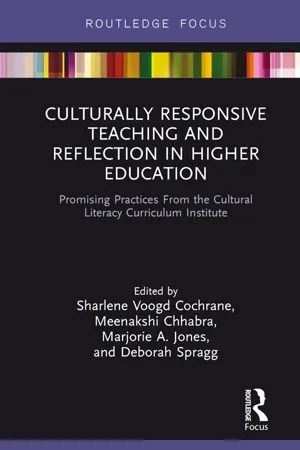
Culturally Responsive Teaching and Reflection in Higher Education explores how postsecondary educators can develop their own cultural awareness and provide inclusive learning environments for all students. Discussing best practices from the Cultural Literacy Curriculum Institute at Lesley University, faculty and administrators who are committed to culturally responsive teaching reflect on how to create an inclusive environment and how educators can cultivate the skills, attitudes, and knowledge necessary for implementing culturally responsive curriculum and pedagogy. Rather than a list of "right answers," essays in this important resource integrate discussion and individual reflection to support educators to enhance skills for responding effectively to racial, cultural, and social difference in their personal and professional contexts. This book is as an excellent starting point or further enrichment resource to accompany program or institutional diversity and inclusion efforts.
eBook - ePub
Culturally Responsive Teaching and Reflection in Higher Education
Promising Practices From the Cultural Literacy Curriculum Institute
- 126 pages
- English
- ePUB (mobile friendly)
- Available on iOS & Android
eBook - ePub
Culturally Responsive Teaching and Reflection in Higher Education
Promising Practices From the Cultural Literacy Curriculum Institute
About this book
Trusted by 375,005 students
Access to over 1.5 million titles for a fair monthly price.
Study more efficiently using our study tools.
Information
Topic
EducationSubtopic
Education General1 Introduction
Cultural Literacy, Cultural Humility, and Reflection
The United States will soon become a majority-minority nation. Analysis of the 2010 Census indicates a shift in the nation’s racial makeup that is reshaping schools, work places, and the electorate. Where now the white population of the United States is 61.5 percent and people of color are 38.5%, within the next generation, the white population will be under 50 percent. The Brookings Institute reports that currently more than 45 percent of students in K–12 are students of color. In the next five years nonwhite children will surpass 50 percent, and by 2039, racial and ethnic minorities will make up a majority of the U.S. working-age population (2013).
These statistics have significant implications for educational practice in colleges and universities; it is increasingly important that faculty, students, and staff respond effectively across racial, religious, and social difference. Colleges and universities face increasingly complex issues that are the focus of current campus concern, including protests demanding better relationships between white students and faculty and students of color, a resurgence of student organizing in response to recent current events and the Black Lives Matter movement, and recognizing the reality and seriousness of continuing racial discrimination in the United States.
These challenges are particularly relevant for primarily white institutions (PWIs): the majority of colleges and universities in the country. In fact, responding to increasing diversity has been on the agenda of many colleges and universities, and the efforts to create inclusive environments produce a lively current discourse. Our institution has been committed to increasing the cultural and economic diversity of the student body, with a goal of having students and faculty of color comprise 20 percent of the total student and faculty population. The numbers have been slowly growing, with the annual “Diversity Score Card” showing employees of color in 2010 at 14.5 percent, and at 18.5 percent in 2014. Students of color increased from 9.3 percent in 2010 to 15.8 percent in 2014 (Addison-Reid, 2014).
Still, Lesley, like most other colleges and universities, remains a primarily white institution. Gusa posits that there is a “White Institutional Presence,” or an ideology within the traditions, practices, and perceptions about knowledge that is taken for granted at such institutions as the norm. Primarily white institutions must not only serve more students of color, but they must serve them well. They also must understand and challenge the effect of whiteness on the curriculum, pedagogy, and student experiences (Gusa, 2010).
Faculty members face the challenge of knowing more about the experience of students of color in PWIs and supporting the culturally responsive skills and attitudes of white students. This is true for faculty in all subjects, disciplines, and coursework, in order to implement cultural literacy and culturally responsive teaching fully into the institutional environment. Our book makes a unique contribution to this emerging discourse by presenting the narratives of faculty actively engaged in the opportunities and challenges of culturally responsive teaching.
Cultural Literacy, Cultural Humility
The Culture Literacy Curriculum Institute (CLCI) content and format and our written narratives are based on the understanding that three foci are critical for increasing culturally responsive teaching in primarily white colleges and universities:
- individual awareness and growth;
- implications for curriculum and pedagogy, including issues of power and structural racism; and
- institutional cultural climate.
We have found the concepts of literacy and humility applied to social and cultural realities an effective way to deepen these conversations.
“Literacy” usually refers to the development of reading, writing, and language skills, while “cultural literacy” captures our goal of building skills in understanding and communicating across varieties of cultural difference and experience. Cultural literacy is a critical set of attitudes, knowledge, skills, and commitments in negotiating the network of beliefs, values, and characteristics that determine a group’s identity and relationships.
CLCI participants read several books in common. Our initial Institute texts included Educating Culturally Responsive Teachers: A Coherent Approach. Villegas and Lucas describe culturally responsive teachers as having a sociocultural consciousness, affirming views of students from diverse backgrounds, and embracing constructivist views of teaching and learning. Such educators are familiar with their students’ prior knowledge and beliefs and design instruction that builds on what students know, yet goes beyond the familiar. These educators sense a responsibility for bringing about educational change so that schools are more responsive to diverse student needs (2002, p. xiv).
We also read Transforming Classroom Culture: Inclusive Pedagogical Practices (2011), in which editors Dallalfar, Kingston-Mann, and Sieber gather writing from faculty primarily from Lesley University and UMass Boston. Aligning with the culturally responsive concepts, the authors highlight their experiences of bringing inclusive theories to teaching practices within their specific disciplines.
“Cultural humility” has deepened our understanding of the ways such work can be effective. A video by Vivian Chavez and Melanie Tervalon introduces participants to the three components of the concept, which align well with the design of the CLCI. The focus on cultural learning as lifelong and related to power issues, plus the importance of institutional support for culturally responsive teaching, spoke to our experiences.
The first component of cultural humility is the commitment to lifelong learning and critical self-reflection, especially around social identities. Cultural humility requires that each of us respond to culture as an ongoing process, accompanied by regular self-reflection. How carefully am I listening? What more can I learn?
One of our Writing Group participants tells this story as an example of her realizing the need for ongoing cultural learning:
We sat crowded around the dining room table in the dimly lit center of the pueblo home, large earthen-ware pots on the kitchen counters and clay sculpture adorning the corner tables and shelves near-by. While hot and dry outside, with a dusty wind blowing, inside cool, fresh air surrounded us as we listened intently to the older woman sharing her home with us. Our class of graduate and undergraduate students traveled from Boston to study the “Cultures and Traditions of the Southwest,” and one of the highlights was a visit to Santa Clara Pueblo and our host and guide, who shared her insights about family, women’s roles, and the experiences of her community, including the pottery-making for which her family excelled.
As she responded to questions, she mentioned a previous visit, looked at me and hesitated. Thinking she had forgotten my name, I reminded her as she continued her conversation. Later in the discussion, this happened again, and again I reminded her of my name. The visit ended with a group photograph; then the students walked ahead toward the van. As I walked by the pots of plants on the small patio and said my goodbyes, she quietly said, “My friend, I know your name. We just talk more slowly in our culture.” Her words, though gentle, carried a forceful message. Shocked and chagrined, I realized that I jumped in with my Western, fast-speaking assumptions, and had not respected her pace, her story. I thanked her for her comment and slowly walked back to the van, embarrassed and troubled. I was still learning to listen to those whose practices were different, and appreciate those differences.
A second quality of cultural humility is the need to recognize and disrupt power imbalances. Such imbalances exist between individuals according to social identities and roles, and between individuals, groups, and institutions. It is vital to positive relationships that such power imbalances be acknowledged and challenged. Power is often an unspoken element in learning environments; faculty in colleges and universities make a number of choices when they teach that reflect their own power, as well as their practice of cultural humility.
While we look to create the quality of cultural humility within our students and ourselves, we also need to fully assess how we express power relationships within our teaching. Working with English language learners (ELL) affords one example of recognizing the power imbalances between teachers and students, and the privileging of English speakers:
One faculty recalled a bright, energetic, fun-loving student in her class, committed to her education, comfortable, expressive, and a conceptual thinker in her home language of Spanish. In English she struggled to express the depth and thoughtfulness of her ideas. Her writing contained English grammar errors and awkward sentence structure. A constant tension existed between her critical thinking ability and academic writing. The faculty member could have said she was not capable of the coursework, and given her a low grade. As a culturally humble educator, she also had the power to give extensive feedback and time to rewrite and rewrite, allowing her student to continue working on her English writing challenges. In making this choice the student could own and express her academic power, inviting her into a process that both acknowledged her strengths and her need to improve her communication skills.
The third requirement for cultural humility is institutional accountability. Responding to cultural difference is a charge to individuals; at the same time, we are part of larger institutions, and many times institutional structures, environments, values, and experiences shape our responses and actions. Accountability includes supporting ways for faculty to talk and develop together and engaging administrators who can make the budget and resource decisions to prioritize this work.
The environments we work and learn within, especially in groups such as faculty organizations, program developers, and university administrators, must set a standard of openness, willingness to learn, reflective engagement, and acknowledgment of power realities. The CLCI has been an example of institutional support and collaboration, from the Provost’s Office and the Office of Equal Opportunity and Inclusion, the Lesley University Diversity Council, faculty and Deans in each school, and collegial leadership assumed by individual faculty.
Developing Cultural Humility: Embracing Race, Privilege and Power, edited by Miguel Gallardo, has added to our understanding of this process and underscores the lifelong weaving of teaching and learning that cultural humility requires. First, we develop the cultural humility capacity in ourselves, our willingness to learn, self-reflect, and acknowledge power dynamics. Then we bring this practice and awareness to our classes, both in course content and pedagogy. We model and address these attitudes and skills with transparency, encourage all voices, and respect individual stories.
One of the critiques our Writing Group raised about cultural humility is that “humility” often suggests passivity, accepting, and not speaking up. It seemed more useful as a goal for white faculty in approaching difference, rather than for the faculty of color. We agreed the notion of “cultural courage” seemed equally necessary for speaking and acting in difficult situations.
As our discussion evolved about both humility and courage, we were struck by the way Parker Palmer, in Healing the Heart of Democracy, writes about humility and chutzpah:
By chutzpah I mean knowing that I have a voice that needs to be heard and the right to speak it. By humility I mean accepting the fact that my truth is always partial and may not be true at all—so I need to listen with openness and respect, especially to “the other,” as much as I need to speak my own voice with clarity.
(2011, p. 43)
A similar dynamic is captured in the term “critical humility,” which describes the paradox necessary for white people to engage in anti-racism:
We define critical humility as the practice of remaining open to the fact that our knowledge is partial and evolving while at the same time being committed to speaking up and taking action in the world based on our current knowledge, however imperfect … In other words, we strive toward being a “good white person” while trying not to fall into the trap of thinking we actually have become that person.
(European-American Collaborative Challenging Whiteness, 2012, p. 2)
Reflection and Relationships
Faculty of color (FOC) at primarily white institutions bring real-life experience to other faculty and both white students and students of color who may not have had close interactions with FOC in higher education. FOC therefore make a critical and significant contribution to the environment and dialogue on culture and diversity. There are challenges embedded in this experience, but practices such as developing syllabi jointly and co-teaching teams of white faculty and FOC are strategies that deepen faculty relationships. Opportunities such as the CLCI also support such relationships.
As colleagues in the Writing Project, both white and faculty of color, we held many conversations about culture and difference. We laughed, cried, and expressed anger about injustices and narrow-minded or prejudiced comments and situations in our lives and in our classrooms. We began to feel comfortable enough with each other to confront our blindness and hubris, and to talk honestly about our mistakes, insights, and moments of success. We experienced the importance of deeper faculty relationships as a significant component in developing an attitude of cultural literacy, cultural humility, and courage. These relationships encouraged honesty and actively challenged us to grow.
The significance of relationship raises a question about how cultural humility develops. In our society, much that passes for news and entertainment contains stereotypes, misinformation, and outright racist, negative images. Unless a white person has opportunities to interact with those of other races, languages, and cultural groups, he or she can remain recruited into racism and closed-mindedness. It takes intention and courage to go beyond these limits, to seek out authentic connections with those who differ in background, identity, and ideas. For those of us, as well as our students, who have not had such experiences, it is critical to expand awareness in other ways, such as reading, interviews, guest speakers, and other acts of reaching out beyond our comfort zone. For those of us teaching mostly white students, such intentional content, resources, and pedagogy are necessary in order to provide the voices and experiences our students have missed.
Being constantly aware of cultural differences, power issues, and institutional challenges may lead white faculty to “burnout” or disengage. This response is, in some ways, the ultimate power reality and example of white privilege—a white person with a secure job can decide to engage with these issues or not and choose to deny or ignore issues of power, maintaining a sense of security and privilege.
The choice to not engage, however, fails to provide a complete and enriching teaching environment for students or faculty. Educators who confront issues of race and other differences through their curriculum, pedagogy, and relationships can find deeply meaningful and rewarding experiences. Cultural literacy and cultural humility open an avenue for faculty as effective culturally responsive educators and for primarily white institutions to more fully realize their goal of educating their students for roles in a diverse and culturally complex future.
More About the CLCI
Goals and Structure
For the past five years, groups of faculty have come together for a week in June to participate in the CLCI. This professional development opportunity began as a proposal by the Lesley University Diversity Council’s Curriculum Committee to the Provost. More than forty full-time faculty/staff have gone through the program, 25 percent of the current full-time faculty.
The proposal stated that as faculty and administrators we have to do our own personal work, building our own cultural awareness and skills, as we implement curriculum and pedagogy and provide institutional support in order to create inclusive, culturally responsive environments. W...
Table of contents
- Cover
- Title
- Copyright
- Contents
- Preface: An Invitation for Dialogue
- Acknowledgments
- 1 Introduction: Cultural Literacy, Cultural Humility, and Reflection
- Section I Knowing Ourselves
- Section II Pedagogy and the Other
- Section III Practice in Community
- Reflection Activities
- Notes for Engaging Discussions
- Contributor Biographies
- Index
Frequently asked questions
Yes, you can cancel anytime from the Subscription tab in your account settings on the Perlego website. Your subscription will stay active until the end of your current billing period. Learn how to cancel your subscription
No, books cannot be downloaded as external files, such as PDFs, for use outside of Perlego. However, you can download books within the Perlego app for offline reading on mobile or tablet. Learn how to download books offline
Perlego offers two plans: Essential and Complete
- Essential is ideal for learners and professionals who enjoy exploring a wide range of subjects. Access the Essential Library with 800,000+ trusted titles and best-sellers across business, personal growth, and the humanities. Includes unlimited reading time and Standard Read Aloud voice.
- Complete: Perfect for advanced learners and researchers needing full, unrestricted access. Unlock 1.5M+ books across hundreds of subjects, including academic and specialized titles. The Complete Plan also includes advanced features like Premium Read Aloud and Research Assistant.
We are an online textbook subscription service, where you can get access to an entire online library for less than the price of a single book per month. With over 1.5 million books across 990+ topics, we’ve got you covered! Learn about our mission
Look out for the read-aloud symbol on your next book to see if you can listen to it. The read-aloud tool reads text aloud for you, highlighting the text as it is being read. You can pause it, speed it up and slow it down. Learn more about Read Aloud
Yes! You can use the Perlego app on both iOS and Android devices to read anytime, anywhere — even offline. Perfect for commutes or when you’re on the go.
Please note we cannot support devices running on iOS 13 and Android 7 or earlier. Learn more about using the app
Please note we cannot support devices running on iOS 13 and Android 7 or earlier. Learn more about using the app
Yes, you can access Culturally Responsive Teaching and Reflection in Higher Education by Sharlene Voogd Cochrane, Meenakshi Chhabra, Marjorie A. Jones, Deborah Spragg, Sharlene Voogd Cochrane,Meenakshi Chhabra,Marjorie A. Jones,Deborah Spragg in PDF and/or ePUB format, as well as other popular books in Education & Education General. We have over 1.5 million books available in our catalogue for you to explore.