The designation ‘Nilotic’ has, for a great number of years, been applied indiscriminately by explorers, traders, government officials and travellers to all those peoples who live in the Upper Nile Valley, along the banks and in close vicinity to the great river and its tributaries.
As with most old terms, applied in the first instance to little-known areas and people, it later became necessary to redefine and limit its scope. The term Nilotic has come to have a specialised meaning for anthropologists. It refers only to certain groups of people in the Nile valley – and to some further south in Uganda, Kenya and Tanganyika – who have closely related physical, linguistic and other cultural characteristics as well as traditions and myths suggesting common origin. It is these features, together with certain characteristic types of social structure and organisation, which have led anthropologists to feel themselves justified in including all such groups under one common title – ‘Nilotes’ – and to recognise the Nilotic peoples as a unique ethnic group. Other groups of people living in the same area have been greatly affected by the Nilotes, through intermarriage, warfare, and constant borrowing over many generations of close, and sometimes intimate contact. In turn, the Nilotes have been greatly modified, physically, linguistically and culturally, by their neighbours and in several cases it has been difficult to determine, often with the slightest and most inadequate ethnographic material, whether a certain group of people should be assigned to the Nilotic peoples or to some other ethnic group, such as the Nilo-Hamitic peoples of East Africa.
The classification of the lesser known tribes of the Upper Nile basin is still controversial, even where language has been acknowledged as the chief criterion of affinity to one or another ethnic group. It may be that some groups will never be classified with certainty owing to extensive mingling with neighbours; in other cases further research will determine the peoples they most closely resemble. For the purpose of this survey only those which can be classified with certainty, and for which we possess adequate information for comparative purposes, will be considered in full.
LOCATION, POPULATION AND NOMENCLATURE
The Nilotic tribal groups are contained approximately within the limits of Lat. 12°N. – Lat. 4°S. and Long. 36°E. – Long. 22°E. The southern half of the Anglo-Egyptian Sudan is the present homeland of the majority of the Nilotes, who are found in the Provinces of Darfur, Kordofan, White Nile, Fung, Upper Nile, Bahr el Ghazal and Equatoria. Certain Nilotic groups, however, are situated in the western borderland areas of Abyssinia, in the northern regions of Uganda, and in Eastern Kenya, while in two instances they overlap into the Belgian Congo and Tanganyika. The Nilotes do not occupy one continuous stretch of territory. In the north there is the block consisting of the Dinka, Nuer, Shilluk and Anuak; separated from these are the Pari, Burun-speaking people, Atwot and scattered groups of the Bahr el Ghazal. The central Nilotes (Acholi, Lango, Alur and Jo-Paluo) are separated from the northern block by Sudanic and Nilo-Hamitic peoples, and the southernmost Nilotic groups are further separated from each other and from the central block by Nilo-Hamites and Bantu. At a broad estimate they number about two and a half millions.
A more detailed account of the location, population, nomenclature and neighbouring tribes of the Nilotic groups follows the list of tribal groups given below:
1. Dinka
2. Nuer
3. Shilluk
4. Anuak
5. Acholi
6. Lango
7. Luo
8. Burun
9. The Bor Belanda
10. Jo Luo (Jur)
11. Shilluk Luo tribes of the Bahr el Ghazal
12. Pari
13. Alur (a) Jo Padhola
(b) Jo Paluo
The official population figures given below are in many cases only approximate owing to the difficulties of carrying out an adequate census in remote and often inaccessible areas.
THE DINKA
LOCATION
The Dinka extend over a vast area from 12° – 6°N. Lat., from Renk in the north to Malek and Tombe in the south, only about 160 miles from the Uganda border. There is a wide extension to the west so that the people occupy much of the Bahr el Ghazal province and also the most southern part of Kordofan province, immediately north of the Bahr el Arab river. There is a long intervening wedge of Nuer about the Bahr el Ghazal, Bahr el Zeraf and main Nile rivers. The Dinka tribes are usually divided into geographical sections as follows:-(1)
(a) The Northern Dinka, situated mainly in the Upper Nile Province; they extend south to the Bahr el Zeraf, Lake No and the Bahr el Ghazal. The main Dinka tribes inhabiting this area are known as the Padang Dinka.
(b) The Eastern Dinka, situated on the right bank of the Nile from south east of Ayod to Malek.
(c) The Central Dinka, inhabiting the area on the left bank of the Nile, extending west to Tonj.
(d) The Western Dinka, situated west of the Nuer about the Jur river area from Tonj in the south and the Bahr el Arab in the north and westwards of Aweil. This area is inhabited by the Malual Dinka and other lesser tribes. In addition the Manangier live in the swamps among the Rek Dinka between the rivers Jur and Lol. The Manangeir are Jo Luo people who took refuge among the Western Dinka to avoid the Arab slave raids and, later, the conflict between the Dinka and Azande. They are rapidly being absorbed by the Dinka and are consequently losing their Jo Luo customs and dialect. They are said to number 1,000 – 2,000 souls approximately.
NEIGHBOURS
The neighbours of the Dinka include the Nuer. There has been conflict between the two for a long time and relations have been predominently warlike and marked by interminable cattle raiding. In the north east the Dinka are in contact with the Shilluk while, in the south west, in the Bahr el Ghazal province, there is the confusion of tribes in the neighbourhood of Wau. Among the Wau district tribes there is the Nilotic Jo Luo (Jur) who have been in immediate contact with their Dinka neighbours for a number of generations and have been subordinate to them to a certain extent.
POPULATION
Total population has been estimated at 500,000 souls approximately.
NOMENCLATURE
The Dinka name for themselves is Jien. Dinka is believed to be the anglicized form of the Arabic Denkawi, from Jien.
THE NUER
LOCATION
The Nuer inhabit the savannah stretching on both sides of the Nile south of its junction with the Sobat and Bahr el Ghazal rivers and on both banks of the two tributaries. The Nile divides the Nuer country into two parts, Eastern and Western Nuerland. According to Evans-Pritchard the most important tribal groups of the Western Nuer are: the Bui, Jagei, Lek, Nuong and Dok. The most important tribes of the Eastern Nuer are: the Thiang, Lak, Gaweir and Lou.(1) The Jekany tribes are found on the west bank of the Nile and also far to the east of the Sobat river where they extend over the Anglo-Egyptian border into Abyssinia.
NEIGHBOURS
The western parts of Nuerland are in direct contact, and usually conflict, with their Dinka neighbours. Nuer expansion has been at the expense of their Dinka neighbours and it is generally recognised that much of present day Nuer country was Dinka in the middle of the 19th century. Relations between Nuer and Dinka will be discussed in the account of the Nuer political structure. The Shilluk are separated from the Nuer by the Dinka, except in a small area, and there has been little contact between the two groups, perhaps owing to the more highly organised society of the Shilluk which renders them difficult to raid with impunity. The Nuer give the reason that the Shilluk have no cattle and they only raid people with cattle.(1) Although in direct contact with the Anuak in the far eastern parts of Nuer territory, tsetse fly and absence of cattle make the area unsuitable for encroachment and the Anuak were only occasionally raided by the Nuer. When rifles were introduced and the Anuak could defend themselves they retaliated with raids on the Nuer. The Burun were occasionally raided by the Nuer for captives. Other communities, Arab and those of the Nuba mountains, were raided only occasionally. Except for the Beir whom the Nuer appear to have respected, and the Dinka whom they fought, most foreign peoples were classed by the Nuer as Bar, that is, cattle-less folk, or people possessing few cattle. Another category was Jur, cattle-less people whom the Nuer regarded as lying on the outskirts of their world; these included the Azande, Europeans, and the Bongo etc., although the Nuer have differentiating terms for most of them.
POPULATION
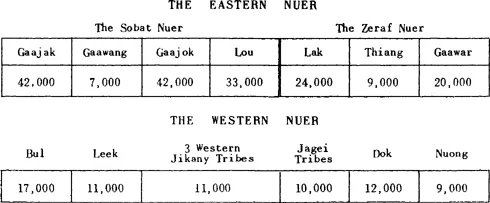
Official estimate of population is 260,000. Estimates for the various tribes are given approximately as follows by Evans-Pritchard.(2)
NOMENCLATURE
The Nuer call themselves Naath, (sing. Ban). The Shilluk, Arabs and Dinka call them Nuer. The Nuer also speak of the tribes west of the Bahr el Jebel as Nath cieng – ‘the homeland Nuer’, and of those east of the river as Nath Doar – ‘Bush Nuer’.(3)
THE ATWOT
These appear to be a Nuer tribe, speaking a Nuer dialect, but having adopted many Dinka habits. They are situated in the Lakes district south west of Yirrol, south of the Dinka; they number 31,600 approximately. Little is known of them.
THE SHILLUK
LOCATION
The Shilluk are the northernmost group of the Nilotic peoples. They occupy a narrow strip of country in the Upper Nile province and are settled mainly along the west bank of the White Nile from near Lake No in the south to approximately 11°N. Lat. – 300 miles south of Khartoum. They also have a number of settlements on the east bank of the Nile and along the lower reaches of the Sobat. In former times their country was larger, extending further north up the river towards Khartoum.
NEIGHBOURS
East of the Shilluk are the Dinka with whom they have little real contact; south west are the Nuer, and, in the north, the Arab Baggara. It was Arab pressure which forced the North Shilluk to retire to their present settlements further south.
POPULATION
It is estimated that there are 100,000 souls approximately.
NOMENCLATURE
According to Howell and Thomson and other authorities, the name Shilluk is most probably an Arabic version of the word Colo which is the name used by the Shilluk to refer to themselves. They are called Teat by the Nuer.
THE ANUAK
LOCATION
A riverain people, the Anuak are distributed along the Baro, Aluro, Obela, Gila and Akobo rivers and their tributaries in Abyssinia, and on the Akobo, Oboth, Agwei and Pibor rivers of the Anglo-Egyptian Sudan.
There are indications that the Anuak formerly occupied a wider territory than at present. They were probably in possession of part of what is now East Jikany Nuer country, north and south of the Sobat river. South of the Oboth river the country was once occupied by Anuak. Evans-Pritchard writes, “Further eastwards the whole country for a considerable distance to the south of the Oboth river was once occupied by Anuak. According to their traditions the noble clan was centred here and a century...