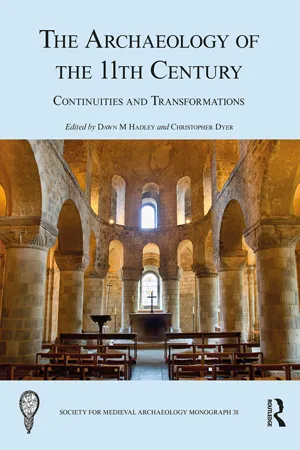
The Archaeology of the 11th Century addresses many key questions surrounding this formative period of English history and considers conditions before 1066 and how these changed. The impact of the Conquest of England by the Normans is the central focus of the book, which not only assesses the destruction and upheaval caused by the invading forces, but also examines how the Normans contributed to local culture, religion, and society. The volume explores a range of topics including food culture, funerary practices, the development of castles and their impact, and how both urban and rural life evolved during the 11th century. Through its nuanced approach to the complex relationships and regional identities which characterised the period, this collection stimulates renewed debate and challenges some of the long-standing myths surrounding the Conquest. Presenting new discoveries and fresh ideas in a readable style with numerous illustrations, this interdisciplinary book is an invaluable resource for those interested in the archaeology, history, geography, art, and literature of the 11th century.
eBook - ePub
The Archaeology of the 11th Century
Continuities and Transformations
- 310 pages
- English
- ePUB (mobile friendly)
- Available on iOS & Android
eBook - ePub
The Archaeology of the 11th Century
Continuities and Transformations
About this book
Trusted by 375,005 students
Access to over 1.5 million titles for a fair monthly price.
Study more efficiently using our study tools.
Information
Subtopic
ArchaeologyIndex
Social SciencesChapter 1
Introduction
The 11th century has been seen as marking a number of important turning points, with the ‘mutation féodale’ around the year 1000, which has played a major role in French historical thinking (eg Bonnassie 1991; Bisson 1994; Bourin and Parisse 1999; Barthélemy 2009), the end of the Scandinavian incursions (Lawson 1993; Rumble 1994), new monastic orders and reform of the Church (Barrow 2015; Lawrence 2015), and important stages in the development of rural landscapes and towns (Astill 2009; Rippon 2009), but none of these movements and trends have exercised such a grip on the imagination of the English as the Norman Conquest. Within weeks of the Battle of Hastings different narratives of the events were being constructed (Van Houts 1997). Did the Conquest mark the rightful succession to his inheritance by a new king, after judgement by battle and after receiving the consent of the English people? Was the outcome of the battle a punishment for the moral degeneration of the English, and in particular the failure of King Harold to keep his oath of loyalty to William? Was Harold a tragic figure, a much-admired hero who made a single error of judgement that cost him his kingdom and his life? In later centuries radicals talked of a Norman yoke which had been imposed on the English by alien lords, and 19th-century nationalist historians could emphasise the German traditions of freedom that inspired the growth of parliamentary government: some regarded feudal institutions as intrusions brought to England by an essentially French aristocracy (Chibnall 1999). It has been a matter of national pride, or at least a point of comparison with most of continental Europe, that there has been no successful invasion of England since 1066. The date is part of the common heritage, and references to the Bayeux Tapestry are made in popular art, including cartoons and advertisements. Every detail of the episode is debated. Was King Harold struck in the eye by a Norman arrow? What was the precise location of the Battle of Hastings? Who designed and embroidered the Bayeux Tapestry? (Clarke 2013; see also Lewis, chapter 12 in this volume). The story of the battle and its rival interpretations are so deeply embedded in the English historical consciousness that archaeologists might be daunted by approaching an event which has been claimed so fully both by academic historians and popular mythology.
Nonetheless, archaeology has much to contribute to our understanding of the Norman Conquest. Indeed, archaeologists are capable of making a far more profound contribution than simply dancing to the historians’ tune, or merely illustrating and embellishing the documentary record (as has occasionally been bemoaned: eg Austin 1990, in which medieval archaeologists were encouraged to reject the agendas of historians). As this volume reveals, many of the insights provided by archaeology relate to developments that have left little or no trace in the written records, so that archaeology can provide entirely new insights into the period which have no connection with political events. Certainly, castle building, and the foundation of religious houses and local churches, were expressions of the power of lordship exercised by particular families who are well-represented in the documentary record, such as fitz Osbern, Lacy and Redvers (see Lilley, chapter 3, and McClain, chapter 11, in this volume), but the archaeological perspective also allows us to escape from a world dominated by the great men familiar from the documents. Moreover, archaeology provides a perspective on the wider cultural and social context, as reflected in, for example, material culture, evidence for environmental change, transformations in settlements and landscapes, and technical innovations.
Exploration of the wider context of the Conquest, is not, it should be emphasised, simply a consequence of the difficulties that archaeologists face in tracing short-term change. Admittedly, attempts to assign pottery, churches or changes in pollen sequences, for example, to one side of the Conquest or the other have tended to prove difficult, if not impossible (eg Gem 1988; Jervis 2013, 456; Creighton and Rippon, chapter 4 in this volume), but it would be an exaggeration to state that the Norman Conquest was archaeologically invisible. We can point to spectacular new structures such as the White Tower in the Tower of London (Impey 2008), or Durham Cathedral (Reilly 1996), which were not just buildings in a new style, but statements about the power and wealth of a new regime. The structural remains from the town houses cleared away in the wake of the Norman invasions to make space for castle building in such places as Oxford and Winchester provide further evidence of the impact of the Conquest (see Fradley, chapter 7 in this volume). Similar destructive effects of castle construction on rural settlements, cemeteries and churches have been identified, at places such as Eaton Socon (Bedfordshire) (Addyman 1965) and Trowbridge (Wiltshire) (Graham and Davies 1993, 71–74; see also Craig-Atkins, chapter 8 in this volume). There were subtle changes in burial customs after the Conquest, with the cessation of the use of special cemeteries for executed criminals, and the growth of the custom of interring infants near the church wall, sometimes in the wake of the abandonment of the churches concerned (see Craig-Atkins 2014 and chapter 8 in this volume). Yet, as we will see, while the Norman Conquest was unquestionably a decisive political event that had major ramifications for both England and Normandy, to make sense of it requires understanding of broader social, economic, religious and political trajectories, which archaeology is especially well placed to elucidate, as the contributions to this volume reveal. This chapter outlines the broader 11th-century context of the Norman Conquest and discusses the issues that historians and archaeologists have addressed to set the scene for the chapters that follow.
The History of the 11th Century
The context for the Norman Conquest of England lies in larger and longer-term trends, over the period c 900–1150. One development was the formation of new states in succession to the Carolingian Empire while, on a smaller scale, an Empire continued to function in the 10th and 11th centuries in the eastern and southern lands, with bases in such provinces as Saxony (north Germany) and Swabia (south Germany), and from cities such as Pavia (Italy) (Bisson 2009). But everywhere territorial principalities were being built on the foundations furnished by the duchies and counties of the west, in, for example, Anjou, Catalonia, Brittany, Burgundy, Flanders and, of course, Normandy, and in the south in Spoleto and Tuscany. City states were emerging in Italy, and entirely new political formations beyond the former frontiers of the Empire, in Denmark, Hungary, Poland and England. The new rulers of these small states took over the powers and functions of kings, and minted money, collected taxes, held courts, appointed clergy, summoned armies, built fortresses and founded towns (Wickham 2010). They seemed aggressive to their own subjects as they asserted their power, and they troubled their neighbours because they tended to expand beyond their traditional boundaries. The kings of Wessex developed their powers as they had built their own monarchy by taking over the ruins of rival kingdoms and recovering territory from the Scandinavian invaders, mainly in the period 870−930, but they were influenced by Carolingian kingship even after the decay of that ambitious political venture (Dumville 1992; Reuter 2003).
The English state achieved an unusual degree of control of its provinces in such matters as law enforcement, tax collection and the control of currency. The central government was represented in each shire by an administrator, and communication between the king and his subjects was achieved through writs (Campbell 2000; Reuter 2003). The making of Domesday Book in 1086 is often cited as an outstanding example of the efficiency of the English state. The king was advised to carry out a survey of the resources of the kingdom, and using the device of the inquest, local people were required to provide information in response to a standard questionnaire. The data about lands, tenants and values were then digested centrally and entered into books which henceforth enjoyed a reputation for accuracy and authority (Sawyer 1985; Roffe 2000; Harvey 2014). No other state in Europe at that time could have contemplated assembling information in such a thorough fashion. England could be conquered if the invaders could capture London and Winchester and thereby gain control of the centralised system of government that connected the king and his advisers to the local communities. It was a profitable country for its ruler because direct taxes could deliver large sums of money with speed and efficiency, and the landed estate belonging to the rulers was larger and more valuable than could be found in most continental kingdoms and principalities (Campbell 2000).
For continental historians, especially those working in France, the 10th and 11th centuries, and in particular the years around the celebrated year 1000, were marked by the emergence of a vigorous and wealthy aristocracy, occupying the ranks of the hierarchy below the counts and dukes who had become the inheritors of the power of the Carolingians. The new aristocrats, emboldened by gaps in the local exercise of authority, seized lands, built or occupied castles, took over the courts and law enforcement, dominated the Church and its lands, and exploited the local population with demands for money and labour, compelling them to use the lord’s mill and wine-press, for which tolls were levied (Bourin and Parisse 1999; Barthélemy 2009). The English nobility, even when the monarchy was shaken by Danish conquest and dynastic changes in the first half of the 11th century, could not behave in such an independent fashion as their continental counterparts, and they exercised their considerable influence and authority in the context of a centralised state (Baxter 2007). On both sides of the English Channel a prominent role was occupied by the lesser aristocracy. On the continent the milites were making a transition from serving as soldiers, in which role they gained a reputation for undisciplined violence, to the possession of minor landed estates, while the Anglo-Saxon thegns served both kings and nobles as administrators, and gained lands and prestigious residences. They held property in towns, and this perhaps helped to give them a reputation as upstart commoners who advanced themselves through money (Fleming 1993).
The 11th century saw a process of economic development affecting all sections of society. New towns were founded and old centres expanded, and they became not just the nodal points for local, regional and international trade, but also centres for manufacture. Industries which had previously been located in the countryside, such as the weaving of cloth, were increasingly concentrated in urban centres. Only in England – thanks to the compiling of Domesday Book – can the percentage of the population living in towns be calculated, admittedly with some difficulties. Nonetheless, we can assert with some confidence that about 10% of the population of England had an urban base in 1086 (Holt 2000, 103−104). We have no precise comparative figures, but towns were larger and more numerous in Flanders and northern Italy, so the townspeople there probably represented a rather higher proportion of the whole population. Historical tradition assigns the origin of English towns to the state policy of building a network of fortifications against the Danes at the end of the 9th and beginning of the 10th century, and the similar measures taken by the Danes (Astill 2009, 262–263), though the largest town, London, owed its existence to the flow of trade across the North Sea, and its network of communications by river and road with southern and midland England. On the continent more varied explanations are given for the genesis of towns, and the great churches are assigned a place alongside rulers and nobles in encouraging and planning towns (Verhulst 1999). Everywhere the success of a town depended on attracting a sufficient number of traders and artisans, and the choice of site in relation to transport by road and water was necessary to ensure a thriving urban community.
In the countryside, England and the continent experienced parallel but not identical tendencies. Slaves were freed and settled on the land; rents and services were imposed on a section of the peasantry, though in England a fully developed form of servility with marriage fines and other payments and obligations developed after 1150. At the same time communities of free peasants survived who enjoyed some self-government and took initiatives such as building their own churches and mills (Bonnassie 1991; Stocker and Everson 2006). In England the free peasants paid rents to lords, but the sums could be token payments. Free and unfree alike experienced, at least in some regions, the processes of the nucleation of villages, and the formation of open fields (Jones and Page 2006; Renes 2010).
It is widely acknowledged that these developments were under way in the 11th century, but the origins are much debated, and the extent to which they continued after 1100 is unclear. It can be assumed that production was increasing, to keep the towns supplied with food and raw materials, and that peasants aimed for a surplus that could be exchanged or sold to pay rents and leave at least a small fund for acquiring goods that could not be grown or made in the village (Wickham 2010, 529–551). The countryside was being carved up into ever-smaller units of lordship or cultivation, in a movement called encellulement by a French historian – each cell (unit of land) was being more intensively exploited by the cultivating peasants, and by the Church and the lords, who squeezed what they could from land and people (Fossier 1982; Faith 1997, 153–177). The supply of money, and its use by the whole population, had increased in the 10th century. The German silver mines continued to produce a great deal in the early 11th century, at a time when towns and trade grew. This abundance aided the English rulers in collecting huge sums of Danegeld, but supplies diminished around the middle of the century (Spuf-ford 1988, 92–98).
The 11th century saw a number of movements of peoples in which the migration of aristocrats and townspeople across the English Channel was just a small part. Turks were moving into Asia Minor, disturbing the Mediterranean world, and north African Almoravids were arriving in Spain in response to the early stages of the reconquest movement, which encouraged a flow of Christian settlers into the former Arab territories in the centre of the country (O’Callaghan 2013). Scandinavians were still on the move in the north Atlantic, beginn...
Table of contents
- Cover
- Title
- Copyright
- CONTENTS
- List of Plates
- List of Figures
- Notes on Contributors
- Acknowledgments
- CHAPTER 1 Introduction
- CHAPTER 2 The Norman Conquest and its impact on late Anglo-Saxon towns
- CHAPTER 3 The Norman Conquest and its influences on urban landscapes
- CHAPTER 4 Conquest, colonisation and the countryside: archaeology and the mid-11th- to mid-12th-century rural landscape
- CHAPTER 5 Manorial farmsteads and the expression of lordship before and after the Norman Conquest
- CHAPTER 6 Anglo-Saxon towers of lordship and the origins of the castle in England
- CHAPTER 7 Scars on the townscape: urban castles in Saxo-Norman England
- CHAPTER 8 Seeking ‘Norman burials’: evidence for continuity and change in funerary practice following the Norman Conquest
- CHAPTER 9 Charity and conquest: leprosaria in early Norman England
- CHAPTER 10 Archaeology and archiepiscopal reform: greater churches in York diocese in the 11th century
- CHAPTER 11 Rewriting the narrative: regional dimensions of the Norman Conquest
- CHAPTER 12 The Bayeux Tapestry: window to a world of continuity and change
- CHAPTER 13 Cuisine and conquest: interdisciplinary perspectives on food, continuity and change in 11th-century England and beyond
- CHAPTER 14 Tradition and innovation: lead-alloy brooches and urban identities in the 11th century
- CHAPTER 15 History, archaeology and the Norman Conquest
- Index
Frequently asked questions
Yes, you can cancel anytime from the Subscription tab in your account settings on the Perlego website. Your subscription will stay active until the end of your current billing period. Learn how to cancel your subscription
No, books cannot be downloaded as external files, such as PDFs, for use outside of Perlego. However, you can download books within the Perlego app for offline reading on mobile or tablet. Learn how to download books offline
Perlego offers two plans: Essential and Complete
- Essential is ideal for learners and professionals who enjoy exploring a wide range of subjects. Access the Essential Library with 800,000+ trusted titles and best-sellers across business, personal growth, and the humanities. Includes unlimited reading time and Standard Read Aloud voice.
- Complete: Perfect for advanced learners and researchers needing full, unrestricted access. Unlock 1.5M+ books across hundreds of subjects, including academic and specialized titles. The Complete Plan also includes advanced features like Premium Read Aloud and Research Assistant.
We are an online textbook subscription service, where you can get access to an entire online library for less than the price of a single book per month. With over 1.5 million books across 990+ topics, we’ve got you covered! Learn about our mission
Look out for the read-aloud symbol on your next book to see if you can listen to it. The read-aloud tool reads text aloud for you, highlighting the text as it is being read. You can pause it, speed it up and slow it down. Learn more about Read Aloud
Yes! You can use the Perlego app on both iOS and Android devices to read anytime, anywhere — even offline. Perfect for commutes or when you’re on the go.
Please note we cannot support devices running on iOS 13 and Android 7 or earlier. Learn more about using the app
Please note we cannot support devices running on iOS 13 and Android 7 or earlier. Learn more about using the app
Yes, you can access The Archaeology of the 11th Century by Dawn M Hadley, Christopher Dyer, Dawn M Hadley,Christopher Dyer in PDF and/or ePUB format, as well as other popular books in Social Sciences & Archaeology. We have over 1.5 million books available in our catalogue for you to explore.