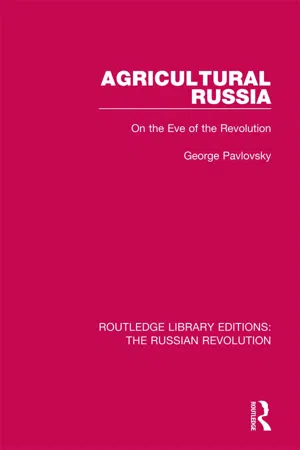
This volume, originally published in 1930, discusses the economics of Russian agriculture during the early 20th century. It analyzes those economic influences which were at work and were bringing about its transformation. Starting from a sketch of the agricultural geography of European Russia, as it had been shaped by natural conditions, historical and economic factors, the author proceeds to the study of the organization and conditions of Russian farming and agricultural production, as well as discussing the Russian characteristics as an agricultural producer and the origins and disposal of her available surpluses of agricultural products.
- 340 pages
- English
- ePUB (mobile friendly)
- Available on iOS & Android
eBook - ePub
About this book
Trusted by 375,005 students
Access to over 1.5 million titles for a fair monthly price.
Study more efficiently using our study tools.
Information
PART I
THE AGRICULTURAL MAP OF RUSSIA
CHAPTER I
NATURAL CONDITIONS
THE agricultural geography of a country is the product of the combined influence of natural conditions, historical development and economic factors. Natural conditions impose certain territorial limitations on farming in all its branches, and though the progress of agricultural science tends, indeed, to expand those boundaries, agriculture is so essentially dependent on the forces of nature that, in the main, the limits thus fixed may be considered as practically rigid. The elaborate design of the agricultural map, on which the hand of history never ceases to work, sometimes nursing a single detail for generations or even centuries, and sometimes bringing about drastic changes in the course of a few short years, has nature for its background. In any attempt to analyse and describe the agricultural conditions of Russia, a brief outline of the natural background on which they developed, is therefore absolutely essential.
European Russia is a vast plain, intersected only by slight undulations of the ground. Changes in the relief of the territory, which exercise so marked an influence on the character of farming in most other countries of Europe, play, therefore, practically no part in shaping the agricultural map of Russia. The natural environment to which farming has to adapt itself depends mainly on two elementary geographical factors, namely latitude and longitude, which determine climatic conditions and, through the latter, to a considerable extent, also the properties of the soil.
Except for a relatively narrow fringe along its Western frontiers, European Russia possesses a climate which can be described as typically continental. This character is especially pronounced in the South and the East of European Russia, owing not only to the geographical position of these parts, far removed from the influence of Atlantic air currents, but also to the special atmospheric regime of the Russian plain. Indeed, the distribution of atmospheric pressure is such that, as a rule, the Northern and Western parts of the country are open mainly to the influence of South-Western winds, especially common during the winter, while the Southern and Eastern districts, protected from the West by the double barrier of the Alps and the Carpathians, are mostly swept by the arid winds of the Asiatic steppes. Accordingly, the severe winters of the North-West of European Russia are somewhat moderated by Atlantic air currents, as well as by the relative proximity of the Gulfstream. Both contribute to the abundance of moisture in the atmosphere, resulting in plentiful rain—and snowfall. While, on the whole, the abundant summer rains in the North-West may, to some extent, be harmful to agriculture, the presence of a thick coat of snow throughout the winter is favourable to farming in these regions, since it enables the cultivation to be extended very far North, into latitudes which, otherwise, would have been agriculturally barren. Indeed, according to the eminent Russian meteorologist and geographer, Professor Voieikov, “were it not for the cover provided by snow, the cultivation of winter crops would be impossible in two-thirds of European Russia.”1
The farther East, away from the moderating influences of the Atlantic air currents and the Gulfstream, the colder and the drier becomes the climate in the same latitudes. Roughly speaking, the area of European Russia over which the Atlantic atmospheric regime exercises a predominant influence does not extend beyond an imaginary line drawn approximately from the White Sea near Archangel, along the Northern Dvina, to some point in the Urals, between Viatka and Perm. The country East of this boundary climatically belongs rather to Asiatic than to European Russia. The central belt of Russia, down to the steppes, on which it borders in the South and the East, is also accessible to Western air currents, whose influence, however, naturally diminishes from West to East, the continental character of the climate tending to assert itself increasingly both in the amount of atmospheric precipitations and in the extremes of temperature.
In the steppes, subject mostly to Eastern atmospheric influences, climatic conditions are entirely different. In the course of the summer months, especially from June to August, conditions here are generally favourable to the predominance in the steppes of Western and South-Western winds, but their beneficial effects are mostly confined to the Western part of the zone. Before these air currents reach the South-East, they have practically lost their moisture in the arid atmosphere of the sun-baked steppes. Yet, they come at the right time. Indeed, in the South, approximately up to the latitude of Kiev (51–52° N.), the greatest amount of rainfall is registered in June, while about 35% of the total annual precipitations fall in the course of the months immediately preceding the harvest. The absolute amount of precipitations, however, is far from sufficient, even in the most favoured parts of the zone. In the late spring the Southern steppes are often swept by strong North-East winds, which, originating in the cold wastes of Siberia, overrun the greater part of European Russia, but are especially violent in the vast open spaces of the South. Another enemy of the farmer in the steppes, more particularly in South-Eastern Russia, is the wind from the deserts of Central Asia and the Caspian shores which, though fortunately not frequent in summer, is disastrous in its effects on ripening crops.
The extreme South-East of European Russia, adjoining the Caspian Sea, removed as it is from Western atmospheric influences, climatically belongs rather to Asia than to Europe.
To sum up this preliminary outline of the atmospheric conditions of European Russia, whose closer consideration must be postponed till the description of the natural zones, it may be said that in every latitudinal belt, as it runs eastwards, the differences between the extremes of summer and winter temperatures tend gradually to increase, while the amounts of precipitations decrease continually. In other words, the farther East, the more continental becomes the climate.
Passing now to the properties of the soil in various parts of European Russia, it is essential to bear in mind that a division based on this principle, registering the transitions from one type of soil to another, corresponds very closely with that into belts according to climate and natural vegetation, thus giving an adequate outline of the natural background of the agricultural map of Russia. This connection between climate, vegetation and soil is due to obvious causes, but in Russia it is especially marked owing to the general flatness of the country, which contributes to the uniformity of conditions over very vast territories. In other countries, whose surface is broken by mountains, no such uniform belts would be met, horizontal and vertical zones being mingled and giving the general effect of patchwork to the map. In Russia, the natural zones stretch over thousands of square miles without interruption, going over into each other along their borders by imperceptible stages.
European Russia may be divided, according to climate, soil and natural vegetation, into the following principal zones, shown on map No.1:
(1) Arctic zone;
(2) Zone of Northern Forests and Marshes;
(3) Zone of Mixed Forests;
(4) Middle-Russian (intermediate) zone;
(5) Black-earth zone;
(6) Zone of Southern Steppes;
(7) South-Eastern Arid Zone.
The two mountainous districts on the Southern fringe of European Russia, namely the Crimea and the Caucasus, though they certainly possess very marked characteristics of their own, are too small to be considered as separate zones. Moreover, nationally, as well as with regard to their farming, they are distinctly non-Russian, and thus fall outside the scope of the present study, dealing with the agricultural industry of Russia proper only.1
The Arctic zone, which occupies the extreme North of Russia, lies mostly beyond the limit of cereal cultivation. This limit passes approximately through the 65° N. in European Russia, the 59° in Siberia and the 51° in the Far East (Kamchatka). Only in some parts of the Murman Coast, exposed to the moderating influence of the Gulfstream, the cultivation of coarse barley is practised occasionally as far North as the 69°, actually beyond the Arctic Circle.2 The farther East, the more severe the conditions, and the wider the zone inaccessible to the farmer.
The extreme North of the zone consists of Arctic barrens (tundra), with practically no vegetation, except mosses and lichens growing on a ground permanently frozen to depths varying from some 20 to about 42 inches. Owing to the frozen condition of the ground and the extreme scarcity of vegetation, the Arctic barrens have no soil in the strict sense of the word, the superficial layers of the subsoil being only slightly tinted with coarse humus to a depth not exceeding two inches or so.3
To the South of the Arctic Circle, the barrens change into mossy marshes with sparsely scattered undersized Northern conifers, forming the Northern fringe of the forest belt, into which they go over gradually. The cultivation of the most hardy and quick-ripening cereals, such as barley and, occasionally, rye and oats, becomes possible, and is actually practised to some extent, mainly on forest clearings, approximately on the latitude of Archangel, about the 65–66° N. Here, South of the White Sea, begins the next natural zone—that of Northern forests and marshes.
The zone of Northern forests and marshes is a very wide belt, stretching approximately from the latitude of Archangel down to a line drawn roughly from Petrograd through Vologda and Nizhny-Novgorod to the South of the province of Perm in the Urals. Thus, the Southern boundary of this zone runs through about the 60° N, in the West and descends to the 56–57° in the East of European Russia. The natural conditions of the zone, though they vary considerably from North to South, with regard to climate and soil, decidedly represent variations of the same type. The average temperature of the year in Archangel and the North of the zone generally is about zero C., while on the latitude of Petrograd it is about + 4° C. The period of vegetation in Archangel does not exceed 125 days; in the South of the zone it increases to about 155 days. From the agricultural point of view, this difference is one of enormous importance. The natural vegetation in the North of the zone is very poor. The forests consist mainly, if not exclusively, of conifers, growing on swampy ground covered with mosses, rough species of grass and an abundance of Northern berries. The conditions are not favourable to the formation of humus, and the natural fertility of the soil is accordingly low. Both climate and soil, therefore, make the North of the zone little suited to agriculture, and the latter is practically confined to the part of subsidiary occupation. In the South of the zone, namely the provinces of Petrograd, Vologda (Southern part), Novgorod (North-Eastern part), Kostroma, Nizhny-Novgorod (Northern part), Viatka and Perm, the natural conditions are more favourable to farming. Here, the area of mossy marshes is considerably smaller, while the richer vegetation and warmer climate allow the formation of more fertile soil. The predominant type of soil is, indeed, the same throughout the zone, but it differs in the proportion of humus and the thickness of the superficial layer enriched by it. The typical soil of the zone is known in Russia under the name of podzol: a word having no exact equivalent in other languages. The podzol is a thoroughly washed-out soil of rather coarse granular structure, varying in its mineral contents according to the nature of the underlying rock. Its superficial layer, generally whitish-grey in colour, contains distinctive streaks of darker substance representing the humified strata. Owing to rapid washing-out, the mixing of humus with the basic soil, which is mostly sandy, is never perfect, and most of the humus gets quickly sucked in and dissolved in the lower strata. The result is that the soil in the strict sense, that is the layer containing humus, is very thin and lacks uniformity; it is accordingly poor. In the South of the zone, where the natural vegetation is richer, the climate less severe and the ground not constantly soaked in water, the quality of the podzol is better, and in many places it changes into a transitional kind of soil, known as podzolisty, intermediate between that of the Northern forests and the sand and clay loams of Central Russia. Though, agriculturally, even the South of the Northern zone cannot be considered as favourable, its great wealth in natural meadows and pastures make it well suited for grazing and dairy farming.
It is only after crossing the Southern boundary of the Northern forest zone that one enters the really agricultural part of Russia, in which farming is more than an auxiliary occupation of the people.
South-West of the line Petrograd—Vologda—Nizhny-Novgorod lies the mixed forest zone, which includes the greater part of the provinces of Novgorod, Yaroslav, Kostroma and Riazan, as well as the provinces of Pskov, Tver, Moscow...
Table of contents
- Cover
- Half Title
- Title Page
- Copyright Page
- Table of Contents
- PREFACE
- INTRODUCTION
- PART I THE AGRICULTURAL MAP OF RUSSIA
- PART II THE ORGANIZATION AND CONDITIONS OF FARMING IN RUSSIA
- PART III RUSSIA’S AGRICULTURAL PRODUCTION
- CONCLUSION
- STATISTICAL APPENDICES
- MAPS
- INDEX
Frequently asked questions
Yes, you can cancel anytime from the Subscription tab in your account settings on the Perlego website. Your subscription will stay active until the end of your current billing period. Learn how to cancel your subscription
No, books cannot be downloaded as external files, such as PDFs, for use outside of Perlego. However, you can download books within the Perlego app for offline reading on mobile or tablet. Learn how to download books offline
Perlego offers two plans: Essential and Complete
- Essential is ideal for learners and professionals who enjoy exploring a wide range of subjects. Access the Essential Library with 800,000+ trusted titles and best-sellers across business, personal growth, and the humanities. Includes unlimited reading time and Standard Read Aloud voice.
- Complete: Perfect for advanced learners and researchers needing full, unrestricted access. Unlock 1.5M+ books across hundreds of subjects, including academic and specialized titles. The Complete Plan also includes advanced features like Premium Read Aloud and Research Assistant.
We are an online textbook subscription service, where you can get access to an entire online library for less than the price of a single book per month. With over 1.5 million books across 990+ topics, we’ve got you covered! Learn about our mission
Look out for the read-aloud symbol on your next book to see if you can listen to it. The read-aloud tool reads text aloud for you, highlighting the text as it is being read. You can pause it, speed it up and slow it down. Learn more about Read Aloud
Yes! You can use the Perlego app on both iOS and Android devices to read anytime, anywhere — even offline. Perfect for commutes or when you’re on the go.
Please note we cannot support devices running on iOS 13 and Android 7 or earlier. Learn more about using the app
Please note we cannot support devices running on iOS 13 and Android 7 or earlier. Learn more about using the app
Yes, you can access Agricultural Russia by George Pavlovsky in PDF and/or ePUB format, as well as other popular books in History & 20th Century History. We have over 1.5 million books available in our catalogue for you to explore.