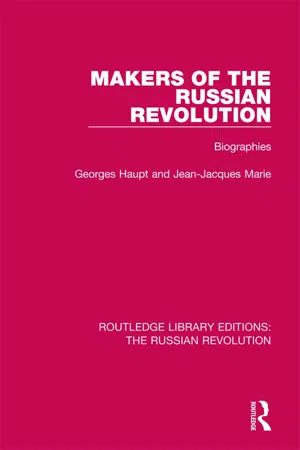
Until the publication of this book in 1974, the leaders of the October Revolution remained very badly known. This book exhumes the autobiographies written by the men whose actions and ideas have moulded events. Unique as sources of documentation on the Bolsheviks, these autobiographies, encompassing personal and political information up to 1917 add an important historical dimension. They allow the reader to appreciate more accurately the role played by each of the protagonists in preparing and carrying out the Revolution and beyond this they put the Bolsheviks of 1917 in the context of their social milieu and of the circumstances that shaped their minds.
eBook - ePub
Makers of the Russian Revolution
Biographies
- 452 pages
- English
- ePUB (mobile friendly)
- Available on iOS & Android
eBook - ePub
Makers of the Russian Revolution
Biographies
About this book
Trusted by 375,005 students
Access to over 1.5 million titles for a fair monthly price.
Study more efficiently using our study tools.
Information
Part II
MEN OF OCTOBER
1
Early Bolsheviks
ANDREY ANDREYEVICH ANDREYEV
(autobiography)
I was born in 1895 into a peasant family in Smolensk province. At first my father worked in a Moscow textile factory and then as a caretaker. After attending the village school for two years, I left to earn my living in Moscow where, at the age of thirteen, I found a job in a tavern—washing dishes and cleaning samovars. At fifteen or sixteen, I first came across Party comrades in Moscow, mainly printers. It was also at this time that I began to take a serious interest in underground and legal Marxist writings, as well as broadening my knowledge through self-education. In 1911 I moved to the Caucasus and the south of Russia where I wandered from town to town in search of work. In 1914 I arrived in St Petersburg, worked in an artillery depot making cartridge cases, and then in the insurance-fund offices of the Putilov and Skorokhod factories.
It was with my arrival in the capital that my underground activity really began. I joined the Party and carried out clandestine work right up to the February Revolution. At the end of 1915 and in 1916,I became representative for the Narva district on the Petrograd Bolshevik Committee and I worked with Zalezhsky, Moskvin, Tolmachev and others on its ‘Executive’. At the height of the February Revolution, I was active in the districts held by the Party, and also in the new Petrograd Committee. At the same time, I helped to organise the Union of Petrograd Metal-Workers, in which I held the post of district union secretary and was a member of the central administration.
After the October Revolution, I was sent by the provisional Bureau of the All-Russian Union of Metal-Workers to organise a union in the Urals. Until 1919 I worked there in trade union and Party organisations. In 1919 I was transferred to the Ukraine where I became a member both of the Central Committee of the Union of Metal-Workers and the Presidium of the VTsSPS. In 1920 I was transferred to Moscow as Secretary of the VTsSPS there, and then I was elected President of the Central Committee of the Railwaymen’s Union, which position I hold to this day.
I am a member of the TsIK of the USSR, and I was elected a member of the RKP (b) Central Committee at the eleventh Congress in 1920, being re-elected at the twelfth and thirteenth Congresses. At the present time I am also a Party Secretary.
For a long time Andreyev remained an important member of Stalin’s entourage: from 1926, he was an alternate member of the Politburo, and he was a full member from 1932. In 1930-1, he was President of the TsKK. From 1931 to 1935 he was Commissar for Communications; then Secretary of the Central Committee from 1935 to 1946, president of the Party Control Commission between 1939 and 1952, Commissar for Agriculture from 1943 to 1946, and Vice-president of the Council of Ministers from 1946 until 1953. He was implicated by a campaign waged in Pravda in 1950 against the ‘zveno’ [‘link’], a work-force unit considered too small in contrast to the ‘brigade’. He was removed de facto from the Politburo at that time, and the nineteenth Congress confirmed this move by giving him the rank of a plain member of the Central Committee. Khrushchev, who had in fact participated in Andreyev’s removal, told the twentieth Congress that ‘by a unilateral decision, Stalin had excluded A. A. Andreyev from the work of the Politburo. That was one of his most inexplicable caprices’.
Andreyev began his career with a blunder. First elected on to the Central Committee in 1920, he sided with Trotsky on the union question in 1920-1 and lost his position in 1921. He changed sides, and was re-elected to the Central Committee in 1922, and to the Orgburo, where he remained until 1927. He was also a member of the secretariat in 1924 5. He had leanings towards the right, but did not commit himself to that side in its subdued struggle of 1928-9. ‘Andreyev is with us: he’s being brought back from the Urals’—to be taken in hand, Kamenev was told by Bukharin. The manoeuvre was successful. In 1937 he was sent Stalin to purge Uzbekistan. His career remained smooth until it was overturned by the ‘zveno’, which was loaded with all the problems of the agricultural crisis. Since 1953, Andreyev has been a member of the Presidium of the Supreme Soviet, and no longer plays any part in political life in the USSR. In 1965, the review Zvezda began publishing his memoirs of October 1917; but only the first instalment ever appeared. …
J.-J. M.
ANDREY SERGEYEVICH BUBNOV
(autobiography)
I was born on 23 March 1883 in Ivanovo-Voznesensk. I was educated at the local secondary school,1 which I left in 1903. Then I went to the Moscow Agricultural Institute (Timiryazev Academy) but did not graduate.
I joined the RSDRP(b) in 1903, having been a member of revolutionary student circles since 1900-1. I became a convinced Bolshevik from the moment I joined the Party. I worked as an organiser and propagandist mainly in the provinces of the central industrial region and in Moscow. In the course of my work, I was arrested thirteen times and spent over four years in prison, including a period in a fortress.
On my first release from prison, I was delegated by the Ivanovo-Voznesensk organisation to attend the Stockholm Congress of 1906 and the London Congress of 1907. I had been a member of the local Party committee since the summer of 1905, and then of the Ivanovo-Voznesensk RSDRP(b) Union, which united a number of local organisations. In 1907 I was transferred by the Central Committee to Moscow, and from the end of 1907 I was a member of the Party Committee there.
During the harsh Tsarist repressions of 1907-10 I continued my Party work despite repeated arrests. In 1908 I was elected a member of the area bureau of the central industrial region and a delegate to the All-Russian Party Conference. However, I was arrested before I could attend. On my release from prison in 1909, I was made an agent of the Central Committee. In May 1910 I was co-opted onto the staff of the Bolshevik ‘centre’ in Russia, but at the end of the year I was prosecuted by the Moscow Chamber of Justice under Article 102 (the Trial of the Thirty-four). From 1910 onwards, there was a noticeable upsurge of enthusiasm in the labour movement. In 1911 I was released and became an activist in Nizhny Novgorod and Sormovo. Then I was informed that I had been co-opted onto the Organisation Committee entrusted with the summoning of the All-Russian Party Conference. I attempted to travel abroad, but was again arrested. Elected a candidate member of the CC, I joined Pozern in producing the Bolshevik paper Povolzhskaya Byl (six numbers of which appeared). In 1912–13, I was a contributor to Pravda in St Petersburg. I was also a member of the Duma ‘fraction’ and the St Petersburg Party Committee’s ispolkom.
The World War found me in Kharkov, whither I had been exiled after my arrest in the capital. From the very beginning of the war, I maintained a consistent internationalist position. In early August 1914, after the Kharkov Bolsheviks’ anti-war proclamation, I was arrested, imprisoned and exiled to Poltava. From there I travelled to Samara and joined the Organisational Bureau created to summon a conference of Bolshevik organisations along the Lower Volga. After its collapse, I was arrested in October 1916, and in February 1917 exiled to the Turukhansk region of Siberia. During this period I did some work on statistics and published a series of research pamphlets on economic problems.
News of the February Revolution reached me in a transit hut in the village of Bobrovka (on the Krasnoyarsk – Yeniseysk highway). I returned to Moscow and joined the Party Bureau for the Central Industrial Region. The sixth Party Congress elected me to the CC. At this time I was also a member of the Moscow Soviet Executive Committee. In August, I was transferred by the CC to Petrograd, where I held seats both on the CC and the Petrograd Soviet Executive Committee, in addition to joining the editorial board of the Party’s military newspaper as CC representative. On 10 November I was elected to the Politburo, and on 16 November to the Military Revolutionary Committee charged with directing the rising. In November I was ordered to the south as Commissar for Railways and took part in the struggle against Kaledin (in Rostov-on-Don). After the seventh Party Congress, I travelled to the Ukraine where I was appointed People’s Secretary of the Workers’ and Peasants’ government, and took part in the fight against the Germans. With the defeat of the Ukrainian government, I joined the Insurrectionary Committee. As a member of the Ukrainian Party CC and the All-Ukrainian Military-Revolutionary Committee, I worked in the ‘neutral zone’ (Chernigov-Kursk region) from August to October, training detachments of the partisan army for the liberation of the Ukraine.
After the second All-Ukrainian Party Conference (in October 1918), I was sent on a secret mission to Kiev. As an experienced conspirator, I was made a member of the clandestine Kiev regional Party Bureau and Chairman of the underground Kiev Soviet. After the overthrow of Petlyura, I joined the new government of the Ukraine. At the eighth Party Congress I was elected a candidate member of the CC, a member of the Commission drafting the Party programme, and a full member of the Ukrainian CC. I was also Chairman of the Kiev Soviet.
In 1919 I was designated a member of the RVS of the Ukrainian Front, and then a member of the fourteenth army RVS. In October of the same year, I was appointed to the RVS of the Kozlov Shock Group. After economic work in Moscow in 1920,I joined the RVS for the North Caucasus Military District. At that time I held seats simultaneously on the Moscow Party Committee, the Don Regional Bureau in Rostov, and the South-East Area Party Committee. During the tenth Party Congress, I was awarded the Order of the Red Banner for my part in the suppression of the Kronstadt mutiny. In 1922-3 I was put in charge of the Agitprop Department of the CC. At the twelfth Party Congress, I was elected a candidate member and at the thirteenth a full member of the Central Committee. In early 1924, I was appointed head of the Political Directorate of the Red Army and a member of the RVS of the USSR. At the same time I held seats on the CC Orgburo and the TsIK of the USSR.
For many years I have undertaken literary tasks on behalf of the Party—my pseudonyms were ‘A. Glotov’, ‘S. Yaglov’, and ‘A.B.’. I have long been interested in the history of the revolutionary movement and the history of our Party. I wrote the pamphlet Turning-Points in the Development of the Communist Party in Russia, which has several times been re-published by many regional Party committees. Amongst my economic works, the most noteworthy is the pamphlet The Shipment of Grain by River, published in 1915, and also a series of articles and surveys on general agronomical questions featured in the journal Zemsky Agronom (Samara) and in agricultural journals in Kharkov and Poltava.
In October 1917, Bubnov was one of the leaders of the Bolshevik Party: a member of the Central Committee, as well as the Politburo, which, although formed on 10 October, never actually met. He was also on the RVS. Brest-Litovsk was a turning-point: an activist with no theoretical strength, Bubnov was also an extreme left-wing communist. He voted against the peace right up to the end, and resigned all posts of responsibility. He had scarcely returned to the Central Committee in 1919 before he was expelled again the following year, no doubt because he was one of the organisers of the so-called ‘Democratic Centralism’ opposition, which reproached the leadership for its excessive ‘Bureaucratic Centralism’.
In October 1923 he was a signatory of the ‘Declaration of the 46’. It was his last act of opposition. Historians agree that his complete about-turn was a function of his appointment in January 1924 as Head of the Political Control of the Red Army and as a member of the RRVS. From then on he allied himself unhesitatingly with the majority and pursued a rapidly rising career. In May 1924 he was elected to the Central Committee and the Orgburo, in December 1925 he became an alternate member of the secretariat. In 1929 he was appointed People’s Commissar for Education. He was not a member of the Stalinist nucleus and the General Secretary put him out of action: in 1934 he disappeared from the Orgburo. In 1937 he was arrested and deported to a camp where he met his death in 1940. With Kossarev he shares the bizarre privilege of having been ‘seen’ in Moscow after his rehabilitation in 1956 by truly perspicacious ‘observers’.
J.-J. M.
VLAS YAKOVLEVICH CHUBAR
(autobiography)
I was born in February 1891 in the village of Fyodorovka, Aleksandrovsk district, Ekaterinoslav province. My parents owned a small plot of land and were both illiterate. I entered school in 1897. In the period preceding 1905, when the activity of revolutionary circles was greatly expanding in the village (one was organised by ‘Artem’), I participated in them, reading and explaining pamphlets to the illiterate. In 1904 when the circles were crushed, I was detained for the first time and interrogated (with humiliating beatings) by gendarmes who had come to the village to investigate ‘sedition’. Under the influence of teachers in the two-class school, I read Darwin’s Origin of the Species to the circle—it also destroyed my belief in God and led me to search for the meaning of my life.
Whilst living with my parents, I worked both on their land and, as a day labourer, on that of the more prosperous farmers. Seeing that it was not worth looking to farming for a career now that there were eight children in the family, I left school in 1904 and went to Aleksandrovsk to study at the Mechanical and Technical School. In 1905, after a pogrom in which my room was ransacked, I returned to the village and took part in the peasant movement. During my studies, I joined revolutionary circles and brought illegal literature to the village.
In 1907, with the return of some comrades from exile, I joined the Bolshevik Party and made contact with workers. During the summer vacations I worked in railway workshops. In term-time I earned money through lessons, in addition to my zemstvo scholarship and the assistance of a zemstvo official. In summer 1909 I was detained on a train for having illegal literature but I escaped.
After finishing school in 1911, I worked in factories until spring 1915, the only interruptions being for unemployment and one spell of six months in prison. I worked in a depot, and I was a plater, metal-worker, fitter and apprentice at the factories in Kramatorsk and Nikopol-Mariupol, as well as at the Bari Brothers’ boiler-making plant in Moscow. During this time I participated in strikes, the insurance campaign, co-operatives and circles. I also undertook agitation and propaganda besides continuing to educate myself.
After May Day 1915 I was mobilised into the army, but after a few months was assigned to the ordnance factory in Petrograd as a lathe operator. I was still there when the February Revolution broke out, and I immediately abandoned work to organise a factory workers’ militia and a factory committee in accordance with the Party line. At the first Conference of Factory Committees of Petrograd, I was elected to the Council.
I devoted myself to this organisation throughout the period up to October, as well as participating in various economic bodies (for example the Factory Conference). At the Congress of Ordnance Factory Workers, I was voted onto the All-Russian Committee (the organ of workers’ control), and at the All-Russian Congress of Factory Committees I was elected to the Council. After October I was elected to the Council of Workers’ Control and then the VSNKh. During the October days I was Commissar of the Artillery Directorate. Since the third Congress of Soviets I have been a member of the VTsIK, and since the creation of the USSR, a member of the TsIK of the Union and its Presidium.
My work in VSNKh from its creation until 1922 included transport, metallurgy, finance and economics. In 1918-19 I was Chairman of the Directorate for State Factories (Sormovo-Kolomna). In 1919 I was head of the VSNKh Commission charged with the reconstruction of industry in the Urals. In early 1920 I was dispatched to the Ukraine where I headed the VSNKh Industrial Bureau, and then the VSNKh itself. Whilst working in Petrograd, Moscow and Kharkov, I was a member of the Union of Metal-Workers and the CC. I have held seats on the All-Ukrainian Revolutionary Committee, then the All-Ukrainian TsIK (from 1920 until the present), and the Sovnarkom, where I was Deputy Chairman.
In 1922 I was appointed head of the Donbass coal industry, from where I was transferred to Kharkov in July 1923 in connection with my election as Chairman of Ukrainian Sovnarkom.
The fourth Ukrainian Party Conference elected me to its CC in 1920, and since 1921 I have been a candidate and then a full member of the CC of the RKP(b).
A prototype of the Western idea of the ‘commissar’ in the 1920s, Chubar was an enterprising, hard and energetic organiser. During the difficult years of the Civil War, he was entrusted with the delicate task of restoring the economy. In July 1919, Lenin gave him full powers to implement, by any means and by any representative of Soviet power, whatever measures he deemed necessary in the Urals. From 1920, he was given the Ukrainian economy to restore, and the Ukraine was to remain his field of action. Enjoying Stalin’s confidence, he took over from Rakovsky in 1923 as head of the Ukrainian government. For eleven years he filled this politically...
Table of contents
- Cover
- Half Title
- Title Page
- Copyright Page
- Table of Contents
- Authors’ note
- Translators’ note
- INTRODUCTION
- I. THE MAJOR FIGURES
- II. MEN OF OCTOBER
- List of periodicals
- Abbreviations, acronyms, organisations
- Index of names
- General index
Frequently asked questions
Yes, you can cancel anytime from the Subscription tab in your account settings on the Perlego website. Your subscription will stay active until the end of your current billing period. Learn how to cancel your subscription
No, books cannot be downloaded as external files, such as PDFs, for use outside of Perlego. However, you can download books within the Perlego app for offline reading on mobile or tablet. Learn how to download books offline
We are an online textbook subscription service, where you can get access to an entire online library for less than the price of a single book per month. With over 1.5 million books across 990+ topics, we’ve got you covered! Learn about our mission
Look out for the read-aloud symbol on your next book to see if you can listen to it. The read-aloud tool reads text aloud for you, highlighting the text as it is being read. You can pause it, speed it up and slow it down. Learn more about Read Aloud
Yes! You can use the Perlego app on both iOS and Android devices to read anytime, anywhere — even offline. Perfect for commutes or when you’re on the go.
Please note we cannot support devices running on iOS 13 and Android 7 or earlier. Learn more about using the app
Please note we cannot support devices running on iOS 13 and Android 7 or earlier. Learn more about using the app
Yes, you can access Makers of the Russian Revolution by Georges Haupt,Jean-Jacques Marie, C. I. P. Ferdinand,D. M. Bellos in PDF and/or ePUB format, as well as other popular books in History & 20th Century History. We have over 1.5 million books available in our catalogue for you to explore.