- 184 pages
- English
- ePUB (mobile friendly)
- Available on iOS & Android
eBook - ePub
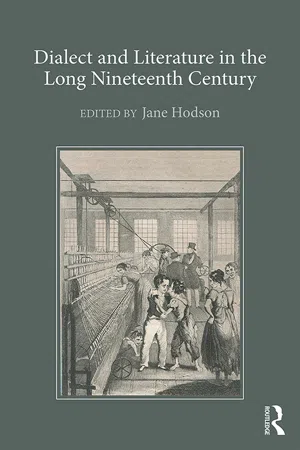
Dialect and Literature in the Long Nineteenth Century
About this book
The nineteenth century witnessed a proliferation in the literary uses of dialect, with dialect becoming a key feature in the development of the realist novel, dialect songs being printed by the hundreds in urban centres and dialect poetry becoming a respected form. In this collection, scholars from a wide variety of disciplines, including dialectology, literary linguistics, sociolinguistics, literary studies and the history of the English language, have come together to examine the theory, context and ideology of the use of dialect in the nineteenth century. The texts considered range from the Cumberland poetry of Josiah Relph to the novels of Frances Trollope and Elizabeth Gaskell, and from popular Tyneside song to the dialect poetry of Alfred Tennyson. Throughout the volume, the contributors debate whether or not 'authenticity' is a meaningful category, the significance of metalanguage and paratext in the presentation of dialect, the differences between 'literary dialect' and 'dialect literature', the responses of 'insider' versus 'outsider' audiences and whether the representation of dialect is a hegemonic or resistant strategy. This is the first book to focus on practices of dialect representation in literature in the nineteenth century. Taken together, the chapters offer an exciting overview of the challenging work currently being undertaken in this field.
Trusted by 375,005 students
Access to over 1.5 million titles for a fair monthly price.
Study more efficiently using our study tools.
Information
1 Introduction
Jane Hodson
1 Why investigate dialect and literature in the nineteenth century?
The nineteenth century witnessed a proliferation and elaboration in the literary uses of dialect beyond anything seen before. At the start of the century, a relatively small number of dialects were represented in fiction, and such representations were often stereotypical and attributed to minor characters for comic effect. During the course of the nineteenth century, as the realist novel became concerned with accurately depicting the lives of different social classes, so the number of dialects represented increased, as did the range of dialect-speaking characters and the degree of detail with which those dialects were represented (for a discussion of nineteenth century trends, see Blake 1981; Adamson 1998; Hodson and Broadhead 2013). At the same time, following both the success achieved by Robert Burns at the end of the eighteenth century and the call by William Wordsworth in his 1800 Preface to the Lyrical Ballads that the language of poetry should use ‘the real language of men’ (Wordsworth and Coleridge 1991 [1800]: 241), poetry began to employ a much wider range of language varieties than it had done previously. Thomas Hardy and Alfred Tennyson provide examples of nationally acclaimed authors who published poems written in dialect. Furthermore, dialect literature written by local authors and aimed at local audiences became increasingly popular, thanks to increased urbanisation, greater literacy and cheaper printing costs. As a result dialect songs and almanacs were printed by their hundreds in urban centres such as Newcastle, Sheffield and Manchester. In short, therefore, although there was a well-established tradition of representing regional and social dialects in English literature long before 1800, changes in literary taste and culture meant that nineteenth-century literature employed of a much broader range of dialects than ever before.
Alongside these developments in literary taste and culture, it is possible to identify two specifically linguistic developments which underpinned the changing treatment of dialect in literature. First, during the course of the nineteenth century a general public interest in philology emerged, which served to generate interest in dialect writings. In Sheffield, for example, the Reverend H.H. Piper gave a lecture on the local dialect to the Literary and Philosophical Club about the Sheffield dialect (1824). The lecture proved so popular that it was repeated for a public audience, and then published for wider circulation still. In 1829 Joseph Hunter published his Hallamshire Glossary which collected many local Sheffield words (1829) and a few years after this, Abel Bywater tapped into a popular taste for dialect material with his miscellany The Sheffield Dialect (1839), which was followed by numerous almanacs and other writings. There was evidently a considerable market for both works about the Sheffield dialect and texts in the Sheffield dialect, and a similar pattern of interest can be discerned in other areas of Britain. Scholarly interest culminated in the publication of Joseph Wright’s six-volume The English Dialect Dictionary between 1898 and 1905 by Oxford University Press, which drew on both spoken language and literary works to provide illustrative quotations.
At the same time, and in conjunction with this rising interest in dialect, readers and writers were becoming increasingly attuned to the sociocultural values of Standard English. The second half of the eighteenth century had witnessed the publication of a large number of prescriptive grammars, including very influential volumes by Robert Lowth (1762) and Lindley Murray (1795). These grammars, and those of their many imitators, established detailed rules concerning the ‘correct’ use of English, some of which directly contradicted the current practices of most writers, as in the case of rules stating that ‘neither/nor’ constructions required a singular verb, and that ‘his’ should be used rather than ‘their’ for singular antecedents of uncertain gender. Simultaneously, as Lynda Mugglestone has explored in Talking Proper (2003), accent became a matter of increasing concern as non-localised ‘Received Pronunciation’ (RP) emerged as the hallmark of prestige and authority, ensuring that local dialects were increasingly seen as lacking national prestige and authority. In short, while there was considerable popular interest in regional dialects, this was accompanied by an increased sense that non-standard forms of the language carried social stigma. This enabled writers to employ dialect representation in much more nuanced and sophisticated ways than hitherto, but also, inevitably, presented a challenge for any writer wishing to deploy dialect in literary texts in ways that did not simply reinforce this stigma.
The nineteenth century thus presents a very rich field of study in terms of dialect representation. However, while some excellent work has been undertaken in the field, much remains to be done. It is telling that there have been few attempts at surveying the literary representation of dialect in the nineteenth century. One exception is Norman Blake, who in Non-standard Language in English Literature (1981) offers a succinct account of the major nineteenth-century authors who incorporated dialect into their writings in his chapters on ‘The Romantics’ and ‘The Victorians’. Blake’s account is useful, but as a small section of a survey that stretches from medieval English to modernism it lacks detail. It is in any case now thirty years old, which means that it does not reflect the expansion of the literary canon that has taken place in recent years, or the many recent developments in the field of sociolinguistics. Another exception is Sylvia Adamson, who makes a strong case for the centrality of the representation of language varieties in English literature since 17 76 as part of her chapter on ‘Literary Language’ in Cambridge History of the English Language (1998). With regard to the use of social and regional dialects in literature, she argues that the nineteenth century witnessed the ‘breaking’ of the ‘literary hegemony of a Standard variety’ (599). However, Adamson is only able to dedicate a short section within a much longer work to the topic of language variation, and as she herself notes, ‘it is impossible to do even summary justice to this proliferation of literary languages in the space at my disposal here’ (599). To date, however, while there has been some excellent work on individual authors or specific genres, no one has attempted a more comprehensive account of this pivotal aspect of nineteenth century English literature.
Why has their not been more work in this field? First, there are two practical reasons. One is the fact that the study of literary dialect stands on the cusp between several different disciplines, most notably dialectology and literary criticism, but also history of the English language, sociolinguistics, corpus linguistics, stylistics and folklore. As a result, this is a field that demands some expertise and interest in attending to both the literary and the linguistic aspects of the field, and it also means that researchers working in broadly the same field are sometimes pursuing very different research questions. When researchers are interested only in the linguistic aspects of dialect representations the texts are mined for the information they provide about language variety, but little consideration is given to the literary purposes that the dialect representation serves. At the other end of the spectrum, literary critics are able to offer nuanced accounts of literary effects of dialect representation, but are less likely to be familiar with the tools provided by dialectology for the historical study of language variety, and may be unaware of relevant developments in dialectology and sociolinguistics. Scholars working in literary linguistics do have knowledge of both fields, but much work in literary linguistics in recent years has been primarily synchronic in approach, and there has been comparatively little interest in the kind of detailed historicisation that work on nineteenth-century dialect literature requires. Thus work on dialect and literature in the nineteenth century has fallen through a number of disciplinary ‘gaps’. This volume brings together academics from across the spectrum of relevant academic backgrounds, from those working at the more literary end, such as Alex Broadhead (Chapter 5), through literary linguists including Taryn Hakala (Chapter 9) and Richard Steadman-Jones (Chapter 10), to linguists such as Joan Beal (Chapter 2).
A second practical reason is that because of the cross-disciplinary nature of this type of research, work has been published in diverse locations, which has in turn resulted in little sense of ongoing dialogue. For example, Sylvia Adamson’s aforementioned chapter, which identifies the proliferation of non-standard voices as one of the key stylistic innovations of the nineteenth and twentieth centuries, and makes some significant observations on the ‘naturalistic’ and ‘metaphoric’ functions of dialect representation, was published in the otherwise solidly linguistic Cambridge History of the English Language and as such has caught the attention of few literary scholars. Taryn Hakala’s “A Great Man in Clogs: Performing Authenticity in Victorian Lancashire” (2010) considers dialect literature in relation to ongoing sociolinguistic discussions about the nature of ‘authenticity’, but its publication in Victorian Studies means that is unlikely to be read either by the sociolinguists with whom it is in dialogue, or by literary scholars working outside the Victorian period. Alex Broadhead’s “Framing Dialect in the 1800 Lyrical Ballads: Wordsworth, Regionalisms and Footnotes” (2010) will attract the attention of literary linguists because it was published in the journal Language and Literature, and its title might draw the attention of scholars of Wordsworth; but it is much less visible to scholars working on dialect in relationship to other authors or periods, which is unfortunate given that it offers an important new way of thinking about the role of paratexts in the representation of literary dialects. The advent of electronic databases might promise to resolve these problems, but the ubiquity of the terms ‘dialect’ and ‘literature’ and their various permutations (‘dialect literature’, ‘literary dialect’, ‘dialect in literature’, etc.) means that searching for articles about dialect and literature remains problematic. Keyword tagging can help, but unless someone specifically tags for ‘dialect_literature’ (and nobody did in the case of the chapters by Hakala and Broadhead) there is no reliable way to identify articles that deal with the literary representation of dialect. Hence, a major aim of this collection is to draw together some of the most interesting current scholarship in this field and so to raise awareness of the range of innovative work that is currently being undertaken.
Leaving aside these practical issues, I would like to propose a third and more fundamental reason for the neglect of dialect in literature, which is that it was for a long time unduly associated with notions of both ‘regionalism’ and ‘authenticity’. This resulted in its being seen as ‘stodgy’: of limited interest to any beyond the local scholar. What all of these chapters do is interrogate dialect in literature and show that, far from being stodgy and limited, the representation of dialect in nineteenth-century literature was a dynamic, controversial and far-reaching issue. In the next section, in order to contextualise this collection of essays and demonstrate where and how it is innovative, I present a brief survey of research on dialect and literature over the past 200 years.
2 A brief history of research into nineteenth-century dialect and literature
In literary criticism, from the beginning a central concern has often been with what the purpose of the dialect representation is. Here are three contemporary reviews of Walter Scott’s Guy Mannering (1815), a novel which contains a good deal of very detailed literary dialect:
The language is very much the same as that of Waverley, it is chiefly composed of a dialect at once vulgar and uncouth.(La Belle Assemblée n.s. 12, Nov 1815: 237)
It displays superior claims to approbation; but we must lament, that it is too often written in language unintelligible to all, except the Scotch.(Critical Review 5th ser. 1 June 1815: 600)
The fastidious will probably object to the unsparing use of the Scottish dialect: but, though sometimes put to a stand by the terms of phraseology so unusual to us, we can willingly pardon even inconvenience for the sake of the additional reality which it bestows on the representation before us.(Monthly Review 2nd ser. 77, 1815: 93)
Even a cursory consideration of the views of Scott’s early nineteenth-century critics gives an idea of the range of contemporaneous responses to the author’s representation of dialect in his novel: prescriptive attitudes underlie the assertions that it is ‘vulgar and uncouth’ and ‘unintelligible’, but one critic finds that it gives the novel ‘additional reality’. Furthermore, the critic from La Belle Assemblée also remarks that the language in which Scott portrays the dialogue of the gypsy fortune teller, Meg Merrilies, ‘is not the language generally held by the gipsy, who belongs to no one particular country more than another’ (1815: 237). These views from almost two hundred years ago capture some concerns that have occupied critics and scholars over the intervening two centuries. Is this use of dialect appropriate for a literary text? What does dialect use contribute to the narrative in terms of characterisation or realism? Is it a valid representation? Would a character from that particular region and social group really use that particular grammatical form, pronunciation or vocabulary item? These questions, to a greater or lesser extent, continue to engage the interest of literary scholars.
Attempts to formalise the study of literary dialect were not particularly apparent until North American scholars began to take a philological–historical approach to fictional dialect representation as authentic linguistic data. George Philip Krapp opens up the field with his pioneering article, “The Psychology of Dialect Writing” (1971[1926]). This foundational essay, which holds that much dialect representation is ‘an ingenious invention of sophisticated literary artists’ as opposed to ‘a reflection and echo of an authentic folk interest in literary expression’ (23) results in Krapp’s assertion that ‘it is beside the point to apply the test of truth to reality too stringently to it’ (26). Krapp finds evidence of some authentic attempts to portray region-specific dialects, and concedes that ‘they have some foundation in reality’ (23), but he is dismissive of much dialect literature. Nevertheless, his essay opened the way for future work in the field, and set the terms for much future debate.
The most notable response to Krapp is Sumner Ives’s (1971[1950]) article “A Theory of Literary Dialect”. In contrast to Krapp, Ives starts from the assumption that ‘authors of literary dialects have been seriously concerned with the validity and justice of their representations’. Ives proposes to use the resources of dialect geography as an authoritative benchmark against which to measure literary representations of dialect and he draws on Kurath’s A Word Geography of the Eastern United States (1949) to demonstrate that authenticity of literary dialect can be deduced. Ives suggests that it is the combination of dialect features depicted, rather than the concentration of them, which is key to ascertaining accuracy of dialect depiction. Combination of features is a means of calculating whether or not literary dialect has ‘regional significance’ (that is to say that it is a fair, accurate and suitably detailed representation of a particular region-specific dialect), and Ives demonstrates that Joel Chandler Harris’s ‘Uncle Remus’ stories do, in fact, pass the authenticity test. Ives concludes judiciously that ‘if it can be decided that a particular author is, in general, reliable, it is possible that his literary dialect will supply details, especially in vocabulary and structure, that are missing from the phoneticians record’ (1971 [1950]: 177).
Ives’s article is a classic in the field, and it continues to be required reading by anyone working in literary dialect today. However, as a founding text in the field of literary dialect it has some serious limitations. Ives was a linguist by training, and the article is drawn from his doctoral dissertation on the phonology of the ‘Uncle Remus’ stories. As such, his primary goal was to assess how useful these stories are in terms of providing data about dialectology for the linguist. Another goal was to rebut Krapp’s dismissal of literary dialect as an ‘ingenious invention’. He is therefore not concerned with the literary effect of Joel Chandler Harris’s use of dialect. This is not to suggest that he is unaware of the literary aspects of dialect representations. Early on he writes that ‘Nearly all examples of literary dialect are deliberately incomplete; the author is an artist, not a linguist or sociologist, and his purpose is literary rather than scientific’ (147). He is also aware of the role of the reader in dialect representation, noting that ‘the author must restrain his desire to be comprehensive and give some thought to the patience and understanding of his readers’ (155). Nevertheless, Ives’s main priority is assessing the authenticity of the literary dialect, rather than on assessing the function of the literary dialect in the text as a wh...
Table of contents
- Cover
- Half Title
- Title Page
- Copyright Page
- Dedication
- Table of Contents
- List of tables
- List of contributors
- 1. Introduction
- PART I: Theory
- PART II: Context
- PART III: Ideology
- Index
Frequently asked questions
Yes, you can cancel anytime from the Subscription tab in your account settings on the Perlego website. Your subscription will stay active until the end of your current billing period. Learn how to cancel your subscription
No, books cannot be downloaded as external files, such as PDFs, for use outside of Perlego. However, you can download books within the Perlego app for offline reading on mobile or tablet. Learn how to download books offline
We are an online textbook subscription service, where you can get access to an entire online library for less than the price of a single book per month. With over 1.5 million books across 990+ topics, we’ve got you covered! Learn about our mission
Look out for the read-aloud symbol on your next book to see if you can listen to it. The read-aloud tool reads text aloud for you, highlighting the text as it is being read. You can pause it, speed it up and slow it down. Learn more about Read Aloud
Yes! You can use the Perlego app on both iOS and Android devices to read anytime, anywhere — even offline. Perfect for commutes or when you’re on the go.
Please note we cannot support devices running on iOS 13 and Android 7 or earlier. Learn more about using the app
Please note we cannot support devices running on iOS 13 and Android 7 or earlier. Learn more about using the app
Yes, you can access Dialect and Literature in the Long Nineteenth Century by Jane Hodson in PDF and/or ePUB format, as well as other popular books in Literature & Sociolinguistics. We have over 1.5 million books available in our catalogue for you to explore.