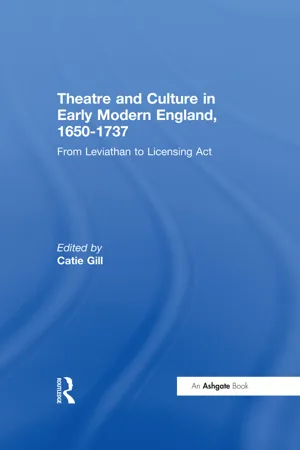
eBook - ePub
Theatre and Culture in Early Modern England, 1650-1737
From Leviathan to Licensing Act
- 190 pages
- English
- ePUB (mobile friendly)
- Available on iOS & Android
eBook - ePub
About this book
Framed by the publication of Leviathan and the 1713 Licensing Act, this collection provides analysis of both canonical and non-canonical texts within the scope of an eighty-year period of theatre history, allowing for definition and assessment that uncouples Restoration drama from eighteenth-century drama. Individual essays demonstrate the significant contrasts between the theatre of different decades and the context of performance, paying special attention to the literary innovation and socio-political changes that contributed to the evolution of drama. Exploring the developments in both tragedy and comedy, and in literary production, specific topics include the playwright's relationship to the monarch, women writers' connection to the audience, the changing market for plays, and the rise of the bourgeoisie. This collection also examines aspects of gender and class through the exploration of women's impact on performance and production, masculinity and libertinism, master/servant relationships, and dramatic representations of the coffee house. Accompanied by a list of Spanish-English plays and a chronology of monarch's reigns and significant changes in theatre history, From Leviathan to Licensing Act is a valuable tool for scholars of Restoration and eighteenth-century performance, providing groundwork for future research and investigation.
Trusted by 375,005 students
Access to over 1.5 million titles for a fair monthly price.
Study more efficiently using our study tools.
Information
Chapter 1
What Do the Servants Know?
BETTY. Well, since Fortune has thrown me in this chamber-maid station, I’ll revenge her cruelty and plague her favourites.
No fool by me shall e’er successful prove,
My plots shall help the man of sense in love.
(Mary Pix, The Beau Defeated, 1700)1
To whet the audience’s appetite for displays of wit and ingenuity yet to come, Betty the chambermaid takes the stage to herself at the finish of the first act of The Beau Defeated. She is knowing, cheerfully and very engagingly knowing. Outside the entertainment industry, however, servitude and knowledge were not at all aligned in Restoration England. Records show the legal system heard and weighed evidence from servants at best with caginess and scruples and with little readiness to rely on the observations or understanding of a subaltern class.2 In his influential writings on education, the progressive philosopher John Locke gave blunt and emphatic warnings, singling out as ‘most dangerous of all’ any exposure of a developing child to ‘the examples of the servants’.3 To focus on servants in Restoration culture is to encounter a line separating actuality and fiction.
By departing from social convention and received opinion and, instead, taking it for granted that servants are perspicacious, art in this era was to achieve complex and subtle effects. Etherege’s play The Man of Mode (1676) – often and quite fairly instanced as the generic Restoration Comedy – is illustrative. Witness, for example, how the tense, intimate bedroom scene between Dorimant and Bellinda is conducted and dramatically enhanced by the presence of Handy, Dorimant’s valet-de-chambre.4 The stage directions call for candlelight, and specify that Dorimant appear in a state of undress, with Handy ‘tying up linen’, which is to say removing and disposing of soiled sheets, from the bed where Dorimant and Bellinda have been consummating the success of their plot to humiliate Mrs Loveit, mistress to Dorimant and Bellinda’s best friend. Bellinda is on edge and starting to panic, for fear Dorimant will subject her to the same disgrace as she helped him engineer for Mrs Loveit. Dorimant swears fidelity, but the extravagance with which he makes the very promises she hungers for only feeds and augments Bellinda’s anxieties. Through the course of their troubled exchanges, Handy comes and goes: he arranges transport for Bellinda, he keeps watch on the street lest any unwanted visitors enter and interrupt the proceedings, and he helps Bellinda make an exit via the back stairs so her departure can pass unobserved. Though he says little, silence does not equate with ignorance, and Handy’s competence betokens awareness. Indeed, from the very opening moments of the play, Handy has been established as privy to his master’s tastes and tendencies: well-versed in Dorimant’s addiction to new and novel conquest, he is equipped to recognize Bellinda’s fears as all too well-founded. His taciturn presence counterpoints the empty promises and vain pleas spilling from the lips of Dorimant and Bellinda, and thereby introduces on stage an understanding that what may appear hectic and emotional is in fact rather more routine than it takes itself to be. Neither laughing at their folly, nor participating in their panic, Handy’s knowingness constitutes an alternative dimension, and enlarges the optic on Etherege’s comedy, disturbingly.
Remarkable here – and throughout the drama and fiction of the Long Restoration – is the ease with which it is taken for granted that servants generally can and do know. By contrast, in our times a different and a double protocol prevails. Nowadays if servants are imagined as knowing, it is on condition that their powers are highly exceptional, so much so as put them in command, like Jeeves, the butler in P.G. Wodehouse’s Bertie Wooster novels. Otherwise – and somewhat surprisingly insofar as postmodern culture often considers itself postindustrial and based on a new service economy – servants have come to be imagined as objects of knowledge rather than as themselves subjects who can be presumed to know. Even a fiercely interrogative text such as The Tortilla Curtain (1995), T. Coraghessan Boyle’s dark and intensely satiric analysis of exploitation and class dependency, exemplifies this current tendency.
A maid showed them in. She was small, neat, with an untraceable accent and a tight black uniform with a white trim and a little apron Delaney found excessive: who would dress a servant up like somebody’s idea of a servant, like something out of a movie? What was the point?5
Delaney is Boyle’s most Gulliver-like antihero, and while he continues to puzzle over what the maidservant signifies, Boyle’s readers are left in no doubt: she is a stage prop, her visibility an element in the apparatus of respectability assembled by a ruthless gangster to glamorize his household, and thereby deflect his guests’ attention from the fact he is living under house arrest. This present-day servant simply signifies, rather than in any way knows. In the larger scheme of the novel, her showiness places her in opposition to the oppressed and unfortunate illegal migrants from Mexico, Cándido, and América, immigrants on whose servitude and labour Delaney and his California neighbours rely, and whose misery and presence they sentence to invisibility, carelessly and regardlessly jeopardizing their existence and survival. Almost out of sight themselves, Cándido and América apprehend the world facing them with piercing sensory vividness, and feel and suffer every one of the blows that rain constantly on them with acid persistence; but their perceptions never modulate into an understanding, and never amount to a knowledge empowering them to grasp or master their situation, not even in a matter of life and death: ‘They hit something, something so big it was immovable, and Cándido lost his grip on América and the raft at the same time; he was in the water suddenly with nothing to hold on to and the water was as cold as death’.6 Lacking a capacity to process information and make of it knowledge, servants most usually appear in postmodern culture as helpless victims, and – as here – as spectacles to evoke pathos and pity; to be a servant and otherwise in contemporary culture is to be magical, like Mary Poppins.
Restoration culture mocked magic, as a bag of low tricks. To investigate further how the Restoration could imagine servants differently – differently from how servants were viewed in Restoration life, and very differently from how servants are portrayed in our own times – I shall take three steps. First of all, I shall propose a set of four protocols or rules concerning servants in Restoration plays up till the end of the seventeenth century. Next I shall outline how radical change to what servants are imagined to know becomes manifest around about 1700. This shift seems to me ideological, and in shorthand it may be described as a turn from Hobbes towards Locke, a move away from universalizing and egalitarianism towards particularization and differentiation. On this basis I shall then consider how what these servants know may indicate how art and ideology entangle.
Rules Concerning Servants in Restoration Drama, Up to 1700
Rule One: Egalitarianism Prevails in Master–Servant Discourse
When masters or mistresses converse with their servants, they do so with a presumption of mutual equality and shared humanity. Such is the note Handy and Dorimant strike, in the opening moments of The Man of Mode:
DORIMANT. Call a footman.
HANDY. None of ’em are come yet.
DORIMANT. Dogs! Will they ever lie snoring abed till noon.
HANDY. ’Tis all one, sir: if they’re up, you indulge ’em so, they’re ever poaching after whores all the morning.
DORIMANT. Take notice henceforward who’s wanting in his duty, the next clap he gets, he shall rot for it.7
In their raillery, Handy and Dorimant echo each other in tone. As the play continues, this sameness of idiom appears too among the women – between Mrs Loveit and her maidservant Pert and between Harriet and her maidservant Busy. Such easiness persists into the theatre of the 1690s, elaborated in the argumentatively witty repartee of servants such as Valentine’s man Jeremy in Congreve’s Love for Love (1695), or Lovewell’s man Brush, in Farquhar’s Love and a Bottle (1698):
BRUSH. Sir, you can’t be my Master.
LOVEWELL. Why so?
BRUSH. Because you’re not your own Master; yet one would think you might be, for you have lost your Mistress. Oons, Sir, let her go, and a fair riddance … my Shoes and Stockings are upon their last Legs with trudging between you. I have sweat out all my moisture of my hand with palming your clammy Letters upon her. I have –
LOVEWELL. Hold, Sir, your trouble is now at an end, for I design to marry her.
BRUSH. And have you courted her these three years for nothing but a Wife?
LOVEWELL. Do you think, rascal, I wou’d have taken so much pains to make her a Miss?
BRUSH. No, sir; the tenth part on’t wou’d ha’ done. – But if you are resolv’d to marry, God b’w’ye.
LOVEWELL. What’s the matter now, Sirrah!
BRUSH. Why, the matter will be, that I must then Pimp for her. – Hark ye, Sir, what have you been doing all this while, but teaching her the way to cuckold ye?8
Even the daftest of social climbers has no trouble accepting that discourse with a servant should proceed on a companionable footing: Mrs Rich in Pix’s The Beau Defeated is so pleased with the maidservant Betty that she confers on her the nobility of a French particle such as she herself would delight in: ‘From henceforth let me call thee de la Bette; that has an air French and agreeable’.9 But though Mrs Rich’s snobbery is mildly ludicrous, her fond courtesy to her maid mitigates rather than intensifies her ridiculousness.
The force of the rule is even more apparent when we consider what happens if it is infringed. Rudeness to a servant earns its perpetrator automatic reproach: when Lord Worthy cuffs his footman Buckle, in Susannah Centlivre’s The Basset Table (1705), t...
Table of contents
- Cover
- Title
- Copyright
- Contents
- List of Contributors
- Acknowledgements
- Chronology
- Introduction
- 1 What Do the Servants Know?
- 2 Flinging the Book Away: Books, Reading, and Gender on the Restoration Stage
- 3 Coffee-houses and Restoration Drama
- 4 Sex and Tyranny Revisited: Waller’s The Maid’s Tragedy and Rochester’s Valentinian
- 5 Sex, Tyranny, and the Problem of Allegiance: Political Drama During the Restoration
- 6 The Adaptation of Seventeenth-Century Spanish Drama to the English Stage During the Restoration Period: The Case of Calderón
- 7 The Female Wits: Women Writers at Work
- 8 ‘Jilting Jades’? Perceptions of Female Playgoers in the Restoration, 1660–1700
- 9 Revolution and the Moral Reform of the Stage: The Case of Durfey’s The Marriage-Hater Matched (1692)
- Works Cited
- Index
Frequently asked questions
Yes, you can cancel anytime from the Subscription tab in your account settings on the Perlego website. Your subscription will stay active until the end of your current billing period. Learn how to cancel your subscription
No, books cannot be downloaded as external files, such as PDFs, for use outside of Perlego. However, you can download books within the Perlego app for offline reading on mobile or tablet. Learn how to download books offline
Perlego offers two plans: Essential and Complete
- Essential is ideal for learners and professionals who enjoy exploring a wide range of subjects. Access the Essential Library with 800,000+ trusted titles and best-sellers across business, personal growth, and the humanities. Includes unlimited reading time and Standard Read Aloud voice.
- Complete: Perfect for advanced learners and researchers needing full, unrestricted access. Unlock 1.5M+ books across hundreds of subjects, including academic and specialized titles. The Complete Plan also includes advanced features like Premium Read Aloud and Research Assistant.
We are an online textbook subscription service, where you can get access to an entire online library for less than the price of a single book per month. With over 1.5 million books across 990+ topics, we’ve got you covered! Learn about our mission
Look out for the read-aloud symbol on your next book to see if you can listen to it. The read-aloud tool reads text aloud for you, highlighting the text as it is being read. You can pause it, speed it up and slow it down. Learn more about Read Aloud
Yes! You can use the Perlego app on both iOS and Android devices to read anytime, anywhere — even offline. Perfect for commutes or when you’re on the go.
Please note we cannot support devices running on iOS 13 and Android 7 or earlier. Learn more about using the app
Please note we cannot support devices running on iOS 13 and Android 7 or earlier. Learn more about using the app
Yes, you can access Theatre and Culture in Early Modern England, 1650-1737 by Catie Gill in PDF and/or ePUB format, as well as other popular books in Literature & Literary Criticism. We have over 1.5 million books available in our catalogue for you to explore.