eBook - ePub
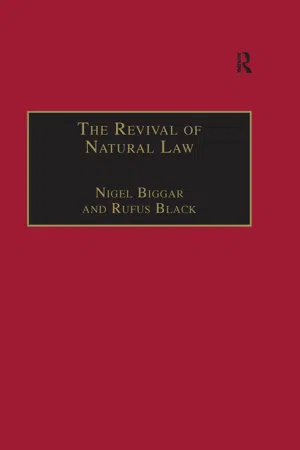
The Revival of Natural Law
Philosophical, Theological and Ethical Responses to the Finnis-Grisez School
- 320 pages
- English
- ePUB (mobile friendly)
- Available on iOS & Android
eBook - ePub
The Revival of Natural Law
Philosophical, Theological and Ethical Responses to the Finnis-Grisez School
About this book
Natural law theory has been enjoying a significant revival in recent times. Led by Germain Grisez in the USA and John Finnis in the UK, one school of thinkers has been articulating a highly developed system of natural law built upon a sophisticated account of practical reasoning and a rich and flexible understanding of the human good. However, long-standing prejudices against old-style natural law among moral philosophers and Protestant ethicists, together with the new theory's appropriation by conservatives in the impassioned debate between the Vatican and dissenting theologians in the United States, have prevented the Finnis-Grisez version from being adequately appreciated. Providing a clear and substantive introduction to the theory for those who are new to it, this book then broadens, assesses, and advances the debate about it, examining crucial philosophical, theological and ethical issues and opening up discussion beyond the confines of the Roman Catholic Church. Part 1, on philosophical issues, starts with two broad chapters that locate the Grisez school in relation to modern moral philosophy and the Roman Catholic philosophical tradition of Thomism, and then follows these with further chapters on two crucial issues: the possibility of consensus on the human good, and the nature of moral absolutes. Part 2, on theological dimensions, begins with a Lutheran critique of Grisez, locates him in relation to the ethics of two very prominent 20th century Protestants, Karl Barth and Stanley Hauerwas, and then explores the major area of theological controversy within the Roman Catholic community - how to conceive of the "Church's" authority with regard to moral matters. Part 3 subjects the school's thought to critical examination in a broad range of ethical fields: bioethics, gender, sex and the environment. A concluding chapter then develops eight topics that recur in the course of the book: the status of ethical realism in the contemporary intellectual climate; whether realism is best conceived in rationalist or naturalist terms; whether marriage should be counted as a basic good; whether physical pleasure should not be counted a basic good; whether it is always wrong to act deliberately against a basic good; the problems of moral certainty and authority; the rapproachement between Protestant and Roman Catholic ethics; and, finally, whether ethical understanding is really independent of one's anthropological point of view. Drawing together North American, European and Australian contributors from across moral philosophy and Protestant ethics as well as from Roman Catholic moral theology, this book opens up the debate about the Finnis-Grisez theory, highlighting its strengths and weaknesses in order to advance current discussion about natural law in moral theology and in moral and legal philosophy.
Trusted by 375,005 students
Access to over 1.5 million titles for a fair monthly price.
Study more efficiently using our study tools.
Information
Topic
Theology & ReligionSubtopic
ReligionPart I:
Philosophical Issues
1
Natural Law Revived:1 Natural Law Theory and Contemporary Moral Philosophy
Natural Law Theory as a Moral Theory: an Outline
Begin by reflecting on what motivates (or can motivate) any and every sort of human agent, at all times and in all places, in their actions. Such reflection reveals a definite variety (as opposed to an indefinite variety) of real basic intelligible goods or values, which are available to or attainable by all humans in all societies and cultures.2 These basic goods are kinds of goods that we can intelligibly conceive any or every human agent as acting towards or for the sake of, in and of themselves, and with no further objective beyond those goods in mind.3 Examples of such intelligible4 goods include: life itself, knowledge and aesthetic experience, friendship, and peace with God or ‘religion’.5
The basic goods are known to be goods simply because they are objects of pursuit. They are known to be basic simply because they, unlike other possible objects of pursuit, are objects of pursuit in themselves. No deductive argument can show that the basic goods are either goods or basic —precisely because of their basicity. One cannot appeal to any deeper reason why someone might want to participate in some basic good: the basic goods themselves provide the deepest reasons that there are for wanting anything. On the other hand, one can show that there would be something deeply irrational about rejecting a basic good or goods. To do so is a kind of incoherence. In another formulation, the basic goods are self-evident —per se nota.6
Different basic goods suggest different possibilities for humans, and make different demands on them. So we need a way of understanding how to relate our living and our choices to these goods, and in particular to the occasions on which their demands conflict or seem to conflict, by pulling us in different directions at once. This way is to be specified by practical reasonableness.
Practical reasonableness, as grasped by humans, is both itself a form of basic good, and so one of the ultimate reasons for acting. But it is also the ability to interrelate or ‘integrate’ the other basic goods in a morally adequate way.7 Its requirements can be summed up in one very simple principle, “the first principle of practical reasoning”. This is St. Thomas’s formula —another self-evident truth8— “that good is to be done and pursued, and evil to be avoided”.9
The central question of ethics, properly so called, is then the problem which practical reasonableness is meant to solve: the problem, namely, of how the basic goods, “the principles that express the general ends of human life”, are to be “brought to bear upon definite ranges of project, disposition, or action”, or instances of these,10 in a way which leads towards “integral human fulfilment”.11
Reflection on this problem suggests a number of further amplifications or specifications of the first principle of practical reasoning or of morality.12 These further amplifications form “the basic requirements of practical reasonableness”, or “the modes of responsibility which specify the first principle [that is, of morality]”.13
These specifications include such things as the following norms: no arbitrary preferences between persons or goods;14 reasonable resistance both to the pushing and the pulling of inappropriate emotions, and to the lack of such impulsions where they are appropriate;15 and a preference for solidarity and community rather than individualism.16
The most important further specification is this thesis: that individuals have three possible attitudes towards any good —they may (i) pursue it or (ii) honour it (without actually pursuing it), or (iii) violate it. Of these three attitudes, actions chosen under attitudes (i) and (ii) are (other things being equal) permitted; but those chosen under attitude (iii) are absolutely forbidden.17
Given these goods and these norms, it is possible to begin the work of casuistry —of applying one’s moral philosophy to particular problems and cases.
Here is a very brief and simplified, but still (I hope) accurate, summary of what the natural law theory expounded by Grisez, Finnis, Boyle and their associates (‘the Grisez School’) comes to, when it is considered as a theory of ethics.18 How might contemporary moral philosophers of other allegiances respond? What might they learn from the Grisez School? And what might the School learn from them?
These questions are real and pressing ones, partly because of the disappointing lack of overlap which is still evident between the agendas of the Grisez School and what I shall call ‘mainstream’ contemporary moral philosophy in the analytical tradition. That mainstream includes, and discusses the works of, consequentialists and contractarians, Humeans and Kantians, neo-intuitionists and Aristotelians, virtue ethicists and Nietzscheans.19 But, despite the remarkable flourishing of the School in the last few years, mainstream ethics20 still does not usually involve it in its discussions. Nor conversely does the Grisez School always draw on or contribute to the mainstream’s discussions as profitably as it might.21
To set up, or widen the range of, useful communication between the two sides, this chapter will consider some of the objections to the Grisez School’s theory which will naturally seem pressing to anyone who works within that mainstream. Such objections are likely to include questions about its relationship to the Aristotelian and Thomist tradition(s), and in particular to that tradition’s allegedly discredited teleological biology; about the School’s understanding of objectivity; about their conceptions of nature (is theirs a naturalistic ethical theory, like Cicero’s or the Stoics’?) and of reason (or is theirs a rationalistic ethical theory, like Kant’s?); and about its attitude to the (alleged) gap between ‘facts’ and ‘values’.
It is possible to answer (or suggest answers to) these questions by exploring the natural law theory of the Grisez School under three main headings. First I shall offer two brief criticisms of its conception of reason. Then I shall review its account of the basic goods (which I believe amounts to a conception of nature). This will lead me, at the end of the paper, to suggest an amendment to its account of the distinction between facts and values.
The tone of my comments here will, inevitably, be a critical one. That critical tone should not be thought to betray a lack of sympathy or engagement with the project. On the contrary: it is because I find the Grisez School’s project so appealing that I think it is necessary to subject it to a particularly close scrutiny. It is not every day that someone achieves what they have achieved: that is, to propose a whole new genus of moral theory. Just as it stands, at the point to which it has by now progressed, their theory is a remarkable philosophical achievement. The purpose of my criticisms is not to knock it down, but to facilitate further progress.
Is the First Principle of Practical Reasonableness Self-Evident?
The Grisez School claims that its “first principle of practical reasonableness” is “self-evident”. Yet famously (or notoriously), they reach some highly controversial ethical conclusions —apparently just by developing and applying that notion. In particular, they conclude that there are some absolute moral prohibitions on certain sorts of action-type. The key to their prohibition of, for example, killing one person to save seven other people from being killed, lies in its insistence on what Grisez calls the seventh and eighth modes of responsibility:
One should not be moved by hostility to freely accept or choose the destruction, damaging, or impeding of any intelligible human good…. One should not be moved by a stronger desire for one instance of an intelligible good to act for it by choosing to destroy, damage or impede some other instance of an intelligible good.22
These modes of responsibility are supposed to be no more than ‘specifications’ of the first principle of morality. And that is supposed to be closely logically related to the ‘self-evident’ first principle of practical reasonableness.23 What is going on here? How can we be moving so easily from ‘self-evident’ first principles, to claims about what must never be done that are, to put it mildly, far from self-evident?
One worry which is raised by this apparently over-easy progress is the cynical one that the modes of responsibility have simply been generated ad hoc to give certain conclusions in applied ethics —so that it is hardly surprising if they do. Another worry is that, in fact, not even this much adhockery will suffice to give the Grisez School the conclusions it wants about, for example, moral absolutism —unless we have a clear and unequivocal understanding of precisely what is meant by the notion of “destroying, damaging or impeding” “an instance of an intelligible good”. But this understanding is far from easy to obtain.24
Moreover, even the first principle of practical reasonableness —let alone the other principles to which it supposedly leads us— does not seem self-evident. St.Thomas’s formula tells us (T) “that good is to be done and pursued, and evil to be avoided”. We are instructed by the Grisez School to view this as a claim the truth of which is to be known just by understanding the terms of the claim. But there are other claims of similar format which might equally be thought to have a claim to self-evidence, if (T) has. For example, these: (U) good is to be done and pursued; (V) evil is to be avoided; (W) good is to be pursued.
Now (U), (V) and (W), taken separately, are not consistent with (T).25 (U) does not prohibit an agent from pursuing good by evil means — as (T) does. (V) does not prohibit an agent from doing nothing —as T does. (W) does not prohibit an agent from doing nothing but evil, provided all he does is done (in some more or less nebulous sense) in pursuit of good —as (T) does. Therefore (U-W) are, logically, real alternatives to (T). So (T) is not self-evident, if by that it is meant that anyone is bound to accept (T) as soon as they understand it. After all, it is in effect true that plenty of people do not accept (T), but accept (U) —or, even worse, (W)— instead. That is what it means to be a consequentialist.
It follows that, to rebut consequentialism, we do not merely need to be able to argue for (something like) Grisez’s seventh and eighth modes of responsibility. We need to be able to argue for the “first principle of practical reasonableness” on which they are founded. I do not suggest that this cannot be done.26 But I do submit that the Grisez School —inclined as they are to miss the real and crucial content of St.Thomas’s practical formula— have not yet done it.
Sensible Goods, Intelligible Goods, and Pain
Leaving reason aside, I turn to nature, as this notion occurs in the Grisez School’s theory; that is, I turn to their account of the basic goods. Why should we think that there are any basic goods? And even if there are, why should we accept the School’s account of which are the basic goods? How might one account of the basic goods be justified against smother? What is the role of claims about objectivity in a theory of the basic goods? And what is the role of claims about self-evidence and incoherence?
The notion of a ‘basic good’ —something which puts an end to chains of explanation of human actions by being pursued in its own right, and not for the sake of anything beyond it— is of co...
Table of contents
- Cover Page
- The Revival of Natural Law
- Copyright Page
- Contents
- List of Tables
- List of Abbreviations
- List of Contributors
- Acknowledgements
- Preface
- Introduction: The New Natural Law Theory
- Part I: Philosophical Issues
- Part II: Theological Dimensions
- Part III: Moral Fields
- Index
Frequently asked questions
Yes, you can cancel anytime from the Subscription tab in your account settings on the Perlego website. Your subscription will stay active until the end of your current billing period. Learn how to cancel your subscription
No, books cannot be downloaded as external files, such as PDFs, for use outside of Perlego. However, you can download books within the Perlego app for offline reading on mobile or tablet. Learn how to download books offline
Perlego offers two plans: Essential and Complete
- Essential is ideal for learners and professionals who enjoy exploring a wide range of subjects. Access the Essential Library with 800,000+ trusted titles and best-sellers across business, personal growth, and the humanities. Includes unlimited reading time and Standard Read Aloud voice.
- Complete: Perfect for advanced learners and researchers needing full, unrestricted access. Unlock 1.5M+ books across hundreds of subjects, including academic and specialized titles. The Complete Plan also includes advanced features like Premium Read Aloud and Research Assistant.
We are an online textbook subscription service, where you can get access to an entire online library for less than the price of a single book per month. With over 1.5 million books across 990+ topics, we’ve got you covered! Learn about our mission
Look out for the read-aloud symbol on your next book to see if you can listen to it. The read-aloud tool reads text aloud for you, highlighting the text as it is being read. You can pause it, speed it up and slow it down. Learn more about Read Aloud
Yes! You can use the Perlego app on both iOS and Android devices to read anytime, anywhere — even offline. Perfect for commutes or when you’re on the go.
Please note we cannot support devices running on iOS 13 and Android 7 or earlier. Learn more about using the app
Please note we cannot support devices running on iOS 13 and Android 7 or earlier. Learn more about using the app
Yes, you can access The Revival of Natural Law by Nigel Biggar,Rufus Black in PDF and/or ePUB format, as well as other popular books in Theology & Religion & Religion. We have over 1.5 million books available in our catalogue for you to explore.