eBook - ePub
Women and the Making of Built Space in England, 1870–1950
- 232 pages
- English
- ePUB (mobile friendly)
- Available on iOS & Android
eBook - ePub
Women and the Making of Built Space in England, 1870–1950
About this book
This interdisciplinary collection explores the relationships between women and built space in England between the 1870s and the 1940s. Historians working in cultural, literary, architectural, urban, design, labour, and social history approach the topic through case studies of often neglected organisations, individuals, practices and initiatives. Included are East End rent collectors, tenants, diarists and correspondents, the All-Europe House, the Women's Co-operative Guild, the Housewives Committee of the Council of Industrial Design, provincial and metropolitan exhibitors, and activists of varying kinds. Moving beyond the study of buildings and their designers, the volume considers the making of space in its broadest sense, from the production of discourses to the consumption of domestic appliances and the performance of roles as diverse as social reformers, committee members and homemakers. It thereby demonstrates that women made a significant contribution to the creation of modern built environments in both public and private spheres.
Trusted by 375,005 students
Access to over 1.5 million titles for a fair monthly price.
Study more efficiently using our study tools.
Information
Chapter 1
Gender, Citizenship and the Making of the Modern Environment
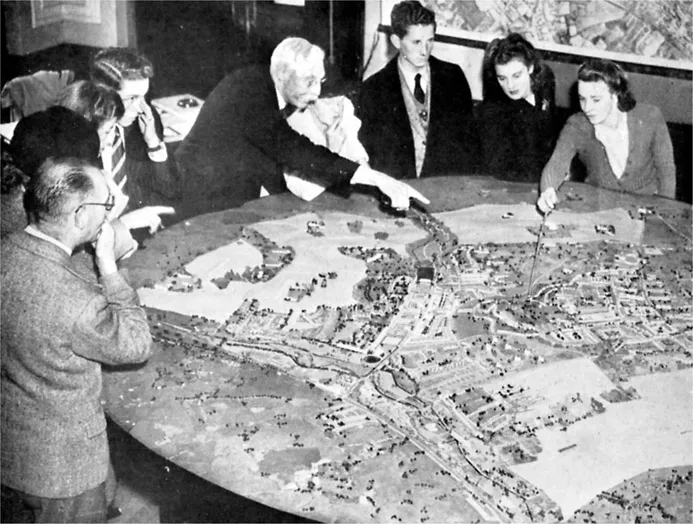
Figure 1.1 Residents study the plan for a new town, c.1951
Source: Editors’ Collection
Patrick Geddes, one of Britain’s foremost prophets of modern town planning, believed that men and women had different roles to play in shaping the modern urban environment. In his most influential early monograph, The Evolution of Sex (1889), co-authored with his student J. Arthur Thomson, he outlined a series of biologically determined binary oppositions between the sexes that informed their social roles.1 At the time, he was under the influence of cell-theory and its explanations for the development of life. There were two main processes. The ‘katabolic’ was profligate of energy, dissipating resources; the ‘anabolic’ conserved energy, was constructive and nurtured resources. The first was identified with male characteristics, the latter, with female.2 When Geddes progressed to a career developing ideas about modern town planning, he translated these characteristics into different roles for men and women. Men were the creators, the actors, who engaged vigorously with the public sphere; women were their best help-mates who attended to the private sphere, the home and, in their communities, brought their nurturing skills to place and people, thus contributing much to bringing men’s plans to fruition.
In a biologically determined world, this was as it should be. Women of the day who were campaigning for the vote and a place in public life were misguided. In evolutionary terms and in Geddes’ opinion: ‘what was decided among the prehistoric Protozoa cannot be annulled by Act of Parliament’.3 Yet the women’s movement, whether suffragist and campaigning peacefully for change, or suffragette and forcing the world to listen, placed a different emphasis on these perceptions. Even women unconcerned by the suffrage campaign were not prepared only to follow. If nurturing was a female skill, perhaps they could be creative in the way they used such skills outside their homes. They did not need to compete with men. Caring for the sick and poor had been a traditional female activity for centuries, and starting from that point new ways could be found of undertaking such activities in the modern city. If the purpose of the male-dominated modern town planning movement was to improve the conditions of life in British cities, this had also been the object of women’s charitable work. Men still headed philanthropic concerns, but the great outpouring of female energy into philanthropic activities in nineteenth-century cities bore witness to women’s belief that they had at least one public role outside their homes.4
Undertaking ‘good works’, caring for the poor of particular urban localities or whole cities and encouraging support for wholesome influences, especially cultural activities such as music, literature and art, were socially acceptable roles for women. They took to such labours in droves. It offered social status and gave women a public role that could be defined as citizenship.5 Citizenship became a loaded word, imbued with a meaning covering both concern for the public sphere and altruistic concern for society’s well-being. For all, suffragists, suffragettes and women opposed to female enfranchisement, the pursuit of citizenship was a way of proving their worth. In his first pioneering planning report, written in 1904 for the city of Dunfermline, Geddes relied on this female voluntary labour to create a better future. He wrote a whole section entitled ‘Life and Citizenship’ as the key to social evolution. In it, he planned for activities and institutions that would include men and women associating together to promote a flourishing civic culture: culture being the evolutionary tool vital to the creation of a healthy body politic.6
The ideal of ‘citizenship’ would prove uniquely adaptable. Indeed, when the great ‘umbrella’ campaigning society for female suffrage changed its name in the wake of the introduction of partial female suffrage in the reform act of 1918, it chose to use the word ‘citizenship’: instead of being the National Union of Women’s Suffrage Societies, it became the National Union of Societies for Equal Citizenship. The name embodied the idea that alongside the rights of women went responsibilities, especially moral responsibilities. Its leader, Eleanor Rathbone, wanted the members to engage in ‘hard thought about long term objectives’.7 What role should women play now that they had a chance to operate in the mainstream of national life? For most women though, the question was academic. Family ties, a lack of higher education for women, and few job opportunities, kept women close to home. This had been true before women were enfranchised and remained so for most of the inter-war period. The scope for women’s action remained their immediate neighbourhood and the city to which they belonged. This was how Rathbone herself had started in Liverpool, but only a tiny handful of women were to follow her to Parliament after 1918.
Thus for many over the whole period from the 1870s to the Second World War and even beyond, citizenship was not a theoretical concept but a practical issue of commitment to locality. There were many outlets for such commitment: in philanthropy, local government,8 socio-religious activities, and the support of women’s organisations, the political and non-political, feminist and non-feminist.9 In these ways, and mostly unrecognised by the campaigners for modern town planning, women made a major contribution to creating new ways of urban living more appropriate to an age of mass urbanisation.10 Out of a sense of citizenship, women developed new ideas on how to improve the quality of the urban environment for those less fortunate than themselves. Mostly as volunteer workers, they had the freedom to be creative, to develop their own organisations and to experiment with ways of improving the physical environment of the poor. At the same time, they were also active in developing a whole host of cultural activities for leisure and pleasure, for rich and poor.11 Their contributions in this respect have largely been ignored.
This chapter seeks to recapture something of what they achieved, but within the context of a set of very specific concerns. Why has women’s role in responding to the problems of urban living been so forgotten despite the effort in recent years to reassess the role of women in the development of modern social work and the welfare state?12 During the period between the 1870s and the 1930s, women in many cities had made a considerable difference, whether located in settlements or undertaking voluntary work in a number of societies such as the Kyrle, which had branches in many provincial cities, or charitable organisations such as Nottingham’s Town and County Social Guild, which was copied in Edinburgh and elsewhere. But by the end of the period there was no longer room for the creativity they displayed. Women were left on the periphery and what they had achieved in the past became submerged as new developments, especially the role of the state in providing public housing, gained importance.13
There are several reasons that could be put forward to explain this oversight. The first concerns the nature of town planning itself. It was after all, the ‘Cinderella’ of social welfare policy, having been incorporated into the 1909 Housing Act in a very modest way. The directive to engage in town planning was still only permissive and extremely limited in scope. It referred only to town extension schemes, which the Germans had been planning for at least 30 years.14 Town planning, as the manipulation of the physical environment, was seen by city administrators at this time as a matter of public health and bye-law regulations.15 Even those public-spirited women who hoped to demonstrate their qualities of citizenship through being elected onto town councils in increasing numbers by the end of the nineteenth century, were very rarely appointed to sit on the public health committee.16 Drains, water supply and environmental nuisances were not seen as the province of women. Yet the quality of the urban environment was not only a matter of bye-laws for roads and housing and the provision of drains. The fact that the majority of the population now lived in cities, a sizeable proportion in large cities, made some late Victorians particularly sensitive to the idea that there was a social and cultural aspect to urbanisation which had to be addressed.
It was in this context that many socially responsive women were to make their contribution to addressing the problems of the modern built environment. Such women, in towns and cities throughout Britain, had themselves been set the challenge of learning how to live in a ‘modern’ city. With the primary responsibility for the health and welfare of their families, they had set about the task with vigour and had surplus energy with which to help poorer female neighbours do the same.17 The kind of questions they addressed did not initially have much to do with town planning as then defined. Rather it was people-centred or, in the terms of this volume, concerned with patterns of inhabitation. Issues were practical. How to find accommodation? How to improve on what has been found? How to bring up a family in the city and keep them all healthy? How to cope with economic vicissitudes and the vagaries of the labour market? How and where to go to buy things? How, with the technological revolutions in transport to even cross the road? These may be people-centred questions, but answers to all of them were circumscribed by the quality of the built environment.
The process of learning how to live in a technologically advanced environment was not a gendered one. But the regulation of homes and family life were primarily the concern of women and led some to think about the built environment of the present and its future control. Just what this amounted to will provide the substance of the rest of this chapter. Firstly, there will be a consideration of how ideas about citizenship in the period from the 1870s to the 1930s enabled women to take initiatives in developing a response to modern living, feeling that their service was part of a larger movement for change. Secondly, there will be an examination of the kind of roles envisaged for women in the formative years of modern town planning, which was dominated by architects, engineers and surveyors.18 For their part, the men who became the new professionals rarely considered questions about the social consequences of their schemes outside the framework of urban design, the provision of facilities, and cost. With the advent of professionalism and training in the practice of town planning, women who sought qualifications to join the new profession usually found themselves in subordinate positions.19
Citizenship, Philanthropy and a Gendered Response to Modern Living
From the 1860s many women in towns and cities in Britain devoted themselves to voluntary work.20 These women were mostly middle-class and often lived in purpose-built suburbs such as Edgbaston in Birmingham, the Park in Nottingham and Broomhill in Sheffield. Some had received secondary or tertiary level education in private academic girls’ schools and the university colleges which were springing up beyond Oxford, Cambridge and London. By working...
Table of contents
- Cover
- Half Title
- Dedication
- Title
- Copyright
- Contents
- List of figures
- List of contributors
- Acknowledgments
- List of abbreviations
- Introduction: Making Space and Re-making History
- 1 Gender, Citizenship and the Making of the Modern Environment
- 2 The Hill Sisters: Cultural Philanthropy and the Embellishment of Lives in late-Nineteenth Century England
- 3 ‘A Novelty among Exhibitions’: The Loan Exhibition of Women’s Industries, Bristol, 1885
- 4 ‘Everything Whispers of Wealth and Luxury’: Observation, Emulation and Display in the well-to-do late-Victorian Home
- 5 Women Rent Collectors and the Rewriting of Space, Class and Gender in East London, 1870–1900
- 6 Gendering the Politics of the Working Woman’s Home
- 7 ‘The House that is a Woman’s Book come True’: The All-Europe House and Four Women’s Spatial Practices in Inter-war England
- 8 ‘Part-Time Practice as Before’: The Career of Sadie Speight, Architect
- 9 Workshops Fit for Homeworkers: The Women’s Co-operative Guild and Housing Reform in mid-Twentieth-Century Britain
- 10 The Housewives’ Committee of the Council of Industrial Design: A Brief Episode of Domestic Reconnoitring
- Bibliography
- Index
Frequently asked questions
Yes, you can cancel anytime from the Subscription tab in your account settings on the Perlego website. Your subscription will stay active until the end of your current billing period. Learn how to cancel your subscription
No, books cannot be downloaded as external files, such as PDFs, for use outside of Perlego. However, you can download books within the Perlego app for offline reading on mobile or tablet. Learn how to download books offline
Perlego offers two plans: Essential and Complete
- Essential is ideal for learners and professionals who enjoy exploring a wide range of subjects. Access the Essential Library with 800,000+ trusted titles and best-sellers across business, personal growth, and the humanities. Includes unlimited reading time and Standard Read Aloud voice.
- Complete: Perfect for advanced learners and researchers needing full, unrestricted access. Unlock 1.5M+ books across hundreds of subjects, including academic and specialized titles. The Complete Plan also includes advanced features like Premium Read Aloud and Research Assistant.
We are an online textbook subscription service, where you can get access to an entire online library for less than the price of a single book per month. With over 1.5 million books across 990+ topics, we’ve got you covered! Learn about our mission
Look out for the read-aloud symbol on your next book to see if you can listen to it. The read-aloud tool reads text aloud for you, highlighting the text as it is being read. You can pause it, speed it up and slow it down. Learn more about Read Aloud
Yes! You can use the Perlego app on both iOS and Android devices to read anytime, anywhere — even offline. Perfect for commutes or when you’re on the go.
Please note we cannot support devices running on iOS 13 and Android 7 or earlier. Learn more about using the app
Please note we cannot support devices running on iOS 13 and Android 7 or earlier. Learn more about using the app
Yes, you can access Women and the Making of Built Space in England, 1870–1950 by Elizabeth Darling, Lesley Whitworth, Elizabeth Darling,Lesley Whitworth in PDF and/or ePUB format, as well as other popular books in History & World History. We have over 1.5 million books available in our catalogue for you to explore.