- 436 pages
- English
- ePUB (mobile friendly)
- Available on iOS & Android
eBook - ePub
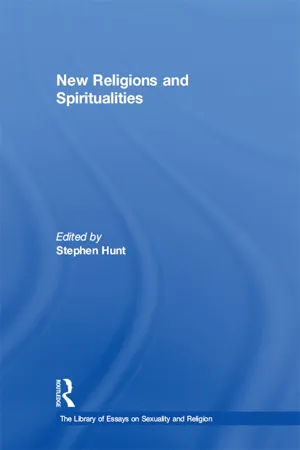
New Religions and Spiritualities
About this book
Since the 1960s a fresh wave of new religions and what has come to be termed 'spiritualities' have been evident on a global scale. This volume in The Library of Essays on Sexuality and Religion focuses on these 'new' religions and their often contentious attitudes towards human sexuality. Part 1, through previously-published articles, provides instances of affirming orientations of the 'new' religions towards sexuality. This entails scrutinising examples of innovative religion from a historical perspective, as well as those of a more contemporary nature. Part 2 examines, with pertinent illustrations, the controversial character of 'new' religions in their 'cultist' forms and matters of sexual control and abuse. Part 3 considers sexuality as articulated through paganism, the occult and esotericism in the postmodern setting. Part 4 examines both hetero- and non-hetero- expressions of sexuality through the so-called 'New Spiritualities', Quasi-religions and the more 'hidden' forms of religiosity.
Trusted by 375,005 students
Access to over 1.5 million titles for a fair monthly price.
Study more efficiently using our study tools.
Information
Topic
Teologia e religioneSubtopic
ReligionePart I
Sexual Affirmation
[1]
Sex in the City of God: Free Love and the American Millennium
In 1873, before an audience of the tenth annual American Association of Spiritualists, Victoria Woodhull told her listeners to prepare for the day when their daughters would be dating the dead. The lecture, “The Elixir of Life,” brought together two of Woodhull’s primary concerns—Spiritualism and the free love movement—in a meta-narrative that is parallel to the thesis of her speech: heaven and earth are about to be literally combined, ushering in a curious and quixotic millennium. She argued that death is caused by disease and that disease is caused by bad sex; eliminating bad sex will eliminate disease, which in turn will eliminate death itself. With death vanquished, the spirits of the dead will return to earth, where all will enjoy eternity in a utopia free from the scourges of illness and all manner of social ills. Against the backdrop of American Spiritualism, Woodhull would tell an extraordinary story in which spiritual advancement healed the body and bodily freedom advanced the spirit.
This millennial vision centered on the perfectability of the human body at the intersection of the discourses of medicine, politics, and religion. Woodhull’s utopia would be ushered in by society’s embracing of the principles of free love, the reform movement that espoused that emotional and physical romantic relations should be governed by mutual love alone without interference from legal or religious authority. Woodhull defied both normative Christianity and the mainstream of Spiritualist believers by refusing to subordinate the body to the soul. Arguing for a natural immortality of the body, she maintained an essential union and inter-reliance of the body and soul rather than a disjuncture between them.
Born Victoria Claflin in 1838, and ironically named for the queen who would come to represent all that was repressive in the nineteenth century, Woodhull led, by all accounts, an extraordinary life. Beautiful and high-spirited, Woodhull was the daughter of a devout but somewhat mad woman and a one-eyed con man from the very wrong side of the tracks in Homer, Ohio. By the age of fourteen, she and her younger sister Tennessee were installed as mediums, with the responsibility of financially supporting their entire family By fifteen, she married Canning Woodhull, a handsome medical doctor, whom she quickly discovered was a liar, drunk, and philanderer. At sixteen, she gave birth to a mentally retarded son whose defects she soon attributed to his father’s drinking. Heartbroken, impoverished because of Canning’s shenanigans, and forced once again to be the breadwinner for her family, Woodhull later recounted that it was at that moment that she pledged herself to “wage war against this seething impacted mass of hypocrisy and corruption” that society called the sanctity of marriage.1
After giving birth to a daughter, Zula, who, along with Tennessee, would be one of her few joys in life, Victoria finally divorced Woodhull and, while retaining his name, married Colonel James Blood, an ardent Spiritualist and intellectual who avowed socialism and land reform. Upon instruction from her spirit guide, Demosthenes, Woodhull moved her family, including her sister Tennie, to New York, where the two sisters set up shop as Spiritualist mediums. Demosthenes had given her very good advice indeed, as one of her clients, Cornelius Vanderbilt, was so impressed by her that he gave the sisters their own financier company, making them the first women stockbrokers in America. In 1870, with the aid of Colonel Blood and his friend the radical reformer Stephen Pearl Andrews, Victoria and Tennessee launched a newspaper, Woodhull and Claflin’s Weekly, which would be the mouthpiece of socialism and free love (and which was delightfully subtitled Upward and Onward).
Woodhull and Claflin’s Weekly touted women’s suffrage, marriage reform, and Spiritualism and was the first American forum for an English translation of Marx’s Communist Manifesto. The paper ran for six years, during which time Woodhull went on the lecture circuit to deliver speeches about politics, many of which were penned by her husband and Andrews. In 1871, she became the first woman to speak to the House Judiciary Committee, arguing that women’s suffrage was already guaranteed by the Constitution. In 1872, she ran for President of the United States with Frederick Douglass as her running mate. The Weekly ran her platform of “the rights of labor and the freedom of woman, free speech and free press, free land and free love.”2 Mired in various scandals and dubbed “Mrs. Satan” by Harper’s Weekly, Woodhull’s bid for the presidency ended with her being in jail on the day Americans reelected Ulysses S. Grant to the office.
In 1871, the National Association of American Spiritualists had elected Woodhull to be its president; two years later, the association split over Woodhull’s politics. That was the year that she delivered “The Elixir of Life” to the Chicago Convention of Spiritualists. Embattled by lawsuits alleging slander in her newspaper and weakened by ill health, Woodhull had been abandoned by the more reputable branch of the suffrage movement, and the public approbation she had received for years in the press had turned into vicious accusations of immorality. The Spiritualists alone, who overwhelmingly supported women’s suffrage and progressive reforms, still welcomed her into their realm. The speech that she delivered that day reflected issues that would consume her thinking for the rest of her remarkable life—a millennium of love, with heaven and earth united. Woodhull’s millennium represents a larger movement in nineteenth-century America, an implicit and explicit protest against normative Christianity, where the body is not dispensable at death but rather is a necessary and intimately conjoined vehicle for the soul.
Utopia
Woodhull, who advocated freedom of all religions, repeatedly proclaimed herself to be a Spiritualist, and the religious movement had already provided a template of perfection that she would infuse with free love. Spiritualism began in 1848 with the Fox sisters’ “mysterious rappings” in Hydesville, New York. The Fox girls, Kate and Margaret, responded to an apparent poltergeist in the house by attempting to communicate with it through a system called “alphabet raps,” one for “a,” two for “b,” and so forth. The ghost responded with raps of his own, and the sweeping religious movement of Spiritualism was inaugurated. For adherents, the ability to traverse the threshold of death and communicate with those in the afterlife was the logical conclusion of the age of communication: as the century progressed, the telegraph, the telephone, and photography would all demonstrate that instant and invisible communication across space was possible. Bridging the gulf between heaven and earth was merely the next step.
The intermediary between heaven and earth was a medium, most often a woman, who would communicate with the dead. As methods of mediumship became more refined in the decade after the Fox sisters’ discovery, mediums would generally enter a trance state where the dead could speak through them. Spiritualism provided the alleviation of grief by assuring the living that their kin were thriving in the afterlife surrounded by deceased relatives and wise angels. It also served as a platform for the famous dead to be consulted about contemporary topics, and telling favorites such as Swedenborg, Shakespeare, and Benjamin Franklin were often called upon as commentators on issues such as abolition and women’s equality. Women ascended to public speaking in a paradox of empowerment by being the passive receptacles of the spirits of renowned men.3
The Spiritualist vision of heaven was largely dependent on the writings of Andrew Jackson Davis, the “Poughkeepsie Seer” and the founder of the Harmonial Philosophy. Davis had already authored several books when the Fox sisters communicated with their ghost, Mr. Splitfoot; by allying with the new movement, Davis provided the needed theological backbone that cemented the new appearances of the dead with an established cosmology of the heavens. Relying heavily on Swedenborg’s mystical visions of the afterlife, Davis expanded his predecessor’s three-tiered heavens to seven tiers that were alive with movement: the dead were not instantly perfected but rather progressed in heaven, climbing the ladder of heavens as they became more knowledgeable and spiritually refined. Heaven was open to all, reflecting the self-identity of the young republic as a meritocracy. As Bret Carroll argues, democratic ideals were working in tandem with religious values as Spiritualism depicted an afterlife that was simultaneously hierarchical and mobile:
Because [Spiritualists] accepted the cultural premium on being “self-made,” they joined a growing number of their contemporaries in rejecting the orthodox Calvinist notions of predestination and divine election. In its place, they envisioned a cosmos much like their understanding of how Jacksonian society functioned; hard work and free action resulted in spiritual ascent, status and authority were achieved rather than ascribed, and success (salvation) was within the grasp of all.4
The heavens themselves resembled a middle-class American landscape sanitized of commerce and poverty, where the dead enjoyed temples, museums, and schools.5 The “Summerland,” as Davis called it, was as close to true multiculturalism as the epoch ever saw: completely inclusive of all peoples, there were ethnic neighborhoods in heaven, and different religions continued to be practiced by their adherents.6 Since Spiritualism dispensed with the idea of hell, sinners were merely consigned to the lowest realms until their misdeeds had been righted.
This inclusivity would have sat well with Woodhull, who repeatedly called for the freedom to practice all religions unmolested. Her usual roster of religions that she mentioned in her speeches included pagans, Universalists, Jews, Muslims, Quakers, Calvinists, Unitarians, and even Catholics, and she frequently compared the right to freedom of religion with the right to freedom of sexuality.7 Generally these comparisons were rhetorical devices to stave off charges of promiscuity on her own part: by analogy, just because one believed that others should be free to be Muslims does not mean that one herself is a Muslim, and the same goes for free love. However, this clever rhetoric was undercut by her obvious favoritism, after Spiritualism, of one religion in particular—the Oneida Community.
The Oneida Community, founded by John Humphrey Noyes, was a working utopia based on Noyes’s conviction that the millennium had indeed already arrived in 70 of the Common Era. Like the Shakers and many of the smaller millennialist movements of the day, the Oneidans tackled what scripture had meant when Jesus responded that, in heaven, “they are neither married nor given in marriage.” Noyes’s response was a communal equality of love, both spiritual and physical. The Oneidans denied charges that they were free lovers, although they occasionally used the phrase to describe themselves; the distinction between the two movements, however, is boldly drawn by history The free love movement advocated any form of heterosexual expression that an individual wished to practice, including monogamy and celibacy. The Oneida Community practiced “group marriage,” wherein all members of the community could, under certain regulations and with strict birth control prohibitions for the men, have heterosexual relations with each other. Noyes saw monogamy as logically and theologically antithetical to the Christian injunction to love all community members equally.8 In direct contrast to the free lovers, members of Oneida expended an extraordinary amount of energy attempting to prevent “exclusive attachments,” or the love of one person more than the love of the community as a whole.
While these distinctions were not lost on Woodhull or her ghost writers, she argued that its “enforced promiscuousness is preferable even to our enforced monogamy”9 and cited the community’s prosperity, honesty, morality, and health as unimpeachable proof of the benefits of free love. Moreover, Woodhull borrowed a central concept from the Oneida Community that became pivotal for her construction of utopia—stirpiculture. Stirpiculture was John Humphrey Noyes’s name for his eugenics experiment that the community undertook in 1869; since their birth control method had been so successful, the community needed to renew its population, and Noyes, a fan of both Plato and Darwin, implemented his attempt to breed people for spiritual superiority. Noyes placed so much hope in the success of this experiment that, even after his abdication of leadership in 1879 and his subsequent exile to Canada, he wrote that all members are “to share the endless blessings that are to come from the race-germ produced, and to take an interest and part … in the evolution of that germ by future cares and labors.”10
...Table of contents
- Cover
- Half Title
- Title Page
- Copyright Page
- Table of Contents
- Acknowledgements
- Series Preface
- Introduction
- PART I SEXUAL AFFIRMATION
- PART II SEXUAL RESTRAINT AND ABUSE
- PART III NEO-PAGANISM, THE OCCULT AND ESOTERICISM
- PART IV NEW SPIRITUALITIES AND QUASI-RELIGIOSITY
- Name Index
Frequently asked questions
Yes, you can cancel anytime from the Subscription tab in your account settings on the Perlego website. Your subscription will stay active until the end of your current billing period. Learn how to cancel your subscription
No, books cannot be downloaded as external files, such as PDFs, for use outside of Perlego. However, you can download books within the Perlego app for offline reading on mobile or tablet. Learn how to download books offline
Perlego offers two plans: Essential and Complete
- Essential is ideal for learners and professionals who enjoy exploring a wide range of subjects. Access the Essential Library with 800,000+ trusted titles and best-sellers across business, personal growth, and the humanities. Includes unlimited reading time and Standard Read Aloud voice.
- Complete: Perfect for advanced learners and researchers needing full, unrestricted access. Unlock 1.5M+ books across hundreds of subjects, including academic and specialized titles. The Complete Plan also includes advanced features like Premium Read Aloud and Research Assistant.
We are an online textbook subscription service, where you can get access to an entire online library for less than the price of a single book per month. With over 1.5 million books across 990+ topics, we’ve got you covered! Learn about our mission
Look out for the read-aloud symbol on your next book to see if you can listen to it. The read-aloud tool reads text aloud for you, highlighting the text as it is being read. You can pause it, speed it up and slow it down. Learn more about Read Aloud
Yes! You can use the Perlego app on both iOS and Android devices to read anytime, anywhere — even offline. Perfect for commutes or when you’re on the go.
Please note we cannot support devices running on iOS 13 and Android 7 or earlier. Learn more about using the app
Please note we cannot support devices running on iOS 13 and Android 7 or earlier. Learn more about using the app
Yes, you can access New Religions and Spiritualities by Stephen Hunt in PDF and/or ePUB format, as well as other popular books in Teologia e religione & Religione. We have over 1.5 million books available in our catalogue for you to explore.