- 600 pages
- English
- ePUB (mobile friendly)
- Available on iOS & Android
eBook - ePub
About this book
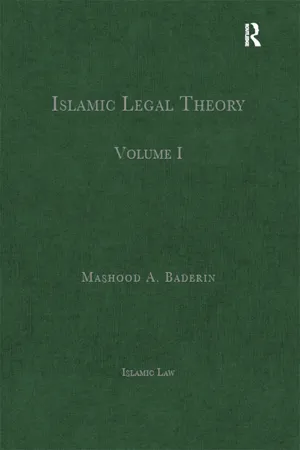
Islamic legal theory (us?l al-fiqh) is literally regarded as 'the roots of the law' whilst Islamic jurists consider it to be the basis of Islamic jurisprudence and thus an essential aspect of Islamic law. This volume addresses the sources, methods and principles of Islamic law leading to an appreciation of the skills of independent juristic and legal reasoning necessary for deriving specific rulings from the established sources of the law. The articles engage critically with relevant traditional views to enable a diagnostic understanding of the different issues, covering both Sunn? and Sh?'? perspectives on some of the issues for comparison. The volume features an introductory overview of the subject as well as a comprehensive bibliography to aid further research. Islamic legal theory is a complex subject which challenges the ingenuity of any expert and therefore special care has been taken to select articles for their clarity as well as their quality, variety and critique to ensure an in-depth, engaging and easy understanding of what is normally a highly theoretical subject.
Part I
Nature of Islamic Law
[1]
ISLAMIC LAW
An Overview of Its Origin and, Elements
* J.D., Georgetown University Law Center, 1981; M.A.T. (Legal Education) Antioch University, 1984. The author practices economic development law in Washington, D.C. He has served as legal counsel to numerous Washington-area Islamic organizations since 1981. In addition to having served as an adjunct professor of law at various universities, Mr. Abdal-Haqq is the former executive director of the Council on Legal Education Opportunity.
CONTENTS
I. | INTRODUCTION | |
II. | ISLAMIC LAW: DEFINITION AND DESCRIPTION | |
A. | Shari‘ah | |
B. | Fiqh | |
III. | ELEMENTS OF SHARI‘AH | |
A. | Basic Conccpts | |
1. Allah | ||
2. Mubammad tbn Abdullab | ||
3. Islam | ||
B. | Qur’an | |
C. | Traditions of Muhammad: Sunnah and Haditb | |
IV. | METHODOLOGIES AND BRANCHES OF FIQH | |
A. | Intcrpretation of Qur’an (Tafsir) | |
B. | Authenticity & Interpretation of Hadith | |
C. | Other Fiqh Methodologies | |
1. Ijma (Consensus) | ||
2. Qiyas (Analogy) | ||
3. Istibsan (The Public Interesi) | ||
4. Istihab (Presumption of Continuity) | ||
5. Urf (Local Ctistom) | ||
D. | Ijtihad (Individual Reasoning) | |
E. | Branches of Fiqh | |
V. | SCHOOLS OF JURISPRUDENCE (FIQH MADHHABS) | |
A. | Hanafi Madhhab | |
B. | Maliki Madhhab | |
C. | Shafii Madhhab | |
D. | Hanbali Madhhab | |
E. | Jafari Madhhab | |
VI. | ISLAMIC LAW IN NORTH AMERICA | |
I. INTRODUCTION
This article surveys the fundamental elements of Islamic law and jurisprudence. It also highlights issues of current concern to American Muslims and examines the prospect for practical application of Islamic law in the United States. Access to information about Islamic law will become increasingly important to American jurists, lawyers, scholars and political leaders as the American Muslim community grows in size and influence. The Muslim population in the United States is estimated to range from five to eight million and Islam is projected to become the nation’s second largest religion early in the next century.1 A distinctive characteristic of Islam is its remarkable synthesis of all aspects of human social interaction and endeavor into a single value system – a system of law. Throughout the entire history of Islam, Islamic law has remained a prime focus of intellectual effort and recognized by Muslims as a religious duty to uphold and protect.2 Nowhere is this urgency of purpose more pronounced than among American Muslims. On one hand, the Muslim community in the United States, as a minority, must establish institutions that will assure its continuation and development. On the other hand, the Islamic sense of mission readily affirms itself in a society struggling to preserve Judeo-Christian-Muslim values.3 Added to this dynamic is the fact that the United States is one of only a few places on earth where the global forces of Islamic resurgence are guaranteed the Constitutional freedoms of expression and organization that are required to promulgate their ideals, whether conservative or reformist.
Islamic law is likely to become the intellectual focus in the American Muslim community as it synthesizes and matures, for it was a high regard for the law that produced the disciplined and united civilization of Islam’s golden era.4 The all-encompassing law of Islam, emanating from the Qur’an itself, embraces every aspect of human activity, defines Islamic values, and dictates standards of behavior.5 Therefore, it must command the attention of any Muslim community seeking to preserve and assert itself. The question then is not whether Islamic law will become the intellectual focus of American Muslims, but rather when will it become the focus and how Islamic legal principles will be implemented.
It would appear that in addition to the sense of religious duty to learn and observe Islamic law, both external and internal community pressures are mandating expedited implementation of methods for practicing the law. External pressure stems from the Muslim perception of public prejudice against Islam. Immigrant Muslims are especially sensitive to media reports equating Islam and Arabs to terrorism.6 The tendency on the part of some media to characterize Islam as an enemy to America and the West is longstanding and well documented.7 Paradoxically, negative media imagery is serving to galvanize the Muslim community. Islamic political and public relations organizations are enjoying wide appeal because of their role in defending Islamic values and traditions against media and other attacks.8 As pointed out, Islamic values are delineated through Islamic legal principles. Thus, American Muslim leadership will feel compelled to find ways of implementing the practice and observance of Islamic law in America for the benefit of their growing constituency.
From within the Muslim community, an increasing number of individuals consistently call for the development of stable institutions that will better ensure the preservation and proper application of Islamic values for the benefit of Muslims and the society at large. For example, one leading Muslim imam has suggested formulation of an indigenous school of thought in Islamic law dedicated to addressing the peculiar concerns of American Muslims.9
That Islamic law will play an increased role in the affairs of American Muslims appears inevitable. As disputes resulting from Islamic religious obligations and agreements entered under Islamic principles work themselves through arbitration and into the courts, the legal, business and political communities will be asked and sometimes required to address questions of law rooted in Islamic tradition. This tradition will present itself in at least two forms – the first based upon conventional adherence only to those jurisprudential principles and methodology established during Islam’s Golden Era, some 900 years ago, and second, those committed to devising new approaches for resolving contemporary concerns where the ancient formulas appear to be inappropriate or inadequate.
Obviously, knowledge of such fundamentals as the origin and elements of Islamic law will be essential in addressing issues emanating from either approach. In the discussion that follows this fundamental material will be discussed along with those areas of law that are likely to be of chief importance to American Muslims. By no means is this article intended to serve as a source of comprehensive information on any Islamic area of law or school of jurisprudence. Rather, it is intended to provide an introductory overview of Islamic law for American readers. Where appropriate, follow-up research and consultation should be conducted.
II. ISLAMIC LAW: DEFINITION AND DESCRIPTION
The term “Islamic law” generally is used in reference to the entire system of law and jurisprudence associated with the religion of Islam,10 including (1) the primary sources of law (Shari‘ah) and (2) the subordinate sources of law and the methodology used to deduce and apply the law (Islamic jurisprudence called fiqh in Arabic). The Arabic phrase for Islamic law is qānūn ul Islamia, which has been described as a calque because it is thought not to be a part of original Islamic vocabulary, but rather was devised in reaction to Western influence. Now, however, qanun ul Islamia is a part of the vocabulary in every Muslim country.11
Some writers use the terms Islamic law, Shari‘ah and/or fiqh interchangeably.12 This easily could result in confusion for readers seeking to sort out the significance of each concept. In this article, the term Islamic law is used in conformity with modern usage and refers to the entire system of law and jurisprudence. The distinction between Shari‘ah and fiqh, however, is an important one and the two terms will not be interchanged. Elaboration on the meaning of each follows in the next two subsections.
At least one writer, Dr. Said Ramadan, has advocated using the term “Muslim jurisprudence” rather than “Islamic jurisprudence” in referring to fiqh because it is his opinion that an incorrect legal conclusion rendered under fiqh, of which there have been many, properly should not be classified as Islamic.13 Adoption of Dr. Ramadan’s distinction between “Islam” and “Muslim” would not necessarily result in fiqh being any less identified as Islamic if labeled “Muslim jurisprudence,” since Muslims are readily identified as Islamic anyway. Additionally, much of fiqh, in the way of process and findings, comports with sound Islamic standards and principles, and therefore is worthy of being recognized as Islamic.
The more important and substantive distinction is between Shari‘ah and fiqh, both of which are considered to be within the scope of the Western description of Islamic law, but with the former of the two being preeminent and ideally forming the basis for all doctrine formulated under fiqh.
A. Shari‘ah
There are two primary sources of Islamic law – the Qur’an (Koran)14 and the Sunnah (traditions of Muhammad ibn Abdullah, the last...
Table of contents
- Cover
- Half Title
- Title Page
- Copyright Page
- Table of Contents
- Acknowledgements
- Series Preface
- Introduction
- Further Reading
- PART I NATURE OF ISLAMIC LAW
- PART II SOURCES OF ISLAMIC LAW
- PART III METHODS OF ISLAMIC LAW
- PART IV PRINCIPLES OF ISLAMIC LAW
- PART V LEGAL REASONING (IJTIHĀD)
- Name Index
Trusted by 375,005 students
Access to over 1.5 million titles for a fair monthly price.
Study more efficiently using our study tools.
Frequently asked questions
Yes, you can cancel anytime from the Subscription tab in your account settings on the Perlego website. Your subscription will stay active until the end of your current billing period. Learn how to cancel your subscription
No, books cannot be downloaded as external files, such as PDFs, for use outside of Perlego. However, you can download books within the Perlego app for offline reading on mobile or tablet. Learn how to download books offline
Perlego offers two plans: Essential and Complete
- Essential is ideal for learners and professionals who enjoy exploring a wide range of subjects. Access the Essential Library with 800,000+ trusted titles and best-sellers across business, personal growth, and the humanities. Includes unlimited reading time and Standard Read Aloud voice.
- Complete: Perfect for advanced learners and researchers needing full, unrestricted access. Unlock 1.5M+ books across hundreds of subjects, including academic and specialized titles. The Complete Plan also includes advanced features like Premium Read Aloud and Research Assistant.
We are an online textbook subscription service, where you can get access to an entire online library for less than the price of a single book per month. With over 1.5 million books across 990+ topics, we’ve got you covered! Learn about our mission
Look out for the read-aloud symbol on your next book to see if you can listen to it. The read-aloud tool reads text aloud for you, highlighting the text as it is being read. You can pause it, speed it up and slow it down. Learn more about Read Aloud
Yes! You can use the Perlego app on both iOS and Android devices to read anytime, anywhere — even offline. Perfect for commutes or when you’re on the go.
Please note we cannot support devices running on iOS 13 and Android 7 or earlier. Learn more about using the app
Please note we cannot support devices running on iOS 13 and Android 7 or earlier. Learn more about using the app
Yes, you can access Islamic Legal Theory by Mashood A. Baderin in PDF and/or ePUB format, as well as other popular books in Law & Public Law. We have over 1.5 million books available in our catalogue for you to explore.