- 432 pages
- English
- ePUB (mobile friendly)
- Available on iOS & Android
eBook - ePub
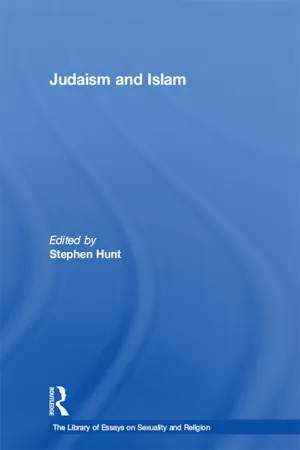
Judaism and Islam
About this book
This volume on Judaism and Islam in The Library of Essays on Sexuality and Religion series overviews perceptions of human sexuality through two major monotheistic faiths, namely Judaism and Islam. Part 1 presents previously published articles on Judaism and sexuality from a historical perspective, in particular, through the writings of the Tanakh and traditional Judaic attitudes. Part 2 focuses more cogently on contemporary themes including both the contestation and defence of conventional Jewish standpoints on sexuality via orthodox and liberal renderings of the faith. Part 3 includes articles examining Islamic views of sexuality from a historical perspective. Here there is a special focus on the faith's construction of sexual categories, as well as the relationship between sexuality, gender and patriarchy. Part 4 takes a cross-cultural and global perspective of the subject with a particular emphasis on the connection between sexuality and moral regulation, besides scrutinising varying and contrasting cultural attitudes in Islamic communities today.
Trusted by 375,005 students
Access to over 1.5 million titles for a fair monthly price.
Study more efficiently using our study tools.
Information
Topic
Theology & ReligionSubtopic
Comparative ReligionPart I
Judaism and Sexuality: Exploring Historical Viewpoints
[1]
Are There Any Jews in “The History of Sexuality”?
Department of Near Eastern Studies University of California, Berkeley
INTRODUCTION: HOMOPHOBIA BEFORE SEXUALITY?
PERHAPS THE most solid conclusion of Michel Foucault’s last research and the scholarship that has followed in its wake has been that there was no autonomous realm of “sexuality” within classical cultures at all; desire and pleasure were inextricably bound up with the relations of power and domination that structured the entire society.1 Permitted and tabooed sexual behavior was completely a function of status. The world was divided into the screwers—all male—and the screwed—both male and female. No parallel research has been done for either biblical or talmudic culture. At first glance, these cultures seem to be cultures within which the category of homosexuality, at least as a taxonomy of practices if not of persons, exists with a vengeance. After all, these cultures and their offshoots are taken to be the very origin of the deep-rooted homophobia within “our culture.”2 This would seem, then, to raise significant problems for Foucault’s notion that “homosexuality” as a category only appears in the modern European culture. Foucault’s total neglect of biblical and Jewish culture in his historical work thus produces a crucial gap in his work and in our knowledge, one that threatens the whole edifice. In this article I will suggest that analysis of biblical and talmudic cultural materials, far from being counterevidence, provides some crucial evidence to flesh out Foucault’s speculation that the category of sexuality of which we know is special to our modern Euro-American culture. The alleged prohibitions on “homosexuality” in Judaism can be plausibly interpreted as being fully comprehended by the workings of gendering in this culture without any category of sexuality being either necessary or even probable to understand them.
THE BIBLE BEFORE SEXUALITY
A Different Taxonomy
“Do not lie with a man a woman’s lyings [miškəbei ʾiššā] that is toʿēbā” (Lev. 18:22).3 This verse is usually taken in both scholarly and popular parlance to prohibit “homosexuality” tout court, a conclusion that, if correct, would provide a serious counterexample to Foucault’s historiography. In this article, I hope to be able to show that another approach to understanding this verse is at least as plausible as the assumption that “homosexuality” is at issue.4 Let me clarify the structure of the argument that follows. I begin with the assumption that there is no more reason to assume that ancient Jewish culture does have a system of sexuality than to assume the opposite. Indeed, given Foucault’s work and the work of historians who have shown how “sexuality” develops at a particular moment in history,5 it becomes equally plausible to begin by assuming that Jewish culture of the biblical and talmudic periods was not organized around a system of sexual orientations defined by object choice (or for that matter in any other way), in other words, to put the burden of proof, as it were, on the other party, I know of no evidence that would support the claim for a system of sexual orientations (there is no talmudic equivalent even for the cinaedus).6 Any positive evidence, therefore, that militates against the production of a category of sexuality in the culture becomes highly significant.
There is one further methodological point.7 The base of data on which I describe late antique Jewish culture is highly skewed in that it includes the expression of one very limited social group within the culture, a learned, hegemonic, male rabbinic elite (and even within that I am almost exclusively concentrating on its Babylonian variety). In fact, I know almost nothing, aside from what I can read between the lines or against the grain of the Talmud, of what the rest of the (Jewish) world was doing or thinking.8 This is particularly significant, because from the much more variegated remains of Greek culture we learn of a heterogeneous cultural situation, wherein certain types of texts—medical texts, for example—have an entirely different ideology of sex than do the high cultural literary artifacts of, for example, Hesiod. This is even more the case in the later Greek and Hellenistic worlds than in the archaic period. There might very well have been an analogous cultural situation in late antique Jewish culture. A partial control is provided by the fact that the Talmud, while the product of an elite, is not elitist in structure in that its modes of expression are often enough vulgar—in the highest sense of that term, and some have claimed that there are even female voices to be discovered there. Furthermore, one would expect that this type of religious elite would be, if anything, more stringent than other segments of the society, although this would be a particularly weak form of argument from silence. These considerations should serve as a caution against any essentializing or totalizing statements about Jewish culture, which I do not claim, in fact, to be making. What I am investigating then are particular discursive practices, not whole cultures—whatever that might even mean—and claiming that these discursive practices are fully comprehensible without assuming a cultural subsystem of sexuality.9 Even more to the point, perhaps, my claim is not to have found proof positive for the Foucaultian hypothesis but, rather, to be disputing what might have been otherwise taken as a body of counterevidence by suggesting what I hope will be accepted as a convincing alternative reading of it.
My first argument in demonstrating the lack of a binary opposition of hetero/homosexuality in talmudic culture (with the above qualifications and strictures) will be a text that shows that the Talmud did not read such a category into the biblical prohibitions on male intercourse, understanding that only anal intercourse and no other male-male sexual practices were interdicted in the Torah. In the Babylonian Talmud Niddah 13b, we find the following colloquy:
Our Rabbis have taught: Converts and those who sport with children, delay the Messiah.
I understand “converts,” for Rabbi Helbo has said that converts are as difficult for Israel as sappaḥat [a skin disease]! But what is this about those who sport with children? If I will say it refers to male intercourse [miškāb zākor, a technical term referring to male-male anal penetration], they are subject to stoning! Rather, [shall we say] it refers to intercrural [between the thighs; děrěk ʾēbārim (Hebrew), diamêrizein (Greek)] intercourse? But that is like the children of the flood [i.e., masturbation—Rashi]. Rather it refers to those who marry minor girls who are not of child-bearing age, for Rabbi Yossi has said that the son of David will not come until all of the souls in the “body” are finished [i.e., until all of the souls that were created at the Beginning of the universe have been born into bodies, the Messiah will not arrive].
The Talmud quotes an earlier text (tannaitic, i.e., Palestinian and prior to the third century of the Christian era) that condemns converts to Judaism and pedophiles in what seems to be rather extreme language. The Talmud (Babylonian and post–third century) asks what is meant by sporting with children. From the answer that the Talmud suggests to its question, it is quite clear that the Talmud sharply distinguishes male-male anal intercourse from other same-sex practices, arguing that only the former is comprehended by the biblical prohibition on male intercourse. This point already establishes the claim that this culture, insofar as we can know it, does not know of a general category of the homosexual (as a typology of human beings) or even of homosexuality (as a bounded set of same-sex practices).
Sporting with Children
It is important to understand the intricate cultural coding of this passage. Rabbinic discourse frequently uses exaggerated language to inculcate prohibitions and inhibitions that are not forbidden in the Torah. There is, accordingly, an inner-cultural recognition that such prohibitions, precisely because they are expressed in extreme language, are not as “serious” as those that are forbidden in the Bible. It is as if there is a tacit cultural understanding that the more extreme the rhetoric, the less authoritative the prohibition. Thus, just as in the case of masturbation, where there is no biblical text indicating that it is forbidden, and it is therefore designated hyperbolically as being like “the children of the flood,” so also for “sporting with children,” the text finds highly hyperbolic language with which to express itself.10 “Preventing the Messiah” has about the same status of hyperbole as being one of “the children of the flood,” and neither of them is taken as seriously as those prohibitions for which the Torah explicitly marks out an interdiction and a punishment.
Thus, since male anal intercourse is forbidden by the Torah explicitly and a punishment marked out for it, there is no need to utilize obviously hyperbolic language like that of delaying the coming of the Messiah. Far from strengthening the case, it only would weaken it. As the canonical commentary of Rashi has it: “Only delaying the Messiah? But it is forbidden by the Torah and punishable by stoning!” (emphasis added). Therefore, claims the Talmud, this cannot be what is meant by “sporting with children” in the text. The Talmud then suggests that what is being spoken of here is the practice of intercrural intercourse between men and boys, according to some authorities the standard sexual practice of Greek pederasty.11 This, however, is “merely” a type of masturbation, for which another axiological category exists. Masturbators are not Messiah delayers but children of the flood.12 All that is left, therefore, for our category of delaying the Messiah is intergender pedophilia, forbidden because it is antinatalist.
The tannaitic text itself will bear, however, some further analysis. The term I have translated “sport with” means variously “to play” and “to laugh” but frequently is used as an explicit term for sexual interaction, as it undoubtedly is meant here. The term for “children” here is a gender-indeterminate word that refers to anyone from infancy to puberty. The first question to be asked of the original statement is, What is the association between converts and those who sport with children? I would suggest that at least a plausible answer is that Greco-Roman converts are taken to be those who sport with children or even tempt other Jews into such sport. If that be granted, it would seem clear that it is pederasty that is being spoken of. The third interpretation that the Talmud offers, then, for the earlier text, namely, that intergender pedophilia is referred to, seems highly implausible. On the other hand, the Talmud’s refusal to understand anal intercourse as being the intention of the original text seems well founded, for it would be, as I have indicated above, highly unusual to use hyperbolic language such as that of Messiah prevention to refer to that for which an explicit biblical reference could be cited. It seems, therefore, that some other pederastic sexual practice is connoted by “sporting with children,” and intercrural intercourse seems as good a candidate as any. In other words, my hypothesis is that the second suggestion that the Talmud makes in order to interpret the original source seems the most likely one, namely, that “those who sport with children” refers to pederasts who practice forms of sexual behavior that do not include anal intercourse. If this reading is accepted, it would follow that both levels of the talmudic discourse, that is, the original Palestinian tannaitic statement and its later Babylonian talmudic interpretations, understood the Torah’s interdiction to be limited only to the practice of male anal intercourse, of use of the male “as” a female. If this interpretation is deemed finally implausible, then the tannaitic evidence falls by the wayside. Whether or not my reading of the tannaitic text is accepted, it is clear that this is how the Babylonian Talmud understood the Torah, as we see, I repeat, from the explicit distinction made between anal intercourse, forbidden by the Torah, and intercrural intercourse, which the Torah has permitted. At the very least, we have positive evidence that late antique Babylonian Jewish culture did not operate with a category of the “homosexual” corresponding to “ours.” As the Talmud understood it, male-male sexual practices other than anal intercourse are not prohibited by the Torah and only...
Table of contents
- Cover
- Half Title
- Title Page
- Copyright Page
- Table of Contents
- Acknowledgements
- Series Preface
- Introduction
- JUDAISM
- ISLAM
- Name Index
Frequently asked questions
Yes, you can cancel anytime from the Subscription tab in your account settings on the Perlego website. Your subscription will stay active until the end of your current billing period. Learn how to cancel your subscription
No, books cannot be downloaded as external files, such as PDFs, for use outside of Perlego. However, you can download books within the Perlego app for offline reading on mobile or tablet. Learn how to download books offline
Perlego offers two plans: Essential and Complete
- Essential is ideal for learners and professionals who enjoy exploring a wide range of subjects. Access the Essential Library with 800,000+ trusted titles and best-sellers across business, personal growth, and the humanities. Includes unlimited reading time and Standard Read Aloud voice.
- Complete: Perfect for advanced learners and researchers needing full, unrestricted access. Unlock 1.5M+ books across hundreds of subjects, including academic and specialized titles. The Complete Plan also includes advanced features like Premium Read Aloud and Research Assistant.
We are an online textbook subscription service, where you can get access to an entire online library for less than the price of a single book per month. With over 1.5 million books across 990+ topics, we’ve got you covered! Learn about our mission
Look out for the read-aloud symbol on your next book to see if you can listen to it. The read-aloud tool reads text aloud for you, highlighting the text as it is being read. You can pause it, speed it up and slow it down. Learn more about Read Aloud
Yes! You can use the Perlego app on both iOS and Android devices to read anytime, anywhere — even offline. Perfect for commutes or when you’re on the go.
Please note we cannot support devices running on iOS 13 and Android 7 or earlier. Learn more about using the app
Please note we cannot support devices running on iOS 13 and Android 7 or earlier. Learn more about using the app
Yes, you can access Judaism and Islam by Stephen Hunt in PDF and/or ePUB format, as well as other popular books in Theology & Religion & Comparative Religion. We have over 1.5 million books available in our catalogue for you to explore.