- 218 pages
- English
- ePUB (mobile friendly)
- Available on iOS & Android
eBook - ePub
About this book
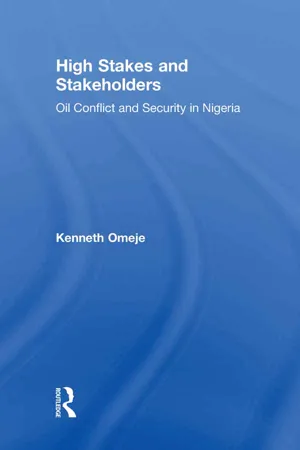
Nigeria is Africa's largest oil producing country. Oil generates enormous wealth but also extensive and devastating conflict in the country. High Stakes and Stakeholders critically explores the oil conflict in Nigeria, its evolution, dynamics and most significantly, the interplay and consequences of high stake politics for the reproduction and persistence of the conflict. It presents a conceptual anatomy of state-oil industry-society relations and demonstrates how the embedded material interests and accumulation patterns of different stakeholders underlie, shape and complicate both the oil conflict and security. In addition, the book provides key insights into comparable conflicts elsewhere in the global south, developing a logical framework for resolving the oil conflict in Nigeria and for reforming the security sector. This book is valuable reading material for courses in international political economy, social ecology, development studies, African politics, conflict and security studies, and environmental law and management. It will also be of interest to policy practitioners, civil societies and the oil industry.
Trusted by 375,005 students
Access to over 1.5 million titles for a fair monthly price.
Study more efficiently using our study tools.
Information
Chapter 1
Introduction: The Rentier Space
1.1 Conceptual Background
High stakes, stakeholders, oil conflict, security and rentier accumulation are the articulating concepts and building blocks of this book. The book explores and analyses the complexus of high stake rentier politics that underlies and interfaces Nigeria’s economy, the state and society and how the phenomenon defines and impacts on the oil conflict and security, especially security within the domestic oil environment. The roles, perspectives and approaches of the different key stakeholders with respect to the oil conflict and its security ramifications are investigated and analysed.
Oil is the mainstay of Nigeria’s economy and the interests and stakes of key players, especially the state and ‘transnational oil companies’ (TNOCs) in the oil economy are considerably high. To a large extent and for understandable reasons, the majority of the oil-bearing communities and people of the Niger Delta region tend to adopt a counter-hegemonic and anti-oil stakeholder discourse and orientation. The state is largely dependent on oil mining rents, taxes and royalties paid by TNOCs, and on profits from its equity stakes in the sprawling investments of the TNOCs. Many scholars have propounded diverse theories on why the Nigerian state has a high propensity to violent conflicts, especially those related to oil. Scholars writing from Marxist political economy and dependency perspectives, who tend to have dominated the discourses, attribute the conflicts to the configuration of interests within the Nigerian economy in which the ‘subversive’ interest of transnational capital is said to be predominant. Expounding this thesis, Terisa Turner in her 1978 classic study tried to apply the ‘triple alliance’ theory then popularized by scholars like Andre Gunder Frank (1967) and Peter Evans (1975, 1977) in the study of Latin American dependent industrializations to the Nigerian situation. Turner (1978:167) used the concept of a ‘commercial triangle’ to depict the dominant class forces in Nigeria, which she conceptualizes as a nexus between forces of international capital and their local Nigerian associates consisting of private sector middlemen otherwise labelled ‘compradors’ and the state officials. The compradorial elites – comprising an ensemble of retired army generals, retired technocrats from the federal service and top politicians – which articulate and advance the interests of international capital in the state system are said to be the hegemonic faction in this alliance of dominant classes. In fact, Turner and Badru (1985:7) have argued quite persuasively that the occasional contradictions within the observed ‘alliance of dominant social class forces’ contribute to the spate of military coups, and political and policy instability in Nigeria.
In the context of the political economy of globalization, the ‘triple alliance’ or ‘commercial triangle’ theory, depicts the host state in the global south as a captured state, compelled to advance and protect the interests of international capital, which in the Nigerian situation not only include oil investments and petro-accumulation, but also extends to the economic and political conditionalities of the neo-liberal economic reforms imposed by the World Bank and International Monetary Fund. State managers and politicians primarily gain support for the state as an institution for promoting activities, policies and legislations essential to sustaining the profitability of transnational investments and markets (Evans, 1997:30). Exponents argue that within this network of foisting and advancing the interest of international capital, state bureaucrats and managers are able to accommodate and satisfy their own interests via reaping unproductive rents and expanding the frontiers of non-productive and corrupt accumulation. Rent-seeking mentality, driven to a pathological extremity in many developing countries like Nigeria, it is argued, causes the state to largely sacrifice the well-being of the populace in policy-making and governance in preference for the interest of international capital and the self-seeking interests of state officials and the hegemonic elites. The populace become progressively impoverished and restive in the face of the callous contrivances of what Evans (1995) calls the ‘predatory state’. Predatory states, whose defining features Nigeria partly expresses, are characterized by ‘weak’ and ‘captured’ institutions, lack of social cohesiveness, low autonomization, pervasiveness of patron-clientelism, an aversion to development and proneness to societal fragmentation and factional conflicts (Evans, 1995, 1997).
The imagery and rhetoric of a ‘captured’ state, akin in helplessness to the biblical sacrificial lamb of atonement, derived from the ‘triple alliance’ or ‘commercial triangle’ theory has dominated the discourses of Nigerian state’s relationship with operating TNOCs in the country since the publication of Turner’s article nearly three decades ago. Whilst one does not contest some of the well-informed postulates of the theory such as the rent-seeking character of the state, the question of primacy of TNOCs’ interests in the country’s oil politics can no longer be sustained in the light of emerging empirical evidence and findings from this study.
Like most oil and gas export-dependent states of the Middle East and North Africa, Nigeria has the institutional framework of a ‘rentier state’. But unlike the archetypal ‘rentier states’ of the Arabian Gulf and Maghreb region, the Nigerian state lacks a unifying political structure in which national identity and hegemonic elite interests are both preceded by and predicated on the invocation of common supranational idiom or cultural heritage such as pan-Islamism, sovereign or constitutional monarchy and pan-Arabism. For conceptual clarity, a rentier state is a state reliant not on the surplus production of the domestic population or economy but on externally generated revenues or ‘rents’, usually derived from the extractive industry such as oil (Kuru, 2002:52). A rentier state generally lacks a productive outlook in the sense that revenues from natural resource rents contribute a significant proportion of the gross domestic products and dominate national income distribution, usually at the expense of the real productive sectors of the economy (Frynas, 2000). Many scholars focusing on the Arabian Gulf oil-rich and oil poor states have expanded the concept of rent to include diverse forms of foreign aid and external development assistance otherwise conceptualized as ‘strategic rent’ (see Schwarz, 2004). In most rentier states of Africa and the Middle East, considerable political influence is wielded by the ‘rentier elites’ – i.e. the hegemonic social forces whose institutional roles or economic interests are interfaced with the system of extraction and distribution of rents. Owing in part to the colonial legacy of skewed economic structures oriented to production and export of primary commodities and distribution of surplus revenues, most rentier economies encourage short-term distribution of revenues rather than long-term or diversified productive investments (Kuru, 2002:54). The distribution of rentier revenues in this context, in the absence of stable and well-developed legal, political and bureaucratic institutions, tends to encourage corruption. The tendency towards corruption in the public realm is further enhanced by the pervasiveness of a ‘patrimonial political culture’.
Patrimonial political culture describes the entrenched values, norms and networks of inherited traditional patterns of politics in most African and post-colonial states, which reflect the outward features of institutionalized administrative states, while operating along patron-client networks and trajectories rooted in historical patterns of authority and social solidarity (see Grugel, 2001). It is a culture that blurs the modernist distinction between the secular and sacred, formal and informal, and most significantly, between public and private resources. In fact, patrimonialism essentially blurs the contemporary statutory distinction between public office, the office holder and public resources. Personal aggrandizement of wealth by state officials, otherwise called ‘primitive accumulation’ in Marxist terminology, is therefore encouraged (or is at the very least not strongly discouraged) under patrimonial systems. Primitive accumulation characterized the historical origin of capitalism in late medieval and early modern Europe (Morton, 2005:375). Richard Joseph uses another concept, prebendalism, to describe the same phenomenon in his analysis of patrimonial politics in Nigeria. According to the theory of prebendalism, state offices are regarded as prebends that can be appropriated by office holders, who use them to generate material benefits for themselves and their constituents and kin groups (Joseph, 1987; 1996). In the ‘Nigerian prebendal republic’, Joseph (1996) argues, the statutory purposes of state offices become a matter of secondary concern. Gore & Pratten (2003:211) in their recent study described the pervasiveness of prebendal corruption in the Nigerian state ‘endemic since the beginning of the oil boom, but locally perceived as having intensified from the 1990s onwards’ as the ‘politics of plunder’.
That is how far the commonalities between Nigeria and the oil-rich rentier states of the Arab world go, albeit there are variations in the degree of prebendal or patrimonial decline observable across various rentier states. On the other hand, the functional level of social cohesion and elite consensus more or less inspired by pan-Islamism and pan-Arabism in such Middle Eastern rentier states as Kuwait, Saudi Arabia, Qatar, Oman, Yemen and United Arab Emirates is lacking in Nigeria given the pluralistic nature of the country’s socio-demographic and ethno-cultural heritage. In the majority of the Middle Eastern oil-rich states, rentierism is still to a large extent unpredatory, contained, controlled and regulated by either an aristocracy or oligarchy whose political dominance and power base are rooted in widely shared religious values. The rentier space is therefore highly circumscribed and stakeholders are relatively few and more cohesive. Consequently, domestic rentier politics in these states is relatively on ‘low stakes’, not least, because the states are not underpinned by or have not basically gravitated to a generalized rentier political culture coupled with the fact that their social structures greatly inhibit competition, dissent and openness.1 In fact, for reasons mostly associated with the perceived threat of political Islam and terrorism, as well as the longstanding Arab-Israeli conflict, to international oil supply from the Middle East, external stakes (mostly western) tend to supersede domestic rentier stakes in the politics of oil in many of the Arab Gulf states. The situation is different in Nigeria. Another significant point of difference is that Nigeria does not have the advantage of a small population like most oil-rich rentier states of North Africa and the Middle East, and this affects the capacity of the state to possibly provide social development and subsidies to the public within the limits of its predatory character and style.
As opposed to a willy-nilly resignation to the caprices of transnational forces, the Nigeria state has over the past three and half decades mounted an assertive ‘nationalism’ in oil politics that has seen its interest in rent-seeking and nonproductive accumulation as the primary thrust of oil-related legislations and policies. Cast in the phraseology of Jean-Francois Bayart (2000:228), the political status quo depicts ‘a model and strategy of extraversion’ that enables the state to exercise sovereignty through the active ‘creation and management of dependence’. In the unfolding political chessboard, the interests of TNOCs largely materialize as a second fiddle, but in many instances coinciding with the interests of the rentier state. Because of its predatory and anti-development inclination, coupled with the fact that it (the state) is dominated by an unstable coalition of some ethnic majority elites whose geographical homelands have little or no oil reserves, the state’s involvement in oil politics tends to be to the disadvantage of the ethnic minorities of the Niger Delta area (at least from the latter’s perspective) where the bulk of Nigeria’s oil resources is produced. The Niger Delta minorities charge the state with deliberate marginalization and gross insensitivity to their plights, and with colluding with oil prospecting companies whose activities result in substantial devastation of the Delta environment.
The discourses of oil conflict in Nigeria are replete with diverse polemical conundrums. Controversial questions, such as who owns oil or an oil-bearing land, under what conditions should oil exploration and production be conducted, who controls what share of the proceeds from oil sales, and how should the negative externalities of oil be managed to mitigate ecological devastation, have over the years informed a barrage of legislations and policies widely believed by commentators like Obi (1999; 2000), Frynas (2000), Ibeanu (2000) and Okonta and Douglas (2001) to be biased in favour of some dominant interests in the oil industry, especially the TNOCs. Many scholars, not least those mentioned above, attribute a ‘hegemonic alliance’ between the Nigerian state and TNOCs. It has been further argued that both the state and TNOCs share a commonality of security perspective and response patterns to threats. Similarly, discourses and narratives of local people’s perspectives of the oil conflict have often portrayed the locals as sharing a broad consensus on the core issues of the conflict, including on the presumed ‘hegemonic alliance’ between the state and TNOCs. This study, among other things, critically interrogates and rethinks some of the conventional wisdom and ‘misconceptions’ of the oil conflict.
Modern political and economic analyses suggest that the state of security in a country is, by and large, a fundamental factor in providing a hospitable climate for productive investments to flourish (Ayoob, 1997:132; Vanguard, 2002). This is particularly true about the developing countries of the South who in the contemporary international conjuncture crucially canvass for foreign capital investments from the highly industrialized countries to enhance their economic performances. Security of property rights, assets and human lives is extremely important, that where it cannot be reasonably guaranteed foreign investors will scarcely be interested in the particular environment concerned even if it promises fabulous returns on investment (Vanguard, 2002). Correspondingly, an unstable, conflict-ridden and corrupt state in which property rights, valuable assets, and personnel safety are in perpetual danger of violent infringement by disgruntled local youths and ethnic militias is practically a disincentive to business and investment. Divestment is not usually ruled out in the case of the latter.
From this basic international political economy perspective, the Nigerian oil industry presents a serious puzzle because according to authoritative macroeconomic security analysis, Nigeria is regarded as highly unfavourable for business due to its reputation for fraud, violence and instability (cf. Frynas, 1998:458-469; Omeje, 2004). The situation is most critical in the oil-rich Niger Delta area where diverse ethnic militias and community activists have in recent years waged an unprecedented violent campaign against the oil industry and the state, protesting, among other things, ecological devastation by the former and social exclusion by the latter. The spate of violent actions and reactions by the three major parties in the oil conflict (TNOCs, oil-bearing communities and the state) has left much of the Niger Delta a worrying security disaster. Paradoxically, the volatile security situation in the Niger Delta and Nigeria in general has not deterred TNOCs from doing business and prospering in the oil region. Explanations for this puzzle are explored in the subsequent chapter of the book.
1.2 High Stakes and Stakeholders: An Anatomy of the Rentier Space
A major feature of the oil dominance of Nigeria’s political economy is the pervasiveness of high stake rentier politics. High stake rentier politics converges and interlinks the rentier features of the economy with the neo-patrimonial traditions of the post-colonial state and society to produce a convoluted political culture marked by clientelistic desperation in both oil-related accumulation and state-society relations. It is a political tradition and process in which the various key stakeholders, clients and partisans of the political economy are disposed to pursue, fast-track, secure, protect and defend oil-related accumulation by desperate measures, including the use of violence or threat of it, as well as placatory tradeoffs and rewards. Shrewdly calculated and structured, placatory trade-offs and rewards could take pecuniary or non-pecuniary forms. The institutionalization of primitive pragmatism, high-risk pecuniary desperation and fast-lane political machinationism are some of the major defining characteristics of high stake rentier politics. Primitive pragmatism is a type of pragmatism that is both incidental to and coterminous with the Marxist notion of primitive accumulation. In primitive pragmatism, accumulation is chiefly pursued and fast-tracked using trickery, deception, blackmail, gerrymandering, fetishism, bewitchment, and subtle methods and processes of dispossession. Mbembe (2001) partly captured these tendencies in his discourse of obscenity as a systemic tradition in the postcolony. For the hegemonic elites at the centre of the accumulation process, the principal advantage of high stake rentier accumulation is that it guarantees quick and enormous surplus value. However, because of the unstable nature of ...
Table of contents
- Cover Page
- Halftitle
- Dedication
- Title Page
- Copyright Page
- Table of Contents
- List of Maps
- List of Tables
- Preface
- Acknowledgements
- List of Abbreviations
- 1 Introduction: The Rentier Space
- 2 The Domestic Security Environment and Perspectives on the Nigerian Oil Conflict
- 3 The Historical and Institutional Contexts of the Oil Conflict
- 4 Ahead of the Game: Shell’s Responsiveness to Domestic Threats
- 5 Relatively at Ease: ExxonMobil’s Oil Operations and Security Threats
- 6 Chevron’s Oil Operations and Security Threats: Doing Business in the ‘Battle Frontline’
- 7 The State and Management of the Oil Conflict
- 8 Key Oil Stakeholders, Security and Security Sector Reform: Discussion and Conclusion
- Bibliography
- Index
Frequently asked questions
Yes, you can cancel anytime from the Subscription tab in your account settings on the Perlego website. Your subscription will stay active until the end of your current billing period. Learn how to cancel your subscription
No, books cannot be downloaded as external files, such as PDFs, for use outside of Perlego. However, you can download books within the Perlego app for offline reading on mobile or tablet. Learn how to download books offline
Perlego offers two plans: Essential and Complete
- Essential is ideal for learners and professionals who enjoy exploring a wide range of subjects. Access the Essential Library with 800,000+ trusted titles and best-sellers across business, personal growth, and the humanities. Includes unlimited reading time and Standard Read Aloud voice.
- Complete: Perfect for advanced learners and researchers needing full, unrestricted access. Unlock 1.5M+ books across hundreds of subjects, including academic and specialized titles. The Complete Plan also includes advanced features like Premium Read Aloud and Research Assistant.
We are an online textbook subscription service, where you can get access to an entire online library for less than the price of a single book per month. With over 1.5 million books across 990+ topics, we’ve got you covered! Learn about our mission
Look out for the read-aloud symbol on your next book to see if you can listen to it. The read-aloud tool reads text aloud for you, highlighting the text as it is being read. You can pause it, speed it up and slow it down. Learn more about Read Aloud
Yes! You can use the Perlego app on both iOS and Android devices to read anytime, anywhere — even offline. Perfect for commutes or when you’re on the go.
Please note we cannot support devices running on iOS 13 and Android 7 or earlier. Learn more about using the app
Please note we cannot support devices running on iOS 13 and Android 7 or earlier. Learn more about using the app
Yes, you can access High Stakes and Stakeholders by Kenneth Omeje in PDF and/or ePUB format, as well as other popular books in Politics & International Relations & International Relations. We have over 1.5 million books available in our catalogue for you to explore.